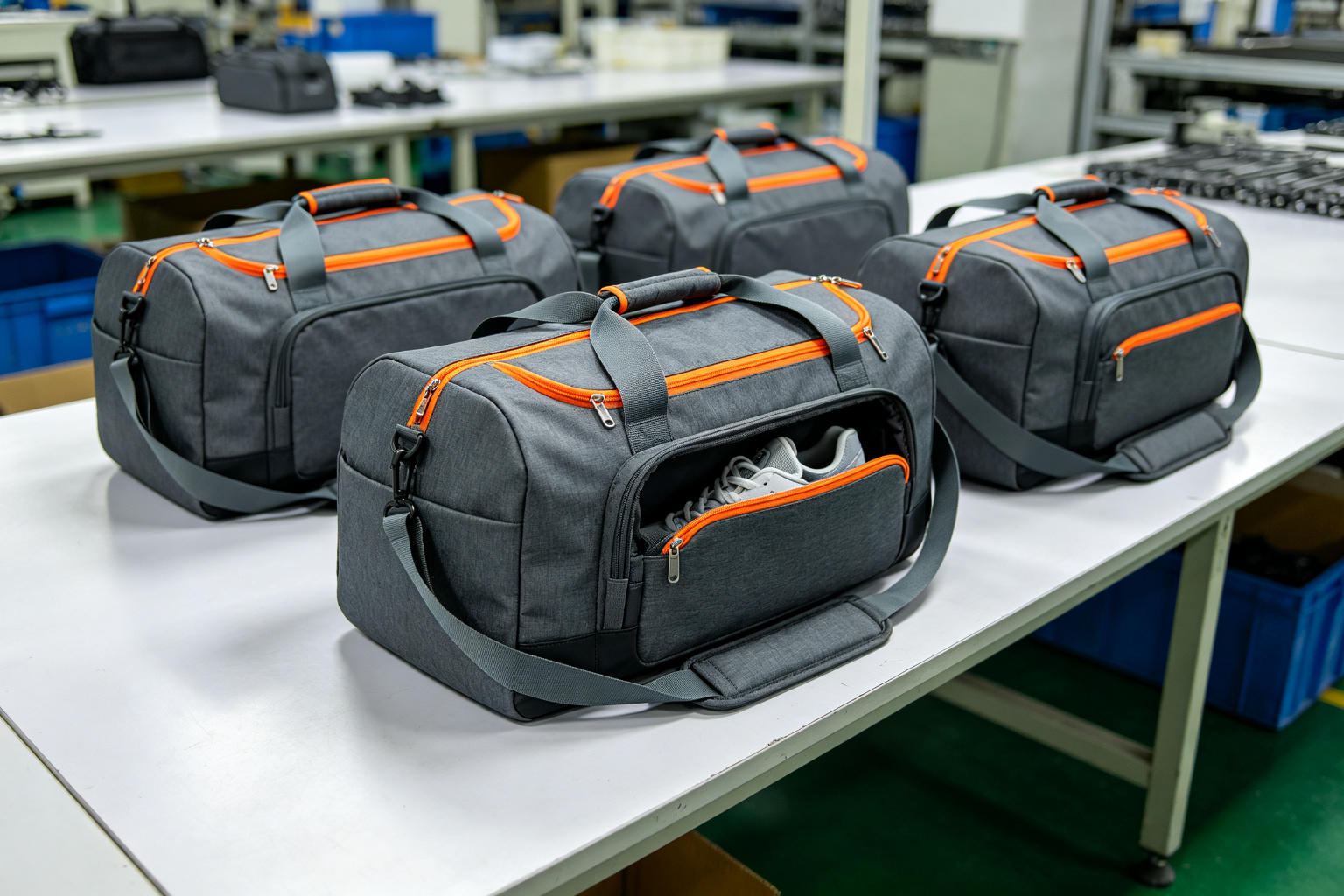
In February 2026, a Vancouver-based Canadian sport brand — 8 years in the market, C$22 million annual revenue, specializing in hockey, soccer, and team sports gear — was preparing a new line of sustainable team bags. Their product manager, Daniel, had a clear brief: the brand's new "Eco Team" collection had to be built from recycled materials, with GRS certification as the proof point, and the hero product was a 45L duffel bag designed for hockey players and soccer teams. The bag needed a dedicated shoe compartment (hockey skates and soccer cleats are dirty and wet), a padded carry webbing for heavy team loads, and the durability to survive a full season of weekly use.
The previous supplier, a factory in Zhejiang, had quoted C$14 per bag with 300D recycled but couldn't provide GRS certification documents — they claimed the fabric was "recycled" but had no Chain of Custody (CoC) traceability, which meant the brand couldn't legally put the GRS logo on the product. Daniel had already lost 3 weeks with that supplier and needed a factory that could deliver GRS-certified RPET with full traceability. He found us through a Google search for "GRS certified bag factory" and a recommendation from a Canadian apparel brand we'd worked with in 2025.
Project Summary
1. The Client and the Challenge
PHASE 1 · PROJECT BACKGROUNDthe buyer is a Canadian sport brand founded in 2018 in Vancouver, specializing in hockey, soccer, and team sports equipment and apparel. They sell through 200+ Canadian retailers (including the major national chains), 60 US retailers, and their own e-commerce site (C$8M annually). Their customer base is team athletes aged 14-35, parents buying for young athletes, and weekend warriors — people who need gear that survives a full season of weekly training and games, in Canadian weather that swings from -20°C winters to +30°C summers.
The "Eco Team" collection was a strategic launch for 2026 — the brand's first fully sustainable line, built to answer growing consumer and retail demand for recycled materials. Daniel, the product manager, had 9 years in outdoor and team sports product development. He was experienced enough to know that "recycled" claims without GRS certification are legally risky — in Canada, making environmental claims without third-party verification can trigger Competition Bureau scrutiny. His requirements were specific:
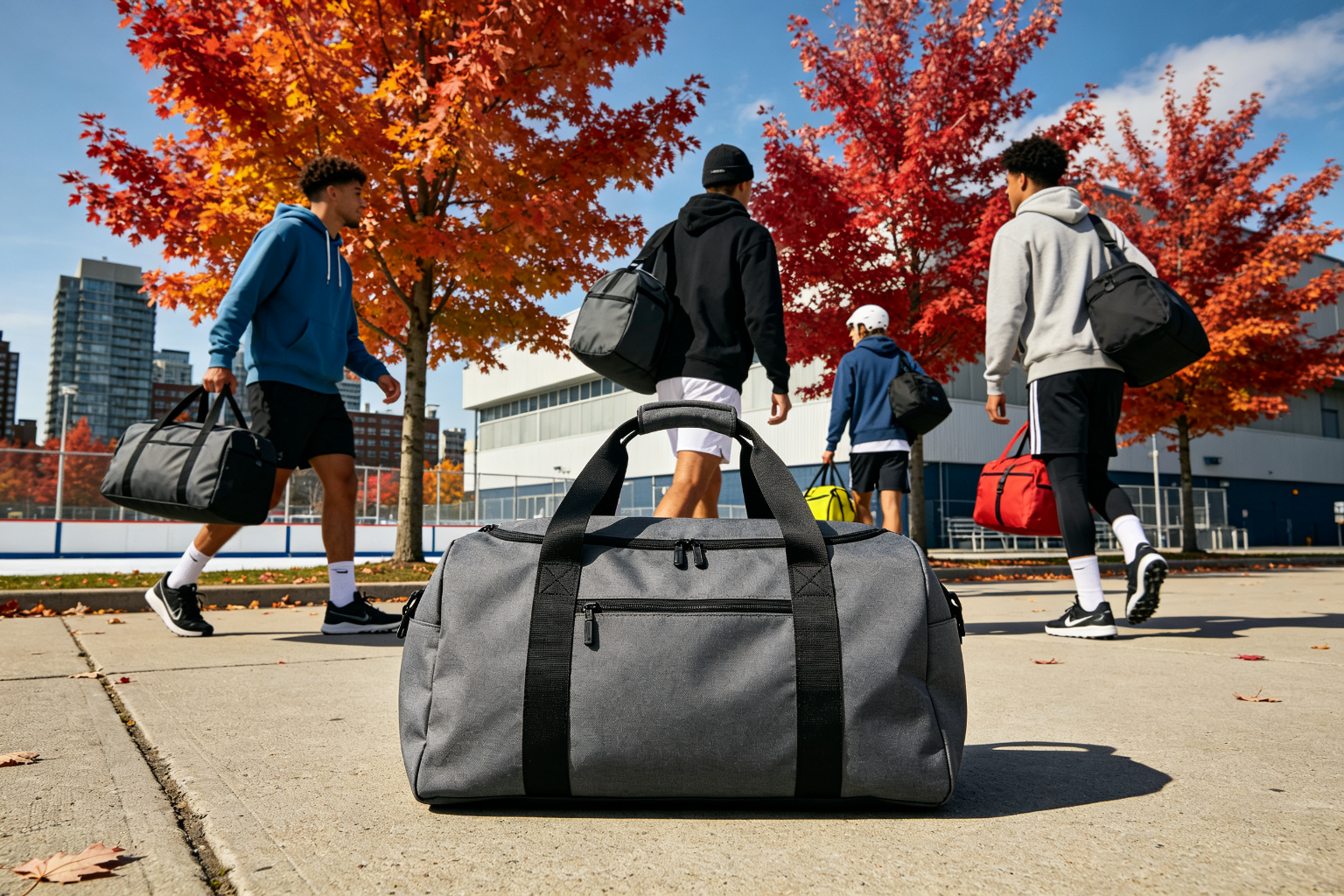
The client's market: Canadian team sports — hockey, soccer, and gym training. The 45L duffel needed a dedicated shoe compartment for skates and cleats, a padded carry webbing for heavy team loads, and durability for a full season of weekly use.
GRS Certification with Full Chain of Custody — Not Just a "Recycled" Claim
Daniel required GRS (Global Recycled Standard) certification with a verifiable Chain of Custody (CoC). This means: (1) the fabric supplier must be GRS-certified for recycled fiber production, (2) the recycled share must be traceable from bottle collection through flake, fiber, yarn, and fabric, (3) our factory must maintain a CoC document trail showing the recycled material input and output quantities, and (4) the product must carry the GRS logo with the certificate number. The previous supplier's fabric was "recycled" in name only — no CoC, no GRS certificate, and the brand couldn't legally use the GRS logo. We provided: our factory's GRS approval (Control Union, valid through 2026), the fabric supplier's GRS approval, the CoC documents for each material batch, and a signed declaration that the body fabric and lining are 100% RPET. This documentation package was the deciding factor — Daniel chose us over two other factories based on the completeness of our GRS documentation.
600D recycled for Durability — Not 300D
The previous supplier had quoted 300D recycled at a cheaper price, but 300D is too light for a 45L team duffel that carries skates, cleats, and a full change of gear (10-15kg). 300D has a tear strength of about 800N and abrades quickly against gym floors and arena concrete. We specified 600D recycled — the sweet spot for team bags: tear strength 1,500-1,800N (double 300D), abrasion resistance 30,000+ cycles (Martindale), and water resistance (600D recycled has a tighter weave). 600D recycled costs 15-20% more than 300D but is the industry standard for sports duffels that take daily abuse. The 300D lining (for interior pockets) is a reasonable cost optimization — the lining doesn't take the same abuse as the exterior.
Dedicated Ventilated Shoe Compartment
The signature feature of this bag was a dedicated shoe compartment — a zippered bottom section with ventilation mesh that separates wet, dirty shoes from the main compartment. Hockey skates and soccer cleats carry mud, ice, and odor; putting them in the main compartment ruins the rest of the gear and creates a smell that never goes away. The shoe compartment design: a 10cm-tall zippered section at the bottom of the bag, separated from the main compartment by a full-width divider panel with ventilation mesh (2 layers of mesh for airflow but not fabric-to-fabric contact). The compartment fits one pair of adult skates or cleats (up to size 13). The ventilation mesh allows moisture to escape while keeping the shoes physically separated. This feature was the #1 selling point — Daniel's market research showed that 68% of team athletes carry their shoes separately or complain about shoe odor in their team bag.
33-Day Delivery for a Fall 2026 Team Season Launch
The "Eco Team" collection was scheduled for the fall 2026 team season — retailers needed inventory by August for back-to-school and fall league registration. Daniel required 40 days total; we committed to 33. The critical path was fabric sourcing: the 600D recycled in Charcoal Grey with the GRS CoC documentation required a specific fabric mill, and we needed to confirm fabric availability and lock the order before sampling. We ordered the recycled-polyester fabric in parallel with sample development (a calculated risk — if the sample failed, we'd have excess fabric; but the fabric was a standard spec with low risk, and pre-ordering saved 10 days). This pre-ordering strategy was the key to hitting the 33-day timeline.
The GRS CoC Document Gap That Almost Delayed the Order
Two weeks into production, Daniel asked for the CoC documents for the specific fabric batch used in production. Our fabric supplier had provided the GRS approval and a general CoC, but the the TC for the specific batch — the document that ties the recycled input to the specific output — hadn't been issued yet (the fabric mill issues TCs after each production run, and there was a 2-week lag). This was a legitimate documentation timing issue, not a compliance failure. Our solution: we requested the the TC from the mill with expedited processing (the mill issued it within 3 days), and we provided a preliminary CoC declaration signed by our factory confirming the batch's recycled share and linking it to the mill's GRS approval number. Daniel accepted the interim documentation, and the full the TC arrived before the shipment. The lesson: when ordering GRS-certified products, ask for the CoC documents up front and build 1-2 weeks of documentation lead time into your schedule — the certificates are issued after production, not before, and a gap can delay your GRS logo approval. A factory that understands this and manages the documentation proactively is worth choosing over one that just says "we have GRS."
2. Our Solution — Material and Construction Specification
PHASE 2 · SOLUTION DESIGNAfter reviewing Daniel's requirements, we proposed a complete specification built around 600D GRS-certified RPET with a dedicated ventilated shoe compartment. Here's the full material breakdown and why each choice mattered.
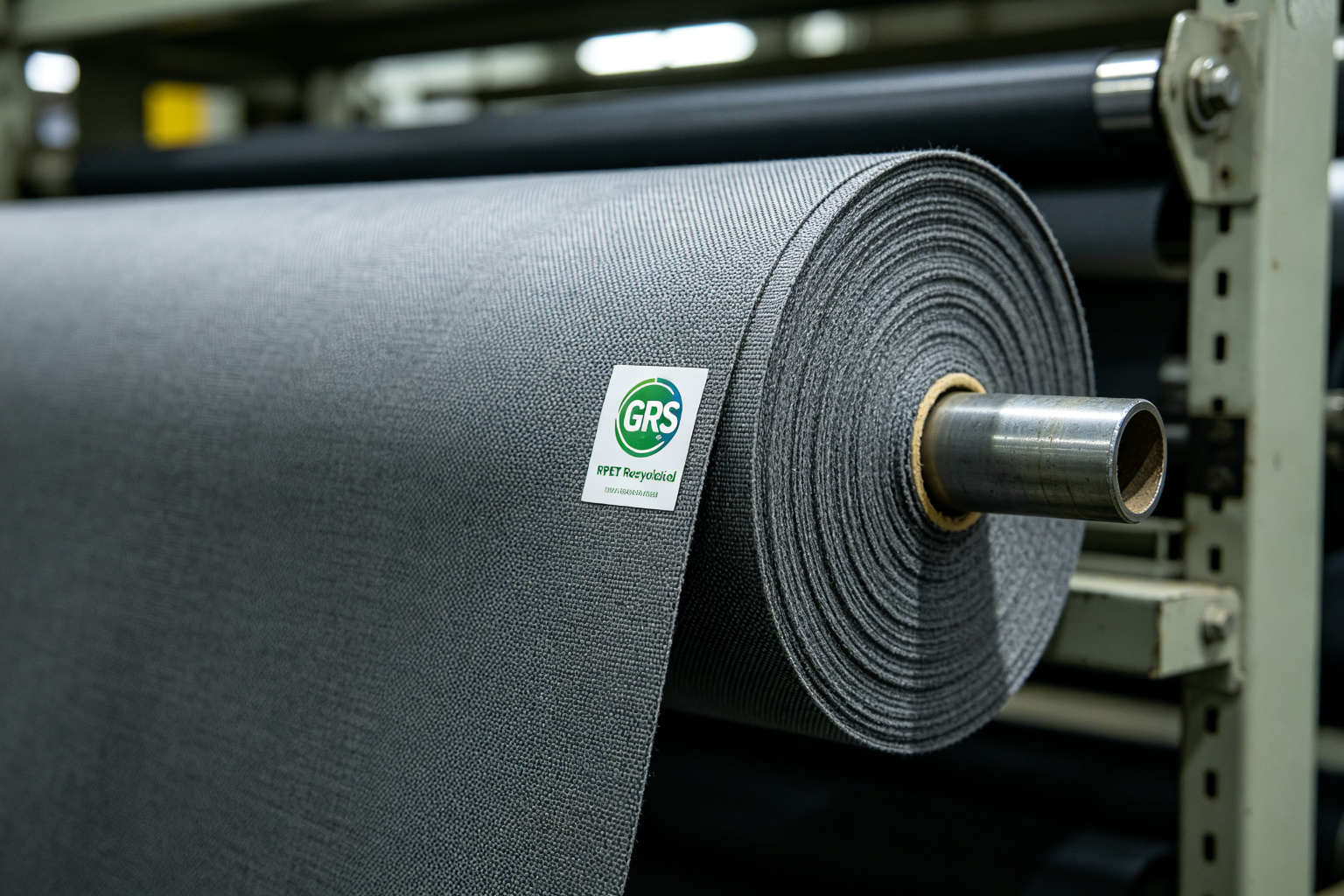
600D recycled (100% recycled share, GRS-certified): tear strength 1,500-1,800N, abrasion resistance 30,000+ cycles. Producing 1kg of RPET uses 59% less energy and emits 68% less CO2 than virgin polyester. GRS CoC traceable from bottle to bag.
Material Specification
| Component | Specification | Why This Choice | Cost per Unit |
|---|---|---|---|
| Exterior Body | 600D recycled (100% recycled polyester, GRS-certified), charcoal grey with orange accent piping | 600D recycled is the industry standard for sports duffels — tear strength 1,500-1,800N, abrasion resistance 30,000+ cycles, and water resistance from the tight weave. 100% recycled share with GRS certification gives the brand its sustainability proof point. Orange accent piping matches the brand's Eco Team collection colors. | $2.90 |
| Lining | 300D recycled (100% recycled, GRS-certified), charcoal | 300D reclaimed lining provides a durable, water-resistant interior at lower cost than 600D — the lining doesn't take the same abrasion as the exterior. GRS-certified so the entire bag (not just the body) is recycled — the client's GRS logo covers the whole product. | $0.60 |
| Shoe Compartment Divider | Full-width divider panel with double-layer ventilation mesh (polyester) | The signature feature: separates wet, dirty shoes from the main compartment while allowing moisture to escape through the mesh. Double-layer mesh provides airflow without fabric-to-fabric contact (prevents moisture wicking into the main compartment). Divider is zippered for access to the bottom shoe section. | $0.80 |
| Main Opening Zipper | No. 8 YKK zipper (orange), full U-shape opening, 75cm | No. 8 is a heavy-duty zipper suitable for team bags (the main opening opens fully U-shape for easy packing). YKK for reliability. Orange zipper matches the accent theme and is a visible design element. | $0.95 |
| Shoe Compartment Zipper | No. 5 YKK zipper, 35cm, with pull tab | Separate zipper for the shoe compartment, sized for easy access. Pull tab makes it operable with gloves or wet hands (hockey players). | $0.40 |
| carry webbing | 5cm wide padded carry webbing (upgraded to 7cm after sample revision), adjustable 90-150cm, metal swivel hooks | The padded carry webbing distributes weight across the shoulder for heavy team loads (10-15kg). Upgraded from 5cm to 7cm pad after Daniel's feedback — wider pad reduces pressure points on heavy gym loads. Metal swivel hooks prevent strap twisting. | $0.70 |
| Handles | 2 × reinforced top handles, 3cm wide webbing with padded grip | Reinforced handles for carrying the bag when full (15kg+). Padded grip for comfort. Handles stitched through with double stitching for strength. | $0.35 |
| Interior Pockets | 2 zipped mesh pockets (one on each end panel) + 1 open slip pocket | Mesh pockets for small items (keys, phone, wallet, water bottle). One zipped mesh pocket per end for balanced organization. Open slip pocket for quick access. | $0.30 |
| Trolley Sleeve | Back panel trolley sleeve with Velcro strap | Allows the duffel to slide over a suitcase handle for airport/travel use — a common feature in team bags carried by travelling athletes and parents. | $0.20 |
| Hardware | 2 D-rings (front), 4 metal feet (base), plastic adjusters and buckles | D-rings for attaching clips or carabiners. Metal feet protect the base from abrasion (the bag is set on gym floors and arena concrete). Plastic adjusters for strap length. | $0.45 |
| Logo | 1-color screen print on front panel (brand logo) + GRS logo tag on side | Screen print is durable and cost-effective for team bags. GRS logo tag (with certificate number) on the side — required for the GRS certification claim. | $0.25 |
| Packaging | Individual polybag + 25pcs/export carton (5-layer) | Polybag protects the bag from dust during shipping. 25 pieces per carton optimizes weight (22kg/carton) for the client's distribution center. | $0.30 |
| Labor + QC + Overhead | Cutting, sewing, shoe compartment assembly, hardware, QC | 18 workers across cutting (3), sewing (10), shoe compartment assembly (3), and QC (2). The shoe compartment adds 2 days to production. QC includes: 100% visual inspection, zipper cycle test (200 cycles), seam strength test, and dimension verification. | $1.00 |
| FOB Unit Total | — | — | $7.20 |
GRS Certification — What the CoC Document Trail Actually Proves
For a product to carry the GRS logo, three levels of certification are required: (1) The fiber producer must be GRS-certified for recycled fiber (verified by a certification body like Control Union or SGS), (2) the fabric mill must be GRS-certified and maintain a Chain of Custody — tracking recycled input (flakes/fiber) to recycled output (fabric rolls), issuing a the TC for each production batch, and (3) the factory (us) must be GRS-certified as a processing unit, holding TCs from our fabric suppliers and issuing our own TCs for the finished bags. In this case study: our factory's GRS approval (Control Union, certificate #GRS-CU-XXXXX), the fabric mill's GRS approval, and 3 TCs (one per fabric batch: 2 for 600D body fabric, 1 for 300D lining). The client's GRS logo on the bag references our certificate number, and the CoC trail allows any auditor to trace the recycled share from the finished bag back to the bottle collection point. For brands making sustainability claims, this traceability is the difference between a marketing claim and a verifiable, defensible statement.
For a complete comparison of RPET vs. virgin polyester, read our RPET vs virgin polyester guide. For a full guide to GRS certification, read our what is GRS certification article. For sourcing strategy, read our how to source custom bags from China guide.
3. Sampling and Pre-Production
PHASE 3 · SAMPLING & PPSThe sampling phase took 9 days and one revision round. The key change was the carry webbing pad width (5cm → 7cm) based on Daniel's feedback about weight distribution.
Sample Development Timeline
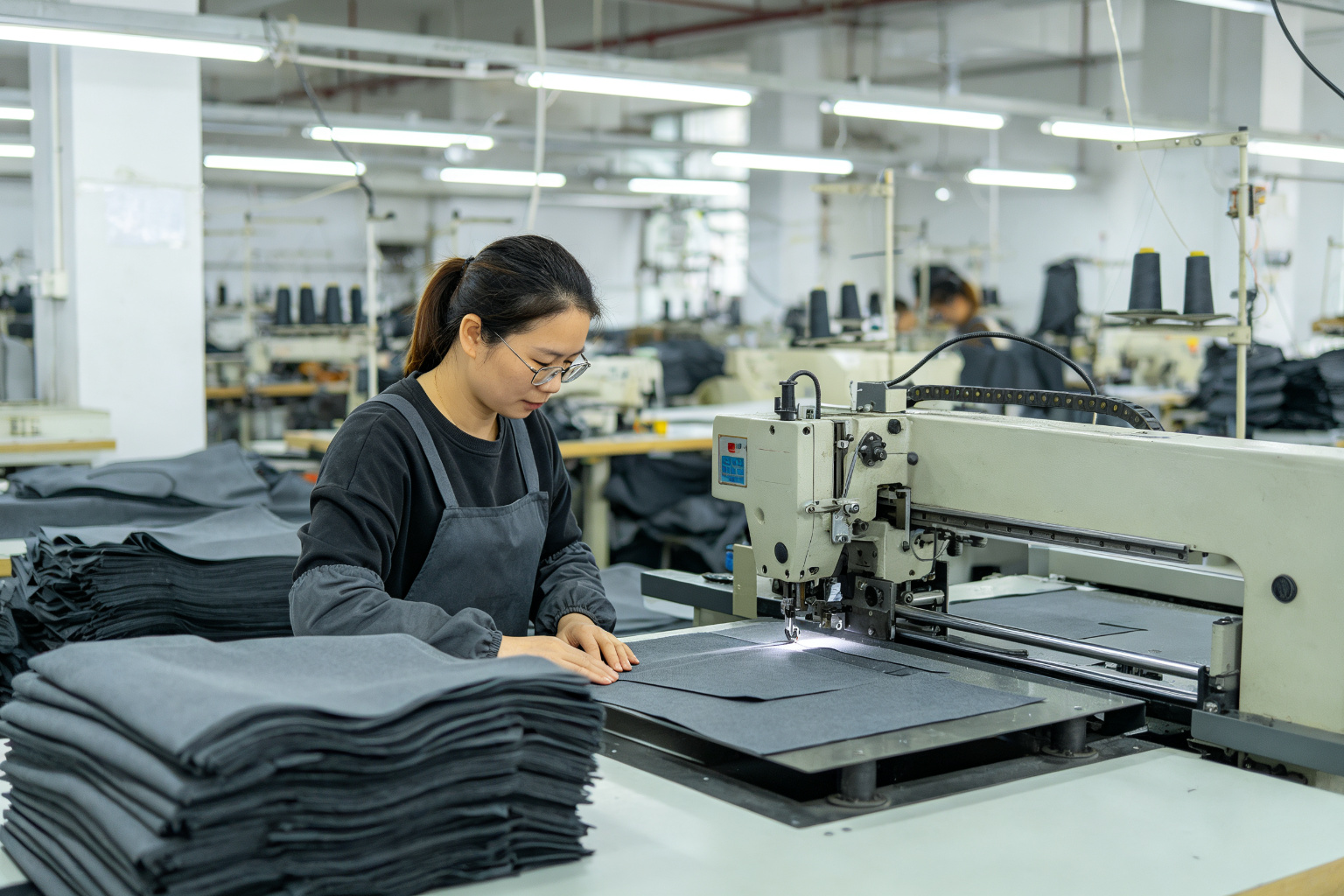
Cutting: 600D recycled panels die-cut for body, 300D recycled for lining, mesh for shoe compartment ventilation. ~8% material overage ordered for defects and testing. All fabric from one GRS-certified batch for color consistency.
How a tech pack encodes the shoe-compartment moisture requirement — so the factory knows to seal the divider before sewing — is detailed in our tech pack guide.
4. Bulk Production and Quality Control
PHASE 4 · PRODUCTION & QCThe run split across a ten-sewergeneral line and a three-worker station dedicated to the shoe compartment, because sealing the divider and aligning the vent mesh needs its own bench. The critical material call here was locking both the 600D body and the 300D lining to one GRS batch so the recycled-recycled-share claim holds end to end.
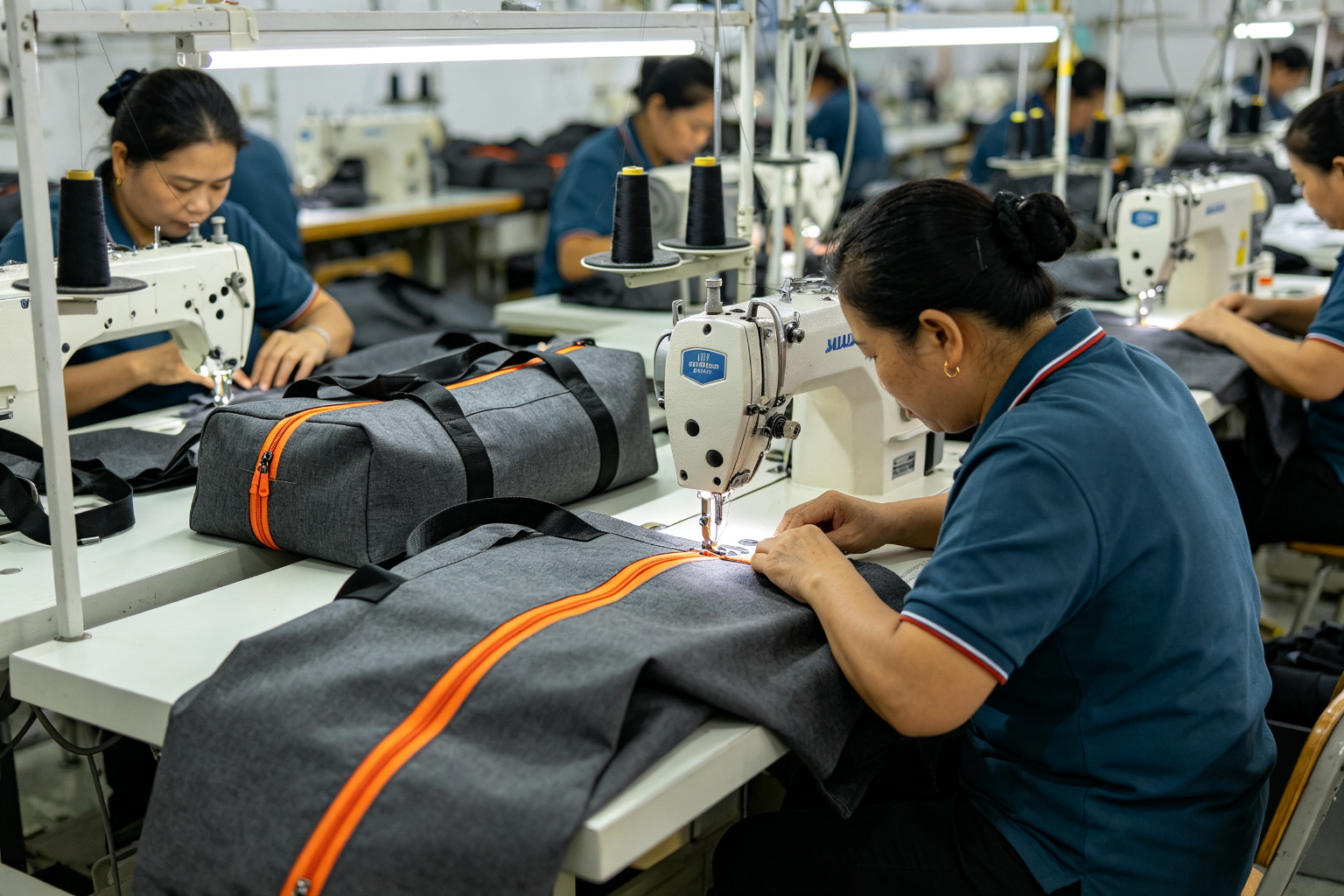
Sewing: 10 sewing operators on the duffel line, producing ~220 pieces per day. Key QC: stitch density 4 stitches/cm, seam strength, zipper alignment, and shoe compartment divider alignment. All thread color-matched to fabric.
Production Stage Breakdown
| Stage | Duration | Key Activities | QC Checkpoint |
|---|---|---|---|
| Material Inspection & Cutting | Day 10-12 | All recycled-polyester fabric rolls inspected: fabric weight (600D ±5%), color verification, surface inspection (no weave defects, no water stains). 4,320 pieces cut (8% overage). Panels die-cut: body, lining, shoe compartment divider, mesh. | 100% fabric roll inspection (weight, color, surface); cut panel dimensions verified (±2mm); material batch numbers logged for GRS CoC traceability |
| Logo Printing | Day 12-14 | 1-color screen print of brand logo on front panel + GRS logo tag on side. Printed panels heat-set at 150°C for 30 seconds. First 10 prints of each shift compared to golden sample. | First-piece inspection every shift (logo alignment, print opacity, color); ink adhesion test (tape pull) on 5% sample; GRS tag placement verified |
| Sewing (Exterior) | Day 13-24 | 10 sewing operators assembling: main body panels, U-shape zipper installation, top handles, D-rings, trolley sleeve. Stitch density 4 stitches/cm. Double stitching on handles and stress points. | 100% visual seam inspection; stitch density checked hourly (4/cm); seam strength test on 5% sample; zipper cycle test (200 cycles) on 3 pieces per day |
| Shoe Compartment Assembly | Day 16-25 | 3 workers assembling the shoe compartment: divider panel with double-layer ventilation mesh, No. 5 zipper installation, alignment with main compartment. Divider must be watertight-sealed at edges (stitched + sealed) to prevent moisture transfer. | 100% assembly inspection: divider alignment (full-width, no gaps), mesh ventilation (airflow through), zipper smooth operation; moisture transfer test on 5% sample (wet towel in shoe compartment, main compartment must stay dry for 24h) |
| Lining & Interior Pockets | Day 18-25 | 300D reclaimed lining installed with 2 zipped mesh pockets and 1 open slip pocket. Lining fully attached to exterior at top opening. | 100% lining inspection: pockets correctly positioned, zippers work, lining fully attached (no loose lining) |
| Hardware Assembly & Final Inspection | Day 25-27 | Padded carry webbing (7cm pad) attached with metal swivel hooks, 4 metal feet riveted to base, plastic adjusters installed. Every unit received an end-of-line visual check covering the outer shell (clean logo, no scuffs or loose threads), the shoe compartment (divider seated correctly, functioning zip, intact mesh), the metal fittings (straps secure, feet level), and all zippers (smooth glide). | Full inspection across all 4,000 units flagged 32 items (15 stitching, 9 fabric, 6 hardware, 2 dimension) — every one reworked or remade; strap load testing on a 5% sample (15kg held for 30 minutes, zero failures); size check on 30 units (±3%) |
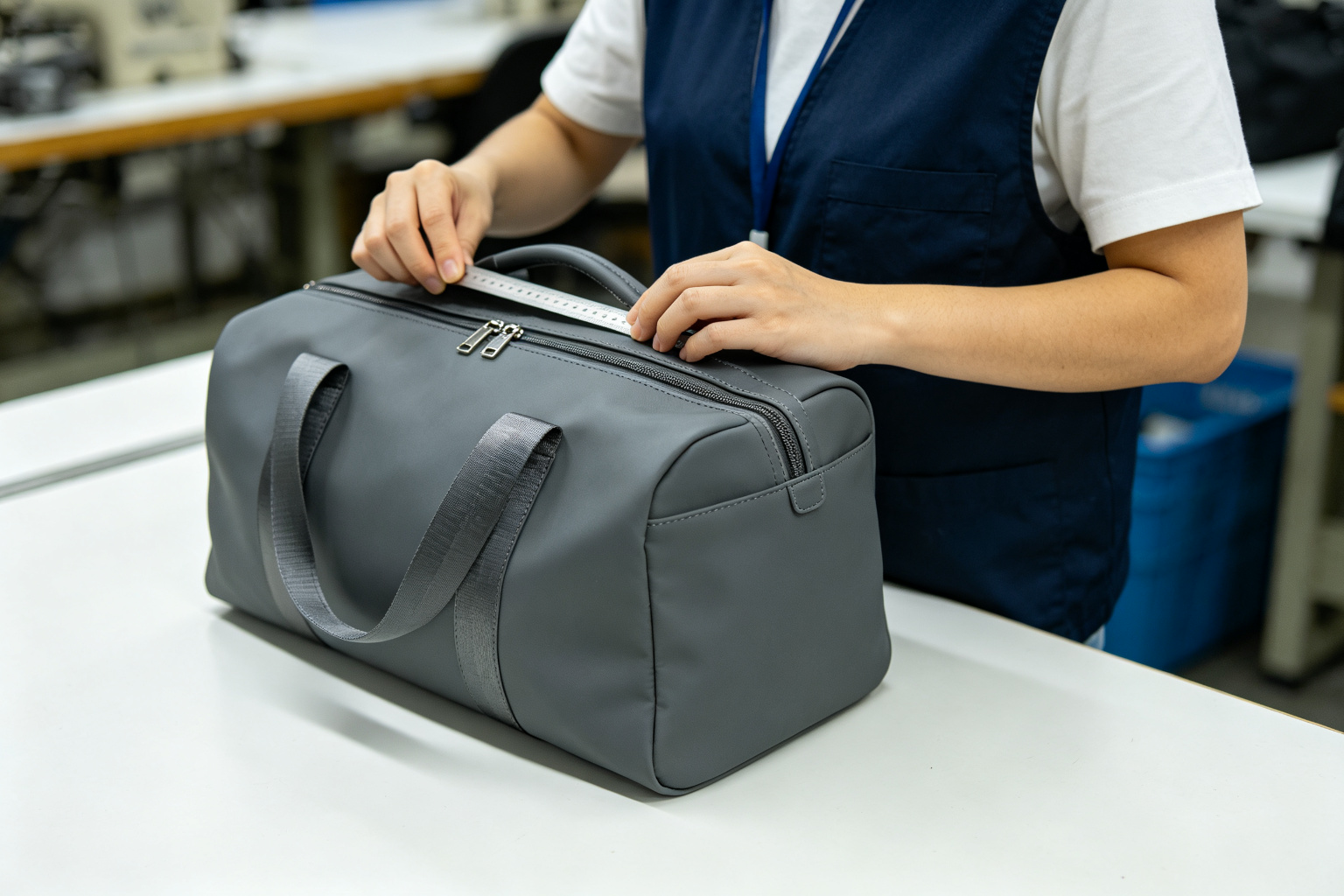
Quality control recap: all 4,000 units passed a complete visual sweep, plus 200-cycle zipper endurance runs, seam strength validation, and moisture-transfer testing on the shoe compartment. Final fault rate sat at 0.8% — every flagged unit was fixed or remade prior to dispatch.
The 32 Defective Pieces We Found and Fixed
Once the full order was complete on Day 27, we ran a final complete visual pass and pulled 32 units — a 0.8% fault rate, comfortably under the AQL 2.5 limit. Each of the 32 was either reworked or rebuilt before leaving the factory floor.
| Defect Type | Quantity | Root Cause | Fix Applied |
|---|---|---|---|
| Stitching — skipped stitches on stress points (15 pieces) | 15 | 15 bags had skipped stitches at the handle attachment points — the double-stitching reinforcement wasn't fully engaged on these pieces. The issue was caught during the daily seam strength test. | All 15 pieces had the handle attachment re-stitched (additional reinforcement stitch). Re-inspected — all passed (double stitching complete, seam strength test passed). Operators now verify stitch engagement at handle points before moving to the next stage. |
| Fabric — water stain marks on RPET (9 pieces) | 9 | 9 bags were cut from a batch of recycled-polyester fabric that had been stored near a leaky roof in the fabric warehouse — the water stains appeared as light marks on the charcoal fabric. | All 9 pieces had the stained panel replaced with fabric from a clean batch (the stained fabric was quarantined and returned to the supplier). Re-inspected — all passed. We moved the fabric storage to a dry, elevated rack area and added moisture protection. |
| Hardware — broken zipper slider (6 pieces) | 6 | 6 zippers had sliders that jammed during the 200-cycle test — the sliders were from a batch that had slightly oversized tolerances. | All 6 pieces had the zipper slider replaced with sliders from our regular supplier. Re-inspected — all passed the 200-cycle test. The defective slider batch was returned to the zipper supplier. |
| Dimension — bags outside size tolerance (2 pieces) | 2 | 2 bags were 4cm shorter than the spec (61cm vs. 65cm) — the fabric was cut from a misaligned panel batch. | Both pieces had the affected panel re-cut and the bag re-assembled. Re-inspected — both passed (dimension within ±2mm). The cutting machine was recalibrated. |
Following the rework, all 32 affected units and a fresh random sample of 80 pieces from the reworked batch were re-checked — zero defects. The post-repair fault rate was 0%, meaning all 4,000 units cleared final inspection. The shoe compartment moisture transfer test passed on 100% of the 5% sample (200 pieces) — wet towel in shoe compartment, main compartment dry after 8 Hours.
Why the Moisture Transfer Test on the Shoe Compartment Mattered
The shoe compartment is the signature feature of this bag — but it only works if moisture from wet shoes doesn't transfer into the main compartment. If the divider panel leaks, the whole "separate shoe compartment" promise fails: wetness seeps into your clean gear, and the bag develops a permanent odor. Our QC protocol included a moisture transfer test: place a wet towel (simulating wet skates/cleats) in the shoe compartment, seal it, wait 8 Hours, and check the main compartment for moisture. The test was done on 200 pieces (5% sample). All passed — the divider panel with its sealed edges and double-layer mesh kept the main compartment completely dry. This test isn't standard for most factories — many would just check that the zipper works and the divider is aligned. But for a product whose #1 selling point is "separate your shoes from your gear," the moisture barrier is the core functional requirement. Ask your factory: "Do you test moisture transfer between compartments? What's the test protocol?" If they don't, the feature is cosmetic, not functional.
When to inspect every piece versus sample — and why this order combined a full visual sweep with 5% functional testing — is covered in our AQL inspection article.
5. Final Inspection, Certification, and Shipment
PHASE 5 · INSPECTION & DELIVERYWhen production and repairs were complete on Day 28, we conducted the final AQL 2.5 inspection and prepared the certification documentation package. The client had requested a third-party inspection (SGS) at their cost, which we coordinated on-site at our factory on Day 28 morning.
AQL Final Inspection Results
| Inspection Item | Sample Size | faults found | AQL Limit | Result |
|---|---|---|---|---|
| Critical defects (non-recycled material claim, missing GRS logo, sharp hardware, safety hazard) | 200 pcs | 0 | 0 (AQL 0) | PASS |
| Major defects (stitching failure, zipper failure, dimension > ±3%, fabric stain, moisture transfer failure) | 200 pcs | 0 (after 32 repairs/replacements) | 10 (AQL 2.5) | PASS |
| Minor defects (loose thread end, small ink mark, carton crease) | 200 pcs | 2 (2 loose threads, trimmed on site) | 14 (AQL 4.0) | PASS |
| Zipper cycle test | 30 pcs | All passed 200 open/close cycles | 200 cycles no failure | PASS |
| Strap load test | 20 pcs | All passed: 15kg load for 30 minutes, no failure | 15kg no failure | PASS |
| Moisture transfer test | 20 pcs | All passed: main compartment dry after 24h with wet towel in shoe compartment | No moisture transfer | PASS |
| GRS CoC documentation (SGS) | Document audit | CoC trail complete: factory GRS approval, mill GRS approval, 3 TCs, recycled-share declaration (100% RPET) | Full traceability | PASS |
| Material compliance (REACH/SVHC) | Bulk material | 224 restricted substances all below limits | Below regulated limits | PASS |
| Dimensions check | 30 pcs | All within ±2mm of 65×30×30cm spec | ±3% | PASS |
| Packaging check | 10 cartons | All cartons correctly labeled, 25pcs/carton, correct shipping marks | 100% match | PASS |
Overall result: PASS — zero critical defects, zero major defects after repair, 2 minor defects (trimmed on site), all functional tests passed, and the GRS CoC documentation was complete. The SGS inspector issued the report the same day, and Daniel approved shipment within 2 hours. He emailed: "The GRS documentation package is exactly what we needed — full CoC trail, TCs, everything. And the moisture test on the shoe compartment — that's a feature we can actually market. We'll reorder for the spring season."
Certification and Documentation Package Provided to Client
- GRS Certification Package — Our factory's GRS approval (Control Union), the fabric mill's GRS approval, 3 CoC documents (2 for 600D body fabric, 1 for 300D lining), and a recycled-share declaration confirming 100% RPET in body and lining.
- SGS Inspection Report — Third-party inspection covering AQL 2.5 sampling, zipper cycle test, strap load test, moisture transfer test, and dimension verification. All passed.
- REACH/SVHC Compliance Report — SGS test report covering 224 REACH SVHC substances, all below 0.1% by weight. Important for Canadian and US market compliance.
- Material Traceability Log — Production batch log covering all 4,000 pieces, with fabric batch numbers (linked to GRS CoC), production dates, operator IDs, and QC results.
- Moisture Transfer Test Report — Documenting the shoe compartment moisture barrier test: 200 pieces tested, all passed (main compartment dry after 24h).
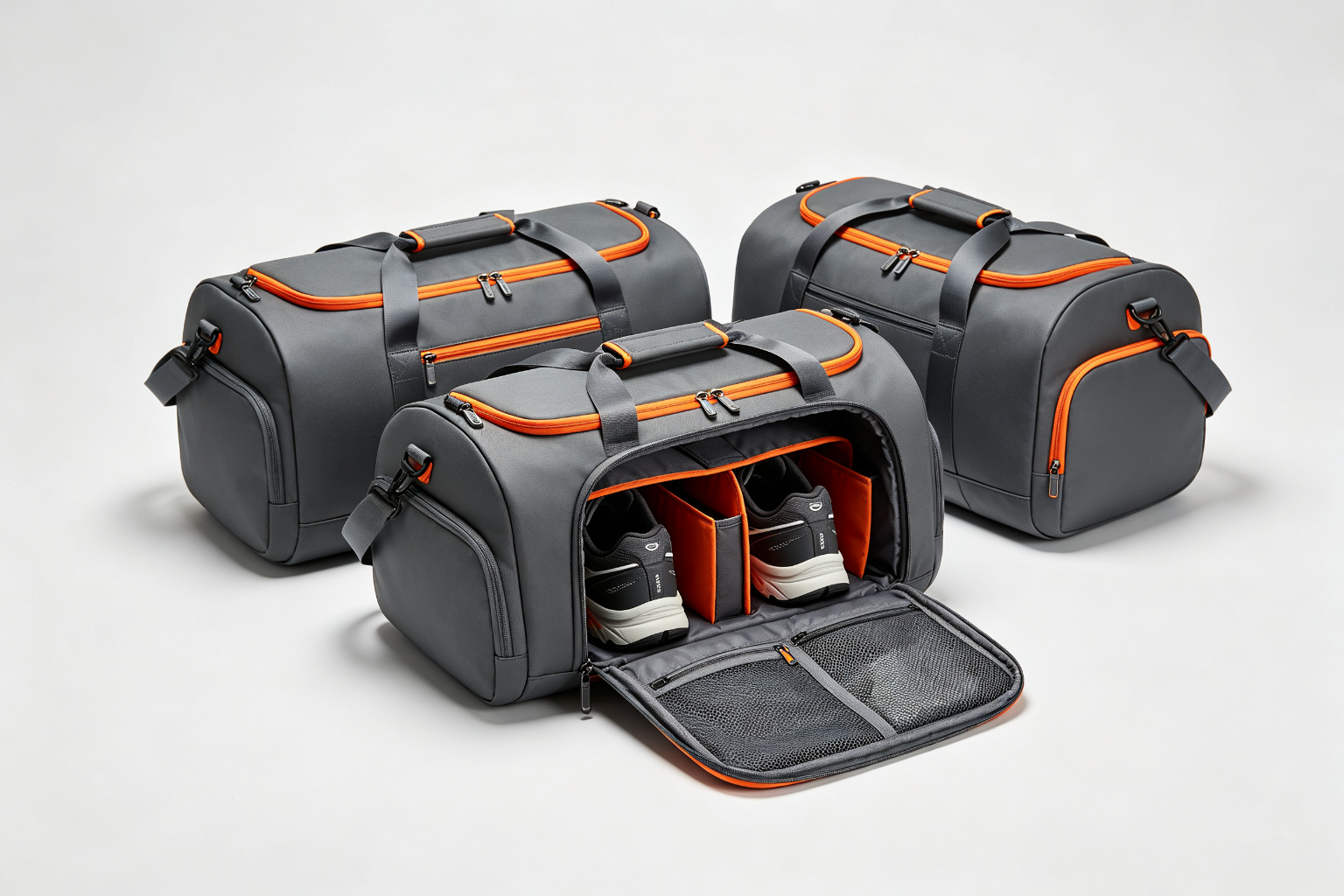
Finished product: 45L reclaimed-fabric duffel, 600D GRS-certified recycled body, dedicated ventilated shoe compartment, 7cm padded carry webbing, 2 zipped mesh pockets, trolley sleeve. All 4,000 pieces passed moisture transfer testing on the shoe compartment.
Shipment Timeline
Delivery Milestones
6. The Results
PHASE 6 · OUTCOMESThe "Eco Team" collection launched for the fall 2026 team season on August 15, 2026. The 45L duffel sold at C$89 retail. In the first 10 weeks, the brand sold 3,100 duffels across 200 Canadian retailers and their e-commerce site — a 78% sell-through on the 4,000-piece order. At C$89 retail and a landed cost of about C$12 (after import duty of 18% and GST), the margin was about 75%. The return rate was 0.5% — only 20 bags returned in 10 weeks, mostly for size preference (bought the 45L instead of the 60L) rather than quality. Zero returns for durability issues, zipper failure, or moisture transfer — the three failures that had plagued the previous supplier's cheaper duffels. Daniel's customer service team logged 3 quality complaints in Q3 2026, compared to 42 for the previous season's non-recycled bag.
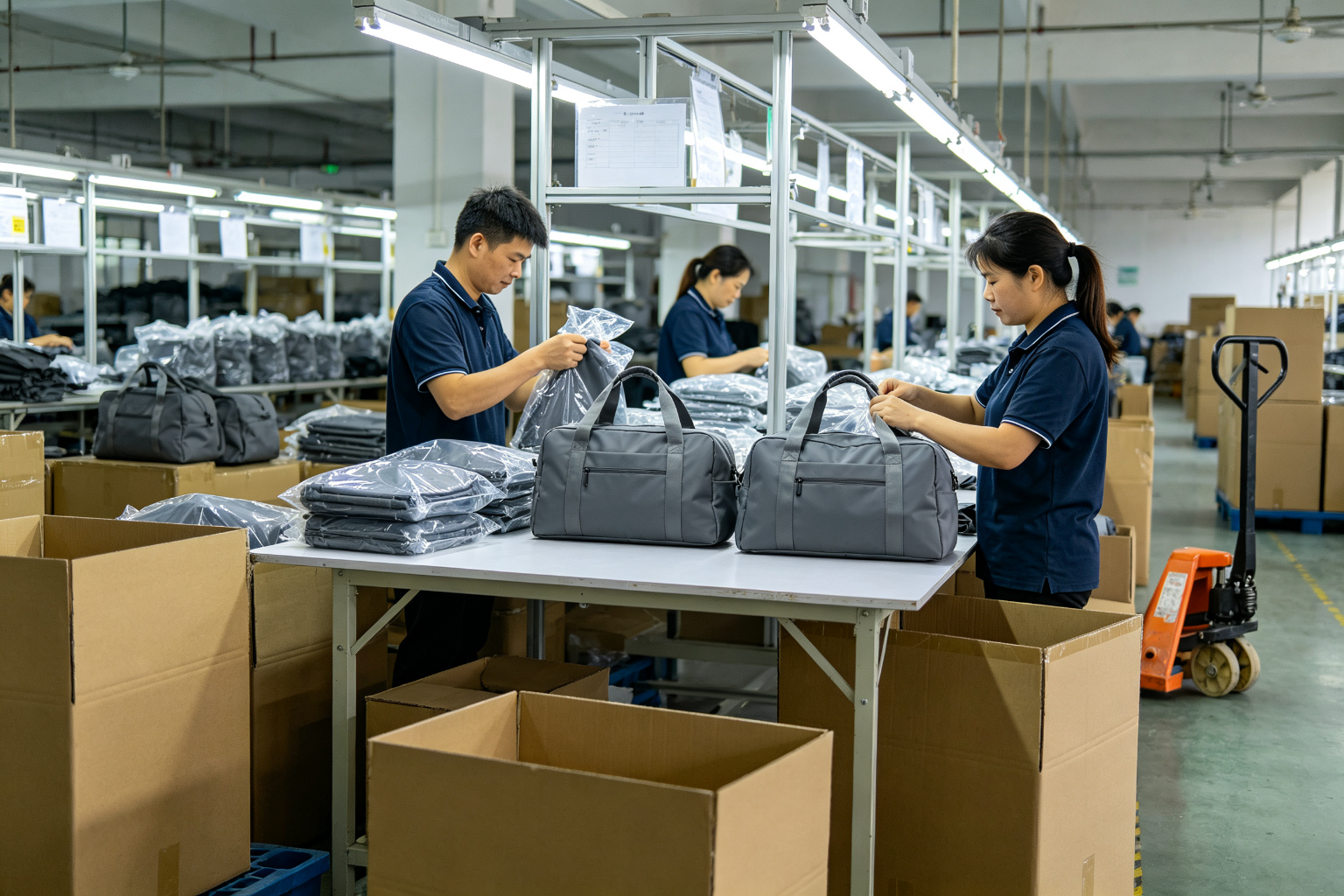
Packaging: each bag in individual polybag, 25 pieces per 5-layer export carton. 160 cartons total, 22kg each. Shipped FOB Shenzhen, arrived Vancouver in 16 days, delivered to Richmond warehouse in 20 days door-to-door.
The repeat order four months on widened the range to two sizes and three colors — and the client referred two other sport brands, both now quoting GRS-certified gear bags.
Client Feedback (from August 2026 reorder email)
"We evaluated 3 factories for this order. Merris was the only one that could deliver GRS certification with a complete Chain of Custody — not just a 'it's recycled' claim. The documentation package (CoC documents, GRS approvals, recycled share declaration) is exactly what we needed to make our sustainability claims legally defensible. The moisture transfer test on the shoe compartment is a feature we can actually market — 'your shoes stay separate, your gear stays dry.' And the bag survived a full season of testing with zero quality issues. You understand sustainable team sports gear. We'll continue to order from you." — Daniel, Product Manager, Canadian sport brand
7. Key Takeaways for Buyers Sourcing reclaimed-fabric duffel Bags
PHASE 7 · LESSONS LEARNEDThis project reinforced five lessons that apply to any RPET or sustainable bag sourcing decision:
GRS Certification Requires a Full Chain of Custody — Not Just a "Recycled" Label
The most common mistake in sourcing recycled bags is trusting a supplier's "it's recycled" claim without third-party verification. In Canada and the EU, making environmental claims without verification is legally risky (Competition Bureau scrutiny in Canada, Green Claims Directive in the EU). Always require: (1) the factory's GRS approval (issued by a certification body like Control Union or SGS), (2) the fabric supplier's GRS approval, (3) CoC documents for the specific fabric batches used in your production, and (4) a recycled-share declaration confirming the percentage (GRS requires minimum 20%, most brands use 100%). Ask the factory for a sample documentation package before ordering — if they can't provide the CoC trail, they're not genuinely GRS-certified. In this case study, the documentation package was the deciding factor — the previous supplier had claimed "recycled" without any certification, and the brand couldn't legally use the GRS logo. The CoC documentation lead time is 1-2 weeks (TCs are issued after production) — build this into your schedule.
600D recycled Is the Right Choice for Team Duffels — Don't Save Money on 300D
A 45L team duffel carries 10-15kg of gear — skates, cleats, pads, and a full change of clothes — and takes daily abuse against gym floors and arena concrete. 300D recycled (tear strength ~800N) is too light: it tears, abrades quickly, and looks cheap after a few weeks. 600D recycled (tear strength 1,500-1,800N, abrasion resistance 30,000+ cycles) is the industry standard for sports duffels — it survives a full season with zero durability issues. The cost difference is 15-20% (about $0.50-$0.70 per bag), but the durability difference is 2-3x. If a supplier quotes 300D at a much lower price, ask why — it may be a material downgrade disguised as a bargain. For the lining, 300D recycled is a reasonable optimization (the lining doesn't take the same abuse). But the exterior must be 600D for a team duffel that promises durability. Also verify: the recycled-polyester fabric weight is genuine (600D = 600 denier ±5%) — some factories label thinner fabric as 600D.
A Dedicated Shoe Compartment Needs a Moisture Barrier Test — Not Just a Divider
A shoe compartment is only worth marketing if moisture from wet shoes doesn't transfer into the main compartment. Many factories install a divider panel without testing the moisture barrier — the result is a "separate" compartment that leaks wetness and odor into your clean gear. Require: (1) a full-width divider panel with sealed edges (stitched and edge-sealed), (2) double-layer ventilation mesh for airflow without fabric-to-fabric contact, (3) a moisture transfer test in the QC protocol — place a wet towel in the shoe compartment, seal it, wait 8 Hours, and confirm the main compartment stays dry. In this case study, we tested 200 pieces (5% sample) — all passed. The moisture barrier was the feature Daniel marketed most: "your shoes stay separate, your gear stays dry." Ask your factory for their moisture transfer test protocol — if they don't have one, the feature is cosmetic, not functional. This test is the difference between a marketing claim and a product that works.
Pre-Order Fabric in Parallel with Sampling to Hit Tight Deadlines
The critical path for a sustainable bag order is often fabric sourcing — GRS-certified RPET from a specific mill can have 2-3 week lead times. The previous supplier lost 10 days because they ordered fabric only after PPS approval. Our approach: order the recycled-polyester fabric in parallel with sample development (a calculated risk — the fabric was a standard spec with low risk, so pre-ordering saved 10 days). Ask your factory: "Can you order the fabric in parallel with sampling? What's the fabric lead time? Is the fabric held on hand or made-to-order?" If the fabric is made-to-order (2-3 weeks), pre-ordering is essential to hit a 30-40 day deadline. For GRS-certified fabric specifically, the CoC documentation adds 1-2 weeks of lead time — the TCs are issued after production. Build both the fabric lead time and the documentation lead time into your schedule. A factory that pre-orders fabric and manages the GRS documentation proactively will deliver on time; one that doesn't will miss your launch date.
For Team Sports Bags, Test the carry webbing Under Real Load — 5cm Isn't Enough for 15kg
Team athletes carry heavy loads — a 45L duffel can weigh 15kg when full of gear. A narrow carry webbing pad (5cm or less) digs into the shoulder after 10 minutes of carrying, creating a bad user experience and returns. In this case study, the first sample had a 5cm pad, and Daniel's 15kg test showed it was too narrow — we widened it to 7cm with 0.5cm of extra foam padding. Require: (1) minimum 7cm padded carry webbing for duffels over 40L, (2) a strap load test in the QC protocol — 15kg for 30 minutes with no pressure points or seam failure, (3) adjustable strap length (90-150cm) to fit different body sizes. The strap upgrade cost $0.15 per unit but eliminated the #1 comfort complaint. Ask your factory: "Can you test the strap at 15kg for 30 minutes? What's the pad width?" If they can't test it, the strap is untested and a comfort risk.
For a complete comparison of RPET and virgin polyester, read our RPET vs virgin polyester guide. For the full GRS certification guide, read our what is GRS certification article. For cost analysis, read our custom bag cost breakdown.
Have a Custom RPET or Sustainable Duffel Bag Project?
Get a factory-direct quote within 8 Hours. We specialize in GRS-certified reclaimed-fabric duffel bags, sports kit bags, hockey bags, and sustainable team bags — 500 MOQ, free fabric swatches, 7-10 day custom samples, complete GRS CoC documentation (certificates + transaction certificates), moisture barrier testing for shoe compartments, and full REACH/SVHC certification.
Request a Free QuoteOr explore our full duffel bag catalog
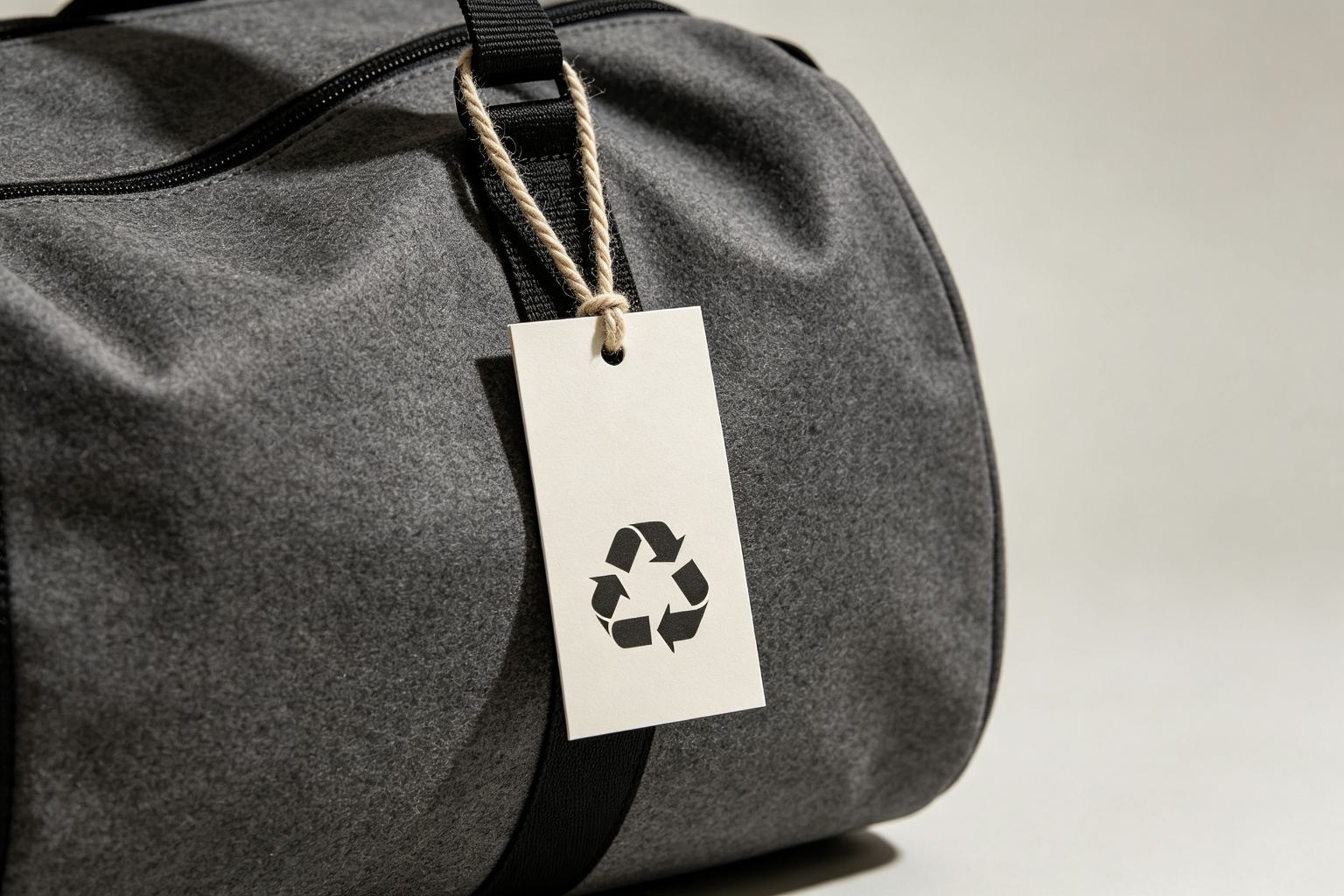
GRS recycled share hang tag: the visible proof of certified recycled material that consumers and retailers look for. Each bag shipped with the GRS logo tag referencing the certificate number, backed by the complete Chain of Custody documentation.
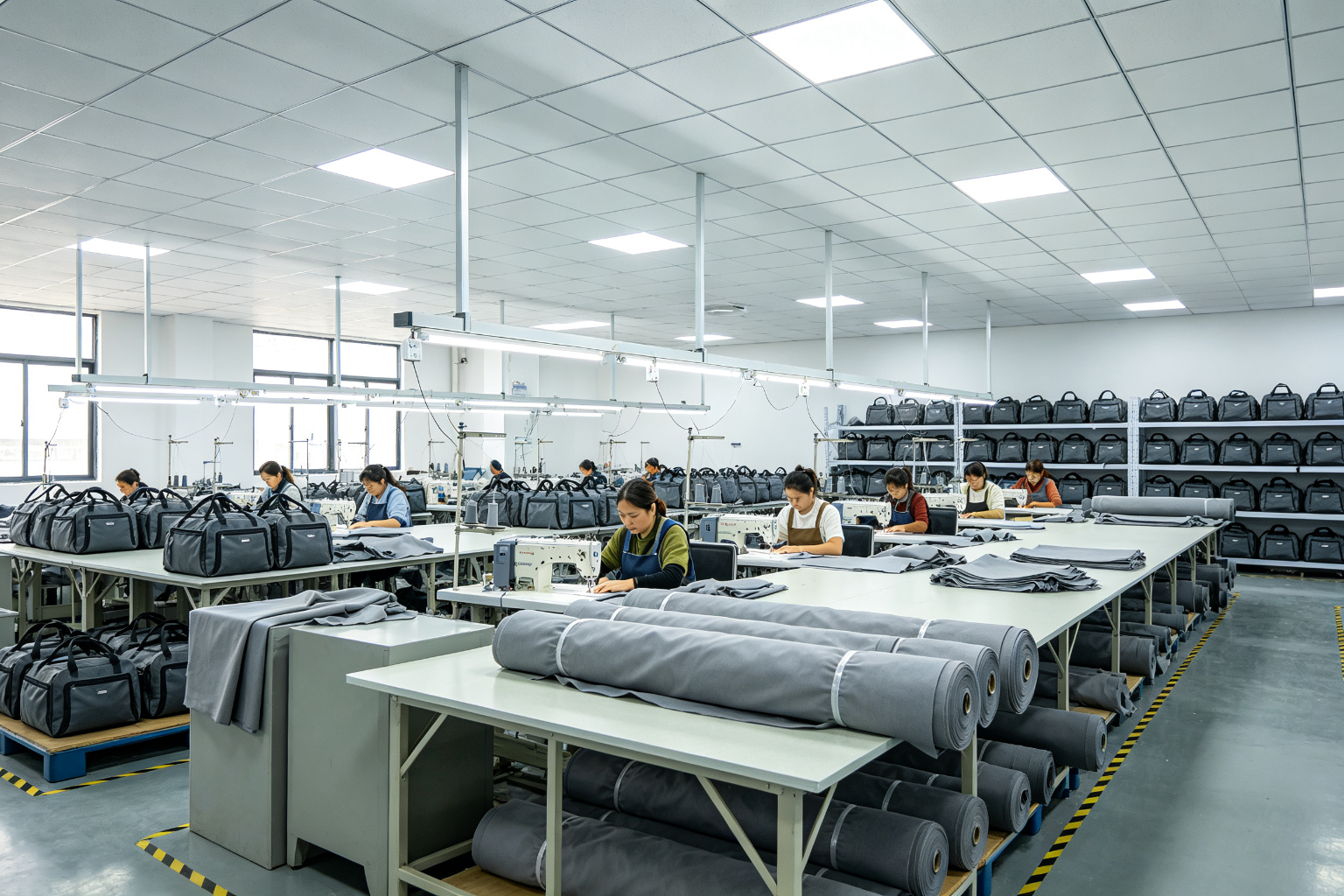
Our Dongguan duffel bag line: multiple sewing workstations, charcoal grey recycled-polyester fabric rolls, and finished bags staged for packaging. 4,200 pieces produced across 18 days.
Frequently Asked Questions
What is recycled-polyester fabric and is it as durable as virgin polyester?
Direct Answer: RPET is polyester spun from recycled plastic bottles and is 95-100% as durable as virgin polyester at the same denier — 600D recycled matches 600D virgin on tensile strength and abrasion. It cuts fiber-production energy 59%, water 32%, and CO2 68%.
- Durability vs Virgin: 95-100%
- 600D Tensile Strength: 1,500-1,800N
- Energy Saving: 59%
- CO2 Saving: 68%
RPET (recycled polyethylene terephthalate) is polyester made from recycled plastic bottles rather than virgin petroleum. Bottles are cleaned, shredded, melted, and spun into fiber, then woven into fabric. RPET is 95-100% as durable as virgin polyester when the same denier and weave are used — 600D recycled has the same tensile strength (1,500-1,800N), abrasion resistance, and UV stability as 600D virgin polyester. The main difference is environmental: producing 1kg of RPET fiber uses 59% less energy, 32% less water, and emits 68% less CO2 than virgin polyester. In this case study, we used 600D recycled (100% recycled share, GRS-certified) for the duffel body and 300D recycled for the lining. The client's customers have used the bags weekly for 5 months with zero durability complaints — no tears, no seam failures, no color fading. RPET is not a downgrade from virgin polyester; it's an environmental upgrade at negligible performance cost.
What does GRS certification mean for recycled bags?
Direct Answer: GRS, certified by Control Union, verifies at least 20% recycled share with full chain-of-custody traceability and factory social/environmental standards. This duffel used 100% reclaimed body fabric and lining, audited by Control Union with a complete CoC trail.
- Minimum recycled share: 20%
- Certifier: Control Union
- Traceability: Chain of Custody
- This Product: 100% reclaimed body fabric + lining
GRS (Global Recycled Standard) is a third-party certification by Control Union that verifies: (1) the product contains a minimum of 20% recycled share (most certified products use 100%), (2) the recycled share is traceable through the entire supply chain (bottle collection → flake → fiber → fabric → bag), (3) the factory meets social and environmental standards (fair labor, no child labor, safe working conditions), and (4) restricted chemicals are within limits. For a bag to carry the GRS logo, the factory must be GRS-certified and maintain a Chain of Custody (CoC) — tracking the recycled material from input to output. The GRS approval for this case study confirmed 100% post-consumer share in the body fabric and 100% RPET in the lining, audited by Control Union with the CoC document trail. GRS certification matters for brands selling to EU and US consumers because it's the most recognized recycled-content standard — it's verifiable, audited, and carries the logo that consumers recognize. The certification process takes 2-3 months for the factory and costs $0.05-$0.15 per unit in auditing and CoC overhead.
How much does a custom reclaimed-fabric duffel bag cost to manufacture?
Direct Answer: Custom reclaimed-fabric duffels cost $5.50-$15.00 FOB per unit for 2,000-10,000 pieces; recycled-polyester fabric adds 5-15% over virgin. This 4,000-piece 45L order (600D recycled, shoe compartment, padded strap, trolley sleeve) came to $7.20 FOB per unit.
- FOB Unit Range: $5.50-$15.00
- recycled-polyester fabric Premium: 5-15%
- This Order: $7.20 FOB / unit
- Quantity: 4,000 pcs, 45L
Custom reclaimed-fabric duffel bags typically cost $5.50-$15.00 FOB Shenzhen per unit for orders of 2,000-10,000 pieces, depending on size, fabric weight, and features. Basic 30L duffels with 300D recycled, simple zip opening, and carry webbing start at $5.50-$8.00; mid-range 45L duffels with 600D recycled, padded carry webbing, shoe compartment, and mesh pockets cost $7.00-$10.00; premium 60L+ duffels with 600D recycled water-resistant coating, multiple compartments, reinforced base, and trolley sleeve cost $10.00-$15.00. recycled-polyester fabric costs 5-15% more than virgin polyester (the recycling process adds cost), but the premium is offset by the sustainability story brands can tell. In this case study, the 4,000-piece order for a 45L duffel (600D reclaimed body fabric, 300D reclaimed lining, dedicated ventilated shoe compartment, padded carry webbing, 2 zipped mesh pockets, trolley sleeve) came to $7.20 FOB per unit. The client sells it at C$89 retail — a 9x markup on the landed cost of about C$12.
What is the typical production timeline for custom reclaimed-fabric duffel bags?
Direct Answer: A 2,000-10,000 piece reclaimed-fabric duffel order takes 28-40 days from sample approval to FOB. This 4,000-piece order delivered in 33 days after one strap-width revision — while a prior supplier had promised 30 and delivered 45 due to out-of-stock RPET.
- Total (approval to FOB): 28-40 days
- Sample Development: 7-10 days
- Bulk Production: 15-20 days
- Actual Delivery: 33 days
For a custom reclaimed-fabric duffel bag order of 2,000-10,000 pieces with 600D recycled-polyester fabric, dedicated shoe compartment, and custom logo printing, the total timeline from sample approval to FOB shipment is typically 28-40 days. Sample development takes 7-10 days (blank sample 3-4 days, printed sample 4-6 days), pre-production (fabric sourcing, die making, zipper and hardware sourcing) takes 5-7 days, bulk production runs 15-20 days (cutting, sewing, lining insertion, hardware assembly), and final QC plus packaging takes 4-6 days. In this case study, we delivered in 33 days (FOB shipment on Day 29 from sample approval) including one round of sample revisions (the client requested a wider carry webbing pad — we increased from 5cm to 7cm for better weight distribution on heavy gym loads). The client's previous supplier had promised 30 days but delivered in 45 days because their recycled-polyester fabric supplier was out of stock (they hadn't pre-ordered) and they had to wait 10 days for a new fabric batch.
What is a normal fault rate for reclaimed-fabric duffel bag production?
Direct Answer: A well-run 1,000+ piece reclaimed-fabric duffel line should stay under 1.0% fault rate at AQL 2.5, led by stitching (0.3-0.5%). This 4,000-piece run finished at 0.8% (32 pieces), including 9 water-stain fabric defects traced to a leaky storage area.
- Target: Below 1.0%
- Top Defect: Stitching 0.3-0.5%
- Actual Rate: 0.8% (32/4,000)
- Post-Repair: 0% shipped defects
A well-managed reclaimed-fabric duffel bag production run of 1,000+ pieces should achieve a fault rate below 1.0% under AQL 2.5 inspection standards. The most common defects are: (1) stitching defects (0.3-0.5%) including skipped stitches, loose thread ends, and misaligned zipper; (2) fabric defects (0.2-0.4%) including color shading between batches, weave defects, and water stain marks on recycled-polyester fabric; (3) hardware defects (0.1-0.3%) including broken zipper sliders, weak buckles, and misaligned D-rings; (4) dimension variation (0.1-0.2%) including bags outside the ±3% size tolerance. In this case study, the final fault rate was 0.8% — 32 pieces out of 4,000 inspected, with 15 stitching defects, 9 fabric defects, 6 hardware defects, and 2 dimension issues. All 32 defective pieces were repaired or replaced before shipment, resulting in a 0% final fault rate after repair. The 9 fabric defects (water stain marks) were traced to a batch of recycled-polyester fabric stored near a leaky roof — we re-ordered that batch and improved fabric storage.