
Nine out of ten buyers we work with write "AQL 2.5" into their purchase order and then cannot explain what the 2.5 means. They trust the factory to inspect its own goods, sign off on the shipment, and then discover defects when the container arrives. AQL is not a vague quality promise. It is a statistical sampling standard with exact sample sizes, exact pass/fail numbers, and a defect classification system that most buyers never learn. This guide explains how AQL actually works for custom bags, what counts as a critical versus major versus minor defect on a bag, how many pieces to pull from a 5,000-piece order, and what to do when the inspection fails. It is written from the QC floor at Dongguan Merris Bag Co., Ltd., where we run inline and final inspection on every production line. If you are evaluating factories, our factory evaluation checklist covers how to verify a supplier's QC capability before you place an order.
What Is AQL and Why It Matters for Bag Manufacturing
AQL stands for Acceptable Quality Limit. It is the maximum percentage of defective units that a batch can contain and still be considered acceptable to the buyer. The standard most factories and inspectors use is ANSI/ASQ Z1.4 in the US, which is identical to ISO 2859-1 internationally. The same tables, the same sample sizes, the same pass/fail numbers.
The reason you use AQL instead of inspecting every piece is practical. A 5,000-piece backpack order cannot be 100% inspected by one person in a day. Even if you could, inspectors get fatigued after several hundred pieces and their miss rate goes up. Statistical sampling gives you a mathematically defensible conclusion about the whole batch by checking a carefully calculated subset. The key word is carefully calculated. The sample size is not "a few hundred" or "whatever the inspector has time for." It comes from a table based on the total order quantity and the inspection level you choose.
Three numbers decide everything in an AQL inspection: the lot size (total pieces in the order), the inspection level (almost always General Level II for bags), and the AQL value (2.5 for major defects, 4.0 for minor). Put those three into the table and you get an exact sample size and exact acceptance and rejection numbers. There is no judgment call in the sampling. The judgment call is in classifying the defects, which is where most inspections go wrong.
AQL Levels Explained: 2.5, 4.0, 6.5 for Bags
Not every part of a bag gets the same AQL level. A broken zipper on a backpack is not the same risk as a loose thread on the inside of a cosmetic bag. Serious buyers assign different AQL levels to different defect categories, and they write all of them into the purchase order.
| AQL Level | What It Means | Bag Application | Our Factory Default |
|---|---|---|---|
| AQL 0.65 | Very strict, less than 0.65% defects allowed | Critical safety items: children's bag small parts, strap load-bearing joints, food-contact cooler liners | Used only for safety-critical components |
| AQL 1.0 | Strict, premium quality standard | High-end leather goods, luxury brand flagship products, small-batch premium lines | Available for premium orders at higher cost |
| AQL 2.5 | Industry standard for finished goods | Major defects on all bag types: zippers, stitching, dimensions, print, hardware function | Default for all major defects |
| AQL 4.0 | Moderate, for less critical issues | Minor defects: loose threads, small scratches, slight color variation in lining | Default for all minor defects |
| AQL 6.5 | Relaxed, for non-product items | Packaging, hang tags, outer box printing, poly bag clarity | Default for packaging and accessories |
The mistake we see most often is a buyer who writes "AQL 2.5" in the PO and means it for everything. That is too strict for minor defects and too loose for critical safety items. A loose thread is not a 2.5 defect. A child's backpack buckle that could come off is not a 2.5 defect either, it is zero tolerance. Specify the level per category and the factory knows exactly what you will accept. For context on where quality control fits into the total price, our bag cost breakdown shows that QC typically runs 3-5% of the unit cost.
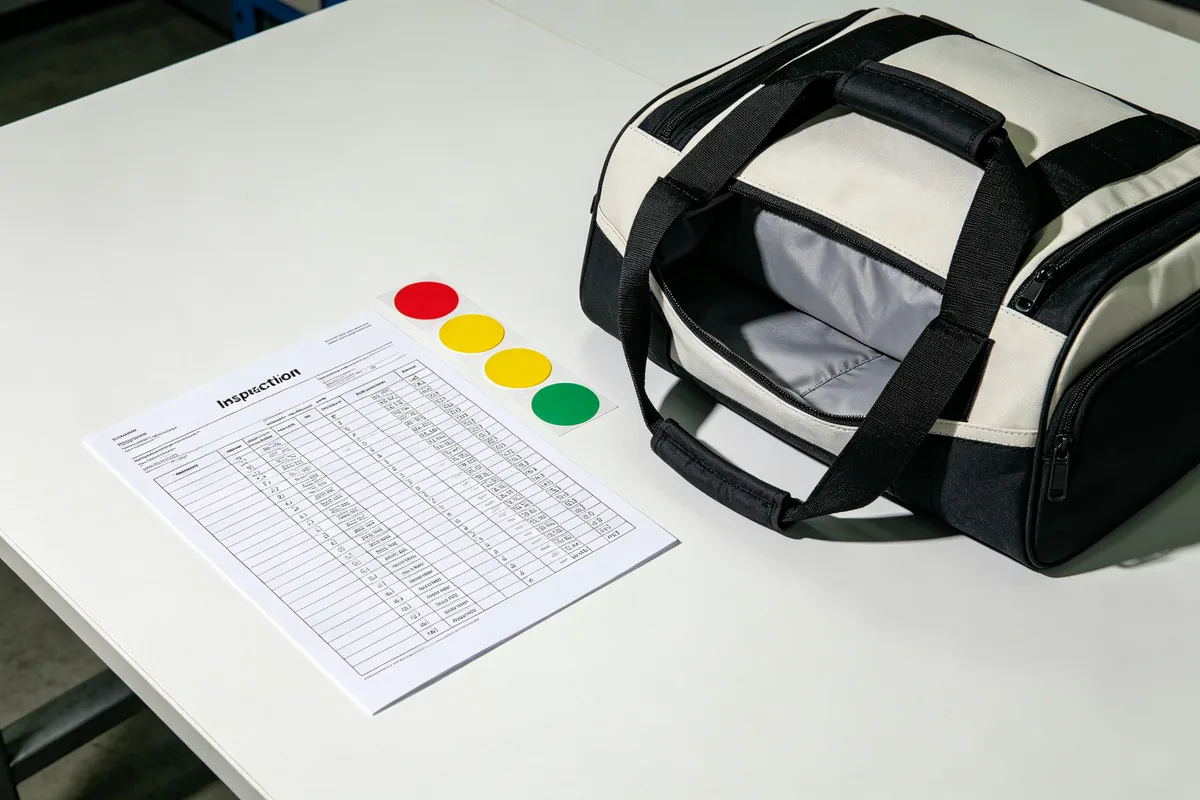
AQL levels are assigned per defect category, not per product. A single bag can have a 2.5 major defect and a 4.0 minor defect at the same time.
Bag Defect Classification: Critical, Major, Minor
This is the section that separates a real inspection from a checkbox exercise. The AQL table tells you how many pieces to check and how many defects fail the lot. It does not tell you what counts as a defect. That is defined by the buyer, and if you do not define it, the factory will define it for you, and they will define it generously.
Every defect on a bag falls into one of three categories. The category decides the AQL level that applies, which decides the pass/fail number. Classify wrong and you either reject good product or accept bad product.
| Category | Definition | Bag-Specific Examples | AQL Level |
|---|---|---|---|
| Critical | Could cause injury, illness, or legal liability. Zero tolerance. | Small parts on children's bags that detach and pose choking risk; strap or handle attachment that breaks under rated load; sharp metal edges or points exposed; toxic material above regulatory limits; mold or contamination in food-contact cooler liners | 0 (any found = fail) |
| Major | Affects function, durability, or appearance enough that a retail customer would return the bag. | Zipper jams, misses teeth, or cannot close; broken or cracked buckle; print or embroidery misaligned by more than 5mm; fabric hole or tear; dimension out of tolerance by more than 1cm; large area of stitching missing or broken; lining color visibly different from approved sample; hardware rust or corrosion; strap attachment loose | 2.5 |
| Minor | Does not affect function or durability. Only a careful buyer would notice. Unlikely to cause a return. | Loose thread ends not trimmed; stitch count slightly off by 1-2 stitches per inch; print offset under 2mm; small surface scratch on hardware; slight wrinkle in packaging; small mark on inside lining not visible in normal use; poly bag slightly cloudy | 4.0 |
One nuance that trips up new buyers: the same physical issue can be a different category depending on the product. A 3mm print offset on a $5 promotional tote bag is minor. The same 3mm offset on a $50 premium leather brand bag is major, because the brand's retail customer expects perfect alignment and will return it. The defect classification should match your market and price point, not a generic list you found online.
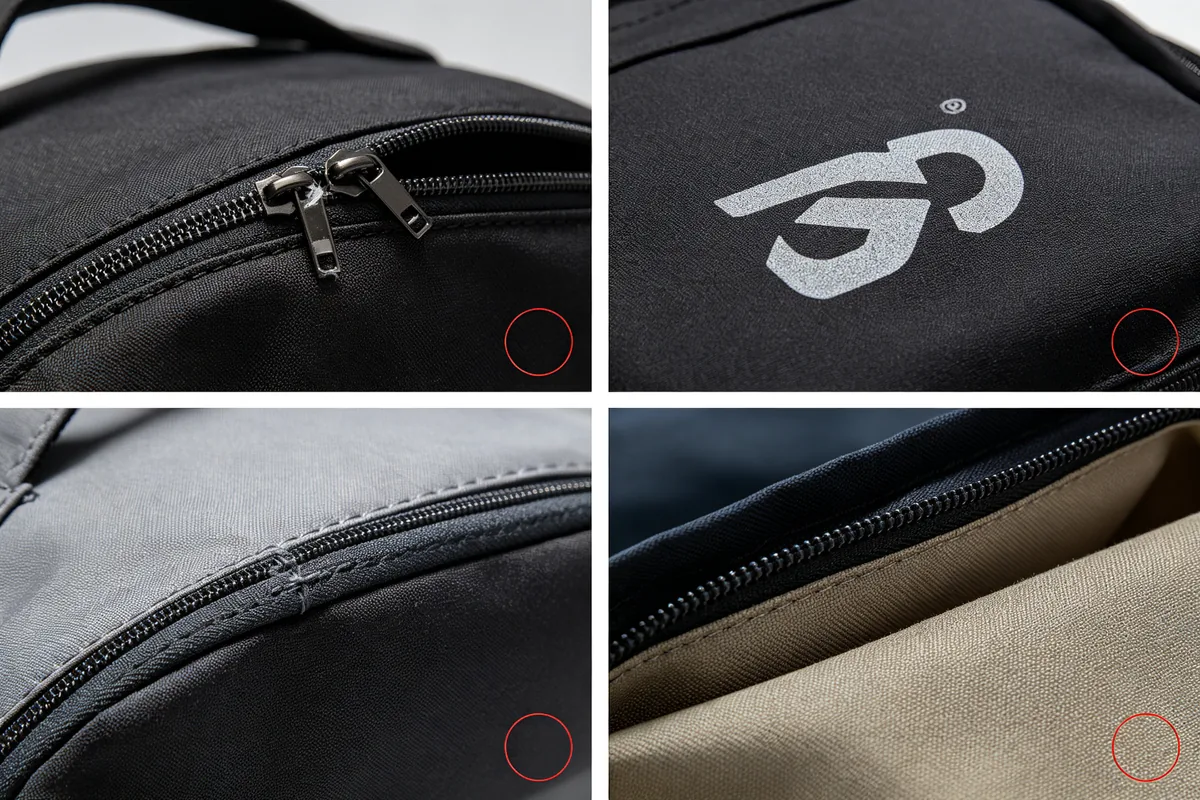
Four common bag defects. The zipper and the stitching are major defects. The print offset and lining shade are minor unless they exceed your tolerance threshold.
The Three Inspection Stages
Most buyers only know about the final inspection after production is done. That is the most expensive stage to find a problem, because everything is already made and packed. Professional buyers use three inspection stages, and the first two are where you save real money.
1. Pre-Production Inspection (PPI)
This happens before cutting, when the materials arrive at the factory. The inspector checks that the fabric matches the approved swatch in color, weight, and texture. The zipper is the right model and length. The hardware matches the approved sample in plating color and strength. The lining is the right material and color. The labels and hang tags are correct. This sounds basic, but we have seen a $20,000 order produced in the wrong shade of navy because nobody checked the fabric roll against the approved swatch before cutting. Catching that at PPI costs nothing. Catching it at final inspection means the whole batch is wrong.
2. During-Production Inspection (DUPRO)
This happens when 20-30% of the order is assembled. The inspector goes to the sewing line and checks the first finished units against the approved sample. Are dimensions correct? Is the stitching consistent? Is the print aligned? Is the lining the right color? The goal is to catch a process problem before it becomes 5,000 identical problems. If one sewing line is using the wrong thread tension, you find it at DUPRO and fix it after 500 pieces, not after 5,000. This is the stage most buyers skip, and it is the one with the highest return on time invested.
3. Final Random Inspection (FRI)
This is the one everyone knows. Production is 100% complete, at least 80% is packed into export cartons, and the inspector randomly samples finished units from the cartons. This is the go/no-go gate for shipment. If FRI passes, the goods ship. If FRI fails, you negotiate rework, concession, or rejection. The problem with relying only on FRI is that by this point, every defect is already sewn into every bag. The only fix is rework or scrap, both of which cost time and money. FRI is necessary but it is the last line of defense, not the only one.
| Stage | Timing | What It Checks | Cost to Fix a Problem Here | We Recommend |
|---|---|---|---|---|
| Pre-Production (PPI) | Before cutting, materials in warehouse | Fabric, zipper, hardware, lining, labels against approved specs | Lowest: reorder material, no labor wasted | Every order over $3,000 |
| During-Production (DUPRO) | 20-30% assembled, on the sewing line | First finished units vs approved sample, process consistency across lines | Low: fix process, rework a few hundred units | Every new style or new factory |
| Final Random (FRI) | 100% complete, 80% packed | Random sample of finished, packed units for all defect categories | Highest: full rework, scrap, or air freight to recover schedule | Every order, always |
For the full production timeline and where each inspection stage fits, our custom bag production process walks through every step from spec sheet to delivered goods.
How to Perform a Final Random Inspection (FRI) on Bags
If you only do one inspection, it is the FRI. Here is exactly how it works, step by step, with the numbers you will actually use.
Confirm the lot size
The lot size is the total number of finished units in the order, not the number of cartons and not the number the factory says is "ready." If your PO is 5,000 pieces and the factory produced 4,980, the lot size is 4,980. Use the actual count, not the PO quantity.
Look up the sample size in the AQL table
Using ANSI/ASQ Z1.4 General Inspection Level II, find the lot size range and read across to the sample size code letter, then to the sample size. These are the numbers you will actually use for bag orders:
| Lot Size (pieces) | Sample Size | AQL 2.5 Ac / Re | AQL 4.0 Ac / Re |
|---|---|---|---|
| 91 - 150 | 20 | 1 / 2 | 2 / 3 |
| 151 - 280 | 32 | 2 / 3 | 3 / 4 |
| 281 - 500 | 50 | 3 / 4 | 5 / 6 |
| 501 - 1,200 | 80 | 5 / 6 | 7 / 8 |
| 1,201 - 3,200 | 125 | 7 / 8 | 10 / 11 |
| 3,201 - 10,000 | 200 | 10 / 11 | 14 / 15 |
| 10,001 - 35,000 | 315 | 14 / 15 | 21 / 22 |
For a 5,000-piece order, you inspect 200 pieces. For major defects at AQL 2.5, you accept if you find 10 or fewer, reject if you find 11 or more. For minor defects at AQL 4.0, accept at 14 or fewer, reject at 15 or more. These numbers are not negotiable and not approximate. They are the standard.
Randomly sample from the cartons
Pull samples from different cartons, different levels of the stack, and different areas of the warehouse. Do not let the factory hand you a carton and say "this one is representative." That is not random. The inspector should select cartons by a random method (drawing numbers, or using every Nth carton) and open them on the inspection table. The factory should not know which cartons will be checked before the inspector arrives.
Inspect each piece and classify every defect
Go through each sampled bag using the 25-point checklist in the next section. Every defect you find gets classified as critical, major, or minor and counted separately. Important: if one bag has one major defect and two minor defects, you count one major and two minor in the tally. You do not count the bag as "one defective unit." AQL counts defects, not defective units, although in practice each unit usually has at most one defect of a given category.
Compare counts against acceptance numbers and decide
After all 200 pieces are inspected, you have three numbers: critical defects, major defects, minor defects. Compare each against its own acceptance number. Critical is always zero tolerance, so any critical defect fails the lot immediately. Major must be at or below 10. Minor must be at or below 14. If all three categories pass, the lot passes. If any one category fails, the lot fails. There is no averaging across categories.

Random sampling means pulling from different cartons and different stack levels. A factory that offers you "the best carton" is not offering random sampling.
25-Point Bag Inspection Checklist
This is the checklist our QC team uses on every final inspection. It is organized by the part of the bag you check, not by defect severity. Run through it on every sampled unit. The tolerance numbers are our defaults for mid-market bags; tighten them for premium product, loosen them for promotional goods.
Appearance (6 points)
- Overall shape: Bag holds its intended shape when filled, not lopsided or collapsed. Compare to approved sample.
- Fabric color: Match approved swatch under natural daylight. No shade variation between panels on the same bag.
- Print / embroidery: Position within 2mm of spec. No smudging, fading, or missing elements. Logo centered on intended panel.
- Cleanliness: No dirt, oil marks, pen marks, or glue residue on exterior or interior.
- Odor: No strong chemical smell, mold, or mildew. New fabric smell is acceptable; solvent smell is not.
- Packaging: Correct poly bag, hang tag position, and carton labeling. No crushed or wet cartons.
Dimensions (3 points)
- Length, width, height: Each within +/- 0.5cm (5mm) of spec. Measure at the widest point, not the seam.
- Strap / handle length: Within +/- 1cm of spec. Both straps on a backpack match within 0.5cm.
- Zipper length: Matches spec within +/- 2mm. Zipper opens fully without stopping short.
Stitching (4 points)
- Stitch density: 7-9 stitches per inch (2.5cm) on all main seams. Count with a stitch ruler.
- Thread ends: All loose threads trimmed. No thread tails longer than 3mm on exterior.
- Stitch tension: No loose loops, no pulled fabric causing puckering or wavy seams. Seams lie flat.
- Reinforcement: Backtack at all stress points (strap attachments, zipper ends, handle connections). No missing reinforcement.
Hardware (4 points)
- Zipper function: Open and close 5 times smoothly. No jamming, no missing teeth, no fabric caught in slider.
- Buckle / snap function: All buckles clip and release with firm tension. No cracked or deformed plastic. Magnetic snaps align and hold.
- D-ring / O-ring / slider: Securely attached, not loose. No sharp edges. Correct metal finish (matte, shiny, gunmetal) matching sample.
- Hardware condition: No scratches, rust, oxidation, or plating defects on visible hardware. Pull tabs present and secure.
Function (4 points)
- Zipper endurance: 5 full open-close cycles with no issue. Slider moves both directions without force.
- Strap / handle pull: Firm hand pull on each strap and handle. No movement at attachment point, no creaking, no loose stitching.
- Pocket function: Every pocket, sleeve, and compartment opens and closes as designed. No sewn-shut pockets.
- Closure system: Velcro aligns and holds; drawstrings pull and release; buttons or snaps fasten correctly.
Lining (2 points)
- Lining material / color: Matches approved sample. No wrong fabric, no visible shade difference between lining pieces.
- Lining construction: No holes, tears, or missed seams inside. Interior pocket stitching secure. No loose lining that catches on items.
Labels (2 points)
- Main label / woven label: Correct text, correct position, securely sewn. No upside-down or crooked labels.
- Care label / hang tag: Correct content (material, country of origin, care instructions), correct barcode or QR code if required, scannable.
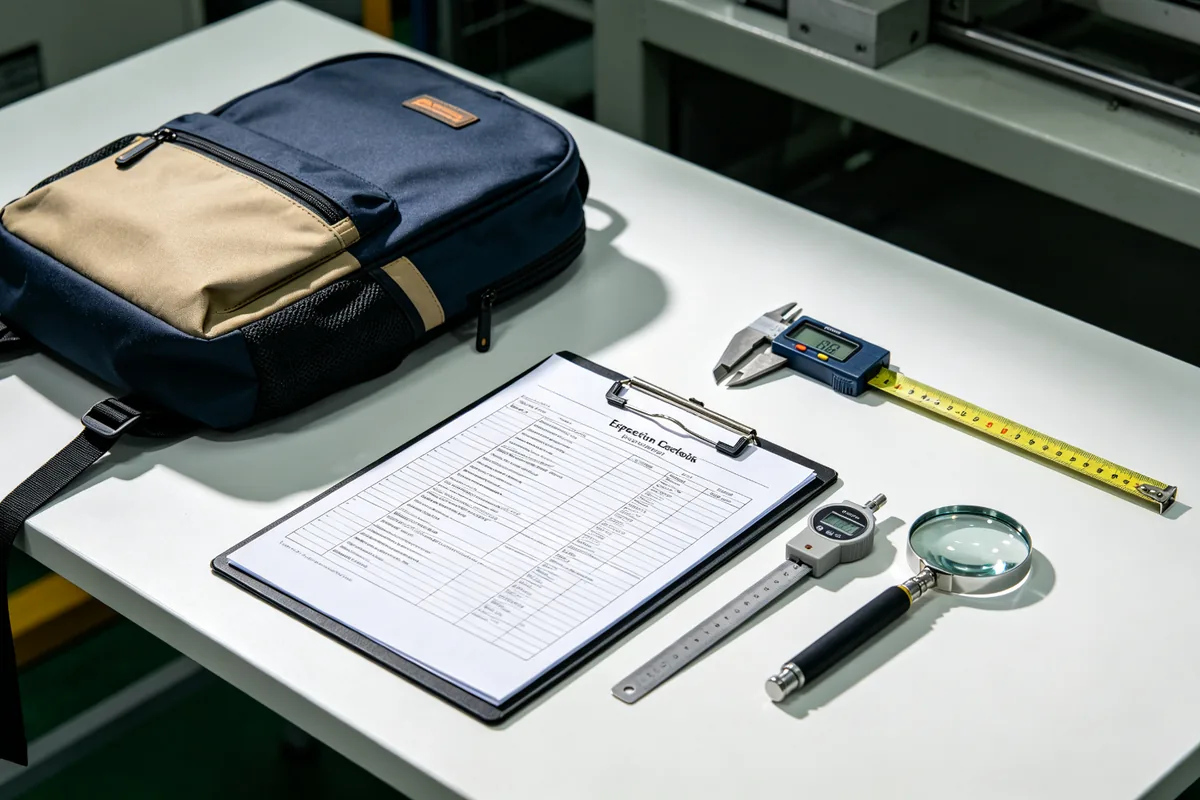
The tools for a proper bag inspection are simple: a caliper for dimensions, a tape measure for straps, a stitch ruler for density, and a magnifying glass for print detail.
Common Bag Defects and How to Spot Them
These are the six defects we find most often on final inspection, and the ones that cause the most disputes between buyer and factory. Learn to identify them on sight and you will know whether your inspector is doing the job or just signing the form.
1. Zipper jamming or missing teeth
The most common functional defect on bags. Causes include using a zipper gauge that is too light for the fabric thickness, sewing the zipper too tight so the tape pulls inward, or a slider that is slightly bent. To spot it, open and close the zipper five times on every sampled bag. If it catches even once, that is a major defect. Do not accept "it just needs breaking in" as an explanation. A zipper that catches at inspection will catch for the end customer.
2. Uneven stitching or skipped stitches
Caused by a dull needle, worn feed dogs on the sewing machine, or an operator running too fast. To spot it, count stitches per inch with a stitch ruler along every main seam. Standard for bags is 7-9 stitches per inch. If you see 5 stitches in one inch and 11 in the next, that is uneven stitching and it is a major defect if it is on a load-bearing seam. Skipped stitches (a gap where the thread did not catch) are always major because they create a weak point that will tear under load.
3. Print misalignment or smudging
Caused by the screen printing frame not registering correctly, ink viscosity wrong, or curing temperature too low. To spot it, measure the distance from the print edge to the reference seam or panel edge with a ruler. Our tolerance is +/- 2mm for mid-market bags. If the logo is 5mm off-center, that is a major defect. Smudging or faded ink is major if it is visible from arm's length. Always check print under natural light, not under the factory's fluorescent lights which can hide color issues.
4. Fabric color difference (shade variation)
Caused by fabric from different dye lots being used in the same order, or the factory cutting panels from different rolls without checking shade. To spot it, compare the front panel to the back panel, and compare one bag to another from the same order. A visible shade difference between panels on the same bag is a major defect. A shade difference between bags in the same order is also major, because the retail customer will see two different colors on the shelf. This is why PPI matters: checking the fabric roll shade before cutting prevents the whole problem.
5. Stitching puckering or wavy seams
Caused by thread tension too tight, or the fabric being stretched as it goes through the sewing machine. To spot it, look at the seam from the side. A good seam lies flat. A puckered seam has small waves or ripples along the stitch line. Pull the seam gently: if it flattens out when pulled, it is tension puckering and may relax over time (minor). If it stays wavy even when pulled, the fabric was stretched during sewing and it is permanent (major). Puckering on a load-bearing seam is always major because it indicates uneven stress distribution.
6. Hardware scratches or rust
Caused by hardware not being protected during production and shipping, or poor electroplating quality. To spot it, run your finger along every visible metal piece and look at it under light. A scratch you can feel is major. Surface rust or oxidation is major because it will worsen over time and the customer will see it. This defect is often missed because inspectors focus on the bag body and skip the hardware. Check every buckle, every D-ring, every zipper slider, every pull tab.
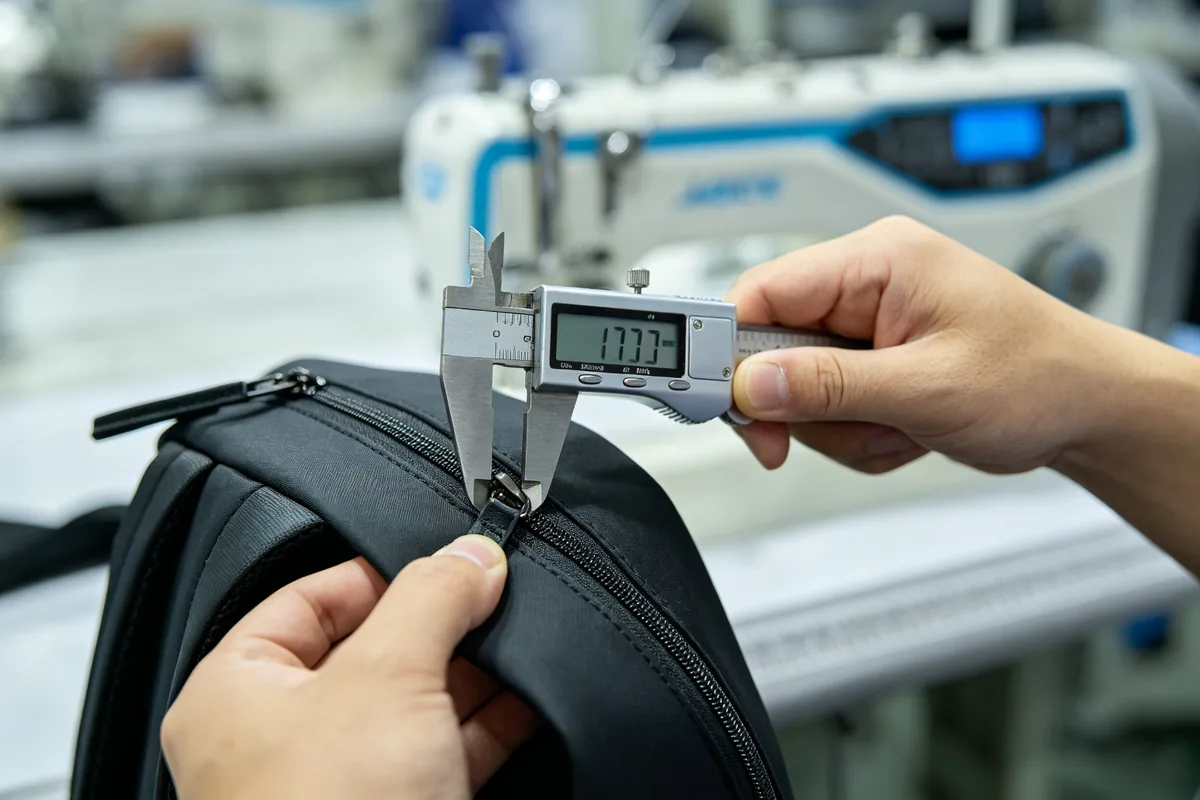
Measuring with a caliper removes the argument. "It looks about right" is not an inspection. A dimension within tolerance or out of tolerance is.
For the full sourcing journey and where inspection fits into the timeline, our sourcing custom bags from China guide covers quality control as the final gate before shipment.
How to Handle a Failed Inspection
A failed inspection is not a crisis if you have a process. It is a crisis if you have no contract terms and no plan. Here is how we handle failures on our own production lines, and how we advise buyers to handle them with any factory.
Scenario 1: Minor defects slightly over the limit
If the minor defect count is 16 when the limit is 15, and there are no major or critical defects, you have a negotiation, not a rejection. Options: accept the shipment with a price concession (typically 2-5% of the order value, depending on defect severity), or require the factory to sort and rework the minor issues before shipment. A price concession is faster. Sorting is more thorough. For minor defects only, either is acceptable. Get the agreement in writing before the goods ship.
Scenario 2: Major defects over the limit
If major defects exceed the rejection number, the lot fails and must be reworked. The factory is responsible for the rework cost and for any schedule delay. Do not accept a factory offer to "just look at the rest and they are fine." The sample told you the lot has a problem. Rework means the factory opens every carton, checks every piece, repairs or replaces every defective unit, and then you schedule a re-inspection. The re-inspection uses a fresh sample and fresh pass/fail numbers. A reworked lot that passes re-inspection can ship. A reworked lot that fails again goes to scenario 3.
Scenario 3: Critical defects or repeated failure
Any critical defect found in the sample means the lot is rejected immediately. There is no rework option for a child's bag with a detachable small part, or a food-contact cooler liner with contamination. The goods must be replaced or scrapped. Similarly, if a lot fails re-inspection after rework, the factory has demonstrated it cannot fix the problem. Reject the lot, demand a refund or replacement production, and reconsider whether this factory should get future orders. In all cases, document everything: photos of every defect, the signed inspection report, the factory's written response. Paperwork is what gives you leverage in a dispute.
What to do in the first hour after a failed inspection
- Do not negotiate on the factory floor. Emotions run high and the factory has home advantage. Thank them, leave, and negotiate from your office or by email.
- Send the written report the same day. Photos, defect counts by category, the AQL table reference, and the pass/fail conclusion. A verbal "it failed" is not evidence.
- State your required action in writing. "We require full rework of major defects and re-inspection before shipment" is clear. "Let's figure this out" is not.
- Do not release the balance payment. If your payment terms are 30% deposit / 70% before shipment, hold the 70% until the re-inspection passes. This is your only leverage.
- Set a deadline. "Rework must be completed and re-inspection passed by [date], or we will require a full refund of the deposit." Deadlines create action.
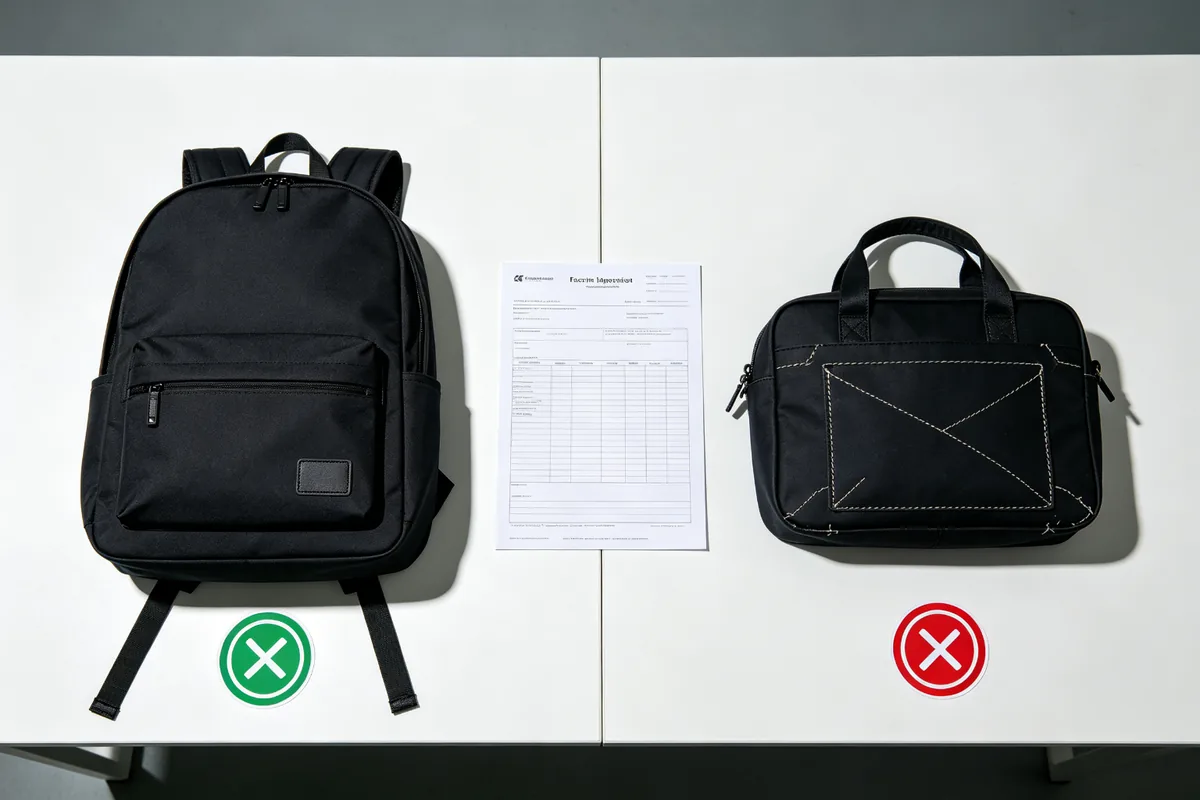
A failed inspection is a business decision, not a personal argument. Have the defect photos, the AQL numbers, and your required action in writing before you call the factory.
Writing AQL into Your Purchase Order
None of the above works if it is not in the purchase order. A factory that hears "AQL 2.5" for the first time at final inspection will say "we never agreed to that." Write the inspection terms into the PO before production starts, and the factory signs it. Here is the clause we recommend, ready to copy into your next PO:
Five things must be in that clause or it does not work: the AQL level per defect category, the inspection standard (ANSI Z1.4 / ISO 2859-1), the inspection stages you require, what happens on failure (rework cost and re-inspection), and who pays for third-party inspection on a failed lot. If any of those is missing, the factory has room to argue. If all five are there and signed, there is no argument.
Cost of Quality: What Inspection Adds to Your Order
Quality control is not free, but it is cheap compared to the alternative. Here is what you should budget.
Factory internal QC is included in the unit price. Every legitimate factory has inline QC and a final QC check, and that cost is built into their quotation. You are not paying extra for it, but you are also not getting an independent check. The factory is checking its own work, and every factory has pressure to ship on time, which creates pressure to pass borderline product.
Third-party inspection costs $150-$300 per man-day for a local inspector in China, or $250-$450 per man-day for a branded firm like SGS, Bureau Veritas, or Intertek. One man-day covers one FRI on up to about 5,000 pieces. A PPI or DUPRO is usually half a day. For a $20,000 order, one FRI at $300 is 1.5% of the order value. That is cheap insurance against a $20,000 problem.
The cost hierarchy that every buyer should internalize: prevention cost (PPI and DUPRO, catching problems early) is less than appraisal cost (FRI, checking finished goods), which is less than internal failure cost (rework and scrap at the factory), which is less than external failure cost (customer returns, chargebacks, brand damage after the goods are sold). Spending $150 on a PPI that catches the wrong fabric before cutting can save you $15,000 in rework and air freight. The math is not close. See our bag cost breakdown for where QC fits into the total unit price.
Bottom Line
AQL inspection is three things working together: exact sample sizes from a standard table, defect classification that is specific to bags and written into your PO, and three inspection stages that catch problems at the cheapest point. The most common mistake is writing "AQL 2.5" and stopping there. That tells the factory nothing about what counts as a defect, nothing about which stages you will inspect, and nothing about what happens on failure. Write the full clause, use the 25-point checklist on every sampled bag, and never release a failed lot on a verbal promise. A factory that can document its weld parameters, run inline checks at set intervals, and reproduce a failed batch's settings to trace root cause is a factory that manages quality. A factory that says "our QC is fine" without showing you the process is a factory you should inspect every time. At Merris, we run PPI, DUPRO, and FRI on every production line and we share the inspection report with every buyer. Send us your spec and we will show you the QC report from your first sample run.
Get a Factory-Level QC Report on Your Next Order
PPI, DUPRO, and FRI on every production line. 13 years of custom bag manufacturing, aligned with BSCI social-compliance and ISO 9001 practices. Send your spec and get an honest quotation with QC stages included within 8 Hours.
Send Your SpecFrequently Asked Questions
What is AQL 2.5 in bag manufacturing?
Direct Answer: AQL 2.5 means no more than 2.5% of a batch may carry major defects for the lot to pass — the most common acceptance level for finished bags. On a 5,000-piece order at inspection level II, you sample 200 units and accept up to 10 major defects.
- AQL Level: 2.5 major defects
- Inspection Level: General II
- Sample Size (5,000pcs): 200 units
- Accept / Reject: 10 / 11 major defects
AQL 2.5 means that in a batch of bags, no more than 2.5% of units may contain major defects for the lot to pass inspection. It is the most commonly used acceptance level for finished bag products. For a 5,000-piece order at general inspection level II, this translates to inspecting 200 samples with a maximum of 10 major defects allowed (acceptance number 10, rejection number 11).
How many samples should I inspect for a 5000-piece bag order?
Direct Answer: For a 5,000-piece order at general inspection level II, code letter L requires 200 samples. At AQL 2.5 you accept 10 major defects; at AQL 4.0 for minors you accept 14; critical defects have zero tolerance and fail the lot immediately.
- Sample Size: 200 pcs
- Major Defects (AQL 2.5): Accept 10 / Reject 11
- Minor Defects (AQL 4.0): Accept 14 / Reject 15
- Critical Defects: Zero tolerance
For a 5,000-piece order using AQL general inspection level II, the sample size code letter is L, which requires 200 samples. At AQL 2.5 for major defects, the acceptance number is 10 and rejection number is 11. At AQL 4.0 for minor defects, the acceptance number is 14 and rejection number is 15. Critical defects have zero tolerance, meaning any critical defect found fails the lot.
What is the difference between major and minor defects in bags?
Direct Answer: A major defect harms function, durability, or appearance enough to trigger a return — a jammed zipper, broken strap, hole, or a print misaligned over 5mm. A minor defect only shows under close inspection, like a loose thread or sub-2mm print offset. Majors use AQL 2.5; minors use 4.0.
- Major Defect Example: Jammed zipper, broken strap
- Minor Defect Example: Loose thread, <2mm offset
- Major AQL: 2.5
- Minor AQL: 4.0
A major defect affects the bag's function, durability, or appearance enough that a customer would return it. Examples include a zipper that jams or breaks, a broken strap attachment, a hole in the fabric, or a print that is visibly misaligned by more than 5mm. A minor defect does not affect function and would only be noticed by a very careful buyer. Examples include a loose thread, a slight print offset under 2mm, or a small surface scratch on hardware. Major defects use AQL 2.5, minor defects use AQL 4.0.
Should I use a third-party inspector or the factory's own QC?
Direct Answer: Use both: factory QC controls the line during production, but hire an independent third-party inspector (SGS, Bureau Veritas, Intertek) for the final random check on orders over $5,000. The $150-$300 per man-day cost is trivial next to a bad shipment.
- Factory QC: Inline process control
- Third-Party Trigger: Orders over $5,000
- Inspection Cost: $150-$300 per man-day
- Accepted Bodies: SGS, BV, Intertek
Use both. The factory's internal QC is necessary for inline process control and catches problems during production, but it is the factory checking its own work. For the final random inspection before shipment, hire an independent third-party inspector (SGS, Bureau Veritas, Intertek, or a local inspection service) for orders over $5,000. For smaller orders or repeat orders with a proven factory, you can rely on the factory's QC plus a video inspection. The cost of a third-party inspection ($150-$300 per man-day) is trivial compared to the cost of a bad shipment.
What happens if my bag shipment fails AQL inspection?
Direct Answer: Three options: accept a slightly-over-limit shipment with a negotiated price cut, require the factory to rework majors at their cost then re-inspect, or reject the lot for replacement or refund on critical defects. Always get the failure in writing with photos.
- Minor Over Limit: Concession / price reduction
- Major Over Limit: Rework at factory cost, re-inspect
- Critical Defects: Reject lot, replace or refund
- Documentation: Written failure report + photos
If the inspection fails, you have three options depending on severity. First, for minor defects slightly over the limit, you can accept the shipment with a negotiated price reduction (concession acceptance). Second, for major defects over limit, require the factory to rework the entire batch at their own cost, then schedule a re-inspection before release. Third, for critical defects or a factory that cannot fix the problem, reject the lot and require replacement production or a refund. Always get the failure in writing with photos, and never release goods on a verbal promise from the factory.