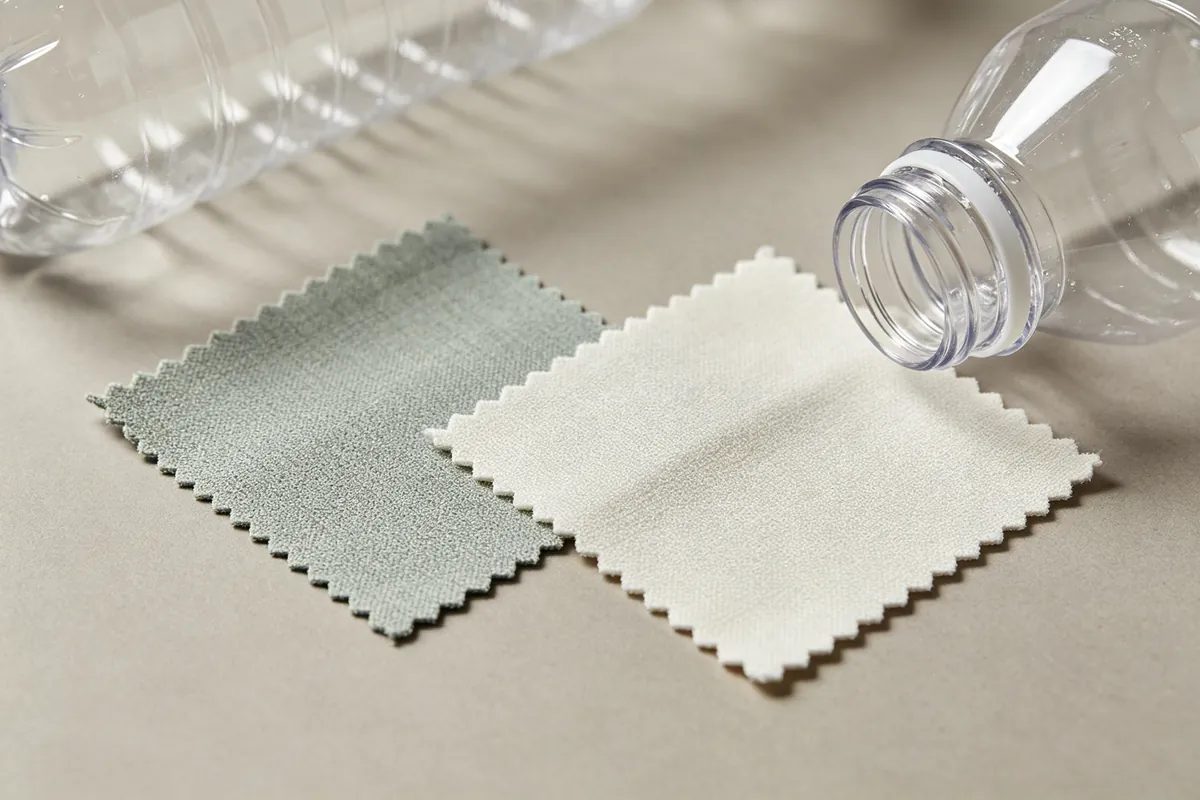
RPET (recycled polyethylene terephthalate) fabric is made from post-consumer plastic bottles that are collected, sorted, cleaned, shredded into flakes, melted, and extruded into polyester fibers — producing approximately 75% less carbon emissions and consuming 90% less water than virgin polyester manufacturing, while matching virgin polyester in tensile strength, abrasion resistance, and color fastness for most bag applications. Virgin polyester is synthesized from petroleum-based PTA and MEG chemicals through polymerization, offering slightly more consistent fiber diameter and wider availability in specialty finishes (waterproof coatings, flame retardant treatments) at a 10-20% lower raw material cost. For most bag categories — including backpacks, duffel bags, tote bags, and cosmetic bags — GRS-certified RPET is functionally equivalent to virgin polyester and is the preferred choice for brands targeting environmentally conscious consumers, retail sustainability requirements, or corporate ESG goals. The primary tradeoffs are slightly higher material cost, narrower color availability (especially bright and neon colors), and the need for GRS supply chain certification to make recycled content claims.
What is RPET (Recycled PET) Fabric?
RPET fabric, also known as recycled polyester or eco-polyester, is manufactured from post-consumer PET (polyethylene terephthalate) waste — primarily plastic water bottles and beverage containers, but also post-industrial PET waste from textile and packaging manufacturing. The recycling process involves: collection and sorting of PET waste by plastic type and color; removal of caps, labels, and contaminants; washing and sterilization; shredding into small PET flakes; melting and filtration to remove impurities; extrusion through spinnerets to form continuous polyester filaments; drawing and texturing to create staple fibers or filament yarns; and weaving or knitting into fabric. One standard 500ml plastic bottle yields approximately 8-10 grams of RPET fiber, meaning a typical backpack requiring 0.8kg of fabric uses the equivalent of 80-100 recycled plastic bottles — a compelling marketing story for eco-conscious brands.
RPET fabric is available in the same weights and weaves as virgin polyester: 210D, 420D, 600D, 900D, and 1680D denier options; plain weave, twill, and ripstop constructions; and can be coated with PU, PVC, or TPE for water resistance. The fiber properties — tensile strength, tear strength, abrasion resistance, and color fastness — are nearly identical to virgin polyester because the chemical composition is the same (both are PET polymer). The main differences are aesthetic: RPET fibers may have slightly more variation in fiber diameter due to the recycling process, which can cause minor texture variations in lightweight fabrics (below 210D), and bright or neon colors may be slightly less vivid because the recycled base material has a slight gray tint that requires more dye to cover. For standard bag weights (420D and above), these differences are not noticeable in normal use.
What is Virgin Polyester Fabric?
Virgin polyester fabric is manufactured from newly synthesized PET polymer produced through the polymerization of purified terephthalic acid (PTA) and monoethylene glycol (MEG), both derived from petroleum or natural gas feedstocks. The manufacturing process involves: chemical reaction of PTA and MEG in a reactor under high temperature and vacuum to form PET polymer chips; melting and extrusion of polymer chips through spinnerets to form filaments; drawing, crimping, and cutting into staple fibers or winding as filament yarns; and weaving or knitting into fabric. Because the polymer is synthesized from pure chemical feedstocks under tightly controlled conditions, virgin polyester has extremely consistent fiber diameter, uniform molecular weight distribution, and minimal impurities — resulting in fabric with perfectly even texture, maximum color brilliance (especially for bright, neon, and pastel shades), and consistent coating adhesion for waterproof and specialty finishes.
Virgin polyester is the most widely used textile fiber in the world, accounting for approximately 52% of global fiber production, with massive global supply capacity and competitive pricing. It is available in every conceivable weight, weave, finish, and specialty treatment: anti-microbial, flame retardant, UV-resistant, anti-static, water-repellent (DWR), and various waterproof coatings (PU 1000mm, PU 3000mm, TPU laminated, PVC coated). For bag manufacturing, virgin polyester is the default choice when consistency, color accuracy, or specialty performance is critical — for example, bags requiring exact brand color matching (Pantone precision), ultra-lightweight fabrics below 150D where fiber consistency matters, or bags requiring certified waterproof ratings (IPX4 and above) where coating adhesion consistency is essential. The primary disadvantage is environmental impact: virgin polyester production is petroleum-intensive, contributes to plastic pollution when products are discarded, and is increasingly subject to regulatory scrutiny and consumer backlash in sustainability-focused markets.
RPET vs Virgin Polyester: Performance Data Comparison
| Property | RPET (Recycled Polyester) | Virgin Polyester | Difference for Bag Use |
|---|---|---|---|
| Tensile strength (warp) | ≥ 95% of virgin (40-60 MPa) | 42-65 MPa | Negligible — both exceed bag requirements (20+ MPa) |
| Tear strength | ≥ 90% of virgin (15-25 N) | 17-28 N | Minor — both well above bag durability thresholds |
| Abrasion resistance (Martindale) | 30,000-50,000 cycles | 35,000-55,000 cycles | Negligible — both far exceed typical bag lifespan (5,000-10,000 cycles) |
| Color fastness to washing (ISO 105-C06) | Grade 4-5 | Grade 4-5 | Identical — both meet retail quality standards |
| Color fastness to light (ISO 105-B02) | Grade 4-5 (dark colors), Grade 3-4 (bright colors) | Grade 4-5 (all colors) | Minor — bright RPET colors may fade slightly faster in prolonged sun exposure |
| Water absorption | 0.4-0.8% (hydrophobic) | 0.4-0.8% (hydrophobic) | Identical — both are naturally water-resistant |
| Available deniers | 210D, 420D, 600D, 900D (1680D limited) | 75D to 1680D+ (full range) | Minor — ultra-light (below 210D) and heavy (1680D) RPET less available |
| Color availability | Standard colors good; bright/neon limited; custom dye MOQ higher | Full color range including bright/neon/pastel; custom dye MOQ lower | Moderate — RPET requires larger minimums for custom colors |
| Coating compatibility (PU/PVC/TPU) | Good for standard coatings; premium coatings may need surface treatment | Excellent for all coatings including premium TPU lamination | Minor — RPET may need corona treatment for high-performance coatings |
| Recycled content certification | GRS, RCS, OEKO-TEX ECO PASSPORT available | Not applicable (virgin material) | Key differentiator — RPET enables recycled content claims |
Environmental Impact: Carbon Footprint and Water Usage
The environmental case for RPET over virgin polyester is well-documented through multiple lifecycle assessment (LCA) studies, including research by Textile Exchange, the Ellen MacArthur Foundation, and the PET Resin Association. Per kilogram of fiber produced, RPET manufacturing generates approximately 2.5-3.5 kg of CO₂ equivalent, compared to 8-10 kg CO₂e for virgin polyester — a reduction of 65-75%. Water consumption is even more dramatically different: RPET production uses approximately 5-10 liters of water per kilogram of fiber (primarily for washing and cleaning recycled flakes), compared to 70-100 liters per kilogram for virgin polyester (primarily for cooling and process water in polymerization and fiber extrusion) — a reduction of 85-90%. Energy consumption follows a similar pattern: RPET uses approximately 30-40 MJ/kg compared to 80-100 MJ/kg for virgin polyester, a reduction of 55-70%.
It is important to note that these environmental benefits depend on the quality of the recycling process. "Chemical recycling" (depolymerizing PET back to its monomer components and re-polymerizing) produces fibers that are chemically identical to virgin polyester with the same environmental benefits, but is currently more expensive and less widely available. "Mechanical recycling" (the standard process described earlier) is more common and less expensive, but the polymer chains are shortened during each recycling cycle, meaning mechanically recycled PET cannot be recycled infinitely — after 2-3 recycling cycles, the polymer quality degrades to the point where it is only suitable for lower-grade applications (fiberfill, insulation, packaging). For bag manufacturing, mechanically recycled RPET is perfectly adequate and is the industry standard. Brands making "100% recycled" claims should ensure their supply chain is GRS certified to verify the recycled content percentage and prevent "greenwashing" — the practice of claiming recycled content without third-party verification.
Cost Comparison: Material Price and Total Cost
Raw material cost is the area where virgin polyester maintains its clearest advantage. As of 2026, standard 600D virgin polyester fabric (PU coated, common for backpacks and duffel bags) costs approximately $1.80-$2.40 per meter (1.5m width), while equivalent GRS-certified 600D RPET fabric costs approximately $2.20-$2.90 per meter — a premium of 15-25%. The price difference varies by fabric weight and specification: lightweight fabrics (210D) have a smaller premium (10-15%) because the material cost is a smaller portion of total fabric cost, while heavy fabrics (900D+) and fabrics requiring custom colors have a larger premium (20-35%) because RPET custom dyeing requires larger minimums and more dye to achieve color consistency. For a typical backpack requiring 1.2 meters of 600D fabric, the material cost difference is approximately $0.50-$1.20 per bag — manageable for most brands, but significant for high-volume, price-sensitive products.
However, the total cost comparison is more nuanced than raw material price alone. Several factors can offset or even reverse the RPET cost premium: brands using RPET may qualify for sustainability certifications or retailer programs that provide marketing support or preferential shelf placement; consumers are increasingly willing to pay a 5-15% price premium for products with verified recycled content (per Nielsen and Deloitte sustainability surveys); some jurisdictions offer tax incentives or reduced environmental fees for products using recycled materials; and RPET may reduce end-of-life disposal costs or extended producer responsibility (EPR) fees in regions with packaging and textile waste regulations. When these factors are considered, the total cost of ownership for RPET bags is often comparable to or lower than virgin polyester, especially for brands selling in sustainability-conscious markets (EU, US West Coast, corporate promotional products with ESG requirements).
GRS Certification and Supply Chain Traceability
When using RPET fabric and making recycled content claims, GRS (Global Recycled Standard) certification is the most widely recognized and credible third-party verification. Administered by Textile Exchange, GRS certification requires: minimum 20% recycled content in the final product (with specific labeling for 20%, 50%, and 100% recycled content); full supply chain traceability from recycled material input to finished product, verified through transaction certificates (TCs) issued at each stage of the supply chain; social compliance requirements (fair labor, health and safety, no child labor) aligned with Fair Trade standards; environmental requirements (wastewater management, chemical restrictions, energy use monitoring); and third-party auditing by accredited certification bodies (Control Union, ICEA, IDFL, etc.). GRS-certified products can use the GRS logo on packaging and marketing materials, and the certification is accepted by major retailers including H&M, Target, Walmart, and Amazon as verification of recycled content claims.
For bag manufacturers, GRS certification involves certifying every stage of the supply chain: the PET recycling facility (input material), the yarn spinning mill, the fabric weaving/knitting mill, the dyeing and finishing facility, and the bag sewing factory. Each stage must maintain segregated production (GRS material must be physically separated from non-GRS material to prevent mixing) and complete transaction certificates for each batch of material transferred between stages. This adds administrative complexity and cost (certification fees typically $2,000-$5,000 per facility per year, plus audit costs), but is essential for brands that want to make credible recycled content claims. Without GRS certification, "recycled polyester" claims are essentially self-reported and vulnerable to greenwashing accusations — major retailers and e-commerce platforms increasingly require GRS or equivalent certification (RCS, SCS Global Services) before accepting recycled content claims in product listings. When sourcing RPET bags, always ask the factory for their GRS certificate scope, confirm that the specific fabric mill in their supply chain is also GRS certified, and request a transaction certificate for your production batch.
When to Choose RPET vs Virgin Polyester
Choose RPET when: your brand identity or marketing strategy emphasizes sustainability and environmental responsibility; your target market includes environmentally conscious consumers (millennials, Gen Z, EU markets, corporate ESG procurement); you sell through retailers that require or prefer sustainable materials (Patagonia, REI, Target sustainable product lines, Amazon Climate Pledge Friendly); you want to differentiate from competitors using standard materials; your product requires recycled content claims for marketing or regulatory compliance; and your color and performance requirements can be met with standard RPET fabric options (standard colors, 210D-900D weights, standard PU coatings). RPET is particularly well-suited for promotional tote bags, corporate gift bags, eco-friendly backpack lines, and products targeting the outdoor and lifestyle segments where sustainability messaging resonates strongly.
Choose virgin polyester when: you require exact Pantone color matching for brand consistency (especially bright, neon, or pastel colors); you need ultra-lightweight fabrics below 210D where fiber consistency is critical; your product requires high-performance waterproof coatings (TPU lamination, IPX5+ ratings) where coating adhesion consistency is essential; you are manufacturing in very high volumes (50,000+ pieces) where the 15-25% material premium becomes a significant total cost; your target market is highly price-sensitive with no sustainability premium; or the specific fabric weight or finish you need is not available in RPET. Virgin polyester remains the default choice for technical insulated cooler bags requiring FDA-compliant food-contact linings, high-visibility safety products requiring certified fluorescent colors, and ultra-budget promotional products where material cost is the primary decision factor. Many brands use both materials strategically: RPET for their main product line and marketing-focused SKUs, virgin polyester for specific technical products or price-sensitive lines.
Conclusion
RPET and virgin polyester are chemically identical materials (both PET polymer) with nearly identical performance characteristics for bag manufacturing — the differences are in environmental impact, cost, color availability, and certification requirements. RPET offers a 65-75% reduction in carbon emissions, 85-90% reduction in water use, and a compelling sustainability marketing story, at a 15-25% material cost premium and with some limitations in bright colors and ultra-light/heavy weights. Virgin polyester offers maximum consistency, full color range, specialty finish availability, and lower raw material cost, but with significantly higher environmental impact and growing consumer and regulatory pressure. For the majority of bag products — especially those targeting sustainability-conscious consumers, corporate ESG procurement, or retailers with sustainable product requirements — GRS-certified RPET is the superior choice, providing functional equivalence with meaningful environmental benefits and marketing value. The decision should be based on your specific product requirements, target market, brand strategy, and total cost considerations — and many successful brands use both materials strategically across their product portfolio.
Looking for GRS-Aligned RPET Bag Manufacturing?
We offer both GRS-aligned RPET and virgin polyester options across all bag categories. Get material samples, recycled content verification, and a factory-direct quotation within 8 Hours.
Request RPET Samples & Quote