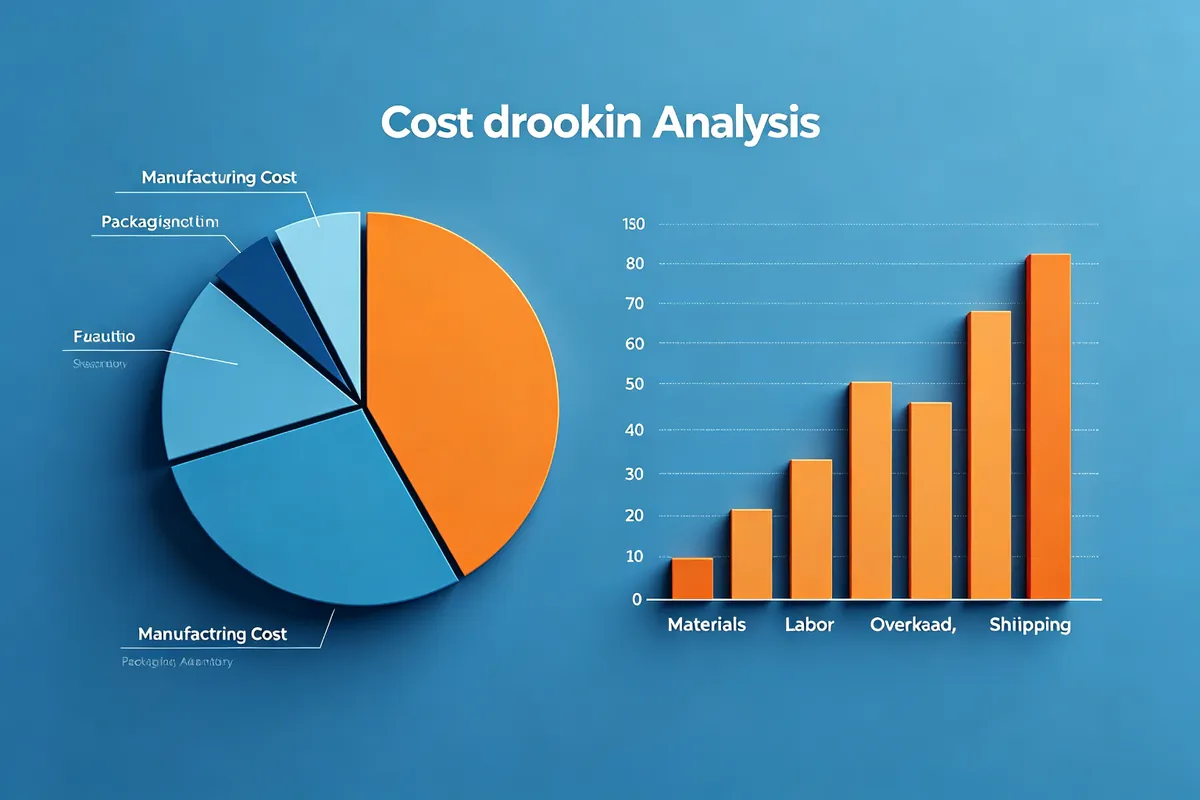
The factory cost (FOB China price) of a custom bag typically breaks down as: raw materials 35-45% (shell fabric, lining, zippers, hardware, thread), direct labor 20-30% (cutting, sewing, finishing, packing), factory overhead 10-15% (rent, utilities, equipment depreciation, management salaries), packaging 5-8% (polybag, hangtag, carton), quality control and testing 3-5% (incoming inspection, in-process QC, final AQL inspection), and factory profit margin 8-15%. For a standard 600D polyester backpack at 1000-piece MOQ, the typical FOB factory price is $4.50-$7.50 per unit, with landed cost (including ocean freight, insurance, customs duty, and domestic delivery to a US warehouse) adding approximately $1.50-$3.00 per unit, bringing total landed cost to $6.00-$10.50. Understanding this cost structure helps buyers identify where cost savings are possible (material substitution, MOQ optimization, packaging simplification) and where "too good to be true" pricing likely indicates hidden quality shortcuts — a factory quoting 30% below the market average is almost certainly cutting material quality, skipping QC steps, or using unskilled labor.
The Complete Custom Bag Cost Structure
Every custom bag's factory price is composed of six primary cost components plus profit margin. The exact percentages vary by bag type, complexity, material, and order quantity, but the following breakdown represents the industry average for standard textile bags (backpacks, duffel bags, tote bags, cosmetic bags) produced in Guangdong, China at 500-2000 piece MOQ.
Cost Component 1: Raw Materials (35-45%)
Raw materials are the single largest cost component in bag manufacturing, typically accounting for 35-45% of the factory price. The material cost includes: shell fabric (the primary exterior material — 600D polyester, 210D nylon, canvas, RPET, TPU, etc.), lining fabric (typically 190T or 210D polyester taffeta, or custom printed lining), zippers (YKK #5/#8, or generic brands — YKK zippers cost 2-3x more than generic but are more durable), hardware (buckles, D-rings, snaps, cord locks — POM plastic or zinc alloy), webbing and straps (polypropylene or nylon webbing, adjustable straps), thread (polyester sewing thread, sometimes bonded nylon for heavy-duty bags), and interlining/foam (EVA foam, PE board, or batting for structure and padding). For a standard backpack, the shell fabric alone might be $1.20-$2.00, lining $0.30-$0.50, zippers $0.40-$1.20 (depending on brand and quantity), hardware $0.30-$0.80, webbing $0.20-$0.50, and other materials $0.20-$0.40 — totaling $2.60-$5.40 in material cost for a bag with a $6.00-$8.00 factory price.
Material cost is the area where factories can most easily cut corners to offer lower prices — and where buyers most often get stung. A factory quoting $4.00 for a bag that should cost $6.00 is almost certainly using: lower denier fabric (420D instead of 600D, or 210D instead of 420D), thinner or lower-quality lining, generic zippers instead of the specified YKK, plastic hardware instead of metal, or recycled/regenerated fabric with inconsistent quality. To protect against material substitution, always: specify exact material specifications in your purchase order (denier, weight, brand, composition), require material samples to be approved before production, conduct incoming material inspection as part of your QC process, and consider third-party material testing (SGS or Intertek) for critical orders. For sustainable materials like GRS-certified RPET, expect a 15-25% material cost premium over virgin polyester, as detailed in our RPET comparison guide.
Cost Component 2: Direct Labor (20-30%)
Direct labor cost includes all wages for workers directly involved in producing the bag: cutting (manual or die-cutting operators), sewing (sewing machine operators — the largest labor component, typically 60-70% of total labor), finishing (trimming threads, turning, quality checking), and packing (inserting into polybags, labeling, carton packing). Labor cost is primarily determined by two factors: the complexity of the bag (how many sewing operations and minutes per bag) and the local wage rate. In Dongguan, Guangdong (2026 rates), the average sewing machine operator earns approximately RMB 5,500-7,500 per month ($760-$1,040) including base salary, overtime, and social insurance — significantly higher than inland Chinese provinces (RMB 3,500-5,000/month) but with more skilled workers and better infrastructure. A simple tote bag might require 8-12 minutes of total labor time, while a complex multi-compartment backpack might require 25-40 minutes. At an effective labor rate of approximately $0.50-$0.70 per minute (including overhead allocation), labor cost ranges from $0.50-$0.80 for a simple tote to $1.50-$2.80 for a complex backpack.
Labor cost is the primary reason bag manufacturing has shifted from China to lower-cost countries (Vietnam, Bangladesh, Cambodia) for very high-volume, simple products — but for custom bags with low MOQs (500-2000 pieces), Chinese factories remain competitive because of their skilled workforce, mature supply chains, and flexible production capabilities. Vietnamese factories typically require higher MOQs (2000+ pieces) and have less experience with complex custom designs. When comparing labor costs between factories, be cautious of unusually low prices — a factory paying workers below minimum wage or skipping social insurance contributions may offer lower prices but exposes your brand to labor practice scandals and retailer rejection. Always verify that your factory has a valid social compliance audit (BSCI or Sedex/SMETA, as discussed in our factory audit comparison) to ensure ethical labor practices.
Cost Component 3: Factory Overhead (10-15%)
Factory overhead includes all indirect costs of running the manufacturing facility that cannot be directly attributed to a specific product: factory rent and property costs, utilities (electricity, water, gas — sewing machines, cutting equipment, and pressing/ironing stations are electricity-intensive), equipment depreciation (industrial sewing machines cost $300-$2,000 each, with a 5-8 year useful life; cutting tables, die-cutting machines, and QC equipment add to the capital investment), management and administrative salaries (factory manager, production supervisors, QC managers, accounting, HR, sales), maintenance and repair of equipment, insurance (property, liability, worker's compensation), and certification and audit costs (ISO9001, BSCI, Sedex, GRS — annual audit fees and compliance costs). Overhead is typically allocated to each unit based on labor hours or machine hours, so more complex bags (longer production time) carry higher overhead per unit. A well-managed, efficient factory might have overhead at 10-12% of total cost, while a smaller, less efficient factory might have overhead at 15-18%.
Overhead is an area where larger factories have a cost advantage — they can spread fixed costs (rent, management salaries, equipment) over higher production volume, reducing per-unit overhead. However, larger factories often require higher MOQs and may be less flexible for custom, low-volume orders. Smaller factories (50-150 workers) typically have higher per-unit overhead but offer more flexibility, better communication, and lower MOQs — making them ideal for custom bag brands with 500-2000 piece orders. When evaluating factory pricing, understand that a slightly higher price from a smaller, more communicative factory may be worth it in terms of reduced quality issues, faster response times, and more flexible customization — the "hidden cost" of working with a large, unresponsive factory (delays, miscommunication, quality problems) can far exceed the per-unit price difference.
Cost Component 4: Packaging (5-8%)
Packaging cost includes: individual polybags (PE or PP plastic bags, typically $0.03-$0.08 each — biodegradable or recycled content polybags cost 20-50% more), hangtags and labels (printed paper hangtags $0.05-$0.20 each, woven labels $0.02-$0.08, care labels $0.01-$0.03), desiccant packets (silica gel, $0.01-$0.03 each — required for ocean shipping to prevent moisture damage), inner boxes or dividers (for fragile or premium products), and export cartons (5-ply corrugated cartons, $0.80-$2.50 each depending on size, typically holding 20-50 bags per carton). For a standard bag at $6.00 factory price, packaging cost is typically $0.30-$0.50 per unit (including allocated carton cost). Packaging is an area where cost savings are relatively easy — using standard polybags instead of custom printed bags, simplifying hangtag design, or increasing carton pack quantity (more bags per carton reduces per-unit carton cost) can reduce packaging cost by 20-40%. However, packaging is also a brand touchpoint — premium packaging (custom printed polybags, high-quality hangtags, branded cartons) can enhance perceived value and justify higher retail prices, so the cost-benefit should be evaluated based on your brand positioning.
Cost Component 5: Quality Control & Testing (3-5%)
Quality control cost includes: incoming material inspection (checking fabric, zippers, hardware against specifications — typically done by the factory's QC team, but may include third-party material testing for critical orders), in-process quality inspection (QC supervisors checking work at each production stage, catching defects early when they can be corrected), final random inspection (AQL 2.5 inspection of finished goods before shipment — the factory's internal QC is included in this cost, but independent third-party inspection by SGS, QIMA, or similar costs an additional $180-$350 per man-day, typically not included in the factory price), and product testing (for specific requirements — color fastness testing, tear strength testing, waterproof rating testing, FDA food contact testing for cooler bags, CPSIA/Prop 65 testing for US market — these tests cost $100-$500 each and are typically charged separately, not included in the per-unit price). A factory with robust internal QC processes will have QC cost at 3-5% of total price; a factory that skips QC steps to reduce cost may quote a lower price but will have higher defect rates — and the cost of defective goods (returns, rework, lost customers) far exceeds the savings from skipped QC. Always confirm that your factory conducts AQL 2.5 final inspection and consider independent third-party inspection for orders over $10,000 or for first-time orders with a new factory, as detailed in our complete sourcing guide.
How MOQ Affects Unit Price
Minimum Order Quantity (MOQ) is one of the most significant factors affecting unit price — the same bag can cost 30-50% more at 500 pieces than at 5000 pieces, due to fixed cost amortization and material purchasing efficiency. The primary drivers of MOQ-based pricing are: setup costs (cutting dies, printing plates, sample development — these are fixed costs amortized over the order quantity, so per-unit setup cost decreases as quantity increases), material minimums (fabric mills often require 500-1000 meter minimums per color, and custom-dyed fabric may require 2000+ meters — at low MOQ, you may pay for the full minimum even if you only use part of it, or pay a premium for "small lot" material), production line efficiency (a bag production line needs 200-500 pieces to reach optimal efficiency — below that, line changeover time and learning curve effects increase per-unit labor cost), and quantity discounts from material suppliers (fabric and hardware suppliers offer 5-15% discounts for larger volume purchases). The table below shows typical unit price scaling for a standard 600D polyester backpack with a $6.50 reference price at 1000 pieces.
| Order Quantity | Unit Price (FOB) | Price vs 1000pcs | Total Order Value | Typical Lead Time |
|---|---|---|---|---|
| 300 pcs (below standard MOQ) | $8.50-$10.00 | +30-55% | $2,550-$3,000 | 25-35 days |
| 500 pcs (standard MOQ) | $7.00-$8.00 | +8-23% | $3,500-$4,000 | 25-30 days |
| 1,000 pcs | $6.00-$7.00 | Reference | $6,000-$7,000 | 25-30 days |
| 3,000 pcs | $5.20-$6.00 | -13-17% | $15,600-$18,000 | 30-35 days |
| 5,000 pcs | $4.80-$5.50 | -20-25% | $24,000-$27,500 | 35-40 days |
| 10,000+ pcs | $4.20-$5.00 | -28-35% | $42,000-$50,000+ | 40-50 days |
Key takeaways from MOQ pricing: the steepest price drop occurs between 500 and 3000 pieces (approximately 25-30% reduction), after which economies of scale diminish — going from 5000 to 10000 pieces only saves an additional 10-15%. For most small and medium brands, the "sweet spot" for cost-effectiveness is 1000-3000 pieces per design/color — enough to benefit from meaningful economies of scale without tying up excessive capital in inventory. If you need below-MOQ quantities (under 500 pieces), options include: paying a premium for small-batch production (many factories will accept 300 pieces at 20-30% higher price), combining multiple colors into one order to reach MOQ (e.g., 200 black + 200 navy + 200 gray = 600 total), using the factory's in-stock materials (no custom dyeing reduces material minimums), or working with a smaller factory that specializes in low-MOQ custom production (typically 50-200 worker factories rather than 500+ worker mass production facilities).
Hidden Costs to Watch For
Beyond the standard cost components, several "hidden costs" can significantly increase your total landed cost and are often not included in the initial factory quotation. Always ask about these upfront and factor them into your total cost calculation:
- Sample fees: $50-$200 per sample (often refundable on bulk order, but not always — always ask about sample fee refund policy). Multiple sample rounds (2-4 typical for custom designs) can add $200-$800 in upfront cost.
- Mold/tooling fees: Custom plastic hardware (buckles, zipper pulls) requires injection molds costing $300-$1,500 each; custom metal hardware requires die-casting molds costing $500-$2,000. These are one-time fees but should be amortized over your expected total order volume.
- Printing plate fees: Custom woven labels, printed packaging, or fabric printing requires printing plates or screens costing $50-$300 per color/design. These are typically one-time fees but may be charged per order if the factory doesn't retain plates.
- Custom dyeing fees: Custom fabric colors (not in the factory's standard color card) require minimum dye lots (500-2000 meters) and may incur a dyeing surcharge of $0.20-$0.50 per meter.
- Third-party inspection: Independent pre-shipment inspection by SGS, QIMA, or similar costs $180-$350 per man-day (most bag inspections take 1 day). This is almost never included in the factory price.
- Product testing/certification: FDA food contact testing (for cooler bags), CPSIA/Prop 65 testing (US market), REACH testing (EU market), or waterproof rating testing costs $100-$500 per test, and may be required by retailers or regulators.
- Shipping and logistics: Ocean freight (LCL $50-$150 per CBM, FCL $1,500-$4,000 per 20ft container), insurance (0.1-0.3% of cargo value), customs duty (bags typically 17.6% US duty rate under HS 4202, varies by material and destination), and domestic delivery ($100-$500 from port to warehouse). These can add 25-50% to the FOB factory price.
- Currency fluctuation: Quotes are typically in USD, but factory costs are in RMB. If RMB appreciates against USD between quote and payment, the factory may request a price adjustment or absorb the cost (reducing their margin and potentially incentivizing cost-cutting). For large orders, consider hedging or negotiating a currency adjustment clause.
How to Negotiate Better Pricing
Effective price negotiation with Chinese bag factories is based on understanding their cost structure and finding mutually beneficial cost reductions rather than simply demanding lower prices. Strategies that work: (1) Increase order quantity — the single most effective way to reduce unit price; even going from 500 to 1000 pieces can reduce price by 8-15%. If you can't increase quantity for one design, combine multiple designs or colors into one production run to reach higher total volume. (2) Simplify the design — reduce the number of components, pockets, or sewing operations to lower labor cost; use standard materials and colors instead of custom options to reduce material cost and minimums. (3) Optimize packaging — use standard polybags instead of custom printed bags, simplify hangtags, increase carton pack quantity — packaging is an easy 20-40% cost reduction with minimal impact on product quality. (4) Offer longer lead time — factories often offer 5-10% discounts for orders with flexible or longer lead times, as they can slot your order into gaps between larger orders and optimize production scheduling. (5) Commit to repeat orders — if you can commit to 2-3 orders per year or an annual volume, factories will often offer 5-15% better pricing because they can plan production and material purchasing in advance. (6) Pay in favorable terms — some factories offer small discounts (2-5%) for higher deposit percentages or faster balance payment, as it improves their cash flow. (7) Compare multiple quotes — get quotes from 3-5 factories and use competitive pricing as leverage, but don't automatically choose the lowest price — as discussed, unusually low prices often indicate quality shortcuts. (8) Build a long-term relationship — factories prioritize loyal, reliable customers for pricing, production slots, and problem-solving. A history of on-time payments, clear communication, and repeat orders earns better pricing than one-off transactional buying.
Real-World Cost Examples
Example 1: Standard 600D Polyester Backpack (1000 pcs)
Specifications: 600D polyester shell, 210D polyester lining, 2 main compartments + front pocket, YKK #5 zippers, POM plastic hardware, adjustable padded shoulder straps, standard polybag + paper hangtag, 30 pcs per carton.
Cost breakdown: Materials $2.40 (41%), Labor $1.50 (26%), Overhead $0.70 (12%), Packaging $0.35 (6%), QC $0.23 (4%), Profit $0.62 (11%). Total order value: $5,800. Estimated landed cost (US warehouse, LCL ocean freight + 17.6% duty + domestic delivery): $7.80-$8.50 per unit. Typical retail price: $24.99-$34.99 (3-4x landed cost markup).
Example 2: RPET Eco Tote Bag (2000 pcs)
Specifications: GRS-certified 300D RPET (recycled polyester) shell, unlined, single main compartment + inner pocket, generic #5 zipper, cotton webbing handles, custom printed hangtag, 50 pcs per carton, GRS Transaction Certificate provided.
Cost breakdown: Materials $1.35 (42% — includes 15-20% RPET premium), Labor $0.75 (23%), Overhead $0.40 (13%), Packaging $0.20 (6%), QC $0.15 (5%), GRS admin $0.10 (3%), Profit $0.25 (8%). Total order value: $6,400. Estimated landed cost: $4.30-$4.80 per unit. Typical retail price: $14.99-$19.99. The RPET material premium adds approximately $0.25-$0.35 per unit compared to virgin polyester, but enables "made from X recycled plastic bottles" marketing and meets retailer sustainability requirements.
Example 3: Insulated Cooler Bag (500 pcs)
Specifications: 420D polyester shell, 5mm EPE foam insulation, PEVA food-contact lining (FDA compliant), RF-welded leak-proof seams, side mesh pocket, adjustable shoulder strap, custom printed polybag + hangtag, 20 pcs per carton.
Cost breakdown: Materials $1.95 (43% — insulation and PEVA lining are significant material costs), Labor $1.20 (27% — RF welding adds labor complexity), Overhead $0.55 (12%), Packaging $0.25 (6%), QC $0.20 (4% — leak testing required), Profit $0.35 (8%). Total order value: $2,250. Estimated landed cost: $6.00-$6.80 per unit. Typical retail price: $19.99-$29.99. Note: FDA food-contact testing ($150-$300) is an additional one-time cost if required by your retailer or market, and RF welding equipment is a specialized capability not all factories have — verify this before placing an order.
Conclusion
Understanding the cost structure of custom bag manufacturing — materials 35-45%, labor 20-30%, overhead 10-15%, packaging 5-8%, QC 3-5%, profit 8-15% — empowers buyers to make informed decisions, negotiate effectively, and avoid the pitfalls of unrealistically low pricing that inevitably leads to quality problems. The most significant cost lever is order quantity: moving from 500 to 3000 pieces typically reduces unit price by 25-30%, while the sweet spot for most small and medium brands is 1000-3000 pieces per design/color. Beyond the factory FOB price, always factor in hidden costs (sample fees, tooling, inspection, testing) and landed costs (freight, duty, insurance, domestic delivery) which can add 25-50% to the total. Effective negotiation is about finding mutual cost reductions (simplified design, optimized packaging, longer lead times, volume commitments) rather than simply demanding lower prices — and building long-term factory relationships yields better pricing, priority production, and better problem-solving than transactional buying. By understanding the true cost of custom bag manufacturing, you can price your products competitively, maintain healthy margins, and build a sustainable supply chain that supports your brand's growth.
Want a Transparent Cost Breakdown for Your Custom Bag Project?
Send us your specifications and quantity — we'll provide a detailed cost breakdown (materials, labor, overhead, packaging, QC) and a factory-direct quotation within 8 Hours. No hidden fees, no surprises.
Get a Detailed Cost Quote