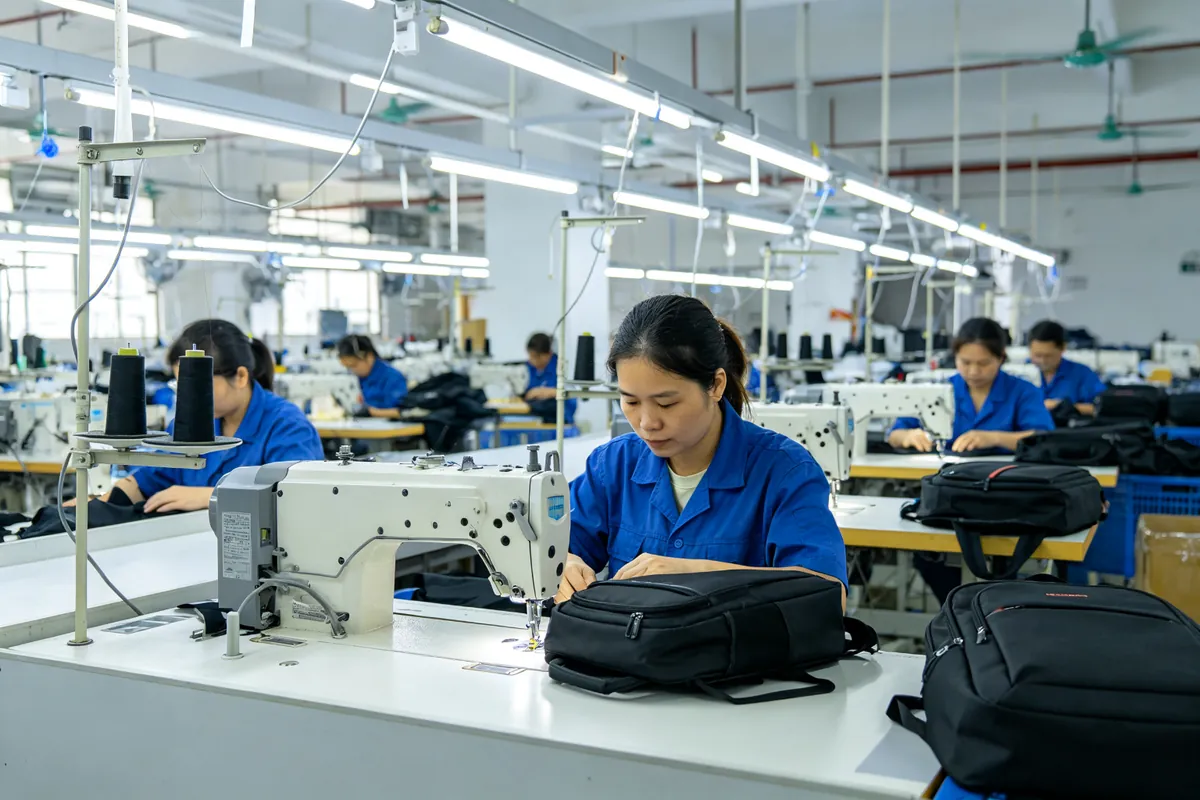
Sourcing custom bags from China requires a structured 8-step process: define your product specifications, find verified bag-specialized manufacturers, request and compare quotations, evaluate physical samples, negotiate MOQ and payment terms, approve pre-production samples, conduct third-party quality inspection, and arrange shipping with customs clearance. The entire process typically takes 25-45 days from first contact to shipment, with minimum order quantities starting at 500 pieces for most bag categories. This guide walks through each step with actionable details and highlights the 7 most common sourcing mistakes that cost new importers time and money.
This guide is the China sourcing playbook in our four-part custom bag series. It focuses on the China-specific decisions: finding the right factory, negotiating like an importer, and clearing customs. Pair it with our guides on the production journey and factory evaluation:
- How to Get Custom Bags Made — the full 9-step production journey from spec sheet to delivery
- How to Choose a Bag Manufacturer — how to verify a factory and score it before you commit
- How to Start a Bag Brand — brand-side planning that shapes what you source
Why China Remains the Top Choice for Custom Bag Sourcing
China accounts for approximately 60% of global bag and luggage production, concentrated primarily in Guangdong Province (Dongguan, Guangzhou, Shenzhen) and Zhejiang Province (Yiwu, Wenzhou). The Dongguan area alone hosts over 3,000 bag factories ranging from 20-worker workshops to 2,000+ employee vertically integrated manufacturers. The key advantages of Chinese bag manufacturing are: mature supply chains with every component (fabric, zipper, buckle, lining, thread) available within a 50-kilometer radius; competitive labor costs combined with high skill levels in specialized bag construction; flexible MOQ terms that accommodate small brands starting at 500 pieces; and rapid production turnaround of 20-35 days for standard orders.
For brands targeting specific product categories, it is critical to select a factory that specializes in that bag type rather than a generalist. A factory that primarily produces cosmetic bags may not have the equipment or expertise for technical backpacks with load-bearing structures, just as a backpack specialist may lack the RF welding equipment needed for insulated cooler bags. Always ask for the factory's primary product categories and request photos of their production lines specific to your bag type.
Step 1: Lock Down Your Product Specs First
Create a Detailed Specification Sheet
Most sourcing delays trace back to one thing: an incomplete product specification. Before you contact any supplier, build a complete spec document. It should capture dimensions (cm and inches both), the main fabric with its denier or weight — 600D polyester, 210D nylon, or 0.4mm TPU as examples — plus lining material, zipper brand and size (YKK #5/#8 or generic), buckles and hardware (POM plastic, zinc alloy), the decoration approach (silkscreen, heat transfer, embroidery, woven label), target MOQ, and a target unit price range. If you have design files (AI, PDF, or technical drawings), include them — factories can work from sketches, but technical drawings reduce interpretation errors dramatically.
For first-time importers, it is acceptable to say "I need recommendations on material" — experienced factories will propose 2-3 material options at different price points. However, you should still define the functional requirements (water resistant, insulated, clear/transparent, foldable) so the factory can recommend appropriate materials. Vague requests like "I want a nice bag" will result in either no response or a generic quotation that does not match your expectations.
Step 2: Find Verified and Specialized Bag Manufacturers
Source Through Multiple Channels and Verify Credentials
Where do you find them? Three channels cover most cases: online marketplaces like Alibaba.com, Global Sources, or Made-in-China.com; physical trade fairs such as Canton Fair or Hong Kong APLE; and personal referrals from people already importing bags. Screen candidates on these signals: a "Gold Supplier" or "Verified Supplier" badge (the platform has done a basic check), a track record of five or more years in bags, and a catalogue where at least 70% of items are bags rather than a grab bag of unrelated categories. Avoid trading companies that pose as factories — you can identify them by checking whether their product range is extremely broad (bags, electronics, clothing, home goods all in one store) and whether they cannot provide factory photos or audit reports.
And before any money moves, verify the seller: ask for the business license and check the registration number against Chinese government records, request photos of the entrance, production floor, and QC area, collect their certification list (BSCI, ISO9001, Sedex, GRS where relevant), and ask for two or three client references in your region. A genuine factory supplies all of this without hesitation. If a supplier refuses to show factory photos or cannot name their certifications, move on — there are plenty of verified alternatives.
Step 3: Collect Quotes and Compare Supplier Proposals
Compare Quotations Line by Line, Not Just Total Price
Email your full spec to the shortlist and ask each factory to price it in detail. You want the unit cost at your target volume (say 500, 1,000, or 3,000), the sample charge and how fast a sample can be made, production lead time, payment terms, packaging specs, and any one-off costs like tooling or screen charges. Put the quotes side by side and compare component by component rather than glancing at the grand total. When you evaluate quotes, resist the temptation to pick the lowest price — a $0.50 gap per unit can hide a downgraded material (420D polyester instead of 600D) or a cheaper zipper (generic rather than YKK), both of which turn into returns and brand damage later. Ask each supplier to spell out the exact material specifications in writing so quotes are comparable on equal terms.
Response time and communication quality are also important evaluation criteria. A supplier that responds to your initial tech pack and within 8 Hours with detailed questions about your specifications is more likely to be responsive during production. A supplier that sends a generic one-line quotation ("$3.50/pc FOB Shenzhen") without asking clarifying questions is likely not serious about your order or is using a template response. Narrow your list to 3-4 suppliers based on quotation competitiveness, communication quality, and specialization match.
Step 4: Get Samples in Hand and Judge Them
Never Place a Bulk Order Without Evaluating a Physical Sample
Set aside roughly $50-$200 for sampling — more when the bag needs bespoke molds or printed plates — and note that most factories credit this back against a confirmed 500+ piece order. Give sampling a week or two for standard designs and up to three weeks for intricate ones, then a few more days for courier delivery. Sample production runs 5-10 working days for standard designs, or 10-15 days for complex designs needing custom hardware or special printing. Put the sample through a hands-on check: does the fabric feel like the grade you specified, are the stitches even and tight at stress points, does the zipper run smoothly over repeated open-and-close cycles, do the buckles and D-rings hold up under pressure, is the print crisp and color-true after a damp-cloth rub, do the measurements stay within a centimeter of spec, and is the lining cleanly attached with pockets where you asked? Any failure here is cheaper to fix now than in bulk.
It is normal for the first sample to have issues — this is exactly why you order samples. Document every discrepancy with photos and send detailed feedback to the factory. A good factory will make corrections promptly and send a revised sample at no additional cost (or a reduced cost). If a factory becomes defensive or refuses to make corrections after you point out clear defects, this is a warning sign about how they will handle quality issues during bulk production. Ask shortlisted factories to ship 2-3 samples (or have your agent collect them) and compare them in one session — differences in lining quality, stitch density and hardware finish are far more visible in hand than in photos.
Step 5: Negotiate MOQ, Pricing, and Payment Terms
Understand the Cost Drivers and Negotiate Strategically
MOQ (Minimum Order Quantity) for custom bags in China typically starts at 500 pieces per design/color for standard bags, though some factories will accept 300 pieces for simple designs or 1000+ pieces for complex bags requiring custom materials or hardware. MOQ is driven by material minimums (fabric mills often require 500-1000 meters per color), setup costs (printing plates, cutting dies), and production line efficiency (a bag production line needs 200-500 pieces to be economically viable). If your required quantity is below the factory's standard MOQ, you can negotiate by: offering to pay a slightly higher unit price, combining multiple colors into one order (e.g., 200 black + 200 navy + 200 gray = 600 total), using the factory's in-stock materials instead of custom-dyed fabric, or agreeing to a longer production timeline that allows the factory to slot your order into gaps between larger orders.
Standard payment terms for Chinese bag factories are 30% deposit upon order confirmation, 70% balance before shipment (after inspection). Some factories may offer 30/70 with balance against copy of bill of lading for established clients, but first-time orders almost always require balance before shipment. Never pay 100% upfront — this eliminates your leverage for quality issues. Payment methods include bank wire transfer (T/T), PayPal (for small amounts, typically under $1000), and Alibaba Trade Assurance (provides buyer protection for orders placed through the platform). For orders over $5000, consider using a letter of credit (L/C) for additional protection, though this adds bank fees and complexity.
Step 6: Sign Off on the PPS
Approve a Pre-Production Sample as the Quality Benchmark
A week or two before the line runs, the factory builds one PPS — a pilot unit from the exact fabric, fittings, and assembly steps of your order. Unlike the earlier design sample, which may swap in cheaper materials, this piece mirrors the final product and becomes your benchmark. Keep it, photograph it, and approve it in writing; once production starts, changes mean extra cost and schedule risk, so confirm colors, hardware, stitching, lining, and packaging first.
At this stage, you should also confirm the production contract in writing, including: unit price, total quantity, color breakdown, material specifications, packaging requirements, production lead time (counted from deposit receipt and PPS approval), inspection terms, shipping terms (FOB, CIF, DDP), and penalty clauses for delays or quality failures. A written contract protects both parties and reduces misunderstandings. Many Chinese factories use their own purchase order format — review it carefully and add any missing terms before signing.
Step 7: Track Production and Do a Final Random Check
Hire a Third-Party Inspector Before Shipment
During production, ask the factory for periodic photo updates — at minimum, shots of material cutting, mid-production assembly, and finished goods before packaging. This surfaces problems early, while they can still be fixed cheaply. When production reaches roughly 80-100% and the goods are packed, book a final random inspection (FRI). Defect tolerance follows AQL — 2.5 for major problems, 4.0 for minor ones — and the audit sample grows with the batch, reaching 80 pieces for a 501-1,200 order. You can do the check on site yourself, or commission a firm like SGS, Bureau Veritas, Intertek, or QIMA. A third-party inspector typically charges $180-$350 per day and finishes a bag inspection in one day.
The inspection report sorts defects into critical (safety hazards, completely wrong product), major (functional failures, significant cosmetic defects), or minor (cosmetic issues that don't affect function). If major defects exceed the AQL threshold, the inspection fails and you can insist on rework or replacement before shipment. Hold off on paying the balance or releasing the goods until inspection passes — once they leave the factory, your leverage over quality drops sharply. If the factory refuses to address failed inspection issues, you can escalate through your payment protection (Alibaba Trade Assurance, PayPal dispute) or legal channels, though prevention through a good factory selection is far more effective than post-hoc resolution.
Step 8: Set Up Shipping and Customs Clearance
Choose the Right Shipping Method and Work with a Freight Forwarder
Once inspection passes and the balance is settled, the factory ships the goods to your nominated forwarder or port. Once the balance is settled, the factory hands the goods to your forwarder. For delivery you have three practical choices ranked by cost: ocean containers (shared LCL or dedicated FCL for 20ft/40ft) suit full production runs and typically take two to five weeks; airfreight runs about half that but roughly triples the bill, so it is only for rush or low-volume premium items; door-to-door couriers like DHL, FedEx, or UPS arrive in a few days but at a per-kilo premium that only makes sense for samples and parcels below about 100kg. For most bag orders of 500+ pieces, sea freight LCL or FCL is the default.
Choose a freight forwarder who knows the China-to-your-country route and can manage booking cargo space, preparing shipping documents (commercial invoice, packing list, bill of lading), customs declaration in China, customs clearance at the destination, and final delivery to your warehouse. Agree on Incoterms before production — with FOB (Free On Board), the factory covers delivery to the port and loading while you handle ocean freight and insurance from that point; with DDP (Delivered Duty Paid), the factory manages everything to your door including duties and taxes, which costs significantly more and is less common for B2B orders. Make sure the commercial invoice describes the products and HS code correctly (bags fall under 4202 for textile or leather bags) to avoid customs holds or duty reassessment.
7 Common Sourcing Mistakes and How to Avoid Them
| Mistake | Consequence | How to Avoid |
|---|---|---|
| Picking the lowest bidder without any due diligence | Bad quality, blown deadlines, or a supplier who vanishes after the deposit | Confirm the business license, ask for factory photos and certifications, and order samples from 2-3 suppliers before committing |
| Spec sheet too vague | Extra sample rounds, production delays, and a final product that misses the mark | Write out dimensions, materials, hardware, printing method, and functional requirements in a full spec sheet before contacting suppliers |
| Remitting 100% in advance | No leverage over quality, and no reason for the factory to fix defects | Stick to the standard 30% deposit / 70% before shipment split and never pay the full amount before inspection passes |
| Ordering bulk without checking a physical sample | Material or construction defects arrive that a sample would have caught | Always order and inspect physical samples before bulk; test zippers, stitching, materials, and dimensions |
| Skipping independent quality inspection | Defective goods reach you, discovered only after arrival when returns are impractical | Bring in an independent inspector (SGS, QIMA, etc.) for an AQL 2.5 random check before shipment and hold the balance until it passes |
| Leaving shipping and customs out of the budget | Landed cost lands 30-50% above estimate and erodes margins | Get freight quotes before ordering and fold ocean freight, insurance, customs duties, and domestic delivery into the total cost calculation |
| No written contract in place | Disputed verbal agreements with no basis for quality or delay claims | Sign a written purchase contract covering unit price, quantity, specs, lead time, inspection terms, and penalty clauses before paying the deposit |
Verifying a Factory Remotely
Most buyers cannot fly to China before every order, but you can still do meaningful due diligence from home. Ask the factory to walk you through the production floor on a video call: cutting tables, sewing stations, QC benches, and finished-goods storage. A real factory will happily do this; a trading company usually hesitates. Cross-check their claimed address against maps, and ask them to hold up a dated newspaper or time marker on the call. You can also commission a short video audit through an inspection agency — many charge a flat fee under $100 for a walkthrough with photos and a short report. These steps do not replace an in-person visit, but they filter out the majority of middlemen early.
Working With Your Chosen Factory: Communication, Documents, and Payment Protection
Clear communication matters more than most importers expect. Chinese suppliers work business hours (UTC+8), so expect a roughly 8-hour time difference with Western markets — email is the standard channel, and a written confirmation after every phone or video call prevents costly misunderstandings. When you send instructions, be explicit: reference your spec sheet and sample number, attach photos of any issue, and ask for a confirmation reply so you have a paper trail.
Keep a complete export package ready before goods ship. The commercial invoice, packing list, and bill of lading are the core three documents, and bags typically classify under HS code 4202 — getting the classification wrong can trigger customs holds or duty reassessment. Many importers also request a Certificate of Origin and, for certified materials, the relevant transaction certificate (GRS, GOTS, or similar). A freight forwarder or customs broker in your destination country can pre-review the paperwork while the goods are still in transit.
Payment protection is worth getting right. The safest structure is a 30% deposit on order confirmation and the 70% balance against shipping documents after inspection passes — never 100% upfront. Platforms like Alibaba Trade Assurance and PayPal offer dispute channels if a transaction goes wrong, and a letter of credit adds bank-guaranteed protection for orders over $5,000. Keep in mind that payment terms are negotiable: a factory that trusts you from a prior order may agree to 30/70 with the balance against a copy of the bill of lading, but first-time buyers should expect to pay the balance before shipment.
Finally, treat the relationship as a partnership rather than a one-off transaction. Factories prioritize repeat clients, so being responsive, paying on time, and giving clear feedback after each round of samples will put you at the front of the production queue when deadlines are tight.
Build a China-Specific Supplier Evidence Pack Before the Deposit
Before approving a new supplier, assemble one folder that proves who will manufacture, invoice and receive payment. Request the company’s Chinese business license and compare the Chinese legal name, Unified Social Credit Code and registered address with the beneficiary shown on the pro forma invoice. Ask whether the production address is the same as the registered address and document any subcontracted processes such as printing, embroidery, RF welding or electroplating. A factory video call should show the current workshop, product-specific equipment and a dated production board—not only a showroom or edited company presentation.
The commercial file should also identify the named Incoterm and location, such as FOB Shenzhen or EXW Dongguan, rather than using “FOB China.” Record who books export customs clearance, who supplies the packing list and commercial invoice, and whether the seller exports directly or through an export agent. If an agent is involved, obtain the agent’s legal name before payment and make sure the purchase contract explains the relationship. Confirm carton marks, unit quantity, gross and net weight, carton dimensions and the proposed HS classification with your customs broker before the balance becomes due.
Keep every approval in the same evidence pack: quotation revision, purchase order, signed specification, color standard, logo artwork, approved sample photographs, inspection booking and corrective-action records. Give each controlled document a version number and date. When the final random inspection occurs, the inspector should be able to identify the exact approved version without searching through chat messages. This China-specific paperwork is less glamorous than product design, but it prevents beneficiary-name surprises, port misunderstandings and disputes over which sample or specification governed the order.
Conclusion
Sourcing custom bags from China is entirely manageable with a systematic approach. The 8-step framework — define specifications, find verified suppliers, compare quotations, evaluate samples, negotiate terms, approve pre-production samples, conduct quality inspection, and arrange shipping — gives you a clear route from concept to delivered goods. What separates smooth projects from painful ones: preparation before you contact suppliers, strict verification of factory credentials, physical sample evaluation, and third-party AQL quality inspection before shipment. Brands that skip these steps to save time or money almost always encounter more costly problems later. With a 500-piece MOQ and 25-45 day lead time, Chinese bag manufacturing remains accessible for small brands willing to invest the effort in proper sourcing procedures.
Looking for a Verified Dongguan Factory for Your Custom Bags?
We are a verified Dongguan manufacturer — ISO 9001-aligned and BSCI social-compliance aligned, 13 years in the bag trade, 500-piece minimum, OEM/ODM services. Send your spec and we will reply with a factory-direct quote within 8 Hours.
Request a Free Quote