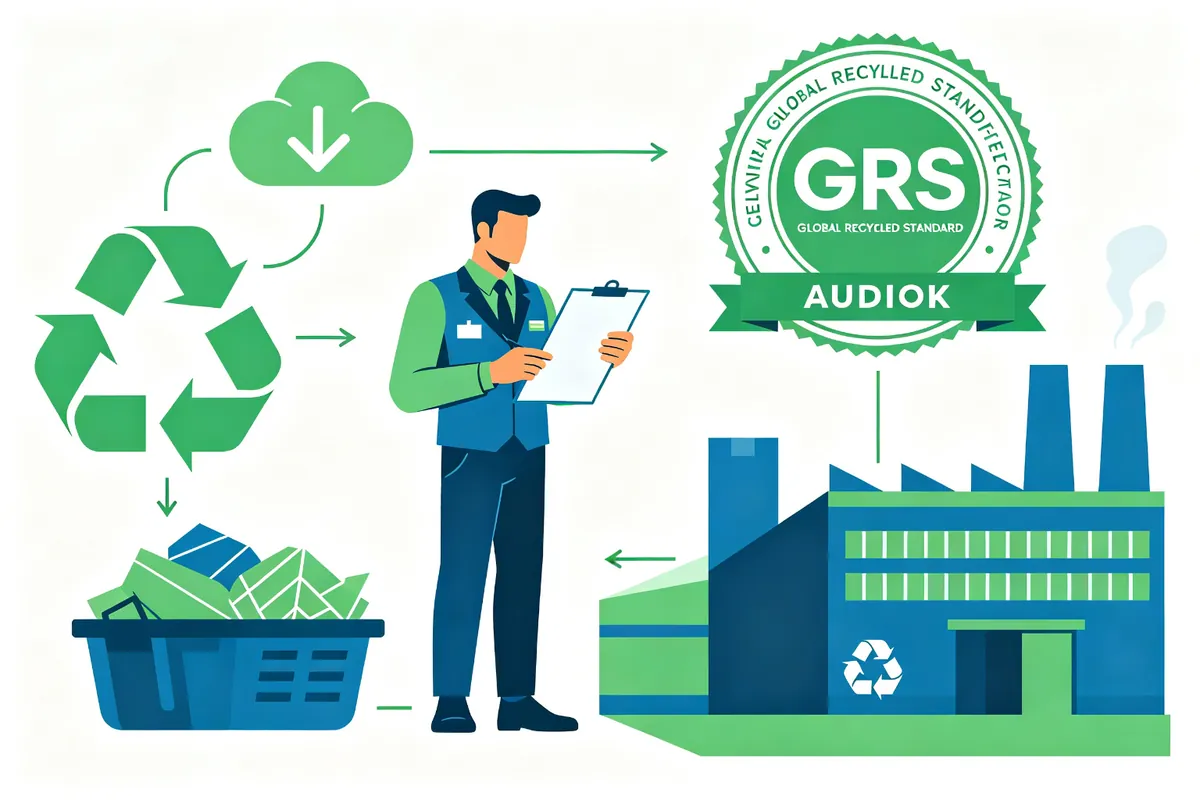
GRS (Global Recycled Standard) is a third-party certification standard administered by Textile Exchange that verifies the recycled content of textile and apparel products, ensures full supply chain traceability from recycled material input to finished product, and sets requirements for social compliance, environmental management, and chemical restrictions. To make "recycled" claims on products, a product must contain a minimum of 20% recycled material verified through GRS, with specific labeling tiers for 20% (GRS logo with percentage), 50% (GRS logo with percentage), and 100% (GRS logo with "100% Recycled" claim). Every facility in the supply chain — from the recycling plant through yarn spinning, fabric weaving, dyeing, and final bag assembly — must be independently GRS certified, and each batch of material must be tracked through Transaction Certificates (TCs) that prove the recycled content percentage and chain of custody. For bag buyers, GRS certification is the most credible way to substantiate recycled content claims, meet retailer sustainability requirements, and avoid greenwashing accusations — but it requires verifying that your factory AND their material suppliers are all GRS certified, not just the final assembly factory.
What is GRS (Global Recycled Standard)?
The Global Recycled Standard (GRS) was originally developed by Control Union Certifications in 2008 and transferred to Textile Exchange (a global nonprofit focused on sustainable textile supply chains) in 2011. The standard was created to address the growing problem of "greenwashing" in recycled content claims — before GRS, any manufacturer could claim their product contained recycled material without any third-party verification, leading to widespread fraud and consumer distrust. GRS solves this by requiring: independent third-party auditing of every facility in the supply chain; physical segregation of GRS-certified material from non-certified material during production; documented chain of custody through Transaction Certificates at every transfer between facilities; and verification of recycled content percentage through mass balance accounting. The current version is GRS 4.0 (published in 2017, with periodic clarifications), and a GRS 5.0 revision is under development with expected publication in 2026-2027.
GRS applies to any product containing at least 20% recycled material, including textiles, apparel, bags, accessories, home textiles, and packaging. It covers both pre-consumer recycled material (waste generated during manufacturing, such as fabric cuttings, yarn waste, or off-spec production) and post-consumer recycled material (waste generated after consumer use, such as plastic bottles, used clothing, or industrial waste). For bag manufacturing, the most common GRS material is RPET (recycled polyethylene terephthalate) made from post-consumer plastic bottles, but GRS also covers recycled nylon (ECONYL), recycled cotton, recycled wool, recycled leather, and other recycled fibers. GRS certification is recognized and accepted by major global retailers and brands including H&M, Zara (Inditex), Target, Walmart, Amazon, Patagonia, Adidas, and IKEA as the standard verification for recycled content claims.
GRS Recycled Content Levels: 20%, 50%, and 100%
GRS certification has three primary recycled content tiers, each with specific labeling and claim requirements. The minimum threshold for any GRS certification is 20% recycled content — products below 20% cannot use the GRS logo or make GRS-certified recycled claims (though they may still use RCS — Recycled Claim Standard — which has a 5% minimum threshold but less stringent requirements). The 20% tier allows use of the GRS logo with the specific recycled percentage stated (e.g., "20% Recycled" or "Made with 30% Recycled Material"), and is common for products where recycled material is blended with virgin material for cost or performance reasons. The 50% tier allows the same GRS logo usage with percentage, and represents a meaningful sustainability commitment where recycled material is the majority component — many retailers' "sustainable product" programs require at least 50% recycled content for preferential placement.
The 100% tier is the highest GRS certification level, where the entire product (or the specified component, such as the shell fabric) is made from 100% recycled material. Products with 100% GRS certification can use the GRS logo with "100% Recycled" claims and are eligible for the strongest sustainability marketing. It is important to understand that GRS recycled content is calculated per component, not per entire product — for example, a backpack might have 100% GRS RPET shell fabric but use virgin polyester lining, non-recycled zippers, and plastic buckles, in which case the overall product recycled content might be 60-70% and the GRS claim would specify "Shell: 100% GRS Recycled Polyester" rather than "100% Recycled Bag." Always clarify with your factory exactly which components are GRS certified and what the overall product recycled percentage is — misleading claims about total product recycled content when only the shell is certified is a common greenwashing pitfall.
What Does GRS Certification Cover?
| Requirement Area | What GRS Requires | How It's Verified |
|---|---|---|
| Recycled Content | Minimum 20% recycled material; verified percentage per component; mass balance accounting of inputs vs outputs | Input-output reconciliation, Transaction Certificates, material testing (optional) |
| Chain of Custody | Full traceability from recycled material input to finished product; every transfer documented with Transaction Certificate | TC review at each supply chain stage; physical segregation inspection |
| Material Segregation | GRS material must be physically separated from non-GRS material during storage, cutting, and production to prevent mixing | Visual inspection of storage areas, production lines, and work-in-progress |
| Social Compliance | Fair labor practices, no child labor, safe working conditions, right to collective bargaining, no discrimination — aligned with ILO standards | Worker interviews, payroll review, facility inspection, policy documentation |
| Environmental Management | Wastewater management and treatment, energy use monitoring, waste segregation and recycling, hazardous material handling | Environmental permit review, wastewater test results, waste disposal records |
| Chemical Restrictions | Compliance with GRS ZDHC (Zero Discharge of Hazardous Chemicals) Manufacturing Restricted Substances List (MRSL) | Chemical inventory review, SDS verification, wastewater testing for restricted substances |
| Labeling and Claims | Correct GRS logo usage, accurate recycled percentage claims, no misleading "eco" or "green" claims without basis | Label and packaging review, marketing material audit |
| Documentation | Complete records of material inputs, production outputs, TCs, supplier certifications, and audit reports retained for 5 years | Document review during annual audit |
The GRS Certification and Audit Process
GRS certification is granted by independent, accredited certification bodies (CBs) that have been approved by Textile Exchange to conduct GRS audits. The major GRS certification bodies include Control Union Certifications, ICEA (Istituto per la Certificazione Etica e Ambientale), IDFL (International Down and Feather Laboratory), and SGS. The certification process for a single facility typically takes 4-8 weeks from application to certificate issuance, and involves the following steps:
Application and Document Review
The facility submits an application to a certification body, including company registration documents, production process descriptions, supplier lists, material flow diagrams, and existing certifications. The CB reviews these documents for completeness and assigns an auditor.
On-Site Audit
An auditor visits the facility to verify: physical segregation of GRS material, production records and input-output reconciliation, social compliance (worker interviews, payroll, conditions), environmental management (permits, wastewater, waste), chemical management, and labeling practices. The audit typically takes 1-3 days depending on facility size.
Corrective Actions (if needed)
If the auditor finds non-conformities (NCs), the facility must implement corrective actions within a specified timeframe (typically 30-90 days depending on severity). Critical NCs (e.g., child labor, no material segregation) must be corrected immediately and may require a re-audit. Minor NCs can be corrected with documented evidence.
Certificate Issuance
After all non-conformities are resolved, the certification body issues a GRS certificate valid for 1 year. The certificate specifies: the certified facility name and address, the scope of certification (products, materials, processes), the certification body, the issue and expiry dates, and the certificate number. The certificate must be renewed annually through a surveillance audit.
Annual Surveillance Audit
GRS certification requires annual re-certification through a surveillance audit, which is similar to the initial audit but may be shorter if no major issues were found previously. Facilities must maintain continuous compliance — if a surveillance audit finds critical non-conformities, the certificate can be suspended or revoked.
Transaction Certificates (TCs): How Supply Chain Traceability Works
Transaction Certificates (TCs) are the core mechanism that ensures GRS supply chain traceability and prevents fraud. A Transaction Certificate is a document issued by a certified facility's certification body that verifies: the quantity and type of GRS-certified material being transferred, the recycled content percentage, the supplier (certified facility), the buyer (must also be a certified facility), the date of transfer, and the unique TC number. Every time GRS material moves from one facility to another — from recycling plant to yarn spinner, from yarn spinner to fabric mill, from fabric mill to dye house, from dye house to bag factory — a Transaction Certificate must be issued by the supplier's certification body and received by the buyer. The buyer's certification body will verify that the TC matches the actual material received, and the chain of custody is maintained.
For bag buyers, this means that when you place a GRS-certified production order, you should request a Transaction Certificate for your specific order from the bag factory. The TC will show: the bag factory as the supplier, you (or your importing entity) as the buyer, the quantity of bags produced, the recycled content percentage, and the TC number. This TC is your proof that the specific batch of bags you received contains the claimed recycled content and was produced through a certified supply chain. You can use the TC number to verify the certificate through the certification body's online verification system (most CBs provide public certificate lookup). Without a Transaction Certificate for your specific order, a factory's GRS certificate alone does not prove that YOUR order contains GRS material — the factory could be certified but produce your order with non-GRS material (a common fraud). Always request the TC for your order and verify it before accepting delivery.
GRS vs RCS vs OEKO-TEX: Which Certification Do You Need?
GRS is the most comprehensive recycled content certification, but it is not the only standard in the market. Understanding the differences helps you choose the right certification for your products and avoid paying for unnecessary certification.
- GRS (Global Recycled Standard): Minimum 20% recycled content, full supply chain traceability through TCs, social compliance requirements, environmental management requirements, chemical restrictions (ZDHC MRSL), third-party auditing. The gold standard for recycled content claims, accepted by all major retailers. Best for brands making strong recycled content claims or selling to retailers requiring GRS.
- RCS (Recycled Claim Standard): Also administered by Textile Exchange, minimum 5% recycled content, supply chain traceability through TCs, but NO social compliance, environmental, or chemical requirements — only verifies recycled content and chain of custody. Less expensive and easier to obtain than GRS. Best for brands that only need to verify recycled content without the broader sustainability requirements, or for products below 20% recycled content (which cannot be GRS certified).
- OEKO-TEX Standard 100: NOT a recycled content certification — tests finished textile products for harmful substances (pH, formaldehyde, heavy metals, azo dyes, etc.) and certifies that the product is harmless to human health. Does not verify recycled content or supply chain traceability. Best for brands making "skin-safe" or "chemical-free" claims, often used in combination with GRS for products requiring both recycled content and safety verification.
- SCS Global Services Recycled Content: An alternative recycled content certification by SCS, similar to RCS in scope (verifies recycled content percentage) but with different auditing procedures. Less widely recognized than GRS/RCS in the textile industry but accepted by some retailers.
For most bag brands making recycled content claims, GRS is the best choice because it is the most widely recognized and accepted by retailers. If your product contains less than 20% recycled material, RCS is the appropriate standard. If you also want to make chemical-safety claims, add OEKO-TEX Standard 100 certification in addition to GRS. Avoid certifications that are self-reported or not third-party audited — these have no credibility with retailers or consumers and expose your brand to greenwashing accusations.
How to Verify a Factory's GRS Certification
Verifying a factory's GRS certification is a critical step that many buyers skip, leading to unpleasant discoveries later (the factory's certificate expired, the certificate doesn't cover their product category, or the factory is certified but their fabric supplier is not). To properly verify GRS certification, follow these steps: (1) Request a copy of the factory's current GRS certificate — check the certificate number, issuing body, scope (does it cover bags/accessories and the materials you need?), issue date, and expiry date. (2) Verify the certificate through the issuing certification body's online verification portal — Control Union, ICEA, IDFL, and SGS all provide public certificate lookup by certificate number. This confirms the certificate is genuine and not forged. (3) Ask the factory for the names and GRS certificate numbers of their material suppliers (yarn spinner, fabric mill, dye house) — the factory being GRS certified is NOT sufficient; every upstream supplier must also be GRS certified for the chain of custody to be valid. (4) Request a sample Transaction Certificate from a recent GRS order to confirm the factory can actually issue TCs (some factories are certified but have never completed a GRS order and may struggle with the TC process). (5) During your production order, require the factory to provide a Transaction Certificate for YOUR specific batch before shipment, and verify the TC number with the certification body.
Common red flags to watch for: the factory's GRS certificate only covers "trading" or "warehousing" rather than manufacturing (meaning they are a trading company, not a production factory); the certificate scope lists "textile fabrics" but not "bags" or "finished products" (the factory may be certified for fabric production but not bag assembly); the certificate is issued by a non-accredited body (only Textile Exchange-approved certification bodies can issue valid GRS certificates); the factory cannot provide upstream supplier GRS certificates (they may be buying non-GRS fabric and relabeling it as GRS — a serious fraud); or the factory is reluctant to issue a Transaction Certificate for your order (they may not actually be using GRS material for your production). If any of these red flags appear, ask for clarification or consider an alternative supplier — GRS fraud is not uncommon and can result in your products being rejected by retailers or subject to regulatory action for false claims.
Cost and Timeline for GRS-Certified Production
GRS certification adds cost at every stage of the supply chain, and these costs are ultimately passed to the buyer. The certification cost components include: certification body fees for each facility ($1,500-$5,000 per facility per year, depending on facility size and CB), audit costs (travel and auditor time, $500-$2,000 per audit), administrative costs for maintaining segregation and documentation (labor and systems), and the higher cost of GRS-certified raw materials (RPET fabric costs 15-25% more than virgin polyester, as discussed in our RPET vs virgin polyester comparison). For a bag factory that is already GRS certified, the incremental cost per bag for GRS production is typically $0.30-$1.50 per bag (depending on bag size and material quantity), plus the higher material cost. For a factory that is NOT yet GRS certified, obtaining certification for the first time costs $3,000-$8,000 total (application, audit, corrective actions) and takes 4-8 weeks — some factories will absorb this cost if you commit to a large enough order (typically 5,000+ pieces), while others will require a certification fee contribution or higher unit price to amortize the cost.
The timeline for GRS-certified production is also longer than standard production because of the additional documentation and TC process. Typical timeline: 1-2 weeks for material sourcing and supplier GRS verification (confirming upstream suppliers have valid certificates and available GRS material), 1-2 weeks for sample development and approval, 2-3 weeks for material production (GRS fabric may have longer lead times because it is produced in segregated batches), 3-4 weeks for bag production (with segregated production lines and documentation), and 1-2 weeks for final inspection, TC issuance, and shipping. Total timeline from order confirmation to shipment: 8-12 weeks for GRS-certified bags, compared to 5-8 weeks for standard non-GRS production. If you are working with a factory that is already GRS certified and has GRS material in stock, the timeline can be shorter (6-8 weeks). Always build extra time into your production schedule for GRS orders — the TC process in particular can cause delays if the factory or their suppliers are inexperienced with GRS documentation.
Conclusion
GRS (Global Recycled Standard) certification is the most credible and widely accepted third-party verification for recycled content claims in textile and bag products. It requires minimum 20% recycled content, full supply chain traceability through Transaction Certificates, social compliance, environmental management, and chemical restrictions — all verified through annual third-party audits. For bag buyers, GRS certification enables credible recycled content marketing, meets retailer sustainability requirements, and protects against greenwashing accusations. However, GRS requires diligence: you must verify that your factory AND all upstream material suppliers are GRS certified, request Transaction Certificates for your specific production batches, and build additional cost (15-25% material premium + $0.30-$1.50/bag certification cost) and time (8-12 weeks vs 5-8 weeks) into your planning. For brands serious about sustainability and recycled content claims, GRS is an essential investment that provides credibility, market access, and protection from the growing risk of greenwashing regulation and consumer backlash.
Need GRS-Aligned Bag Manufacturing with Full Traceability?
We work with a GRS-aligned supply chain across bag assembly and maintain verified upstream supply chains for RPET fabric. Get Transaction Certificates for every order and verified recycled content documentation within 8 Hours.
Request GRS-Aligned Bag Production & Quote