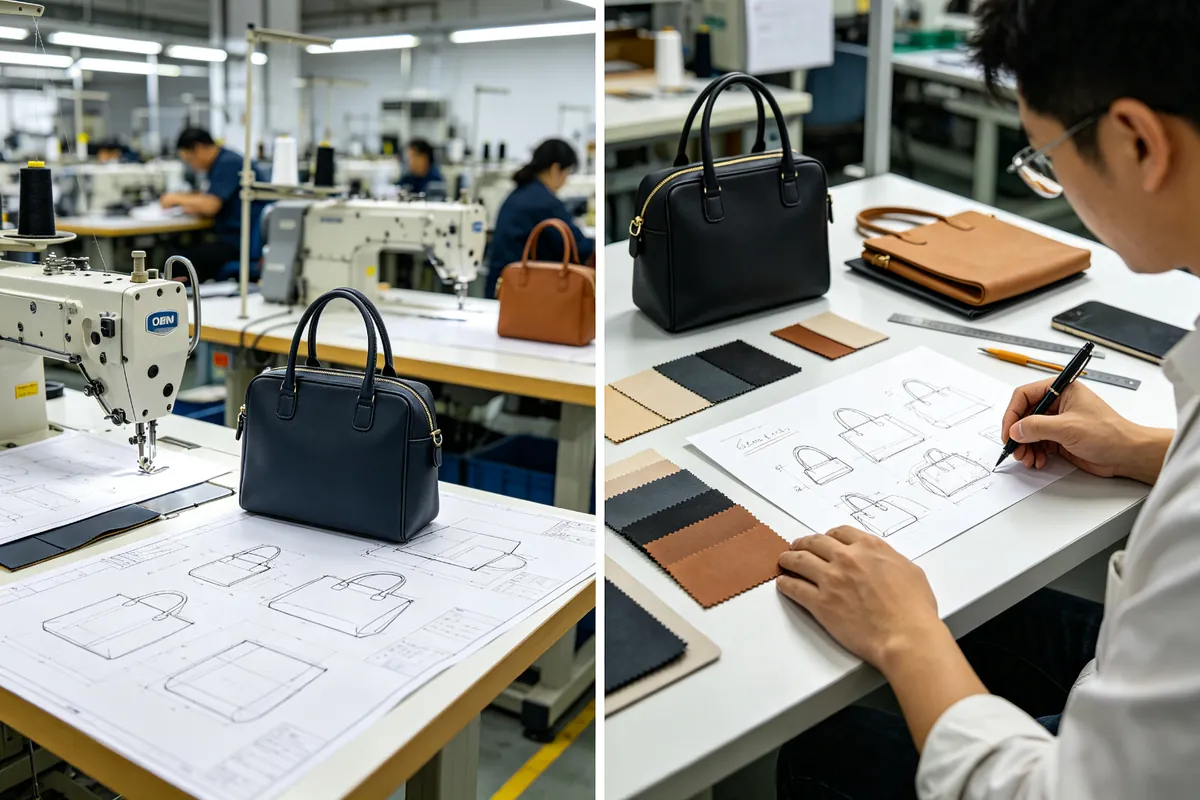
OEM (Original Equipment Manufacturer) means you provide the complete design and specifications, and the factory produces your bags exactly to your design — you retain full design ownership and IP. ODM (Original Design Manufacturer) means the factory provides existing designs from their catalog, and you customize elements like logo, color, material, or hardware — the factory retains the base design IP. Choose OEM if you have unique designs, need full brand differentiation, and can absorb higher development costs and longer lead times. Choose ODM if you want faster time-to-market, lower development costs, and are comfortable modifying proven existing designs. Many brands use a hybrid approach: ODM for initial product launches to test market demand, then OEM for signature products once the brand is established.
What is OEM Bag Manufacturing?
OEM manufacturing, also called "private label manufacturing" or "contract manufacturing," is a model where the buyer (your brand) provides a complete product design — including technical drawings, material specifications, hardware requirements, construction details, and packaging design — and the factory produces the product exactly to those specifications. The factory's role is purely manufacturing: they source materials per your bill of materials (BOM), cut and assemble the bags, conduct quality control, and package them with your branding. You retain full ownership of the design and any associated intellectual property (trademarks, design patents, copyrights). The factory cannot sell your design to other clients without your permission, and you can take your design to any factory for production.
OEM is the standard model for established brands with in-house design teams, or for brands that have developed unique product features or aesthetics that differentiate them from competitors. For example, a brand that has designed a backpack with a patented suspension system or a unique organizational structure would use OEM manufacturing to ensure the design is produced exactly as intended. OEM typically requires higher upfront investment in design development, sampling (often 2-3 rounds to perfect the construction), and custom tooling (molds for plastic hardware, printing plates, cutting dies). Production lead times are longer because the factory must set up a new production line for your unique design, and MOQs are typically higher (500-1000 pieces minimum) because the factory needs to recover setup costs.
OEM at a Glance
Best for: Brands with unique designs, established product lines, full design teams
Design ownership: Buyer retains full IP
Development cost: High ($500-$5000+ for samples, tooling, plates)
Sample rounds: 2-4 rounds typical
Production lead time: 30-45 days
Typical MOQ: 500-1000 pieces
Unit price: Lower at scale (no design royalty)
What is ODM Bag Manufacturing?
ODM manufacturing, also called "white label manufacturing" or "private label with factory designs," is a model where the factory has already developed a catalog of existing bag designs, and you select a design from their catalog and customize it with your branding. Customization typically includes: your logo (printed, embroidered, or woven label), custom colors (within the factory's available fabric colors or custom-dyed for larger orders), material upgrades or downgrades, hardware changes (zipper color, buckle type), and sometimes minor structural modifications (adding a pocket, changing strap length). The factory retains ownership of the base design — they can sell the same design (with different branding) to other clients, and you typically cannot patent or exclusively protect the base design. Your IP is limited to your brand name, logo, and any custom modifications you specifically commission.
ODM is the ideal model for new brands, startups, or brands that want to quickly add products to their lineup without investing in design development. Because the factory has already developed and tested the design, there is no need for multiple sample rounds — you typically receive one sample for approval, and production can begin immediately. Development costs are minimal or zero (some factories charge a small logo setup fee of $30-$100), and MOQs are often lower (300-500 pieces) because the factory is using existing patterns and cutting dies. The tradeoff is that your product will not be unique — competitors can source the same or very similar designs from the same factory, and your differentiation is limited to branding, color choices, and minor customizations. ODM is common for cosmetic bags, tote bags, and other categories where design differentiation is less critical than branding and price.
ODM at a Glance
Best for: New brands, startups, quick product line extensions, price-sensitive markets
Design ownership: Factory retains base design IP; buyer owns branding and custom mods
Development cost: Low ($0-$300 for logo setup)
Sample rounds: 1 round typical
Production lead time: 15-25 days
Typical MOQ: 300-500 pieces
Unit price: Slightly higher (factory recovers design investment)
OEM vs ODM: Side-by-Side Comparison
| Factor | OEM (Your Design) | ODM (Factory Design) |
|---|---|---|
| Design source | Buyer provides complete design, tech pack, BOM | Factory provides catalog designs; buyer selects and customizes |
| IP ownership | Buyer owns full design, can patent, can move to any factory | Factory owns base design; buyer owns branding and custom modifications only |
| Exclusivity | Factory cannot sell your design to others (contractual) | Factory can sell same base design to any client (no exclusivity unless negotiated) |
| Development cost | $500-$5,000+ (samples, tooling, molds, printing plates) | $0-$300 (logo setup fee only) |
| Sample rounds | 2-4 rounds typical (construction refinement) | 1 round typical (branding confirmation) |
| Sample lead time | 10-20 days per round | 5-10 days |
| Production lead time | 30-45 days after PPS approval | 15-25 days after sample approval |
| Minimum order quantity | 500-1,000 pieces per design/color | 300-500 pieces per design/color |
| Unit price at 1000pcs | Lower (no design royalty, pure manufacturing cost) | 5-15% higher (factory recovers R&D investment) |
| Customization depth | Full — every element customizable (materials, construction, dimensions, features) | Limited — logo, color, material swaps, minor structural changes |
| Brand differentiation | High — unique product design creates competitive barrier | Low — competitors can source identical or near-identical products |
| Time to market | Slow (60-90 days from design to delivery) | Fast (30-45 days from selection to delivery) |
| Risk profile | Higher — design may not sell, development costs sunk if cancelled | Lower — proven design, minimal upfront investment, easy to pivot |
| Best for brand stage | Established brands with design capability, signature products | New brands, startups, test marketing, line extensions, promotional products |
When to Choose OEM for Your Bag Brand
OEM is the right choice when product design is a core part of your brand identity and competitive strategy. Choose OEM if: you have an in-house design team or work with a freelance designer who can create complete technical packages; your product has unique features, construction methods, or aesthetic elements that competitors cannot easily copy; you need full control over every material and component for quality or sustainability reasons (e.g., specific GRS-certified RPET fabric, YKK zippers, custom-molded hardware); you plan to order in sufficient quantity to amortize development costs (typically 1000+ pieces per design); and you want to build a product portfolio that cannot be replicated by competitors sourcing from the same factory. OEM is also necessary if you intend to apply for design patents or if your brand's marketing story centers on unique product innovation.
For example, a brand specializing in technical cooler bags with a proprietary insulation system would need OEM manufacturing because the insulation construction is unique and not available in any factory's ODM catalog. Similarly, a luxury brand with signature hardware, custom lining patterns, and proprietary construction methods would use OEM to ensure brand consistency and exclusivity. The key question to ask: if a competitor could buy the exact same bag from the same factory with their logo on it, would that damage your brand? If yes, you need OEM.
When to Choose ODM for Your Bag Brand
ODM is the right choice when speed, cost efficiency, and low risk are more important than product uniqueness. Choose ODM if: you are a new brand or startup with limited capital and want to test market demand before investing in custom design; you need to add products to your lineup quickly for a seasonal launch, trade show, or promotional campaign; your brand differentiation comes from branding, marketing, and customer experience rather than unique product design; you are targeting price-sensitive markets where product uniqueness is less important than competitive pricing; or you want to validate a product category before committing to OEM development. ODM is also ideal for promotional products, corporate gifts, and private label programs where the client's logo is the primary customization.
For example, a new brand launching a line of fashion waist bags might start with ODM to get products to market quickly, test which styles sell best, and build brand awareness — then transition to OEM for their best-selling styles once they have sales data and capital to invest in custom design. Many successful DTC brands follow this path: ODM for initial launch and market validation, OEM for signature products and brand-defining pieces. The key question to ask: is the primary value of this product the design itself, or is it the brand, price, and convenience? If the latter, ODM is sufficient.
The Hybrid Approach: OEM Base with ODM Customization
Many brands use a hybrid model that combines elements of both OEM and ODM, often called "semi-OEM" or "ODM with deep customization." In this model, you select an ODM design from the factory's catalog as a starting point, then commission significant custom modifications that go beyond standard ODM customization — for example: changing the bag's dimensions, adding new compartments or features, specifying custom materials not in the factory's standard catalog, or creating custom-molded hardware. These modifications are typically developed jointly by you and the factory, with IP ownership negotiated in the contract. The hybrid approach offers a middle ground: lower development costs and faster lead times than pure OEM (because you are starting from a proven base design), but more product uniqueness than pure ODM (because the modifications make the product meaningfully different from the catalog version).
Hybrid is particularly suitable for brands that have outgrown pure ODM but are not ready for full OEM investment. For example, a brand that has been selling an ODM duffel bag successfully might commission a hybrid version with custom dimensions, an added shoe compartment, custom lining with their brand pattern, and custom zipper pulls — creating a product that is recognizably theirs while still leveraging the factory's existing base pattern and production setup. When negotiating hybrid projects, it is critical to clarify IP ownership in writing: who owns the modifications, can the factory sell the modified design to other clients, and what are the terms if you move production to another factory?
IP Protection: What You Need to Know
Intellectual property protection is the most significant legal difference between OEM and ODM, and it is often misunderstood by new importers. In OEM, you own the design by default — you created it, and the factory is merely producing it under contract. However, you should still include IP protection clauses in your manufacturing contract: confirm that the factory cannot use your design for other clients, cannot display your products in their showroom or on their website without permission, and must return or destroy all design files, patterns, and samples upon contract termination. You should also consider registering design patents in your target markets (US design patent, EU Community Design, Chinese design patent) for your most important products, especially if the design has unique aesthetic features.
In ODM, the factory owns the base design, and your IP is limited to your brand name, logo, and any custom modifications you specifically commission and pay for. This means the factory can sell the same base design to your competitors — and they often do. If exclusivity is important to you, you can negotiate an exclusivity clause in your ODM contract: the factory agrees not to sell that specific design (or that design with specific modifications) to other clients in your market for a defined period. Exclusivity typically comes at a cost — either a higher unit price, a higher MOQ, or an exclusivity fee — because the factory is forgoing sales to other clients. Always get exclusivity in writing with clear terms: which designs, which markets, what duration, and what penalty for breach. Without a written exclusivity agreement, assume the factory can and will sell the same design to others.
Conclusion
The choice between OEM and ODM is not an either-or decision — most successful brands use both models at different stages and for different product categories. OEM offers full design ownership, maximum brand differentiation, and lower unit prices at scale, but requires higher upfront investment, longer lead times, and higher MOQs. ODM offers fast time-to-market, minimal development costs, and lower risk, but provides limited product uniqueness and no base design IP ownership. The hybrid approach offers a middle ground for brands that want more customization than ODM provides without the full investment of OEM. The right choice depends on your brand stage, design capability, budget, time-to-market requirements, and competitive strategy. As a general framework: start with ODM to validate market demand and build capital, transition to hybrid for your best-selling products, and use OEM for signature, brand-defining pieces that justify the investment.
Not Sure Whether OEM or ODM Is Right for You?
We offer both OEM and ODM manufacturing with flexible customization. Tell us about your product idea and brand stage — we'll recommend the right model and provide a quotation within 8 Hours.
Get Manufacturing Advice