Getting custom bags made follows a 9-step process: define your specifications, choose between OEM and ODM, vet and select factories, request and compare quotations, order and evaluate physical samples, approve a pre-production sample, run production with 30/70 payment terms, conduct third-party quality inspection, and arrange shipping. The full journey from first inquiry to delivered inventory takes 8-14 weeks, with a typical cost of $2,500-$15,000 for a 500-piece first order at $3-$10 per unit. This guide is written from the factory floor specifically for first-time buyers who have never gone through a custom manufacturing process, and it includes the exact documents, numbers, and red flags you need at every step.
This guide is the end-to-end production walkthrough in our four-part custom bag series. If you are a first-time buyer who needs the full journey from spec sheet to delivered stock, start here. The other guides go deeper on specific decisions:
- How to Choose a Bag Manufacturer — a 4-phase evaluation framework and 12-point scoring sheet for vetting factories
- How to Source Custom Bags from China — sourcing channels, MOQ negotiation, shipping and customs clearance
- How to Start a Bag Brand — positioning, budgeting and launch planning before you order
Why the Manufacturing Process Matters for First-Time Buyers
Most sourcing failures are not caused by bad factories — they are caused by buyers who do not understand the process. A buyer who does not know what a pre-production sample is cannot demand one. A buyer who does not know what AQL 2.5 means cannot insist on proper inspection. A buyer who does not know the difference between OEM and ODM cannot negotiate ownership of their design. This guide closes those knowledge gaps. By the end, you will be able to communicate with any bag factory like someone who has done this before, ask the right questions, and avoid the mistakes that cost first-time buyers time and money.
Step 1: Define Your Specifications
Write Down Every Detail Before You Contact a Factory
The manufacturing process cannot begin until you know exactly what you want. Your spec sheet needs to pin down every variable that affects cost and quality. Beyond the obvious — dimensions in cm and inches, primary fabric (say 600D polyester, 210D nylon, or 12oz canvas), lining and its color, zipper brand and size (YKK #5/#8 or generic), hardware (POM plastic, zinc alloy, snap hooks), and strap width plus material — include the decoration route (silkscreen, heat transfer, embroidery, woven label, or debossed logo), logo placement and size, target MOQ, a target unit price range, and any functional must-haves such as water resistance, insulation, RFID blocking, or a laptop sleeve. If you are not sure about materials, write "factory recommendation for [function] at [price point]" — an experienced factory will propose 2-3 options at different price tiers. This one document saves more time than any other step in the entire process.
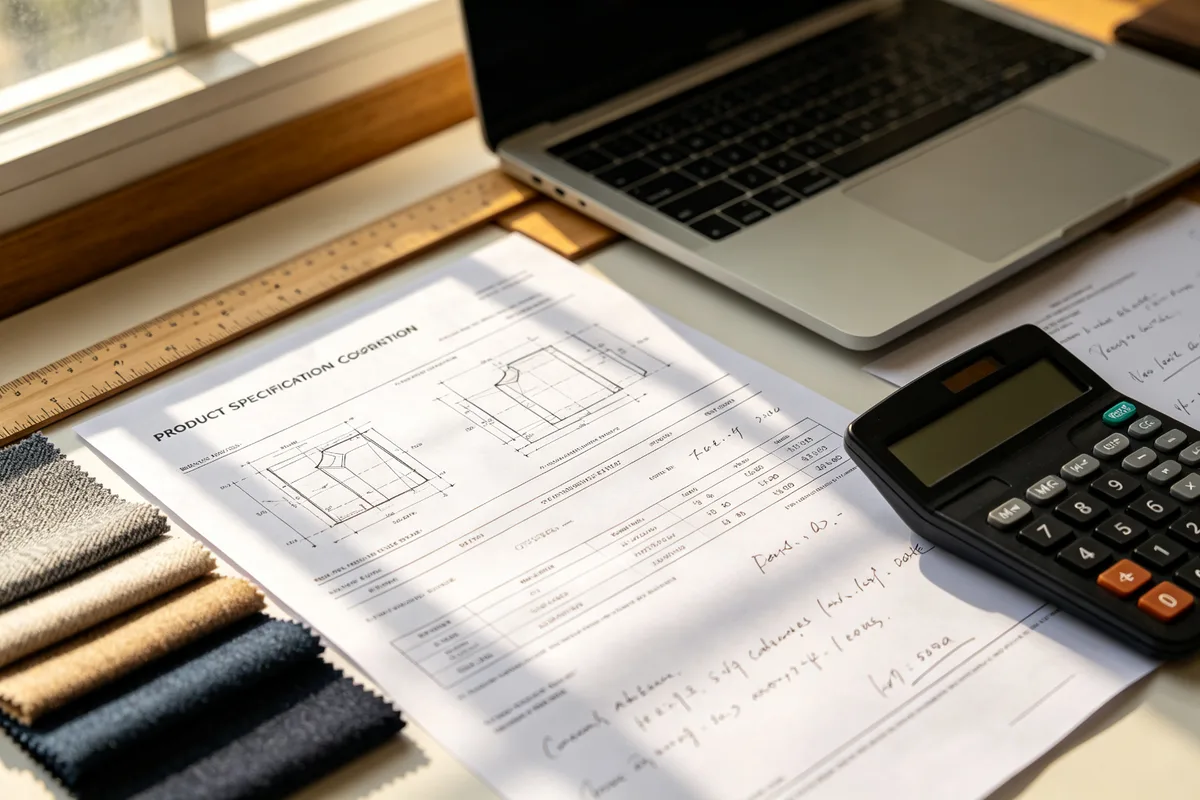
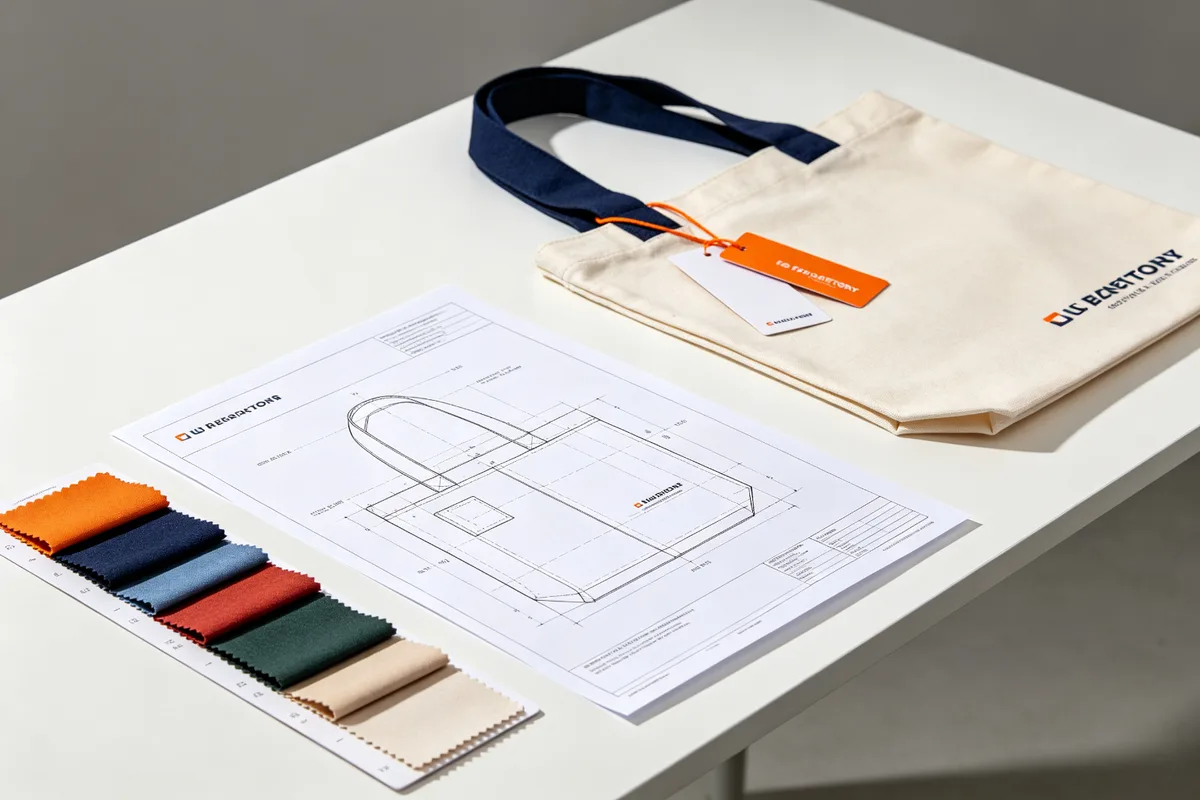
Step 1-4: A complete spec sheet plus a line-by-line quotation comparison is the foundation of a smooth manufacturing process.
Step 2: Choose Between OEM and ODM
Two Manufacturing Models, Two Very Different Outcomes
Before you contact any factory, you need to decide which manufacturing model fits your situation. OEM (Original Equipment Manufacturing) means you provide the full design — your specifications, your design files, your intellectual property — and the factory manufactures it to your spec. This gives you complete design ownership and a product that is exclusive to your brand, but it costs more per unit and requires more upfront design work. ODM (Original Design Manufacturing) means you select an existing factory design, customize the color, material, and branding, and put your logo on it. This is faster and cheaper, and the factory has already solved the design and production problems, but your product is not exclusive — the same base design may be sold to other brands. For first-time buyers, ODM is often the safer entry point if you are not confident in your design skills, while OEM is the right choice if you have a clear, differentiated vision. Our detailed OEM vs ODM comparison walks through the full cost, lead time, and IP implications.
Step 3: Vet and Select Factories
Find Bag Specialists, Not Generalists or Trading Companies
Build a shortlist of 5-8 factories through B2B platforms (Alibaba.com, Global Sources, Made-in-China.com), trade shows (Canton Fair, Hong Kong APLE), or industry referrals. Screen for bag specialists — at least 70% of their listed products should be bags, not a mix of electronics, clothing, and home goods (that mix is the signature of a trading company). A factory that primarily makes cosmetic bags may not have the equipment for technical backpacks with load-bearing structures. Put each candidate through five checks: business license (verify the registration number), factory photos (entrance, production floor, QC department), certification list (BSCI, ISO9001, Sedex, GRS), client references in your region, and product category match. A legitimate factory provides all five without hesitation — if a supplier refuses or makes excuses, move on. For a deeper walkthrough of verifying a supplier before you transfer any deposit, read our guide on how to audit a custom bag manufacturer in China, which breaks the verification into a 5-pillar framework and a 10-point checklist.
Step 4: Request and Compare Quotations
Compare Line by Line, Not Just Total Price
Send your spec sheet to your 5-8 factory shortlist and request a detailed quotation. A professional quotation includes: unit price broken down by quantity tiers (500, 1,000, 3,000 pieces), sample cost and sample lead time, production lead time, payment terms, packaging details (polybag, carton dimensions, carton weight), and any additional fees (mold fee, printing plate fee, setup fee). Compare proposals line by line instead of staring at the bottom-line number. A $0.50-per-unit difference may reflect a material downgrade (420D instead of 600D polyester) or a lower-quality zipper (generic instead of YKK), which will surface as returns and brand damage later. Ask each factory to specify exact material grades in their quotation so you can compare apples to apples. Also evaluate response quality — a supplier who answers within 8 Hours with detailed clarifying questions is showing you how they will behave during production. For a full breakdown of where your money goes, see our custom bag cost breakdown.
Step 5: Order and Evaluate Physical Samples
Never Skip the Sample — It Is Your Cheapest Insurance
A prototype for your bag usually runs $50-$200, and many factories drop that charge once you commit to a 500+ piece order. Producing it takes 5-15 working days depending on complexity. Courier delivery via DHL or FedEx adds 3-7 days and $30-$60. When your samples arrive, go through them systematically: material weight and texture against your spec sheet, stitching quality (8-10 even stitches per inch, reinforced stress points), zipper smoothness (open and close 10+ times), hardware durability (buckles click securely, D-rings do not bend under pressure), printing accuracy (color match to your Pantone reference, rub 20 times with a damp cloth), dimensions (tolerance ±1cm), and overall construction (clean lining, correct pocket placement). Order samples from 2-3 of your top candidates and compare them side by side — photographs and descriptions never reveal everything that a physical comparison does. Expect 1-2 revision rounds. If a factory becomes defensive when you point out defects, treat that as a warning about how they will handle quality issues in bulk production.
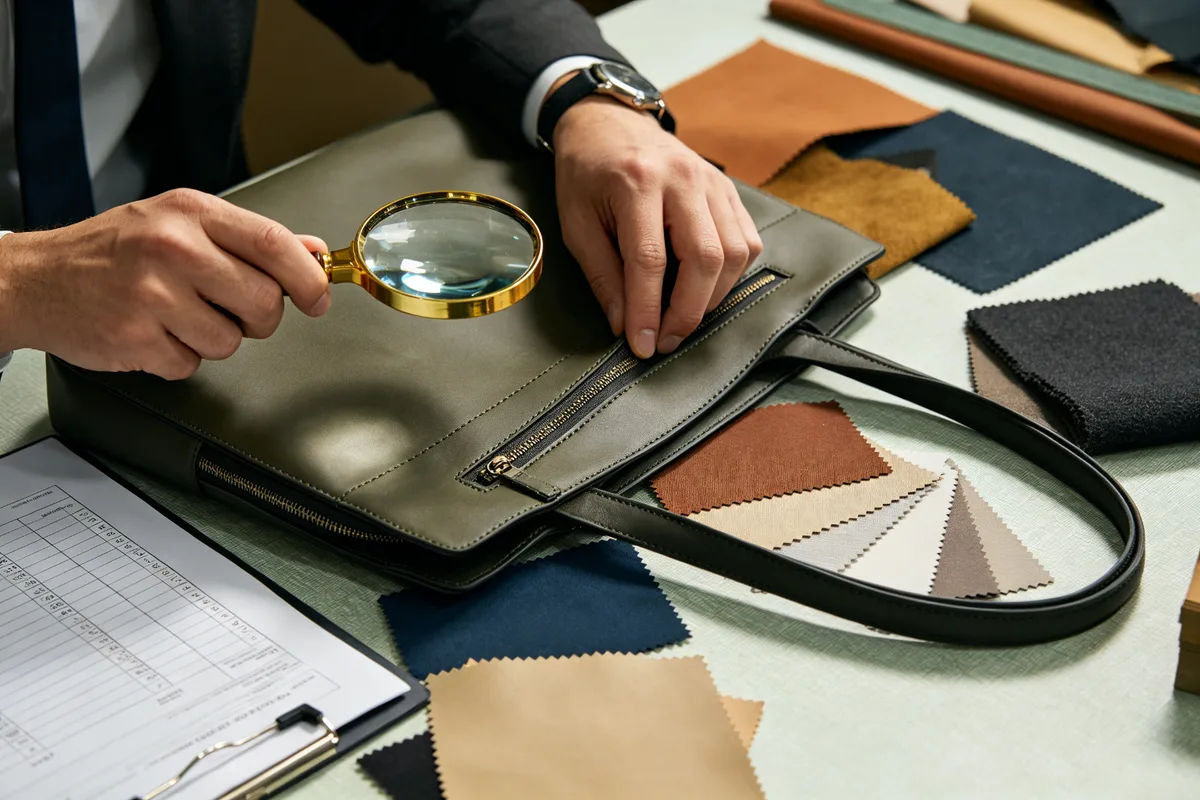
Step 5: A physical sample inspection with a checklist catches issues that photos never will.
Step 6: Approve the Pre-Production Sample
PPS Is Your Contractual Quality Benchmark
After you select a factory and approve your development sample, require a pre-production sample (PPS) before mass production begins. The pre-production sample is built from the same line materials, hardware, and construction as your final run — that is what sets it apart from the development sample, which may have used stand-ins. Sign it off with photos and keep the physical unit as your benchmark for final inspection. Once approved it becomes the agreed quality target; any later change can add cost and push the schedule, so double-check every detail first: dimensions, colors, logo placement, stitch colors, hardware finish, lining, and packaging. This is also the moment to sign the written purchase contract covering unit price, quantity, color breakdown, material specs, lead time, inspection terms, shipping terms, and penalty clauses.
Step 7: Run Production with Safe Payment Milestones
30% Deposit, 70% Before Shipment — Never 100% Upfront
Standard payment terms for Chinese bag factories are 30% deposit upon order confirmation and 70% balance before shipment (after inspection passes). Never pay 100% upfront — this eliminates your leverage for quality issues. Payment methods include bank wire transfer (T/T), PayPal for small amounts under $1,000, and Alibaba Trade Assurance for orders placed through the platform. For orders over $5,000, a letter of credit (L/C) adds protection but costs more in bank fees. During production, request photo updates at three checkpoints: material cutting (confirms the correct fabric arrived), mid-production assembly (confirms the construction matches your PPS), and finished goods before packaging (confirms quantity and quality before boxing). These checkpoints catch problems early, when they can still be corrected without delaying your shipment. Mass production typically runs 20-35 days from deposit receipt and PPS approval.
Step 8: Conduct Final Quality Inspection
AQL 2.5 Random Inspection Before You Pay the Balance
Once production hits 80-100% and the goods are boxed, arrange a final random inspection (FRI). The usual quality bar is AQL 2.5 on major defects and 4.0 on minor defects, with the count of pieces examined scaled to your order size — 80 units for a 501-1,200 piece batch. You can travel to the factory to inspect yourself, or hire a third-party company such as SGS, Bureau Veritas, Intertek, or QIMA. Third-party inspection costs $180-$350 per man-day, and most bag inspections are wrapped up in a single day. The inspection report classifies defects as critical (safety hazards, wrong product), major (functional failures, significant cosmetic defects), or minor (cosmetic issues). If the number of major defects exceeds the AQL threshold, the inspection fails and you can require rework or replacement before shipment. Do not pay the balance or authorize shipment until inspection passes — once goods leave the factory, your leverage drops sharply. This $250 investment is the best insurance in the entire process.
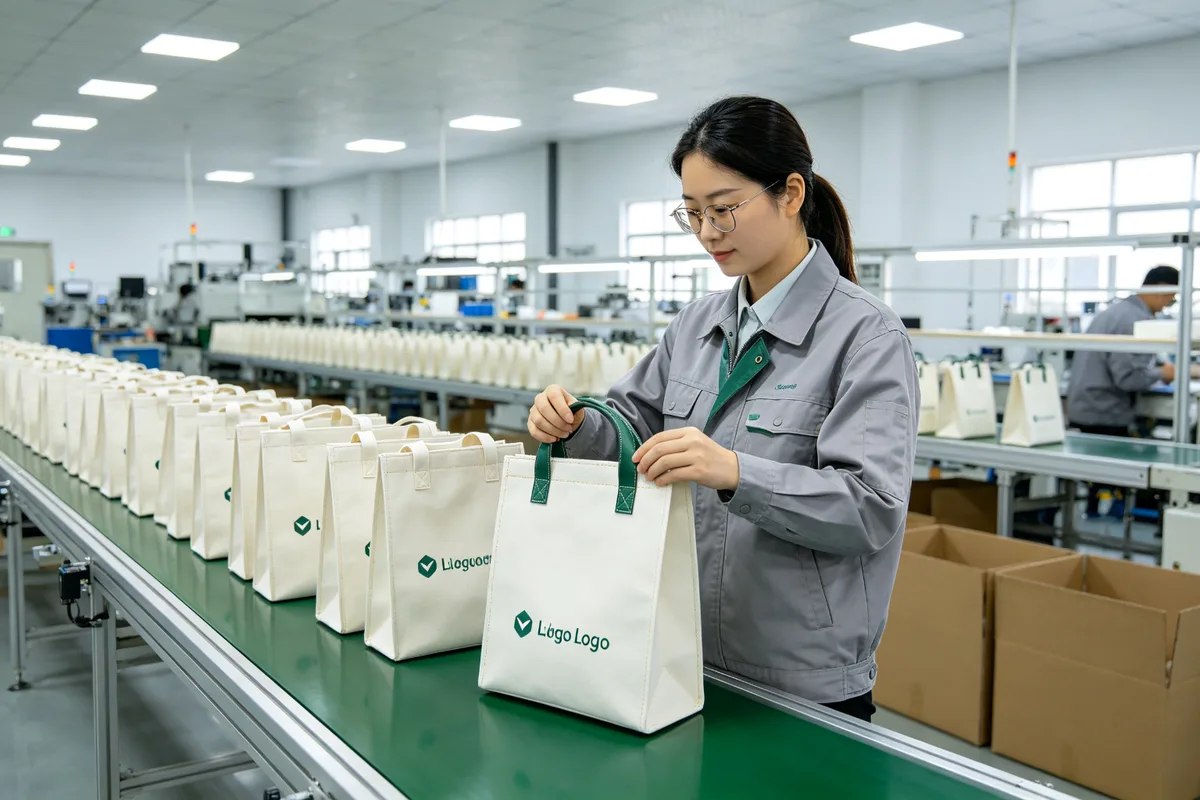
Step 8: A final AQL 2.5 inspection catches defects before your goods leave the factory.
Step 9: Arrange Shipping and Delivery
Sea Freight for Bulk, Air Freight for Urgent, Express for Samples
After inspection passes and the balance is paid, the factory delivers your goods to a freight forwarder or port. Delivery comes down to three modes, each with a different time/cost trade-off. Containerized ocean shipping (LCL shares space, FCL takes a whole 20ft or 40ft container) is the budget pick for full runs and typically lands in 15-35 days. Air cargo cuts that to 5-10 days but at a steep price, so it only makes sense for tight deadlines or compact, valuable shipments. Express couriers like DHL, FedEx, or UPS are the fastest option at 3-7 days door-to-door, yet they are reserved for samples or shipments under roughly 100kg because the per-kilo rate is prohibitive. For most 500+ piece bag orders, sea freight LCL is the standard choice. Work with a freight forwarder experienced in China-to-your-country shipping to handle booking, commercial invoice, packing list, bill of lading, customs declaration, and clearance. Confirm your Incoterms before production — FOB means you handle ocean freight and insurance from the port; CIF means the factory arranges insurance and freight to your destination port; DDP means the factory handles everything to your door including duties and taxes (most expensive, less common for B2B). Ensure your commercial invoice accurately describes the products and HS code — bags typically fall under 4202 for textile or leather bags.
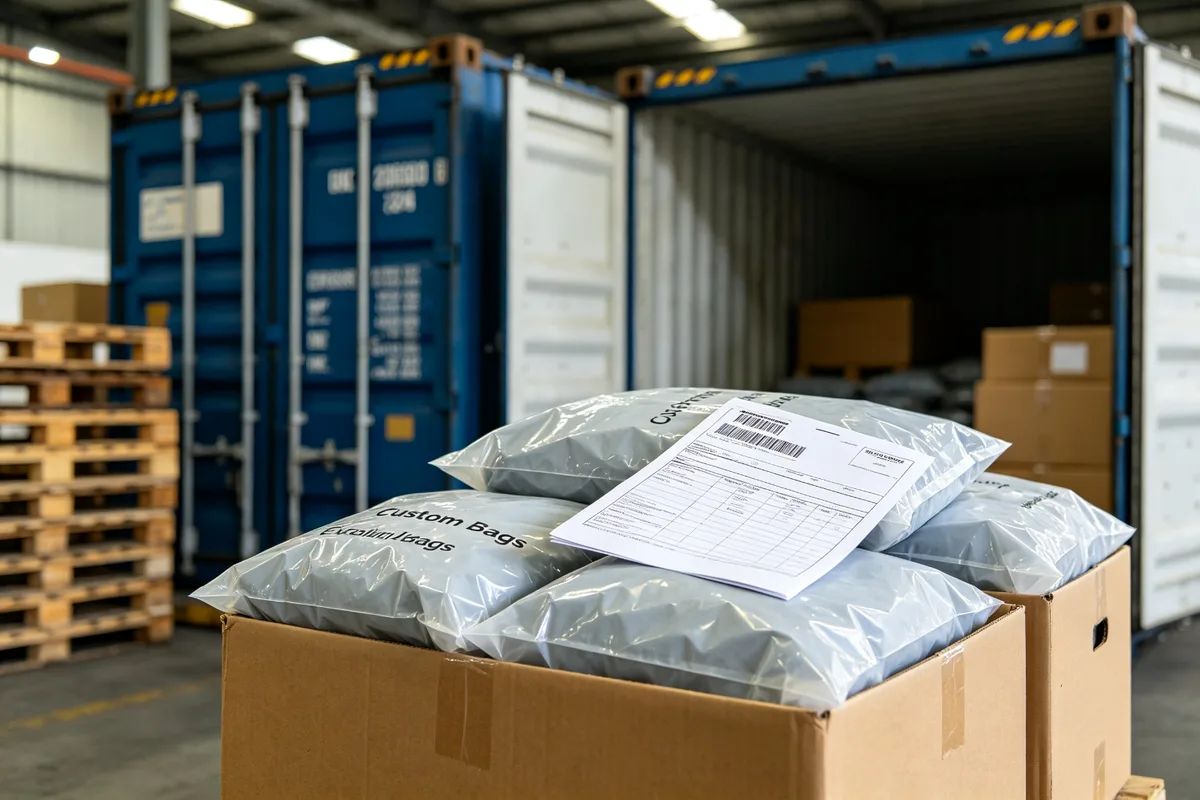
Step 9: Packed cartons, packing list, and freight documentation complete the manufacturing journey.
What It Costs to Get Custom Bags Made
The table below shows realistic cost ranges for a 500-piece first order. These are factory-level figures that first-time buyers can use as a budgeting baseline.
| Cost Item | Lean | Standard | Premium | Notes |
|---|---|---|---|---|
| Sample fees (2-3 factories) | $150 | $300 | $600 | Often refundable on bulk order |
| Production (500pcs at $3-$10/unit) | $1,500 | $3,000 | $5,000 | 30% deposit, 70% before shipment |
| Packaging (polybags, hangtags, cartons) | $150 | $350 | $800 | Custom packaging costs more |
| Third-party inspection | $0 (self-inspect) | $250 | $350 | AQL 2.5, one man-day |
| Sea freight (LCL) + insurance | $400 | $700 | $1,200 | Depends on volume and destination |
| Customs duties & clearance | $200 | $400 | $700 | Varies by country |
| Total | $2,400 | $5,000 | $8,650 | Excludes ongoing operating costs |
First-Time Buyer Timeline
| Stage | Duration | Key Deliverable | Cumulative |
|---|---|---|---|
| Specs & model decision | 1-2 weeks | Spec sheet + OEM/ODM decision | Week 2 |
| Factory vetting & quotations | 1-2 weeks | Shortlist of 2-3 factories, quotes compared | Week 4 |
| Sampling & revisions | 2-4 weeks | Approved physical sample | Week 8 |
| PPS & contract | 1 week | PPS approved, purchase contract signed | Week 9 |
| Mass production | 3-5 weeks | Production complete, ready for inspection | Week 14 |
| Inspection & shipping | 2-5 weeks | Inspection passed, goods shipped | Week 19 |
| Total | 8-14 weeks | Inventory received | 2-3.5 months |
Buyer Glossary: Terms Every First-Time Buyer Should Know
| Term | Meaning |
|---|---|
| MOQ | Minimum Order Quantity — the smallest number of units a factory will produce per design/color. Typically 500 for custom bags. |
| OEM | Original Equipment Manufacturing — you provide the design, factory makes it to your spec. |
| ODM | Original Design Manufacturing — you customize and rebrand an existing factory design. |
| PPS | Pre-Production Sample — a sample made from production-line materials, used as the quality benchmark for bulk production. |
| AQL | Acceptable Quality Limit — the industry defect threshold used in random inspection (2.5 major / 4.0 minor). |
| FOB | Free On Board — factory pays to deliver and load at the port; buyer handles ocean freight and insurance. |
| DDP | Delivered Duty Paid — factory handles everything to your door including duties and taxes. |
| T/T | Telegraphic Transfer — bank wire transfer, the most common payment method for bag orders. |
| L/C | Letter of Credit — a bank-guaranteed payment method offering extra protection for large orders. |
| HS Code | Harmonized System code — customs classification; bags typically fall under 4202. |
7 Mistakes First-Time Buyers Make
| Mistake | Consequence | How to Avoid |
|---|---|---|
| Skipping the physical sample | Bulk order arrives with defects that a $50 sample would have caught | Always order and inspect a physical sample before committing to bulk. |
| Choosing the cheapest quotation | Hidden material or hardware downgrades, returns, and brand damage | Compare quotations line by line with exact material grades, not just total price. |
| Paying 100% upfront | No leverage for quality issues, factory has no incentive to fix defects | Use 30% deposit / 70% before shipment terms; never pay in full before inspection passes. |
| Working with trading companies by mistake | 15-30% markup, no control over production quality or lead time | Check product range — at least 70% bags — and verify the business license. |
| Skipping the PPS | Bulk production may use different materials than the approved sample | Demand a PPS made from production-line materials before mass production. |
| No third-party inspection | Defects discovered only after arrival, when returns are impractical | Hire SGS/QIMA/Intertek for AQL 2.5 inspection before shipment. |
| Ignoring shipping and customs in the budget | Landed cost 30-50% higher than expected, eroding margins | Get freight quotes before ordering and factor in duties, insurance, and clearance. |
Conclusion
Getting custom bags made is a straightforward but detail-heavy process. The 9 steps — define specs, choose OEM or ODM, vet factories, compare quotations, evaluate samples, approve the PPS, run production with safe payment milestones, inspect quality, and arrange shipping — form a clear path that any first-time buyer can follow. The process is designed to protect you: samples catch design issues, the PPS locks the quality standard, payment milestones keep leverage on your side, and third-party inspection catches defects before they leave the factory. Skip any of these safeguards to save a little time or money, and the risk shifts to your side of the table. With a 500-piece MOQ, $2,500-$15,000 typical cost, and an 8-14 week timeline, custom bag manufacturing is accessible to any buyer who follows the process properly. If you are also deciding whether to build a full brand around your product, our guide on how to start a bag brand covers the brand-side strategy.
Ready to Get Your Custom Bags Made?
As a certified factory with BSCI & ISO9001 and 13 years focused on custom bags, we handle OEM and ODM at a 500-piece MOQ. Send over your spec and get a direct factory quote within 8 Hours — first-time buyers also get a free sample consultation.
Get Your Free QuotationFrequently Asked Questions
How much does it cost to get custom bags made?
Direct Answer: A 500-piece standard custom bag order totals roughly $2,500-$15,000, or $3-$10 per unit, covering samples, production, packaging, third-party inspection, and sea freight. Premium materials, custom hardware, and high-end branding push the cost upward.
- Order Size: 500 pieces
- Total Cost: $2,500-$15,000
- Per-Unit Cost: $3-$10
- Sample Fee: $150-$400
- Third-Party Inspection: $180-$350
For a 500-piece order of a standard custom bag, the total cost ranges from $2,500 to $15,000 depending on materials and complexity. Per-unit factory cost is typically $3-$10. This includes sample fees ($150-$400), production deposit, packaging, third-party inspection ($180-$350), and sea freight shipping. Premium materials, custom hardware, and higher-end branding increase the cost.
What is the minimum order quantity for custom bags?
Direct Answer: The working minimum at most Chinese bag factories is 500 pieces per design and color. Simple builds from stocked fabric can drop to ~300, while custom-dyed fabric or specialty hardware usually needs 1,000+. Bundling colors into one PO lowers the effective minimum.
- Standard MOQ: 500 pcs per design/color
- Stock-Fabric Trial: From ~300 pcs
- Custom Builds: 1,000+ pcs
- MOQ Trick: Bundle colors in one PO
The working minimum at most Chinese bag factories is 500 pieces per design and color. Simpler designs built from stocked materials can sometimes go as low as 300, while more involved builds — custom-dyed fabric or specialized hardware — usually need 1,000 or more. Bundling several colors into a single PO is a common way to bring the effective minimum down.
How long does it take to get custom bags manufactured?
Direct Answer: Budget 8-14 weeks end to end: samples 1-2 weeks, approval and revisions 1-3 weeks, bulk production 20-35 days, then sea freight 15-35 days (or 5-10 by air at higher cost). First-time buyers should plan 12-16 weeks to be safe.
- Sample Production: 1-2 weeks
- Sample Approval: 1-3 weeks
- Bulk Production: 20-35 days
- Sea Freight: 15-35 days
- Air Freight: 5-10 days
The typical timeline is 8-14 weeks. Sample production takes 1-2 weeks. Sample approval and revisions take 1-3 weeks. Mass production takes 20-35 days. Sea freight shipping takes 15-35 days. Air freight reduces shipping to 5-10 days but costs significantly more. First-time buyers should budget 12-16 weeks to be safe.
Can I order custom bags without samples?
Direct Answer: Ordering without a physical sample is strongly discouraged — samples reveal material quality, stitching, hardware durability, and color accuracy that photos cannot. The $50-$200 sample cost is the cheapest insurance against an entire defective bulk order.
- Sample Cost: $50-$200
- Risk Skipped: Whole bulk order defects
- Inspection Scope: Material, stitching, hardware, color
We strongly advise against it. Physical samples reveal material quality, stitching, hardware durability, and color accuracy that photos cannot capture. The $50-$200 sample cost is the cheapest insurance in the entire process — skipping it risks an entire bulk order arriving with defects that could have been caught. Always evaluate at least one physical sample before placing a bulk order.
How do I pay a bag factory safely?
Direct Answer: Pay 30% deposit on order confirmation and 70% balance before shipment once inspection passes — never 100% upfront. Use T/T wire, PayPal for small amounts, or Alibaba Trade Assurance; for orders over $5,000 a letter of credit adds protection.
- Deposit: 30% on confirmation
- Balance: 70% before shipment
- Payment Methods: T/T, PayPal, Trade Assurance
- Large Orders: L/C over $5,000
Standard terms are 30% deposit on order confirmation and 70% balance before shipment after inspection passes. Never pay 100% upfront. Payment methods include bank wire transfer (T/T), PayPal for small amounts, and Alibaba Trade Assurance for platform orders. For orders over $5,000, a letter of credit (L/C) adds extra protection but costs more in bank fees.