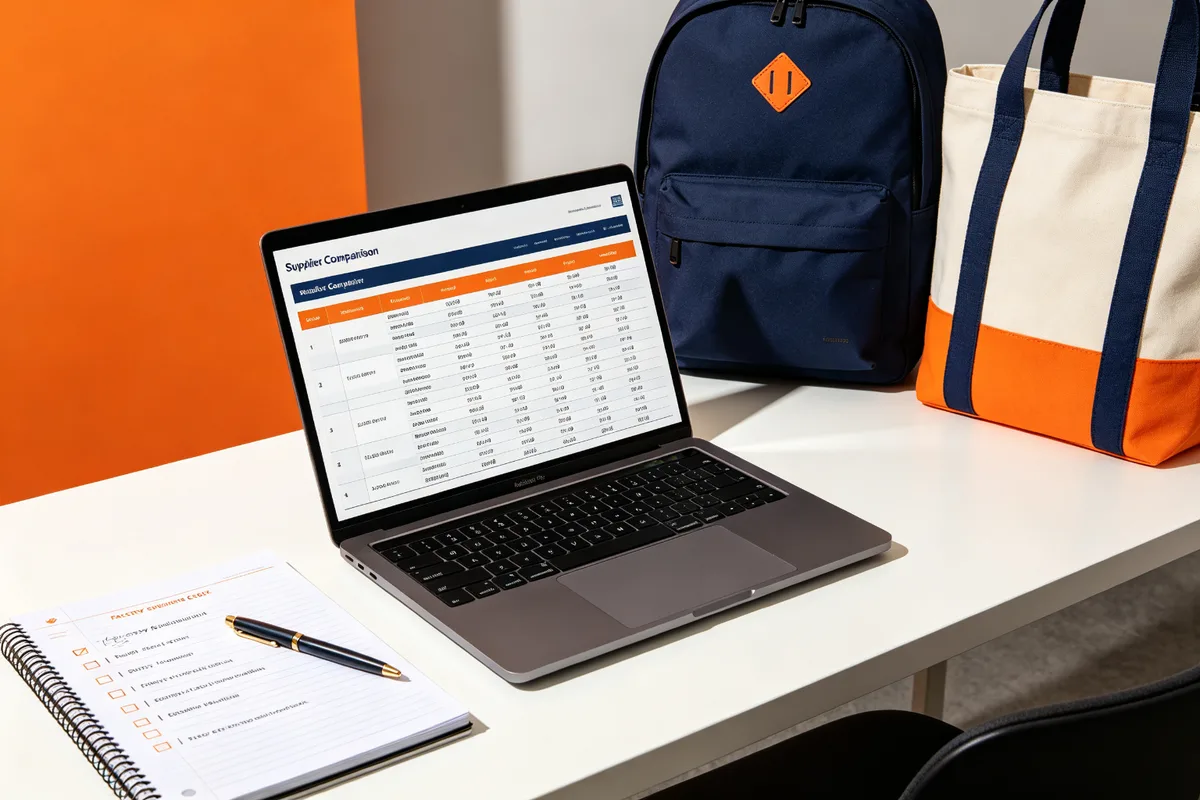
Choosing the right bag manufacturer comes down to a 12-point evaluation across four dimensions: identity verification (business license, real factory vs trading company, track record), production capability (product-line match, R&D and sampling, equipment, capacity), quality systems (QC process, certifications, sample quality), and commercial terms (quote transparency, MOQ and payment, communication). With the right factory, a 500-piece first order typically costs $2,500-$15,000 and takes 8-14 weeks; with the wrong one, you lose your deposit, your timeline, and your brand reputation. This checklist is built from 13 years of factory-floor experience in Dongguan and has been used to vet suppliers across the global bag industry.
This guide is the factory evaluation framework in our four-part custom bag series. Use the 4-phase checklist and 12-point scoring sheet before you send a single inquiry. For the surrounding steps in the buyer journey, see:
- How to Get Custom Bags Made — the full production journey this evaluation feeds into
- How to Source Custom Bags from China — finding factories, collecting quotes and negotiating terms
- How to Start a Bag Brand — the brand-side strategy that defines what you need from a manufacturer
Why Choosing the Right Manufacturer Is the Highest-Stakes Decision
Every other decision in your bag business — design, pricing, marketing, positioning — builds on top of the manufacturer you select. A great design in the hands of a factory that cannot execute it becomes a mediocre product. A sharp price point is meaningless if the factory quietly downgrades materials. In our years of producing custom bags for over 200 brands, we have seen the same pattern repeat: buyers who do their supplier diligence upfront rarely regret it, while buyers who chase the lowest quote almost always pay more later in returns, delays, and reorders. This guide walks you through the 12 checks that matter, grouped into four phases, so you can evaluate any supplier systematically rather than on gut feeling.
Phase 1: Identity Verification
Verify the Business License
Start by asking for the supplier's business license and the registration number printed on it. In China, you can verify a business license online through the National Enterprise Credit Information Publicity System. Confirm three things: the legal company name, the registered capital and establishment date, and — most importantly — that the registered business scope includes bag or luggage manufacturing. Many trading companies register a scope that only covers import-export trade, which is your first red flag. A manufacturing license with a production address is a strong positive signal. Do not accept a WeChat screenshot as proof — ask for a clear photo and verify the number yourself.
Confirm It Is a Real Factory, Not a Trading Company
This is the single most expensive mistake in the industry. A genuine source factory owns production equipment, employs its own pattern makers and QC staff, and can show you a live production floor. A trading company markets a pretty website, borrows factory photos, and marks up prices by 15-30%. Three quick signals separate them: first, product range — if less than 70% of the supplier's listings are bags and they also sell electronics, clothing, and home goods, that mix is the signature of a trader. Second, ask for a real-time video call to the workshop floor — a genuine factory agrees immediately and shows you machines running; a trader makes excuses or sends a stock video. Third, ask to see the machines themselves and name them — computerized sewing, high-frequency welding, pattern machines. A factory knows its own equipment. For a deeper look at how to systematically verify a supplier's claims, our complete guide to auditing a custom bag manufacturer walks through a five-pillar audit framework in detail.
Check Track Record and Client References
How long has the supplier been in business, and who have they served? A factory with 10+ years of history and a stable export record behaves far more predictably than a new setup. Request 2-3 client references, ideally in your own market or product category, and actually contact them. Ask references about communication speed, sample revision handling, on-time delivery, and how the factory resolved any quality issues. A factory that cannot or will not provide verifiable references is a risk you should not take with your deposit. At Merris, we have been producing custom bags since 2013 and are happy to share client references across Europe, North America, and the Middle East.
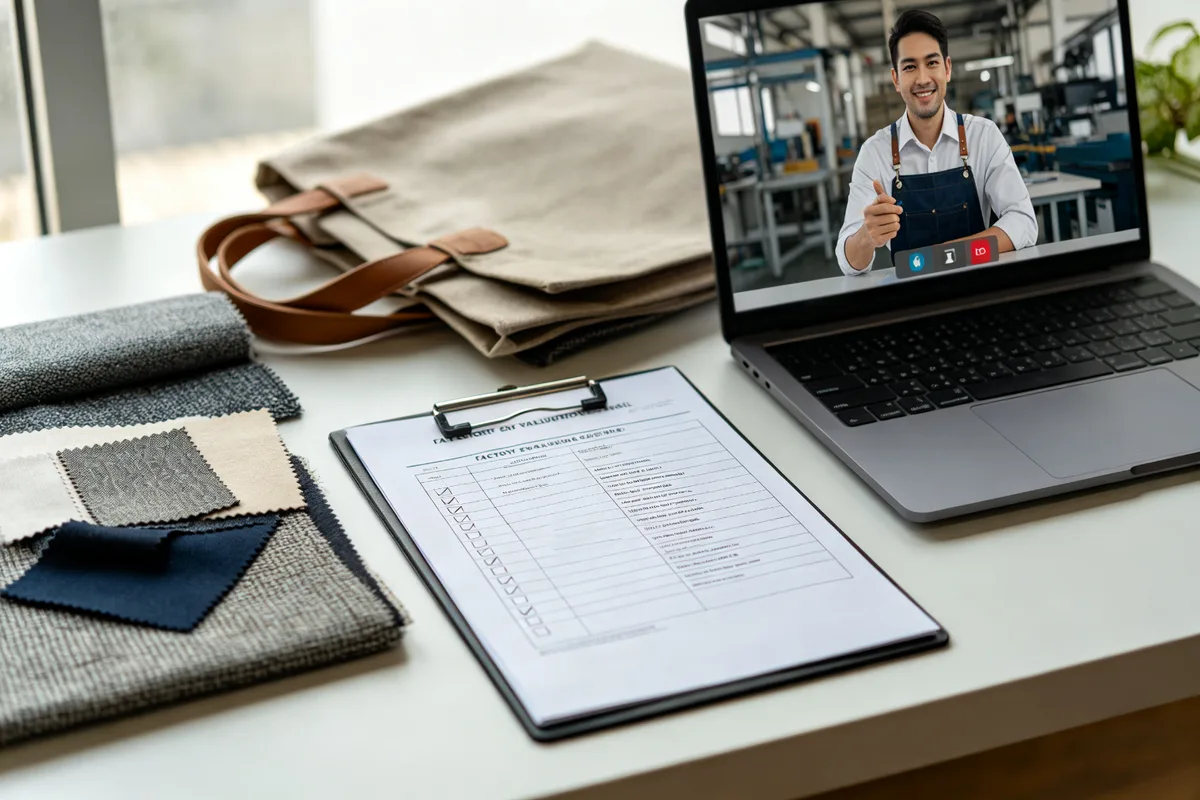
Phase 1-2: A documented evaluation checklist plus a live video walk-through separates real factories from traders.
Phase 2: Production Capability
Verify Product-Line Match
Not all bag factories are equal across product types. A factory that primarily produces cosmetic bags may not own the equipment for technical backpacks with load-bearing frames and padded straps, and a cooler bag specialist needs high-frequency welding that a plain tote maker does not have. Confirm the factory's core product lines match your product before evaluating anything else. This single check filters out most mismatched suppliers and saves you weeks of wasted sampling.
Evaluate R&D and Sampling Capability
A genuine manufacturer owns an independent sample room with dedicated pattern makers — not freelancers borrowed from the production line. Ask three questions: can they complete a first-round paper pattern within 3-5 days, can they produce 3D modeling renderings before cutting physical fabric, and how many sample revisions are included in the sample fee? A supplier that can only "copy your reference photo" but cannot produce a tech pack or suggest structural improvements is a trading-company signal. The sample room is the heart of the factory — if it is missing, so is the factory's ability to turn your idea into a manufacturable product.
Inspect Equipment and Machinery
Machinery quality determines stitching consistency, seam strength, and whether specialized constructions are even possible. On your video call or factory visit, look for four categories: computerized auto sewing machines (consistent stitch density), programmable pattern sewing machines (precise decorative stitching and logos), high-frequency welding machines (waterproof bags and PVC/TPU seams), and edge-painting and polishing stations (leather and PU luxury finishes). A factory that cannot show you its equipment live is hiding something. Our factory capabilities page shows our own production floor so you can see what a real setup looks like.
Assess Capacity and Lead Time
Even a good factory is useless if it cannot deliver your volume on time. Ask for specific numbers: monthly capacity in pieces by product type, number of production lines and workers per line, peak-season contingency plans (peak season typically runs July-October), and current capacity utilization. A factory running at 100% cannot absorb your rush order. A reliable factory will openly share its production schedule; a trader gives vague answers like "no problem, we can handle it." At Merris, we run 120+ workers across 6 production lines with a monthly output of 60,000+ bags, and we share our realistic lead times upfront — because the worst thing you can promise a customer is a deadline your factory cannot meet.
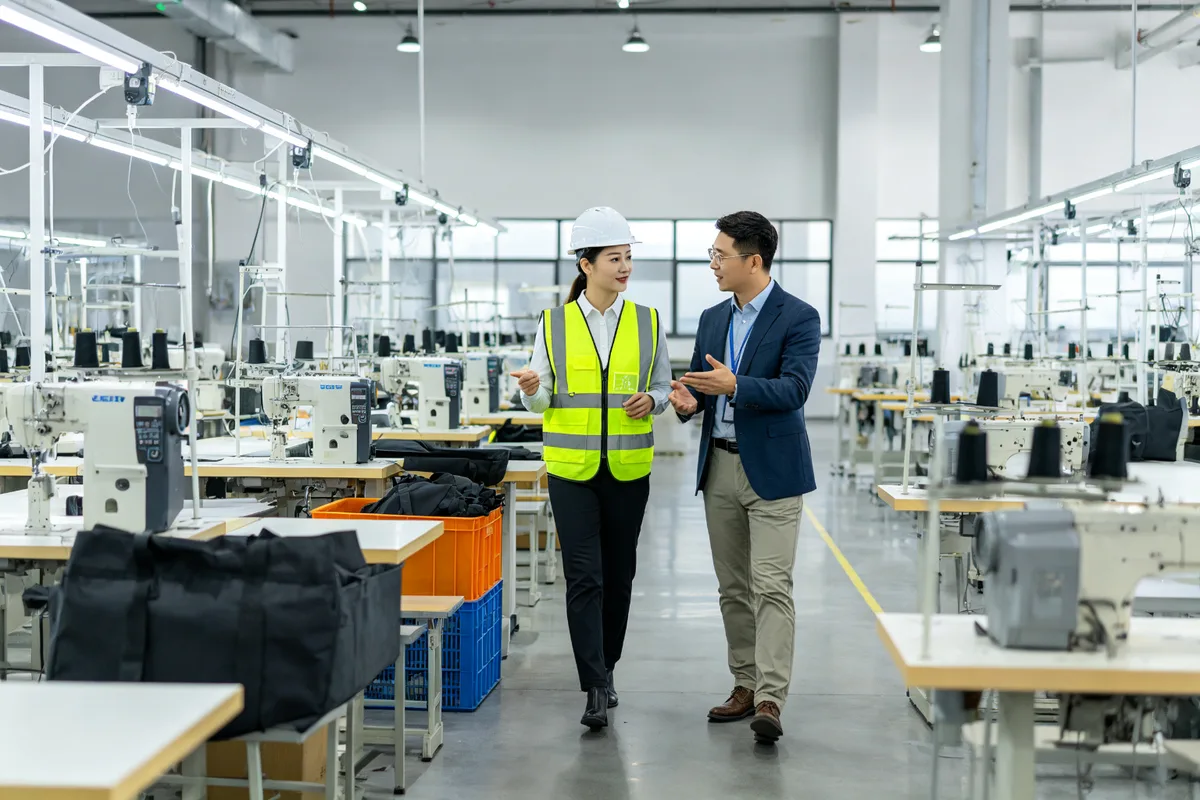
Phase 2: A live factory tour reveals equipment, capacity, and working conditions no website can fake.
Phase 3: Quality Systems
Review the Quality Control System
A factory without a documented QC process is gambling with your brand reputation. Verify these checkpoints exist: IQC (incoming quality control — fabric, zippers, and hardware tested before production starts), in-process QC (inline inspections during cutting, sewing, and assembly), and FQC/OQC (final/outgoing QC with AQL-based inspection before packing). Ask for a sample QC report from a previous order. Factories that follow AQL 2.5 or stricter standards and can produce signed inspection records are serious partners. For a factory-level breakdown of AQL inspection standards, bag defect classification, and exact sample sizes, see our AQL inspection for custom bags guide; those who say "we check everything" with no documentation are not.
Verify Certifications
Certifications prove a factory has been independently audited — something a trader cannot claim. Request BSCI, ISO9001, Sedex, or GRS certificates and verify three things: they are current, issued in the factory's legal name, and cover the production site. Many suppliers display outdated or borrowed certificates, so always ask for the certificate number and check it with the issuing body. Our detailed guide on BSCI vs ISO9001 vs Sedex explains what each audit actually verifies and how to validate certificates. If you are sourcing recycled materials, also confirm GRS certification is in the factory's own name.
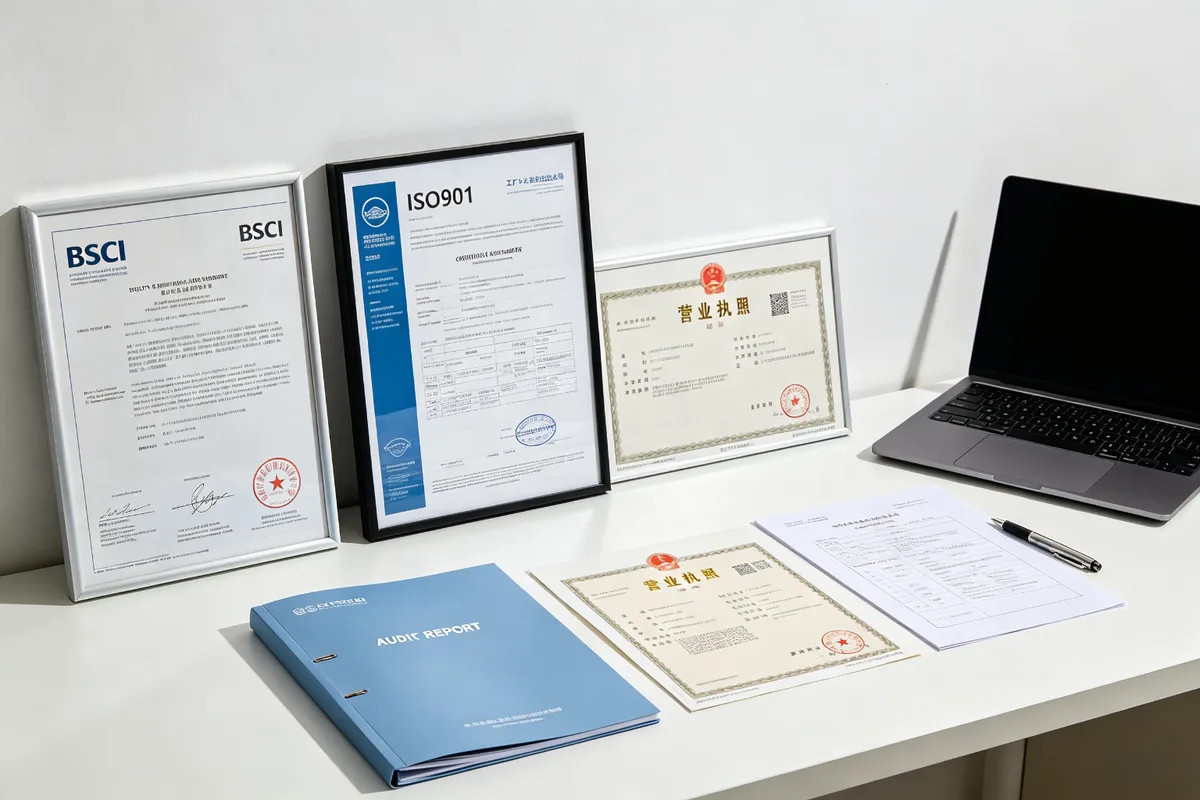
Phase 3: Verify every certificate is current and issued in the factory's own legal name.
Evaluate Physical Samples
No amount of documentation replaces holding the actual product. Order samples from 2-3 shortlisted factories and compare them side by side on: material weight and texture, stitching density (8-10 even stitches per inch), zipper smoothness (open and close 10+ times), hardware durability, printing accuracy against your Pantone reference, and dimensions within tolerance. Sample fees typically run $50-$200 and are usually refunded on a bulk order. The factory that produces the best sample at a fair price — and answers your revision feedback professionally — is your strongest candidate. This is the cheapest quality insurance in the entire sourcing process.
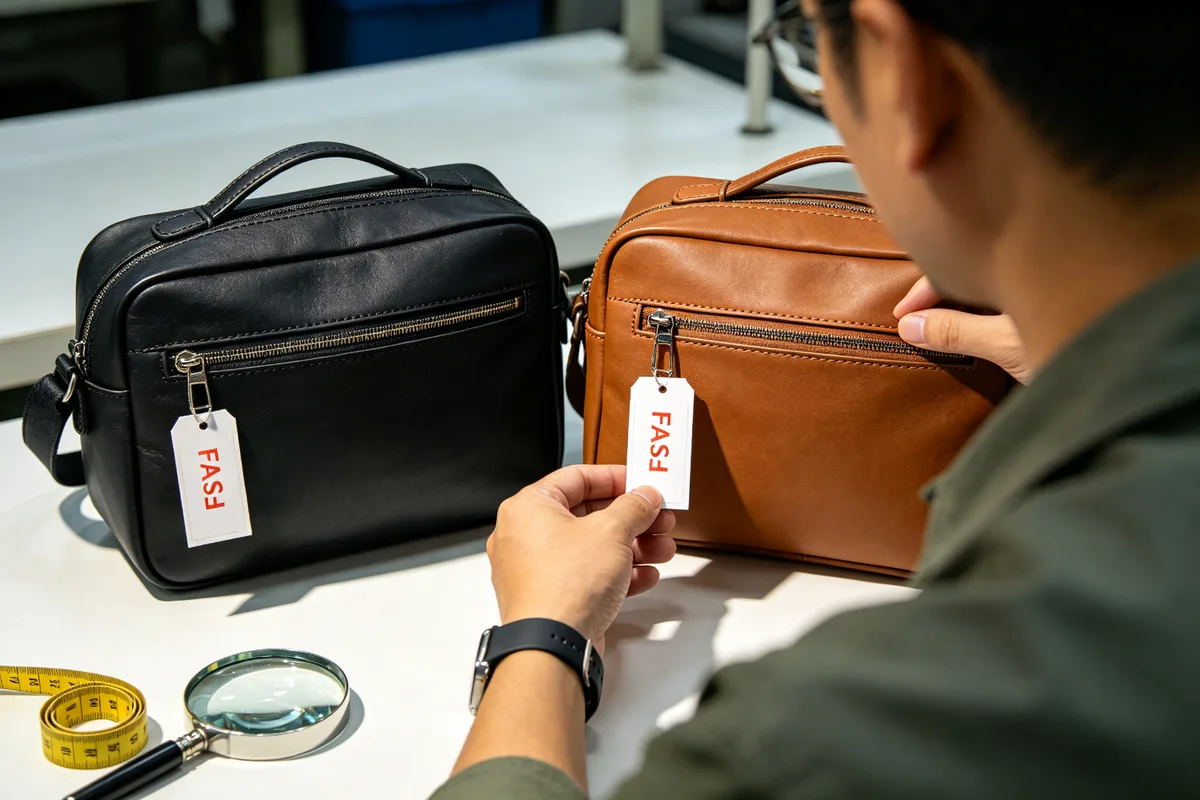
Phase 3: Comparing physical samples side by side reveals real quality differences photos cannot show.
Phase 4: Commercial Terms
Check Quote Transparency
A professional quotation breaks down unit price by quantity tiers (500, 1,000, 3,000 pieces), sample cost and lead time, production lead time, payment terms, packaging details, and any additional fees such as mold or printing plate charges. Compare quotations line by line, not by total price — a $0.50-per-unit difference often reflects a material downgrade (420D instead of 600D polyester) or a lower-quality zipper. Ask each factory to specify exact material grades so you can compare apples to apples. For a full view of where your money goes, see our custom bag cost breakdown.
Assess MOQ, Payment Terms, and Communication
Three final checks close out the evaluation. First, MOQ: confirm the factory's minimum fits your first order — 500 pieces is the industry standard for custom bags, and you can lower effective MOQ by combining colors into one order (see our MOQ strategy guide). Second, payment terms: standard safe terms are 30% deposit and 70% before shipment after inspection — never pay 100% upfront. Third, communication: a supplier who responds within 8 Hours with detailed clarifying questions is showing you exactly how they will behave during production. Choose a partner who asks about your target price, market, and quality expectations — that curiosity is the strongest predictor of a good manufacturing relationship.
The 12-Point Scoring Sheet
Print this table and score each candidate factory 1-5 per point. Anything below 3 on identity verification or quality systems should eliminate a candidate immediately.
| # | Check | Weight | Ask / Verify |
|---|---|---|---|
| 1 | Business license | Critical | Registration number, scope includes bag manufacturing |
| 2 | Real factory vs trader | Critical | 70%+ bags in range, live video walk-through |
| 3 | Track record & references | High | 10+ years, 2-3 verifiable client references |
| 4 | Product-line match | High | Core lines match your product type |
| 5 | R&D & sampling | High | In-house sample room, tech pack, 3-5 day patterns |
| 6 | Equipment | High | Computerized sewing, welding, pattern machines |
| 7 | Capacity & lead time | High | Monthly capacity, utilization, peak-season plan |
| 8 | QC system | Critical | IQC, in-process, FQC/OQC, sample QC report |
| 9 | Certifications | High | BSCI, ISO9001 current and in factory's name |
| 10 | Physical samples | Critical | Compare 2-3 factories side by side |
| 11 | Quote transparency | High | Line-by-line with exact material grades |
| 12 | MOQ, payment, communication | High | 500 MOQ, 30/70 terms, 24-hour responses |
Red Flags That Should Eliminate a Supplier
| Red Flag | Why It Matters | Action |
|---|---|---|
| Refuses a live video walk-through | Real factories are proud to show their floor | Eliminate immediately |
| Mixed product range (bags + electronics + clothing) | Trading company signature | Verify factory status or eliminate |
| No verifiable business license or references | Cannot confirm who you are dealing with | Eliminate immediately |
| No QC documentation, only "we check everything" | Quality is unmanaged | Demand a sample QC report |
| Vague answer on capacity or lead time | Cannot or will not commit | Ask for written production schedule |
| Demands 100% payment upfront | Removes your leverage entirely | Refuse; standard is 30/70 |
| Cheapest quote with no material grades | Hidden downgrades likely | Ask for exact specs or eliminate |
Conclusion
Choosing a bag manufacturer is a decision you can make confidently with a structured checklist. Work through the 12 points in four phases — identity verification, production capability, quality systems, and commercial terms — score each candidate, and trust the process rather than the sales pitch. The strongest predictor of a good partnership is transparency: a factory that openly shares its license, floor, equipment, capacity, QC records, and pricing is showing you it has nothing to hide. When you have shortlisted your finalists and are ready to compare them against a deeper five-pillar audit — R&D, equipment, capacity, QC, and certifications — the full framework is available in our guide to auditing a custom bag manufacturer. And if you are just entering the process, our guide on how to get custom bags made maps the full manufacturing journey from specs to shipping.
Evaluate Merris as Your Manufacturer
13 years of custom bag manufacturing, aligned with BSCI social-compliance and ISO 9001 practices, 120+ workers, 6 production lines, 60,000+ bags per month. Book a live video factory tour and get a line-by-line quotation within 8 Hours.
Book a Factory TourFrequently Asked Questions
How do I know if a bag manufacturer is legitimate?
Direct Answer: Verify the business license and registered scope includes bag manufacturing, check export history and client references, and request a live video walkthrough of the production floor. A real factory will happily show it; cross-check that BSCI/ISO9001 certificates are current and in their own name.
- Check: Business license + scope
- Proof: Live production-floor video
- Certificates: Current, in factory's name
- References: Client references on request
Verify the business license and registration number, confirm the registered scope includes bag manufacturing, check the factory's history and export record, and request client references. A legitimate manufacturer will happily provide a live video walk-through of their production floor; a trading company cannot. Cross-check their BSCI or ISO9001 certificates are current and issued in their own name.
How do I tell a real factory from a trading company?
Direct Answer: Real factories own equipment, employ pattern makers and QC staff, and can show their own machinery live. Trading companies list mixed products (under 70% bags), cannot walk you through their line, and mark up prices 15-30%. Ask for a real-time workshop call.
- Real Factory: Owns equipment, pattern makers, QC
- Trading Company: Mixed catalog, <70% bags
- Markup: 15-30%
- Test: Live workshop-floor video call
Real factories own production equipment, employ pattern makers and QC staff, and can show you a live production floor. Trading companies typically list a mixed range of products (bags, electronics, clothing) with less than 70% bags, cannot walk you through their own machinery, and mark up factory prices by 15-30%. Ask for a real-time video call to the workshop floor — a genuine factory will agree immediately.
What certifications should a custom bag factory have?
Direct Answer: The baseline certifications buyers ask for are BSCI (social compliance), ISO 9001 (quality management), Sedex/SMETA (ethical audit), and GRS (recycled materials). Verify each is current, issued in the factory's legal name, and covers their actual production site.
- Social Compliance: BSCI
- Quality Management: ISO 9001-aligned
- Ethical Audit: Sedex/SMETA
- Recycled Materials: GRS-aligned
The most common and valuable certifications for custom bag factories are BSCI (social compliance), ISO9001 (quality management), Sedex/SMETA (ethical audit), and GRS (recycled materials). BSCI and ISO9001 are the standard baseline buyers ask for. Verify each certificate is current, issued in the factory's legal name, and covers their production site — many suppliers display outdated or borrowed certificates.
How many bag manufacturers should I compare before choosing?
Direct Answer: Shortlist 5-8 factories, quote all of them, and order physical samples from 2-3 finalists. Comparing at least 3 quotes line by line reveals real price and material ranges, while 2-3 samples expose quality gaps photos hide. Cheapest-quote-only is the classic first-buyer mistake.
- Shortlist: 5-8 factories
- Quote Comparison: At least 3 line-by-line
- Sample Order: 2-3 finalists
- Avoid: Cheapest quote without samples
Shortlist 5-8 factories, request quotations from all of them, and order physical samples from 2-3 finalists. Comparing at least 3 quotations line by line reveals realistic price ranges and material grades, while comparing 2-3 physical samples reveals real quality differences that photos cannot show. Choosing the cheapest quote without sample comparison is the most common first-buyer mistake.
Can I visit or video-audit a factory before ordering?
Direct Answer: Yes — visit in person if you can, otherwise request a live video call covering the entrance, production floor, sample room, and QC department. For deeper due diligence, run a structured audit across R&D, equipment, capacity, QC, and certifications before bulk orders.
- Best Option: In-person visit
- Remote Option: Live video walkthrough
- Audit Scope: R&D, equipment, capacity, QC, certs
Yes. The best option is an in-person visit if you are in China or nearby. If not, request a live video call that walks through the entrance, production floor, sample room, and QC department in real time. For a deeper systematic check, follow a structured audit framework covering R&D, equipment, capacity, QC, and certifications before placing a bulk order.