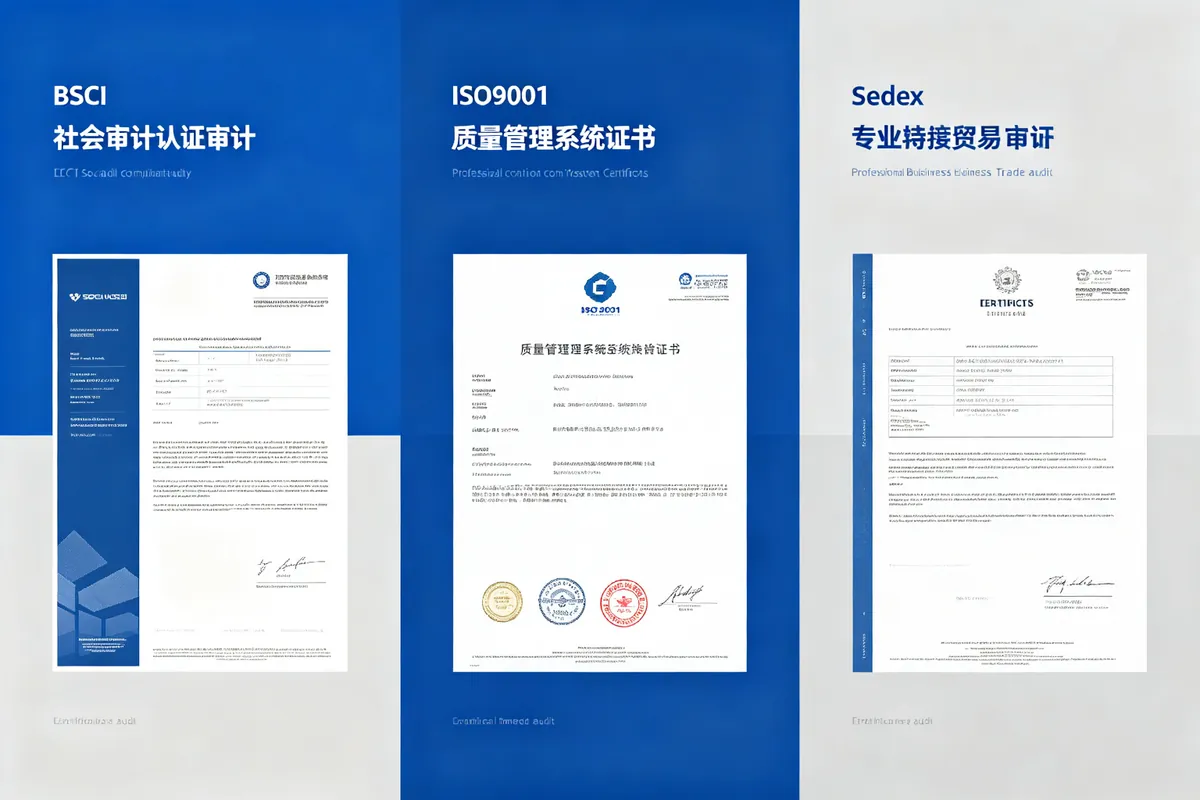
BSCI (Business Social Compliance Initiative), ISO9001, and Sedex (SMETA) are the three most common factory audit certifications in bag manufacturing, but they verify fundamentally different things: BSCI and Sedex/SMETA are social compliance audits that verify labor practices, working conditions, and ethical trade, while ISO9001 is a quality management system certification that verifies process control and consistent product quality. For most bag buyers sourcing from China, the ideal combination is ISO9001 (quality) + either BSCI or Sedex (social compliance), because these two cover the primary risk areas — product quality and ethical labor — that retailers and consumers care about. BSCI is most commonly required by European retailers (Lidl, Aldi, H&M, Carrefour), Sedex/SMETA is dominant among UK and global brands (Tesco, Sainsbury's, Walmart, Disney), and ISO9001 is a near-universal baseline requirement accepted by all retailers as evidence of quality management. When evaluating a factory, check which specific certifications they hold, verify the certificates are current and in scope, and understand that no single certification covers both quality and social compliance — you need at least two.
What is BSCI Certification?
BSCI — Business Social Compliance Initiative
BSCI is a social compliance certification system developed by European retailers to verify that factories meet minimum labor and ethical standards. It is NOT a quality certification — it does not assess product quality or manufacturing processes. BSCI audits cover 13 performance areas: occupational health and safety, fair remuneration, working hours, freedom of association and collective bargaining, no child labor, no forced labor, no discrimination, ethical business behavior, environmental protection (basic), and supply chain management. BSCI uses a rating system (A, B, C, D, E) based on audit findings, with A/B being "good" and C/D/E requiring corrective actions and re-audit. BSCI is recognized by over 2,000 member companies, primarily European retailers and brands.
BSCI audits are conducted by accredited third-party auditing companies (SGS, Bureau Veritas, TÜV, Intertek, etc.) and can be either announced (scheduled in advance) or unannounced (surprise). The audit typically takes 1-2 days depending on factory size, and involves: document review (payroll records, working hours, permits, policies), factory inspection (workshop conditions, safety equipment, fire exits, dormitories, canteen), and worker interviews (confidential interviews with randomly selected workers to verify that documented practices match reality). BSCI certification is valid for 2 years, with a re-audit required before expiration. A factory with a BSCI rating of A or B is generally considered acceptable by most European retailers; ratings of C or below may require additional corrective actions or re-audit before the factory is approved as a supplier.
What is ISO9001 Certification?
ISO9001 — Quality Management System
ISO9001 is the international standard for quality management systems (QMS), verifying that a factory has documented processes and procedures to consistently produce products that meet customer requirements and applicable regulatory standards. It is NOT a social compliance or labor certification — it does not assess working conditions, wages, or labor practices. ISO9001 certification covers: quality policy and objectives, documented procedures for all key processes, supplier evaluation and management, incoming material inspection, production process control, in-process and final quality inspection, non-conforming product handling, corrective and preventive actions, internal audits, management review, and continuous improvement. ISO9001 is the most widely recognized quality certification globally, with over 1 million certified organizations worldwide, and is accepted by virtually all retailers and brands as evidence of quality management capability.
ISO9001 certification is granted by accredited certification bodies (SGS, Bureau Veritas, TÜV, DNV, etc.) following a two-stage initial audit: Stage 1 is a document review to verify that the quality management system is documented and ready for implementation; Stage 2 is an on-site audit to verify that the documented processes are actually being followed in practice. After certification, annual surveillance audits (typically 1 day) verify ongoing compliance, and a full re-certification audit is required every 3 years. ISO9001 does not use a rating system — a factory is either certified (compliant) or not certified (non-compliant), though audit reports may note minor or major non-conformities that must be corrected. For bag manufacturing, ISO9001 certification indicates that the factory has systematic quality control processes — incoming material inspection, in-process quality checks, final random inspection (AQL), and non-conformance handling — which reduces the risk of quality defects in your orders. It is important to note that ISO9001 certifies the quality management SYSTEM, not the product itself — a factory can be ISO9001 certified and still produce defective products if they fail to follow their own procedures, which is why independent product inspection (as discussed in our sourcing guide) remains important even with ISO9001-certified suppliers.
What is Sedex (SMETA) Audit?
Sedex / SMETA — Supplier Ethical Data Exchange / Sedex Members Ethical Trade Audit
Sedex is a global nonprofit membership organization dedicated to improving ethical and responsible business practices in global supply chains. SMETA (Sedex Members Ethical Trade Audit) is the audit methodology developed by Sedex, and it is one of the most widely used ethical audit formats in the world. Like BSCI, SMETA is a social compliance audit — it does NOT assess product quality. SMETA audits cover four pillars: labor standards (working hours, wages, child labor, forced labor, freedom of association), health and safety (workplace safety, fire safety, emergency preparedness, occupational health), environment (waste management, wastewater, energy use, chemical management — optional pillar), and business ethics (bribery and corruption, fair competition, intellectual property — optional pillar). SMETA is unique in that it is a "shared audit" format — a single SMETA audit can be shared with multiple Sedex member buyers through the Sedex platform, reducing audit duplication for factories. Sedex has over 60,000 member sites in 180+ countries, including major retailers like Tesco, Sainsbury's, Walmart, Disney, and Primark.
SMETA audits are conducted by accredited audit companies and can be 2-pillar (labor + health & safety) or 4-pillar (adding environment + business ethics). The audit duration is typically 1-3 days depending on factory size and audit scope. SMETA does not issue a "certificate" or pass/fail rating — instead, it produces a detailed audit report with findings categorized by risk level (critical, major, minor, observation), and the factory is expected to implement corrective actions with specified deadlines. Buyers review the audit report and corrective action plan (CAP) to determine whether the factory meets their ethical sourcing standards. This is different from BSCI, which issues a formal rating (A-E) and certificate. SMETA's strength is its wide acceptance among global brands and the shared audit platform, which reduces audit fatigue for factories — a factory can complete one SMETA audit and share it with all their Sedex-member buyers, rather than completing separate audits for each customer. For buyers, SMETA provides a standardized, detailed audit format that is comparable across suppliers, and the Sedex platform allows tracking of corrective actions over time.
BSCI vs ISO9001 vs Sedex: Side-by-Side Comparison
| Factor | BSCI | ISO9001 | Sedex / SMETA |
|---|---|---|---|
| Primary Focus | Social compliance & labor practices | Quality management system | Ethical trade & social compliance |
| Administering Body | amfori (FTA) | ISO (via accredited CBs) | Sedex (nonprofit) |
| Geographic Origin | European Union | International | United Kingdom / Global |
| Audit Scope | 13 social compliance areas (labor, H&S, environment basic) | Quality management system (processes, procedures, continuous improvement) | 2-pillar (labor + H&S) or 4-pillar (+ environment + ethics) |
| Product Quality Assessed? | No | Yes (system-level, not product testing) | No |
| Labor Practices Assessed? | Yes | No | Yes |
| Rating / Certification | Formal rating A-E + certificate | Certified / Not certified + certificate | Audit report with findings (no certificate, no pass/fail) |
| Validity Period | 2 years | 3 years (annual surveillance) | 2 years recommended (no formal expiration) |
| Audit Duration | 1-2 days | 2-4 days (initial), 1 day (surveillance) | 1-3 days (depending on scope) |
| Typical Cost (factory pays) | $800-$2,500 | $3,000-$8,000 (initial), $1,500-$3,000 (annual) | $1,000-$3,500 (2-pillar), $1,500-$5,000 (4-pillar) |
| Shared Audit Platform | amfori BSCI platform (members only) | No (certificate is public) | Sedex platform (shared with all member buyers) |
| Major Retailer Acceptance | Lidl, Aldi, H&M, Carrefour, Metro, C&A (EU retailers) | Universal — accepted by all retailers as quality baseline | Tesco, Sainsbury's, Walmart, Disney, Primark, Gap (UK/global brands) |
| Unannounced Audit Option | Yes (semi-announced or unannounced) | No (announced surveillance audits) | Yes (announced, semi-announced, or unannounced) |
| Corrective Action Tracking | Yes (via amfori platform) | Yes (via certification body) | Yes (via Sedex platform, CAPR) |
Which Certification Do Major Retailers Require?
Retailer requirements vary by market and brand, but there are clear regional patterns. European retailers (especially German, French, and Dutch discount and department stores) overwhelmingly require BSCI — Lidl, Aldi, Kaufland, Carrefour, Metro, C&A, and H&M all accept or require BSCI as their primary social compliance audit. UK-based retailers and global brands with UK headquarters typically require Sedex/SMETA — Tesco, Sainsbury's, Asda, Primark, Marks & Spencer, and John Lewis all use Sedex as their ethical sourcing platform. US retailers are more fragmented — Walmart uses its own Responsible Sourcing audit but accepts SMETA and BSCI as equivalent; Disney requires its own International Labor Standards (ILS) audit but accepts SMETA 4-pillar; Target uses its own audit but accepts BSCI and SMETA; and Amazon requires its own Supplier Code of Conduct audit for certain product categories. For quality management, virtually all retailers — across all markets — accept ISO9001 as evidence of quality management capability, though many do not explicitly require it (they rely on their own product inspection and quality requirements instead).
If you are selling to a specific retailer, the safest approach is to ask the retailer directly for their approved audit list — most retailers publish a list of accepted social compliance audits on their supplier portal. If you are selling to multiple retailers or through a distributor, the most versatile combination is ISO9001 (universally accepted for quality) + SMETA 4-pillar (widely accepted by UK/US/global brands for social compliance) — this combination covers the requirements of the largest number of retailers. If your primary market is Europe, substitute BSCI for SMETA. If you are selling direct-to-consumer (DTC) or through small boutiques rather than major retailers, you may not need any specific certification — but having ISO9001 + a social compliance audit (BSCI or SMETA) still provides credibility, reduces supply chain risk, and positions you for future retail expansion. Always verify that the factory's certification covers the specific product category you are sourcing — a factory might be BSCI certified for "textile accessories" but not for "bags/backpacks," or ISO9001 certified for "plastic products" but not for "textile manufacturing." The certificate scope must explicitly include your product type.
How to Verify Factory Audit Certificates
Verifying factory audit certificates is essential — certificate fraud (forged certificates, expired certificates presented as current, certificates for a different factory or product scope) is not uncommon in Chinese manufacturing. To verify certificates properly: (1) Request a clear copy of the certificate from the factory, including the certificate number, issuing body, scope, issue date, and expiry date. (2) For ISO9001: verify through the certification body's online certificate verification portal — major CBs (SGS, Bureau Veritas, TÜV, DNV, Intertek) all provide public certificate lookup by certificate number or company name. Confirm the certificate is current (not expired), the company name and address match the factory you are dealing with, and the scope includes your product category. (3) For BSCI: verify through the amfori BSCI platform — the factory should be able to provide their BSCI DBID (database ID) and you can ask the factory to share their audit report and rating through the amfori platform. Note that BSCI certificate details are not fully public — you may need the factory's cooperation to access the full audit report. (4) For Sedex/SMETA: verify through the Sedex platform — the factory should have a Sedex membership ID and should be able to share their audit report and corrective action plan through the Sedex platform. SMETA audit reports are not public; they are shared through the Sedex platform between members. (5) Cross-check the factory name and address on the certificate against the factory's business license and the address you will be visiting or shipping from — a certificate for "Dongguan ABC Bag Factory" at "123 Industrial Road" does not cover production at a different address or a related company with a different name.
Common red flags: the certificate is expired (always check the expiry date — many factories present expired certificates hoping buyers won't notice); the certificate scope does not include your product (e.g., certificate for "garment manufacturing" when you are sourcing bags); the company name on the certificate doesn't match the factory you are dealing with (the factory may be using a parent company's or sister factory's certificate); the certificate is issued by a non-accredited body (only certification bodies accredited by national accreditation bodies like CNAS in China, UKAS in UK, ANAB in US can issue valid ISO9001 certificates; BSCI audits must be conducted by amfori-approved audit companies); or the factory is reluctant to share the full audit report or certificate verification details (they may have something to hide, such as a poor BSCI rating of D/E or critical SMETA findings). If any red flags appear, ask for clarification or request that the factory obtain proper certification before placing an order — working with an uncertified or fraudulently certified factory exposes you to quality risks, labor practice scandals, and retailer rejection.
Cost and Timeline for Each Certification
If your chosen factory does not already have the certification you need, you may need to request that they obtain it — but who pays and how long it takes depends on the certification and your order size. For ISO9001, the initial certification process takes 2-4 months (including system documentation, internal audit, management review, and two-stage certification audit) and costs $3,000-$8,000 depending on factory size and certification body. Many factories will absorb this cost if you commit to a large order (typically 10,000+ pieces or annual volume commitment), while smaller factories may require a certification fee contribution ($500-$2,000) or higher unit price to amortize the cost. For BSCI, the audit process takes 4-8 weeks from application to audit completion and report issuance, and costs $800-$2,500 depending on factory size and audit type (announced vs unannounced). BSCI is generally faster and cheaper than ISO9001 because it is a single audit rather than a system implementation process. For Sedex/SMETA, the audit process takes 3-6 weeks and costs $1,000-$3,500 for 2-pillar or $1,500-$5,000 for 4-pillar, depending on factory size. SMETA is similar to BSCI in timeline and cost, with the added benefit of the shared audit platform.
When requesting certification from a factory, be clear about: which specific certification you need (BSCI rating A/B, ISO9001 with bag manufacturing scope, SMETA 4-pillar); the timeline you need it by (build this into your production schedule — don't expect a factory to get certified in 2 weeks); who pays for the audit (negotiate this upfront — for large orders, factories often absorb the cost; for small orders, you may need to contribute); and whether the certification will be maintained for future orders (a factory that gets certified for your order should maintain it for future business). If you are a small buyer with a 500-1000 piece order, it is generally not realistic to require a factory to obtain new certification just for your order — in this case, you should either choose a factory that already has the certification you need, or accept the factory's current certifications and rely on your own product inspection for quality control. For larger orders (5,000+ pieces) or ongoing annual volume, requesting certification is reasonable and most factories will accommodate it.
Which Certification Should You Require?
The certification you should require depends on your target market, sales channels, brand values, and order size. Here is a decision framework: If you sell to major European retailers (Lidl, Aldi, Carrefour, H&M, C&A): require BSCI (rating A or B) + ISO9001. If you sell to UK or global brands (Tesco, Sainsbury's, Walmart, Disney, Primark): require SMETA 4-pillar + ISO9001. If you sell to US retailers (Walmart, Target, Amazon): check the retailer's specific approved audit list — most accept SMETA or BSCI for social compliance, and all accept ISO9001 for quality. If you sell DTC or through small boutiques (no major retailer requirements): ISO9001 is recommended for quality assurance; social compliance certification (BSCI or SMETA) is optional but recommended for brand credibility and risk mitigation. If you are a small buyer with 500-1000 piece orders: prioritize factories that already have ISO9001 + at least one social compliance audit; don't require new certification for small orders. If sustainability and ethical sourcing are core brand values: require ISO9001 + SMETA 4-pillar (includes environment pillar) + GRS (if using recycled materials, as discussed in our GRS certification guide).
The most important principle is: no single certification covers everything. ISO9001 covers quality management but not labor practices; BSCI and SMETA cover social compliance but not product quality. For comprehensive supply chain assurance, you need at minimum one quality certification (ISO9001) + one social compliance audit (BSCI or SMETA). Additionally, certifications are system-level assurances — they do not replace the need for product-level quality inspection. Even with an ISO9001-certified factory, you should still conduct pre-shipment inspection (AQL 2.5) for every order, as discussed in our complete sourcing guide. Think of certifications as reducing risk (a certified factory is less likely to have systemic quality or labor issues) rather than eliminating risk (certified factories can still produce defective products or have labor violations that occur between audits). The most robust sourcing strategy combines: verified factory certifications (ISO9001 + BSCI/SMETA), detailed product specifications and approved pre-production samples, independent pre-shipment quality inspection, and clear contractual quality and compliance requirements.
Conclusion
BSCI, ISO9001, and Sedex/SMETA are complementary certifications that verify different aspects of factory capability: ISO9001 for quality management systems, BSCI and SMETA for social compliance and ethical labor practices. For most bag buyers, the ideal supplier has ISO9001 (quality) + either BSCI (EU market) or SMETA (UK/global market) for social compliance. These certifications reduce supply chain risk, meet retailer requirements, and provide brand credibility — but they do not replace the need for product-level quality inspection or clear contractual requirements. When evaluating factories, always verify that certificates are current, in scope for your product category, and issued by accredited bodies — certificate fraud is not uncommon and can expose your brand to quality failures, labor scandals, and retailer rejection. For small orders (500-1000 pieces), prioritize factories that already have the certifications you need rather than requiring new certification; for larger orders or ongoing volume, requesting certification is reasonable and most factories will accommodate it. By understanding what each certification covers (and what it doesn't), you can make informed supplier selection decisions that protect your brand quality, ethical standards, and market access.
Looking for a BSCI & ISO 9001-Aligned Bag Factory?
We follow ISO 9001-aligned quality management practices and maintain BSCI social compliance audit records, with verified upstream supply chains. Get factory audit reports, certification verification, and a factory-direct quotation within 8 Hours.
Request Audit Reports & Quote