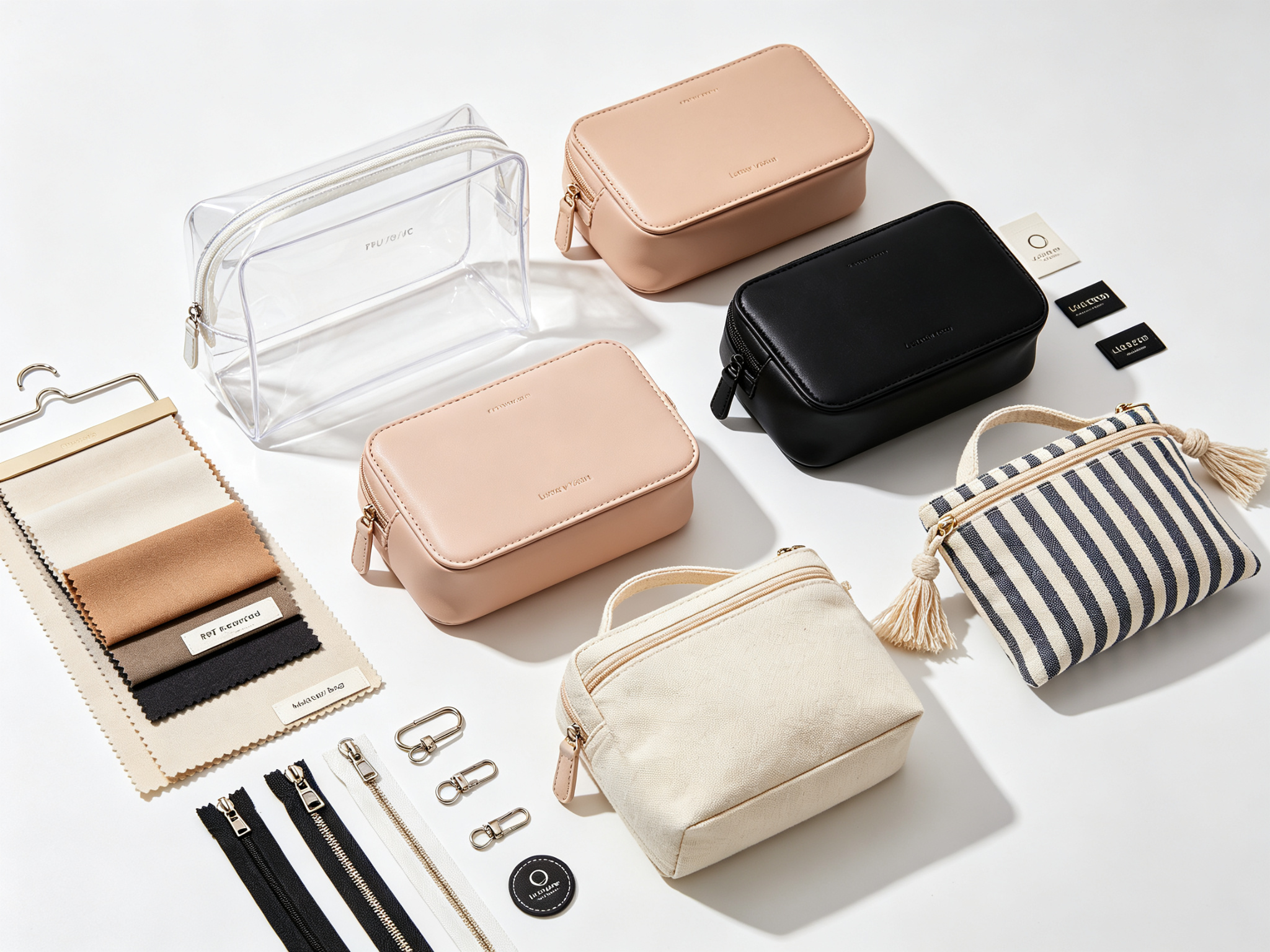
Custom cosmetic bags are a flexible private-label category with options for both low-volume launches and larger retail programs. Indicative factory pricing varies widely by material, size, construction, branding, and order quantity; retail pricing is controlled by each brand and channel. The category spans five distinct material systems — clear TPU/PVC/EVA, vegan leather, RPET recycled fabric, canvas/cotton, and water-resistant Oxford — each requiring different manufacturing equipment, construction methods, and compliance checks. Choosing the wrong material or construction method can create avoidable quality and cost problems for a new brand.
From our factory floor in Liaobu Town, Dongguan, we have produced over 2 million custom cosmetic bags for more than 120 beauty and lifestyle brands across 18 countries. We have seen brands succeed with a $1.50 clear PVC pouch sold at $12 in drugstores, and we have seen brands fail by ordering vegan leather cases from a factory that only does heat-sealed PVC work. This guide consolidates 13 years of manufacturing experience into a practical sourcing framework: how to select the right material, which construction method matches your design, what compliance certifications you actually need, and what the real costs and timelines look like at 500 MOQ.
Phase 1: Material Selection — The 5 Cosmetic Bag Material Systems
PHASE 1 · MATERIAL DECISIONThe first decision in any cosmetic bag project is material selection. This choice influences your manufacturing partner, construction method, compliance checks, unit cost, and perceived quality. Do not start with a design sketch and then "find a material that works" — start with the material system that matches your brand positioning, then design within its constraints.
Clear TPU, PVC, and EVA — The Transparent Pouch Category
Quick Answer
Choose the material and construction together: clear TPU, PVC, or EVA for transparent travel pouches; stitched canvas, RPET, nylon, Oxford, or PU for structured cosmetic bags and organizers. Define dimensions, gauge or fabric weight, logo method, zipper, lining, target market, tests, MOQ, and shipping term in the tech pack before requesting quotes.
Clear thermoplastic materials are common in travel cosmetic bags because a transparent pouch makes it easier to organize liquids for airport screening. TSA 3-1-1 is a rule for the traveler's liquids and container, not a product certification for a bag or a guarantee that a particular design will pass every airport inspection. Always verify the current requirements for your target market and describe your product as designed to support the rule rather than "TSA approved."
| Material | Transparency | Typical Gauge | Travel-Use Fit | Durability | Odor / Material Checks | Indicative Unit Cost (500 MOQ) |
|---|---|---|---|---|---|---|
| Clear TPU | High; confirm by sample | 0.3-0.5mm | Good for organized travel liquids | Very high; flex-resistant grades available | Request formulation and restricted-substance testing | $1.80-$3.50 |
| Clear PVC | High; confirm by sample | 0.2-0.4mm | Common low-cost option | Medium; formulation matters | Check plasticizers, odor, and restricted substances | $1.20-$2.50 |
| Clear EVA | High; confirm by sample | 0.3-0.6mm | Soft, flexible travel pouch option | High; grade dependent | Confirm the intended-use documentation | $2.00-$3.80 |
| Frosted TPU | Partly transparent | 0.3-0.5mm | Less suitable where contents must be visible | Very high; grade dependent | Request formulation and restricted-substance testing | $1.90-$3.60 |
Factory Insight
Clear TPU is often a strong choice for premium beauty brands because it can provide a soft hand feel and low-odor result when the formulation is well controlled. It usually costs more than PVC. PVC can still be appropriate for value-focused programs, but request a material sample, odor evaluation, and restricted-substance test before approving production. Any airing or conditioning period should be agreed with the factory and validated on your actual packaging.
For brands sourcing clear TPU/PVC cosmetic bags, the critical specification is gauge thickness. 0.2mm PVC feels flimsy and develops creases after 2-3 uses; 0.4mm TPU has a premium hand feel and survives 50+ flex cycles without cracking. Most factories default to 0.25mm to cut costs — specify 0.35mm minimum in your tech pack and verify with a micrometer during sample approval.
Vegan Leather (PU) — The Luxury Cosmetic Case Category
PU (polyurethane) vegan leather is the fastest-growing material in premium cosmetic packaging, driven by beauty brands moving away from animal leather for ethical positioning and cost consistency. Saffiano PU (cross-hatched texture) is the most popular finish for vanity cases and brush rolls because it resists fingerprints, cleans easily, and has a structured hand feel that mimics genuine leather at 40% of the cost.
When sourcing luxury vegan leather cosmetic cases, specify the PU backing material: knitted backing is softer and more flexible (good for pouches), while woven backing is stiffer and more durable (required for structured vanity cases with metal frames). PU thickness should be 0.6mm-0.8mm for bags — anything thinner will show the backing texture through the surface, and anything thicker adds unnecessary cost and weight.
Common Pitfall
Do not confuse "PU leather" with "PVC leather" (also called "vinyl"). PVC leather has a plastic-like smell, cracks after 6-12 months of use, and cannot be embossed with fine detail. PU leather is breathable, flexible, and accepts hot-stamping, embossing, and silk-screen printing cleanly. Always request a material swatch card with both options before committing — the difference is obvious in hand.
RPET Recycled Fabric — The Eco-Conscious Beauty Brand Choice
RPET (recycled polyethylene terephthalate) cosmetic bags are made from post-consumer plastic bottles — typically 8-12 bottles per bag depending on size. This material has exploded in demand since 2023 as beauty brands face pressure from consumers and retailers (Sephora, Ulta, Target) to demonstrate sustainable packaging. GRS (Global Recycled Standard) certification is the industry benchmark — it verifies the recycled content percentage through chain-of-custody documentation from bottle collection through spinning, weaving, and final assembly.
For RPET recycled cosmetic bags, expect a 15-25% cost premium over virgin polyester. The recycled yarn is slightly more expensive, and GRS-certified factories charge a certification fee ($300-$800 per order) plus administrative overhead for transaction certificates. However, this premium is often offset by higher retail pricing (eco-branded cosmetic bags command 20-30% price premiums) and access to retailers that require sustainable sourcing documentation.
Read our RPET vs Virgin Polyester guide for a detailed comparison of environmental claims, cost differences, and certification requirements. Every Merris cosmetic bag order is made to order — we hold no off-the-shelf stock, build to your approved spec, and quote FOB Shenzhen.
Canvas and Cotton — The Natural, Printable Pouch Category
Canvas and cotton cosmetic bags are the most customizable material system because they accept virtually every printing method: silk-screen, digital UV, sublimation, heat transfer, and embroidery. 8oz natural canvas is the industry standard for promotional cosmetic pouches and gift-with-purchase items — it is inexpensive ($2.00-$3.50 unit cost), accepts vibrant full-color prints, and has a natural, artisanal aesthetic that appeals to indie beauty brands.
For canvas cosmetic bags with custom details (tassels, contrast zippers, custom lining), the key specification is fabric weight. 6oz canvas is too thin for bags with hardware (it tears at the attachment points after 20-30 uses); 10oz canvas is premium but adds $0.50-$0.80 per unit. 8oz is the sweet spot for most cosmetic bag applications. Always pre-wash the canvas before cutting — unwashed canvas shrinks 5-8% after first wash, which ruins bag dimensions if not accounted for.
Water-Resistant Oxford — The Hanging Toiletry Organizer Category
300D and 600D Oxford fabric with PU coating is the standard material for hanging toiletry organizers and travel wash bags. These are structured, multi-compartment bags with built-in hooks, mesh pockets, and waterproof linings — a more complex product than a simple pouch. 300D Oxford is lighter and more flexible (good for foldable travel organizers); 600D Oxford is heavier and more durable (required for bags with rigid frames or heavy contents).
When sourcing hanging toiletry organizer bags, pay special attention to the lining material. PEVA (polyethylene vinyl acetate) lining is waterproof and food-contact safe, but it can develop a plastic odor in hot shipping containers. Nylon taffeta lining is odor-free and more durable, but it is only water-resistant (not waterproof) — it will leak if liquids spill inside. For toiletry bags designed to hold potentially leaky bottles (shampoo, conditioner, body wash), specify PEVA lining with sealed seams.
Phase 2: Construction Methods — Heat-Sealed vs. Stitched
PHASE 2 · MANUFACTURING PROCESSCosmetic bags are manufactured using one of two fundamentally different construction methods: heat-sealed (RF-welded) or stitched. These methods require different equipment, different worker skill sets, and produce bags with different performance characteristics. The most common sourcing mistake we see is sending a stitched canvas bag design to a factory that only does heat-sealed PVC work — or vice versa. The factory will take the order, produce a substandard result, and the buyer will discover 40% defect rates at final inspection.
| Characteristic | Heat-Sealed (RF-Welded) | Stitched |
|---|---|---|
| Materials | TPU, PVC, EVA (thermoplastics only) | Canvas, Oxford, PU leather, nylon, RPET |
| Equipment | High-frequency RF welding machines ($15K-$50K each) | Industrial sewing machines ($1K-$5K each) |
| Seam Type | Molten material fusion — no holes, completely leak-proof | Mechanical thread bond — stitching holes exist |
| Water Resistance | 100% waterproof at seams | Requires seam-sealing tape for water resistance |
| Design Flexibility | Limited to simple shapes (pouches, envelopes) | Unlimited — gussets, pockets, zippers, hooks, frames |
| Setup Cost | High (custom welding molds $300-$800 per design) | Low (pattern making $50-$150 per design) |
| Perceived Quality | Clean, modern, premium look for clear bags | Traditional, structured, craft-oriented look |
| Typical Products | TSA clear pouches, waterproof wash bags, vinyl makeup cases | Hanging organizers, canvas pouches, vegan leather cases, brush rolls |
Factory Specialization
In Dongguan, cosmetic bag factories typically specialize in one construction method. A factory with 20 RF welding machines and 5 sewing machines is a heat-seal specialist — they will produce excellent clear TPU pouches but mediocre canvas bags. Conversely, a factory with 50 sewing machines and 1 RF welder is a stitching specialist — do not send them a complex clear PVC design with multiple gussets and curved seams. Always ask: "What percentage of your production is heat-sealed vs. stitched?" If the answer is less than 70% for your required method, keep looking.
Heat-Sealed Construction Details
RF (radio frequency) welding applies high-frequency electromagnetic energy to compatible thermoplastic materials, generating heat that fuses the seam. Cycle time and bond strength depend on the material, thickness, tool, temperature, pressure, and machine settings. Validate the result with a documented peel, leak, and flex test on production-intent samples rather than relying on a universal strength claim.
The critical quality control point for heat-sealed bags is weld temperature and pressure. Too little heat or pressure creates a weak bond that separates after 10-20 flex cycles; too much heat melts through the material, creating thin spots that tear. We test every production run by cutting open 3 random bags and performing a peel test on each seam — the bond should withstand 5kg of pulling force for 10 seconds without separation.
Stitched Construction Details
Stitched cosmetic bag construction follows the same industrial sewing principles as apparel and accessories, but with cosmetic-bag-specific requirements. The most important specification is stitch density: 7-9 stitches per inch (SPI) is standard for cosmetic bags. Less than 7 SPI creates loose seams that gap and fray; more than 9 SPI perforates the material excessively, weakening the seam and creating potential leak points.
For PU leather and coated fabrics, always specify bonded nylon thread (not cotton or polyester spun thread). Bonded nylon has a lubricated coating that prevents the needle from heating up and melting the coating material — a common defect called "needle burn" that appears as brownish marks along stitch lines on PU leather bags. Thread weight should be #69 (Tex 70) for most cosmetic bag applications; #92 (Tex 90) for heavy-duty hanging organizers with metal frames.
Phase 3: Compliance & Certification — What You Actually Need
PHASE 3 · REGULATORY COMPLIANCECompliance is the area where cosmetic bag brands waste the most money on unnecessary certifications — or fail to get the certifications they actually need, resulting in customs detention or retailer rejection. The key is to match your certification strategy to your target market and sales channel, not to collect every certificate a factory offers.
TSA 3-1-1 Travel-Use Requirements (US Market)
If your clear cosmetic bag is marketed for US air travel, explain how its dimensions and transparency support the TSA 3-1-1 liquids rule: one quart-sized clear bag containing liquids, gels, and aerosols in containers of 3.4 ounces (100 ml) or less. The rule applies to the traveler's packing and screening process; airports and airlines may apply additional procedures, so confirm current guidance before printing a claim on packaging.
Marketing Compliance Note
TSA does not certify or approve specific cosmetic bags. Avoid "TSA certified" and "TSA approved" unless you have a documented basis for the exact claim. Safer wording is "clear travel pouch designed for easier airport screening" or "designed around TSA 3-1-1 packing guidance," with a note that final screening decisions are made by airport security.
Travel-Use Wording
TSA does not certify or approve specific cosmetic bags. Use wording such as “clear travel pouch designed for easier airport screening” or “designed around TSA 3-1-1 packing guidance,” and note that final screening decisions are made by airport security.
REACH and Restricted-Substance Checks (EU Market)
REACH (Registration, Evaluation, Authorisation and Restriction of Chemicals) regulates chemical substances in products placed on the EU market. For cosmetic bags, buyers commonly screen for restricted phthalates in flexible PVC and some coated materials, as well as other substances on the current REACH Candidate List. A material is not automatically compliant simply because it is called TPU, EVA, PU, or eco; compliance depends on the formulation, supplier documentation, and applicable use case.
Request current supplier declarations and, when required by your buyer or risk assessment, a laboratory report for the relevant restricted substances for each material or component. Test scope, price, and validity vary by laboratory and material; do not treat a report as a permanent certificate for every future batch. Confirm your obligations with the EU importer or compliance adviser, especially when selling through major retailers.
Buyer Note
REACH evidence is material- and market-specific. Ask for current supplier declarations and, when required by your buyer or risk assessment, a laboratory report covering the relevant restricted substances. Test scope, price, and validity vary by laboratory and material; confirm your obligations with the EU importer or compliance adviser.
GRS Certification (Recycled Material Claims)
If you market your cosmetic bag as "recycled," "made from recycled plastic bottles," or use any recycled content claim, GRS (Global Recycled Standard) certification is the industry-accepted verification. GRS requires a minimum of 20% recycled content, verifies chain-of-custody from raw material through finished product, and includes social and environmental criteria for the manufacturing facility.
For cosmetic bags with 100% RPET fabric, GRS certification is straightforward — the fabric supplier provides a transaction certificate (TC) for each batch, and the bag manufacturer must be GRS-certified to handle and assemble the material. Expect to pay a $300-$800 certification fee per order plus 5-10% administrative overhead. Without GRS certification, your "recycled" claim is unverifiable and may trigger FTC green-guideline enforcement in the US or similar consumer protection action in other markets.
See our GRS certification guide for a detailed breakdown of requirements, costs, and the audit process.
Prop 65 (California Market)
California Proposition 65 requires businesses to provide warnings to Californians about significant exposures to chemicals that cause cancer, birth defects, or other reproductive harm. For cosmetic bags, the primary Prop 65 concern is again phthalates in PVC and lead in metal hardware (zippers, buckles, rivets). If you sell into California (which includes any e-commerce sale shipping to a California address), you must either ensure your materials meet Prop 65 safe harbor levels or provide a warning label.
The practical solution is to specify Prop 65-compliant materials in your tech pack: TPU instead of PVC, and lead-free metal hardware (zinc alloy or stainless steel instead of brass with lead plating). Most Dongguan factories can provide Prop 65 compliance at no additional cost if specified at the design stage — retrofitting compliance after production is expensive and often requires remaking the entire order.
Factory-Level Certifications (BSCI, ISO9001, Sedex)
Factory-level certifications (BSCI, ISO9001, Sedex/SMETA) are social compliance and quality management audits, not product certifications. These are required by major retailers (Target, Walmart, Sephora, Ulta) before they will place a purchase order with a factory. If you are selling direct-to-consumer through your own website or Amazon, these certifications are not legally required — but they are a good indicator of factory quality and reliability.
Read our BSCI vs ISO9001 vs Sedex comparison to understand which certification matters for your sales channel.
Phase 4: Cost Breakdown, MOQ, and Lead Time
PHASE 4 · COST & TIMELINEUnderstanding the real cost structure of custom cosmetic bags prevents the most common negotiation mistake: accepting a low per-unit quote that hides additional fees (mold costs, printing plate fees, packaging charges) that add 20-30% to the final invoice. A transparent cosmetic bag quote should break down into the following components.
| Cost Component | Clear PVC Pouch | Clear TPU Pouch | Canvas Pouch | PU Leather Case | Hanging Organizer |
|---|---|---|---|---|---|
| Material Cost | $0.40-$0.80 | $0.60-$1.20 | $0.70-$1.30 | $1.20-$2.20 | $1.50-$2.80 |
| Labor Cost | $0.30-$0.60 | $0.40-$0.70 | $0.50-$0.90 | $0.80-$1.50 | $1.20-$2.00 |
| Hardware (zipper, puller) | $0.20-$0.40 | $0.20-$0.40 | $0.30-$0.50 | $0.50-$1.00 | $0.60-$1.20 |
| Logo Printing (1 color) | $0.15-$0.30 | $0.15-$0.30 | $0.20-$0.40 | $0.30-$0.60 (emboss) | $0.20-$0.40 |
| Packaging (polybag + insert) | $0.10-$0.20 | $0.10-$0.20 | $0.15-$0.30 | $0.30-$0.60 (dust bag) | $0.20-$0.40 |
| Factory Overhead (15-20%) | $0.15-$0.30 | $0.20-$0.40 | $0.25-$0.50 | $0.45-$0.85 | $0.55-$1.00 |
| FOB Unit Total | $1.20-$2.50 | $1.80-$3.50 | $2.00-$4.00 | $3.50-$6.50 | $4.00-$7.50 |
One-Time Setup Costs (Not Per-Unit)
RF welding mold: $300-$800 per design (heat-sealed bags only)
Silk-screen printing plate: $30-$80 per color
Embossing mold: $80-$200 (PU leather only)
Custom zipper puller mold: $150-$400
Sample fee: $30-$80 per sample (refundable on orders 1000+)
These are one-time costs — they do not repeat on reorders of the same design.
MOQ Strategy for Cosmetic Bags
For Merris projects, 500 pieces per color and style is a common planning MOQ; the actual minimum depends on material, construction, tooling, and current production capacity. Treat the figures below as an indicative starting point and confirm the final MOQ in your quotation:
- Clear PVC/TPU pouches: Can start at 300 pieces if using an existing welding mold (no custom shape). Custom shapes require 500 pieces to justify the $300-$800 mold cost.
- Canvas/cotton pouches: 500 pieces standard, but some factories accept 300 pieces for simple designs with existing patterns.
- PU leather cases: 500-1000 pieces. PU material is purchased in rolls, and custom colors require 1000+ pieces for the material supplier to dye a custom batch.
- Hanging toiletry organizers: 500 pieces minimum. These are complex multi-component products — below 500 pieces, the per-unit setup cost makes the price uneconomical.
For first-time orders, we recommend starting with 500 pieces in one color, even if your budget allows more. This lets you validate quality, packaging, and market response before committing to a larger order. Most brands that start with 2000+ pieces on their first order end up with 30-40% of inventory in a color or design that does not sell — a $3,000-$5,000 mistake that a 500-piece test order would have avoided. Read our MOQ strategy guide for more on negotiating minimums and structuring test orders.
Lower-Risk Launch
A smaller test run can help validate quality, packaging, and market response before you commit to additional SKUs. The right quantity depends on your sales channel, forecast, and cash-flow plan. See our MOQ strategy guide for practical ways to structure a first order.
Realistic Production Timeline
| Phase | Duration | Key Activities |
|---|---|---|
| Sample Development | 5-10 days | Pattern making, material sourcing, first sample production, logo application |
| Sample Revision (if needed) | 5-7 days | Adjust dimensions, material, logo placement based on feedback |
| Pre-Production | 3-5 days | Bulk material purchasing, cutting, logo plate/mold making, PPS sample |
| Bulk Production | 15-20 days | Cutting, printing/embossing, assembly, QC at each stage |
| Final QC & Packaging | 2-3 days | AQL 2.5 random inspection, defect sorting, polybag packaging, carton packing |
| Shipping Booking | 2-3 days | Forwarder booking, customs documentation, container loading |
| Total (no revisions) | 27-41 days | From sample approval to FOB shipment |
For a complete guide to the sampling and production process, see our how to get custom bags made article.
How to Choose the Right Cosmetic Bag Manufacturer
The cosmetic bag manufacturing landscape in Dongguan ranges from 5-person workshops operating out of residential apartments to 500+ worker factories with clean rooms and automated RF welding lines. Price is not a reliable indicator of quality — we have seen $1.50 PVC pouches from a 20-person workshop outperform $2.50 pouches from a 200-person factory because the workshop specialized in one product type and the factory was a generalist.
Use this evaluation framework when assessing cosmetic bag manufacturers:
- Specialization match: Does 70%+ of their production match your material and construction method? A heat-seal specialist for clear TPU pouches; a stitching specialist for canvas and PU leather. Ask for photos of their production floor — you should see the equipment you need (RF welders or industrial sewing machines) in active use.
- Sample quality: Order samples from 2-3 factories and compare side by side. Evaluate material thickness (use a micrometer), stitch density (count stitches per inch), seam strength (pull test by hand), logo application (alignment, edge crispness), and overall finish (loose threads, glue marks, scratches). The factory that produces the best sample is almost always the factory that will produce the best bulk order.
- Communication responsiveness: How quickly do they respond to emails and WeChat messages? Do they answer technical questions specifically, or do they give vague "yes, we can do that" responses? A factory that cannot explain their weld temperature settings or stitch density specifications in detail is a factory that does not control those parameters — and you will see the result in defect rates.
- Client references: Ask for 2-3 client references in your product category and price range. Contact them and ask: Did the final product match the approved sample? What was the defect rate at final inspection? How did the factory handle issues? Would you order from them again? If a factory refuses to provide references, that is a red flag.
- Compliance documentation: Request BSCI/Sedex audit reports (if selling to retailers), REACH test reports for your specific materials, and GRS certificates (if using recycled content). Verify the certificates are current and cover your product category. A factory with valid, current documentation has already passed third-party scrutiny — significantly reducing your risk.
For a more detailed factory evaluation framework, read our how to choose a bag manufacturer guide.
Ready to Source Custom Cosmetic Bags?
Get a factory-direct quote within 8 Hours. 500 MOQ, free material swatches, and 7-10 day custom samples. We specialize in clear TPU/PVC, vegan leather, RPET recycled, and hanging toiletry organizers.
Request a Free QuoteOr explore our full cosmetic bag catalog
Frequently Asked Questions
What is the minimum order quantity for custom cosmetic bags?
Direct Answer: The standard MOQ for custom cosmetic bags is 500 pieces per color per style. Clear TPU/PVC pouches on existing molds can start at 300, while vegan-leather cases with custom hardware need 500-1,000. Sample fees of $30-$80 are refunded on orders over 1,000 pieces.
- Standard MOQ: 500 pcs per color/style
- Existing-Mold TPU/PVC: From 300 pcs
- Custom Hardware Cases: 500-1,000 pcs
- Sample Fee: $30-$80, refunded >1,000 pcs
The standard MOQ for custom cosmetic bags is 500 pieces per color per style. Clear TPU/PVC pouches can sometimes start at 300 pieces for existing molds, while vegan leather cases with custom hardware typically require 500-1000 pieces. For first-time orders, we recommend starting with 500 pieces in one or two colors to validate the market before expanding SKUs. Sample fees ($30-$80 depending on complexity) are fully refunded on orders over 1000 pieces.
Which material is best for TSA-compliant clear cosmetic bags?
Direct Answer: Clear TPU is often the best TSA pouch choice — soft hand feel, good flex — but confirm gauge, transparency, odor, and restricted-substance results for the exact formulation. PVC is cheaper but needs plasticizer and odor checks; no material guarantees a particular airport outcome.
- Best All-Rounder: Clear TPU
- Budget Option: Clear PVC (check plasticizer)
- Must Confirm: Gauge, odor, restricted-substance tests
Clear TPU is often a good choice for a transparent travel pouch because it can offer a soft hand feel and good flex performance. Ask the factory to confirm the actual gauge, transparency, odor, and restricted-substance test results for the selected formulation. Clear PVC is usually the lower-cost option but requires careful plasticizer and odor checks; EVA is soft and flexible, with performance depending on grade. No material guarantees a particular airport screening outcome.
How much does it cost to manufacture custom cosmetic bags?
Direct Answer: Custom cosmetic bag unit costs run $1.20-$7.50 FOB Shenzhen, from PVC pouches ($1.20-$2.50) up to premium vegan-leather cases ($3.50-$6.50). A 500-piece order typically totals $1,000-$4,000 including branding and setup.
- Unit Range: $1.20-$7.50 FOB
- Clear PVC Pouch: $1.20-$2.50
- Premium Vegan Case: $3.50-$6.50
- 500-Pc Total: $1,000-$4,000
Custom cosmetic bag unit costs range from $1.20 to $7.50 FOB Shenzhen, depending on material and complexity. Clear PVC pouches start at $1.20-$2.50, clear TPU at $1.80-$3.50, canvas/cotton at $2.00-$4.00, RPET recycled at $2.50-$4.50, premium vegan leather cases at $3.50-$6.50, and hanging toiletry organizers at $4.00-$7.50. Additional costs include custom logo printing ($0.15-$0.80 per unit), custom hardware ($0.30-$1.00), and retail packaging ($0.20-$0.80). A 500-piece order typically totals $1,000-$4,000 including all customization and one-time setup fees.
What is the difference between heat-sealed and stitched cosmetic bag construction?
Direct Answer: Heat-sealed (RF-welded) seams fuse TPU/PVC/EVA into a leak-proof, hole-free bond — required for TSA clear bags — while stitched construction sews fabric panels for structured, flexible designs. Verify your factory owns the right equipment for your material before sampling.
- Heat-Sealed: Leak-proof, TPU/PVC/EVA only
- Stitched: Fabric, flexible designs, seam tape needed
- Check First: Factory equipment matches material
Heat-sealed (RF-welded) construction uses high-frequency radio waves to melt and fuse TPU/PVC/EVA materials together, creating a completely leak-proof seam with no stitching holes. This is the required construction for TSA-compliant clear bags and waterproof toiletry pouches. Stitched construction uses industrial sewing machines to join fabric materials (canvas, Oxford, vegan leather) with thread, creating a stronger mechanical bond suitable for structured bags and hanging organizers. Heat-sealed bags have a cleaner, more premium look but are limited to thermoplastic materials and simple shapes. Stitched bags offer unlimited design flexibility but require seam-sealing tape for any water resistance. Most factories specialize in one method — verify your chosen factory has the right equipment before sampling.
How long does it take to produce custom cosmetic bags?
Direct Answer: Plan 27-41 days from design approval to FOB for a 500-piece order: samples 5-10 days, pre-production 3-5 days, bulk 15-20 days, QC and booking 4-6 days. Rush runs in 15-20 days cost a 15-20% expedite fee; allow 45 days total from inquiry.
- Sample Development: 5-10 days
- Bulk Production: 15-20 days
- Total (approval to FOB): 27-41 days
- Rush Option: 15-20 days, +15-20% fee
The full production timeline from design approval to FOB shipment is 27-41 days for a 500-piece order. Sample development takes 5-10 days (blank samples in 3-5 days, custom logo samples in 7-10 days). After sample approval, pre-production takes 3-5 days (material sourcing, cutting, logo plate/mold making). Bulk production runs 15-20 days depending on complexity and factory load. Final QC inspection takes 2-3 days, and booking shipping takes another 2-3 days. For urgent orders, some factories offer rush production in 15-20 days for a 15-20% expedite fee. We recommend allowing 45 days total from initial inquiry to delivered inventory to account for any revisions or delays.
Do I need REACH or Prop 65 compliance for cosmetic bags?
Direct Answer: Compliance depends on destination: for the EU, request current supplier declarations and lab evidence for REACH restricted substances; for California, assess Proposition 65 exposure with your importer. Specify required tests and documentation in the tech pack before production.
- EU: REACH restricted substances evidence
- California: Prop 65 assessment
- Where to Spec: In the tech pack
Compliance depends on the destination market, product composition, sales channel, and importer responsibilities. For the EU, request current supplier declarations and, when appropriate, laboratory evidence for relevant REACH restricted substances; a material is not automatically compliant because it is labeled TPU, EVA, or PU. For California, assess Proposition 65 exposure and warning requirements with your importer or compliance adviser. Specify the required tests and documentation in the tech pack before production.