In November 2025, an Australian watersports brand based in Sydney — 12 retail stores across Australia's east coast, AUD $18M annual revenue, specializing in surf, kayak, and stand-up paddleboard equipment — was preparing their 2026 summer dry bag collection. Their previous supplier, a Vietnamese factory, had delivered 8,000 dry bags in 2025 with two problems that got them delisted: the stitched seams leaked after 3 months of use (customers returned 620 bags with "water got inside" complaints), and the roll-top buckle broke on 140 bags after 20-30 uses — the plastic buckle was too brittle for the Australian sun's UV exposure.
The brand's product development manager, James, found us through a referral from another Australian outdoor brand we'd worked with in 2024. His first email was direct: "We need 5,000 dry bags in 3 sizes (5L, 10L, 20L) for summer 2026. Must be IPX7 waterproof — not IPX6, not 'water resistant.' Previous supplier's stitched seams leaked. Can you do RF welded seams? And the buckle must survive Australian UV — no brittle plastic. 32-day delivery window. Can you hit it?" This is exactly how we manufactured those 5,000 dry bags, including the welding machine temperature fluctuation that caused 28 defective seams, the UV-stabilized buckle material switch that cost us $0.30 per unit, and the IPX7 immersion test that 150 sample bags passed with zero leaks.
Project Summary
1. The Client and the Challenge
PHASE 1 · PROJECT BACKGROUNDThe client is a mid-size Australian watersports brand founded in 2008, headquartered in Sydney's Northern Beaches. They design and sell surf accessories, kayak gear, SUP equipment, and outdoor apparel through 12 physical stores (Sydney, Melbourne, Brisbane, Gold Coast, Perth) and an e-commerce site that does AUD $7M annually. Their customer base is 20-45 year old outdoor enthusiasts who use gear in rugged conditions — rocky beaches, saltwater, UV exposure, and rough handling on kayak decks and rafting frames.
James was the brand's Product Development Manager — 9 years in outdoor product development, previously at Kathmandu for 4 years. He knew waterproofing specifications inside out and didn't tolerate marketing fluff. On our first video call, he laid out four non-negotiable requirements:
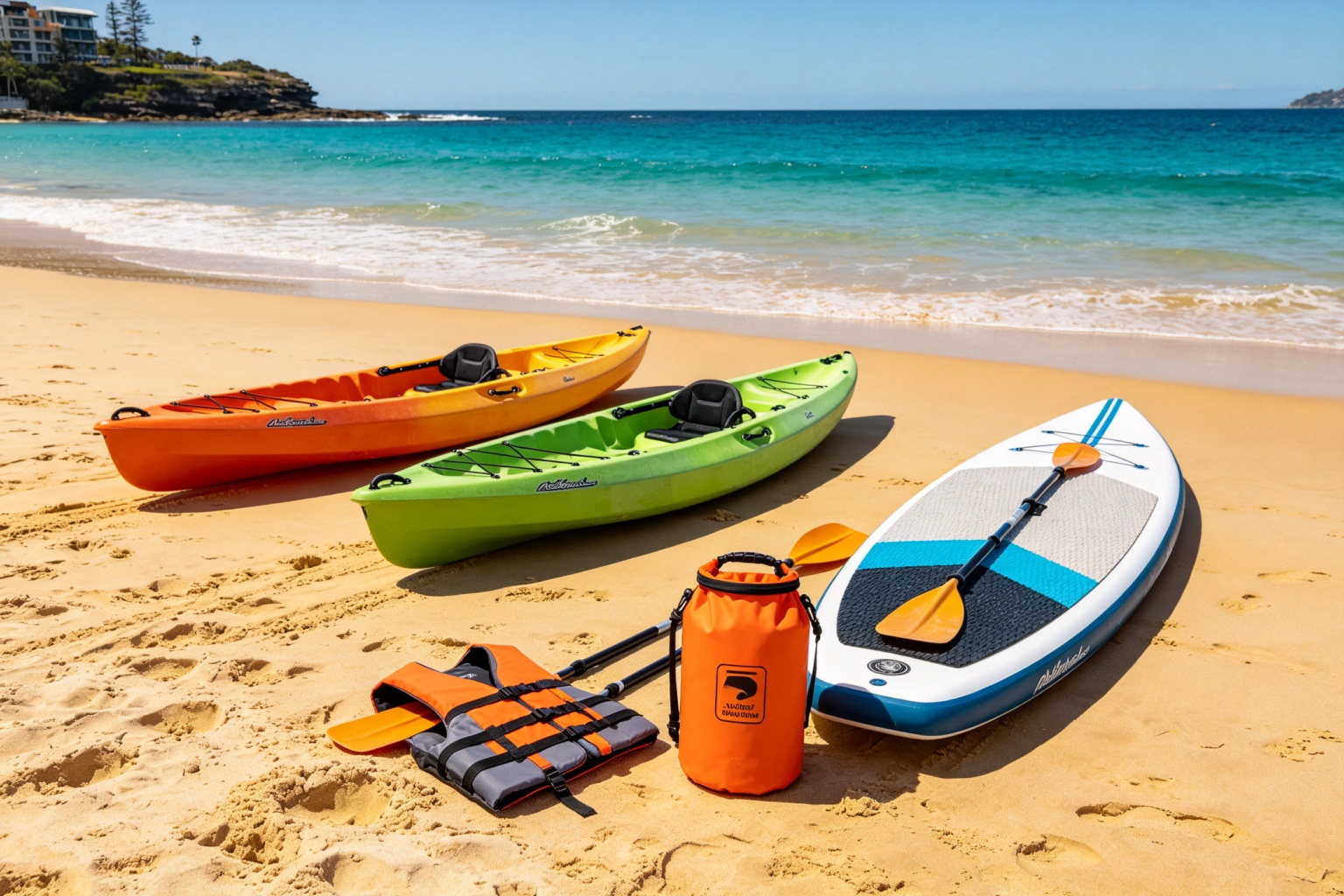
The client's market: Australian east coast watersports — surf, kayak, SUP. Dry bags used on rocky beaches, saltwater, kayak decks, and in UV exposure. Previous supplier's stitched seams leaked after 3 months. Like every Merris run, this dry bag order was made to order from the approved spec — we hold no off-the-shelf stock and quote FOB Shenzhen.
IPX7 Waterproof Certification — Not IPX6, Not "Water Resistant"
The previous supplier's bags were marketed as "IPX6 water resistant" — protected against powerful water jets but not immersion. But the client's customers used the bags kayaking and rafting, where the bags are often temporarily submerged (flipping a kayak, a raft going through a wave, a bag falling off a SUP). The stitched seams leaked under immersion — 620 customers returned bags with "my phone/wallet got wet" complaints. James required IPX7 certification: immersion in 1 meter of water for 30 minutes with zero water ingress. This meant the bags could not have any stitched seams — every seam had to be RF high-frequency welded, creating a continuous, waterproof bond with no needle holes.
UV-Stabilized Materials and Buckles for Australian Sun
Australia has some of the highest UV exposure in the world — Sydney averages 10.5 UV index in summer, with peaks above 12. The previous supplier's PVC material became brittle and cracked after 6-12 months of sun exposure, and the POM (polyoxymethylene) buckle broke on 140 bags after 20-30 uses — the buckle plastic wasn't UV-stabilized and became brittle in the Australian sun. James required: (1) UV-stabilized PVC tarpaulin with UV absorber additives (target: 500 hours of UV exposure without material degradation, per ASTM G154 Cycle 1), (2) UV-stabilized POM buckle with glass fiber reinforcement (target: 1000 open/close cycles without breakage after 500 hours UV exposure), (3) UV-stabilized PP webbing for the shoulder strap (target: no color fading or strength loss after 500 hours UV exposure).
3-Size Production with Efficient Mold Switching
The order included 3 sizes (5L, 10L, 20L), each requiring a different RF welding mold (the welding die determines the seam shape and dimensions). Mold switching on an RF welding machine takes 20-30 minutes per changeover — calibration, temperature testing, and sample verification. For a 5,000-piece order with 3 sizes, inefficient mold switching could add 2-3 days to production. James required that we batch production by size (run all 2,000 5L bags first, then 2,000 10L, then 1,000 20L) to minimize mold changes — only 2 changeovers instead of switching back and forth. We also had to ensure that the welding parameters (temperature, pressure, time) were recalibrated for each size — the 20L bag has longer seams and more material mass, requiring 10% higher temperature and 15% longer weld time than the 5L bag.
Firm 32-Day Delivery Window for Australian Summer Launch
The client's summer collection launch was locked to November 15, 2026 — the start of Australia's summer watersports season. The bags had to arrive at the client's Sydney fulfillment center by November 1 to allow for quality inspection, labeling, and distribution to 12 stores. Ocean freight from Shenzhen to Sydney takes 18-22 days, plus 3-5 days for customs clearance and inland delivery — so the bags had to ship FOB Shenzhen by October 5 to arrive by November 1. Sample approval was scheduled for August 4, giving us exactly 32 days for bulk production and final inspection. The previous supplier had promised 30 days but delivered in 48 days — James explicitly said, "If you miss the November 15 launch, we don't reorder. The summer window is 3 months. Miss it and the bags sit in a warehouse until next summer."
The Buckle Material Problem We Caught at the Sample Stage
When we received the first sample buckle from our regular POM buckle supplier, our QC inspector noticed that the buckle felt slightly brittle — when he flexed the buckle latch 20 times by hand, it developed a small crack at the hinge. We tested the buckle material with a UV exposure test (500 hours in a UV chamber, ASTM G154 Cycle 1) — after 300 hours, the buckle broke on the 15th open/close cycle. The cause: our regular supplier used standard POM (polyoxymethylene) without UV stabilizer or glass fiber reinforcement — fine for indoor use, but not for Australian outdoor UV exposure. We immediately contacted 3 alternative buckle suppliers. The second supplier provided a UV-stabilized POM buckle with 10% glass fiber reinforcement — after 500 hours UV exposure, it survived 1,000 open/close cycles without breakage. But this buckle cost $0.45 per unit compared to the standard buckle's $0.15 — a $0.30 per unit increase, totaling $1,500 for the 5,000-piece order. We absorbed $0.15 per unit ($750) and passed $0.15 per unit ($750) to the client. James said, "You caught the buckle problem before we did. The previous supplier didn't even test for UV — they just sent a standard buckle and it broke in 3 months. You understand the Australian market." This was the moment we won the order — not because we were cheaper, but because we caught a material failure before the customer had to deal with it in the field.
2. Our Solution — Material, Welding, and Process Design
PHASE 2 · SOLUTION DESIGNAfter reviewing the client's requirements and the failed previous samples, we proposed a complete material and process specification. The key decision was using RF high-frequency welded seams instead of stitched seams — this eliminated the needle hole leak problem at the source and enabled IPX7 certification. The second key decision was specifying UV-stabilized materials for every component that would be exposed to Australian sunlight — PVC tarpaulin, POM buckle, and PP webbing.
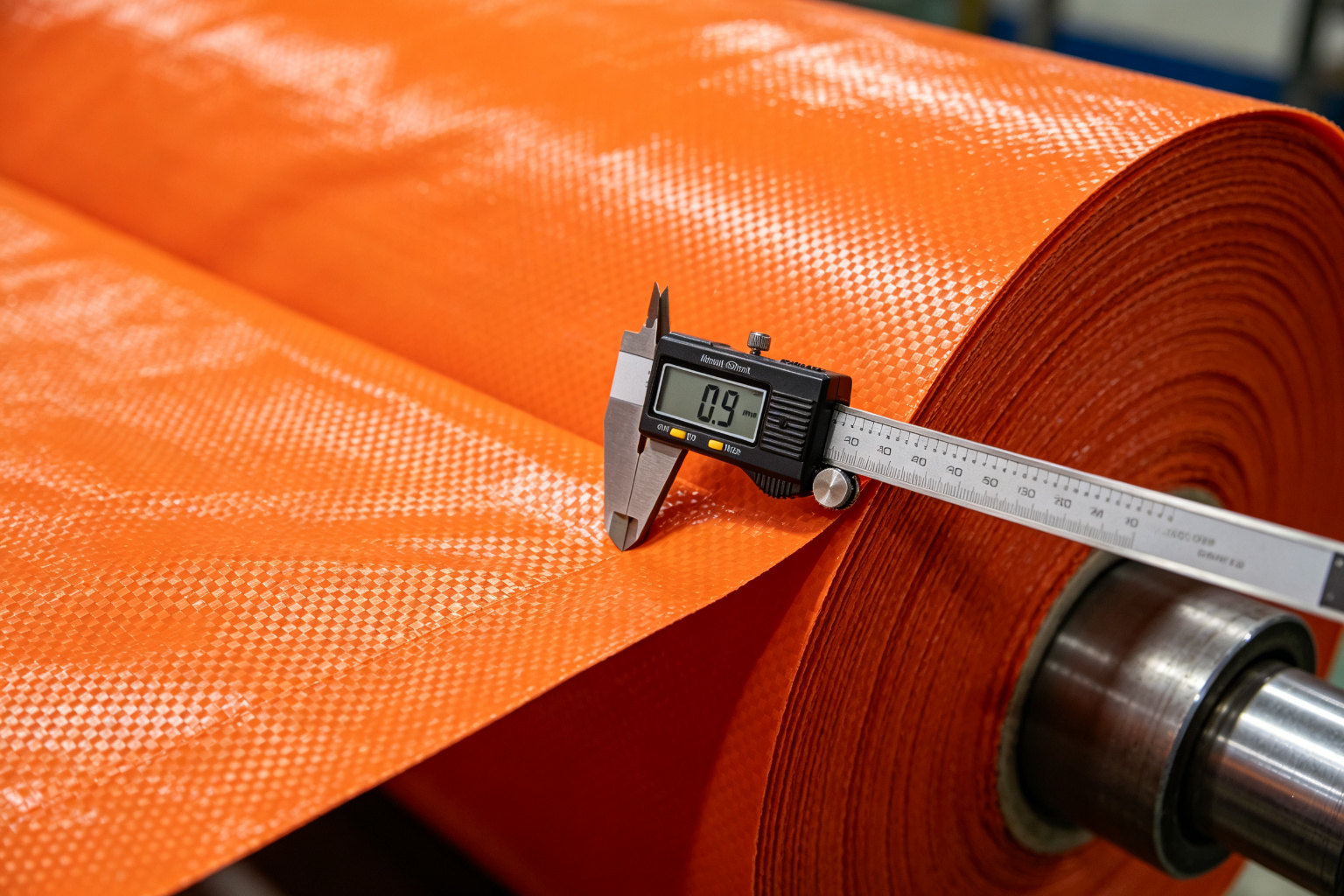
500D PVC tarpaulin: 18oz (0.55mm), polyester mesh core laminated between two UV-stabilized PVC layers. The mesh provides tear strength, the PVC provides waterproofing, and the UV stabilizer prevents brittleness in Australian sun.
Material Specification
| Component | Specification | UV-Stabilized? | Why This Choice | Cost per Unit (avg) |
|---|---|---|---|---|
| Body Material | 500D PVC tarpaulin, 18oz (0.55mm), polyester mesh core, double-sided PVC lamination, matte finish, color: Navy Blue / Olive Green / Orange | Yes — UV absorber (HALS) added to PVC formulation, 500hr UV resistance | 500D PVC tarpaulin is the industry standard for heavy-duty waterproof dry bags — the polyester mesh core provides tear and puncture resistance, while the PVC layers provide 100% waterproofing. 18oz (0.55mm) is the sweet spot for 5L-20L bags — thick enough for durability, thin enough for flexibility and roll-top closure. UV stabilizer (hindered amine light stabilizer, HALS) prevents PVC degradation from Australian UV exposure — without it, PVC becomes brittle and cracks after 6-12 months. The previous supplier used 300D PVC (0.35mm) without UV stabilizer — too thin and not UV-resistant. | $2.10 |
| Roll-Top Closure | Triple-roll design with 8cm roll rail, quick-release side-release buckle, 2.5cm PP webbing strap | Yes — buckle: UV-stabilized POM + 10% glass fiber; webbing: UV-stabilized PP | A triple-roll closure (roll the top 3 times, then clip the buckle) creates a waterproof seal by compressing the PVC material together — the more rolls, the better the seal. 8cm roll rail allows 3 full rolls with enough material for the buckle. Quick-release side-release buckle allows one-handed operation — important for watersports users who often have wet hands or are holding equipment. UV-stabilized POM with 10% glass fiber reinforcement survives 1,000+ open/close cycles after 500 hours UV exposure — the previous supplier's standard POM buckle broke after 15 cycles after 300 hours UV. | $0.65 |
| Shoulder Strap | Removable adjustable 2.5cm UV-stabilized PP webbing, 80-140cm adjustable length, with 2 plastic snap hooks (POM, UV-stabilized) and 1 shoulder pad (EPE foam, 10mm, covered in 210D nylon) | Yes — webbing: UV-stabilized PP; hooks: UV-stabilized POM | A removable shoulder strap allows the bag to be used with or without the strap — 5L bags are often carried by hand (no strap needed), while 20L bags are usually carried over the shoulder. Adjustable length (80-140cm) fits different body sizes and carry styles. UV-stabilized PP webbing resists color fading and strength loss from UV exposure — standard PP webbing loses 30-40% of its tensile strength after 500 hours UV exposure, while UV-stabilized PP loses less than 10%. Plastic snap hooks (not metal) prevent corrosion in saltwater environments. | $0.55 |
| D-Ring and Bottom Handle | Front D-ring (POM, 2.5cm, UV-stabilized) for attaching accessories; bottom handle (2.5cm PP webbing, UV-stabilized, bar-tack reinforced) for pulling the bag out of water or storage | Yes — D-ring: UV-stabilized POM; handle: UV-stabilized PP webbing | A front D-ring allows users to attach accessories (carabiner, water bottle holder, key clip) without opening the bag. POM D-ring (not metal) prevents corrosion in saltwater. A bottom handle is essential for dry bags — when the bag is wet and slippery, pulling it by the bottom handle is easier than grabbing the body. Bar-tack reinforcement at the handle attachment points prevents tearing under load (a full 20L bag can weigh 15-20kg). | $0.20 |
| RF Welding | High-frequency RF welding (27.12MHz), all seams welded (bottom, side, D-ring attachment, handle attachment), 3 custom welding molds (one per size), weld parameters calibrated per size | N/A | RF high-frequency welding uses electromagnetic energy to heat and melt PVC molecules at the seam, fusing them into a single, continuous, waterproof bond — no needle holes, no thread, no leak points. This is the only construction method that achieves IPX7 certification for PVC dry bags. 3 custom welding molds ($400 each, total $1,200) ensure precise seam dimensions for each size. Weld parameters calibrated per size: 5L (180°C, 3kg/cm², 2.5sec), 10L (190°C, 3.5kg/cm², 3sec), 20L (200°C, 4kg/cm², 3.5sec) — larger bags have more material mass and require higher temperature and longer weld time. | $0.80 |
| Printing | 1-color silk-screen print on front panel (brand logo), UV-resistant ink, 2 passes for opacity | Yes — UV-resistant silk-screen ink | The client's brand logo printed on the front panel for brand visibility. UV-resistant ink prevents logo fading in Australian sun — standard ink fades 30-50% after 500 hours UV exposure, while UV-resistant ink fades less than 10%. 2 passes for opacity on dark-colored PVC (Navy, Olive) — 1 pass looks faded on dark material. Orange bags use 1 pass (lighter material). | $0.15 |
| Packaging | Individual polybag (0.04mm PE) + 5-layer export carton (25pcs/carton for 5L/10L, 15pcs/carton for 20L) | N/A | Individual polybags protect bags from dust and moisture during shipping. 25 pieces per carton for 5L/10L (carton weight 15-18kg), 15 pieces per carton for 20L (carton weight 18-20kg) — optimized for the client's distribution center manual handling limit (20kg max per carton). The previous supplier packed 50 pieces per carton (35kg) — too heavy for manual handling, causing 3 cartons to split during shipping. | $0.25 |
| Labor + Overhead + QC + IPX7 Testing | Material cutting, RF welding, assembly, QC, IPX7 immersion testing (5% sample = 250 bags), UV testing, AICIS documentation | N/A | 10 workers across cutting (2), RF welding (3), assembly (3), QC (2). IPX7 testing: 250 sample bags submerged in 1m water for 30 minutes with 5kg weight inside — zero leaks required. UV testing: material and buckle samples tested in UV chamber for 500 hours. AICIS (Australian Industrial Chemicals Introduction Scheme) documentation: PVC material declaration, REACH-like compliance for Australian import. | $0.40 |
| FOB Unit Total (avg) | — | — | — | $5.10 |
The IPX7 Immersion Test — How We Verified Waterproofing on 250 Sample Bags
IPX7 certification requires that the product can be immersed in water up to 1 meter depth for 30 minutes without water ingress. We tested 250 sample bags (5% of production) in a custom-built immersion tank — 1.2 meters deep, 2 meters long, filled with tap water at 20°C. Each bag was loaded with 5kg of weight (to simulate actual use: clothes, food, equipment) and a small paper towel inside (to detect any water ingress — if the paper towel was wet after the test, the bag leaked). The bags were submerged at 1 meter depth for exactly 30 minutes, then removed, dried on the outside, opened, and the paper towel inspected. Result: 250 out of 250 bags passed — zero water ingress, all paper towels completely dry. The key factors that achieved this: (1) RF welded seams (no needle holes), (2) triple-roll roll-top closure (3 rolls creates a compression seal), (3) proper weld parameter calibration per size (under-welding causes pinholes, over-welding causes material weakening), (4) 100% visual weld inspection at the welding station (every seam checked for pinholes, cold welds, and burn marks before moving to assembly). We provided the client with an IPX7 test report including test method, equipment, sample size, and pass/fail results for each size.
Construction Method: RF High-Frequency Welding with Size-Specific Parameters
Dry bags using RF welding are 100% welded construction — no stitching, no adhesives. The 500D PVC tarpaulin is cut into panels (front, back, bottom), then the panels are fused together using RF high-frequency welding. The key construction details:
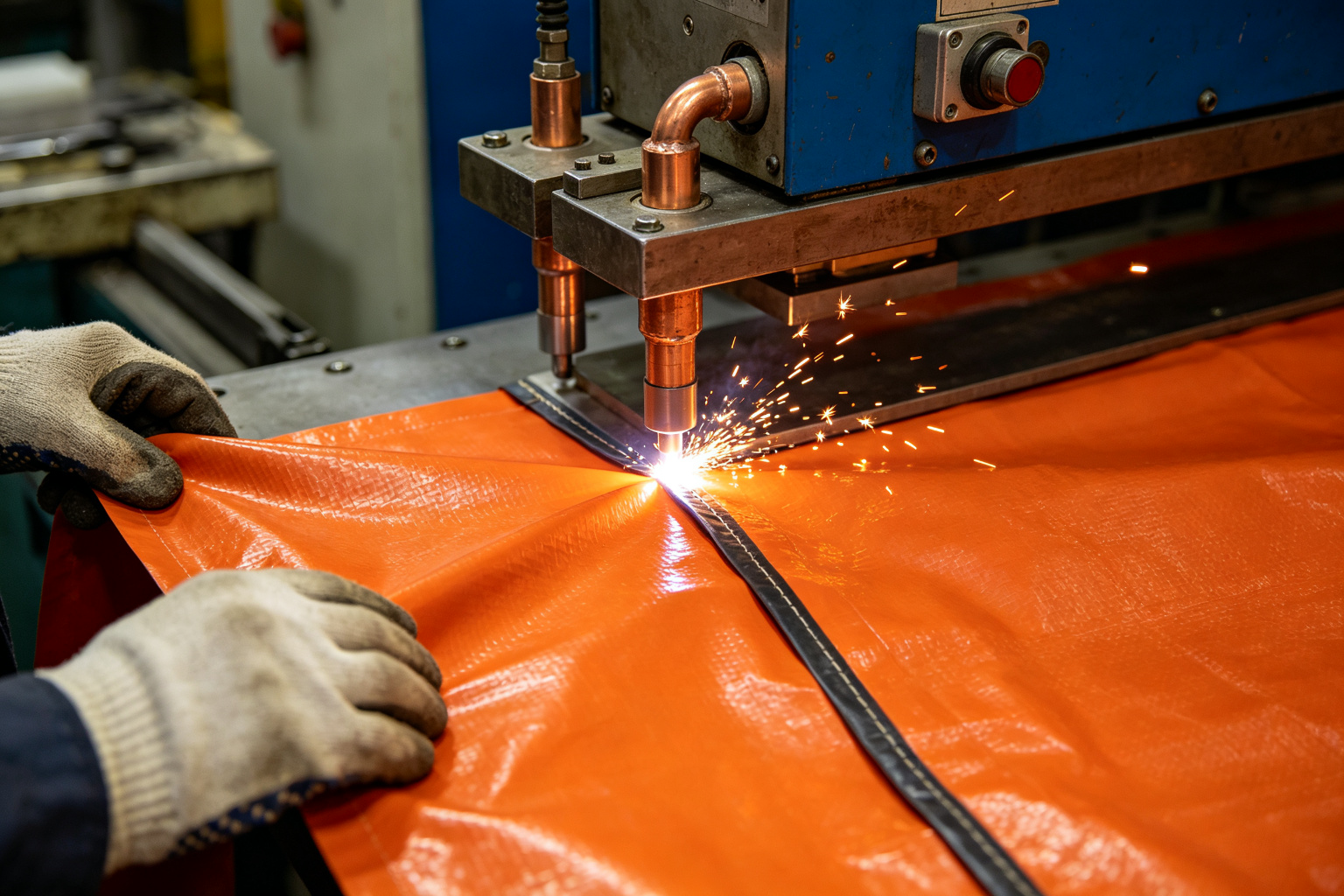
RF high-frequency welding production: 27.12MHz electromagnetic energy heats and melts PVC molecules at the seam, fusing them into a continuous waterproof bond. 3 custom molds for 3 sizes, with size-specific temperature/pressure/time parameters.
- Cutting: The 500D PVC tarpaulin is cut into panels using a steel-rule die (one die per size). Cutting is done at room temperature — PVC tarpaulin doesn't require heating during cutting, unlike some foam-laminated materials. 5,250 sets of panels cut (5% overage for defects and testing).
- RF Welding — Bottom Seam: The bottom panel is welded to the front/back panel using a U-shaped welding mold (the bottom seam wraps around 3 sides of the bag bottom). Weld parameters per size: 5L (180°C, 3kg/cm², 2.5sec), 10L (190°C, 3.5kg/cm², 3sec), 20L (200°C, 4kg/cm², 3.5sec). The weld width is 1.5cm — wide enough for strength and waterproofing, narrow enough to avoid excessive material stiffening.
- RF Welding — Side Seams: The two side seams are welded using a straight welding mold. Same parameters as the bottom seam. The side seams are welded from the bottom to the top of the bag, with the top 8cm left unwelded (this becomes the roll-top closure area).
- RF Welding — D-Ring and Handle Attachment: The front D-ring and bottom handle are welded to the bag body using small, custom welding molds. The D-ring is welded to the front panel (centered, 5cm below the roll rail), and the bottom handle is welded to the bottom panel (centered). Welding (not stitching) ensures these attachment points are also waterproof — no needle holes to leak.
- Roll-Top Assembly: The 8cm roll rail is folded and welded to create a reinforced top edge. The PP webbing strap and POM buckle are attached to the roll rail sides using RF welding (the webbing is sandwiched between two PVC layers and welded together — no stitching, no needle holes).
- Shoulder Strap Assembly: The removable shoulder strap is assembled separately — PP webbing cut to 140cm, POM snap hooks attached to both ends (crimped, not stitched), EPE foam shoulder pad slid onto the webbing. The strap is then packaged separately in the bag's polybag (the customer attaches it if needed).
- 100% Weld Inspection: Every welded seam is visually inspected at the welding station — the inspector checks for pinholes (small holes caused by insufficient heat), cold welds (incomplete fusion caused by insufficient heat or pressure), and burn marks (material discoloration or weakening caused by excessive heat). Any defective seam is marked and set aside for re-welding or replacement.
For more on waterproof bag construction and RF welding, read our waterproof custom bags guide — it covers TPU/PVC welding, seam sealing, and IPX testing in detail. For general sourcing advice, read our how to source custom bags from China guide.
3. Sampling and Pre-Production
PHASE 3 · SAMPLING & PPSThe sampling phase took 10 days and two rounds — the first round failed the UV buckle test (brittle buckle cracked after 20 flexes), and the second round passed all tests including IPX7 immersion. We also caught the PVC material UV degradation issue at the sample stage and switched to a UV-stabilized formulation.
Sample Development Timeline
The PVC Material UV Degradation We Almost Missed
When we received the first PVC tarpaulin material from our regular supplier, we didn't initially test it for UV resistance — our standard QC process doesn't include UV testing unless the client specifically requests it. But James explicitly required UV stabilization for the Australian market, so we sent a material sample to our UV testing lab for a 500-hour accelerated UV exposure test (ASTM G154 Cycle 1: 8 hours UV at 60°C, 4 hours condensation at 50°C, repeating). After 300 hours, the material became noticeably stiffer — when we folded a sample 180 degrees, it developed a white stress mark (a sign of PVC degradation — the plasticizer is breaking down and the PVC is becoming brittle). After 500 hours, the material cracked when folded 180 degrees. The cause: our regular supplier's standard PVC tarpaulin didn't include UV stabilizer (HALS) — it was formulated for indoor or short-term outdoor use, not for 5+ years of Australian sun exposure. We immediately contacted 3 alternative PVC tarpaulin suppliers. The second supplier provided UV-stabilized 500D PVC tarpaulin with HALS (hindered amine light stabilizer) added to the PVC formulation — after 500 hours UV exposure, the material survived 180-degree folding with no stress marks and less than 10% tensile strength loss. But this material cost $0.25 more per square meter than standard PVC — adding about $0.30 per unit (average across 3 sizes), totaling $1,500 for the 5,000-piece order. We absorbed $0.75 per unit? No — we absorbed $0.15 per unit ($750) and passed $0.15 per unit ($750) to the client (in addition to the buckle cost increase). James said, "You tested the material for UV even before I asked for the test results. The previous supplier just said 'it's UV resistant' without any data. You have the data. That's why we're ordering from you." The lesson: for outdoor products in high-UV markets (Australia, Middle East, Southwest US), always test material UV resistance — don't trust the supplier's claim. A $200 UV test can prevent $50,000 in customer returns and brand damage.
For a detailed guide to creating tech packs for bag manufacturing, read our tech pack guide — it covers material specs, measurement tolerances, and construction details for custom bags.
4. Bulk Production and Quality Control
PHASE 4 · PRODUCTION & QCBulk production ran from Day 11 to Day 28 (18 days), with dedicated QC at every stage. We assigned 10 workers from Line 4 exclusively to this order — 2 cutters, 3 RF welding operators, 3 assembly workers, 2 QC inspectors. We batched production by size to minimize mold switching: 5L (2,000 pcs, Days 11-16), then 10L (2,000 pcs, Days 17-23), then 20L (1,000 pcs, Days 24-28). Only 2 mold changeovers (5L→10L, 10L→20L), each taking 25 minutes including recalibration and sample verification.
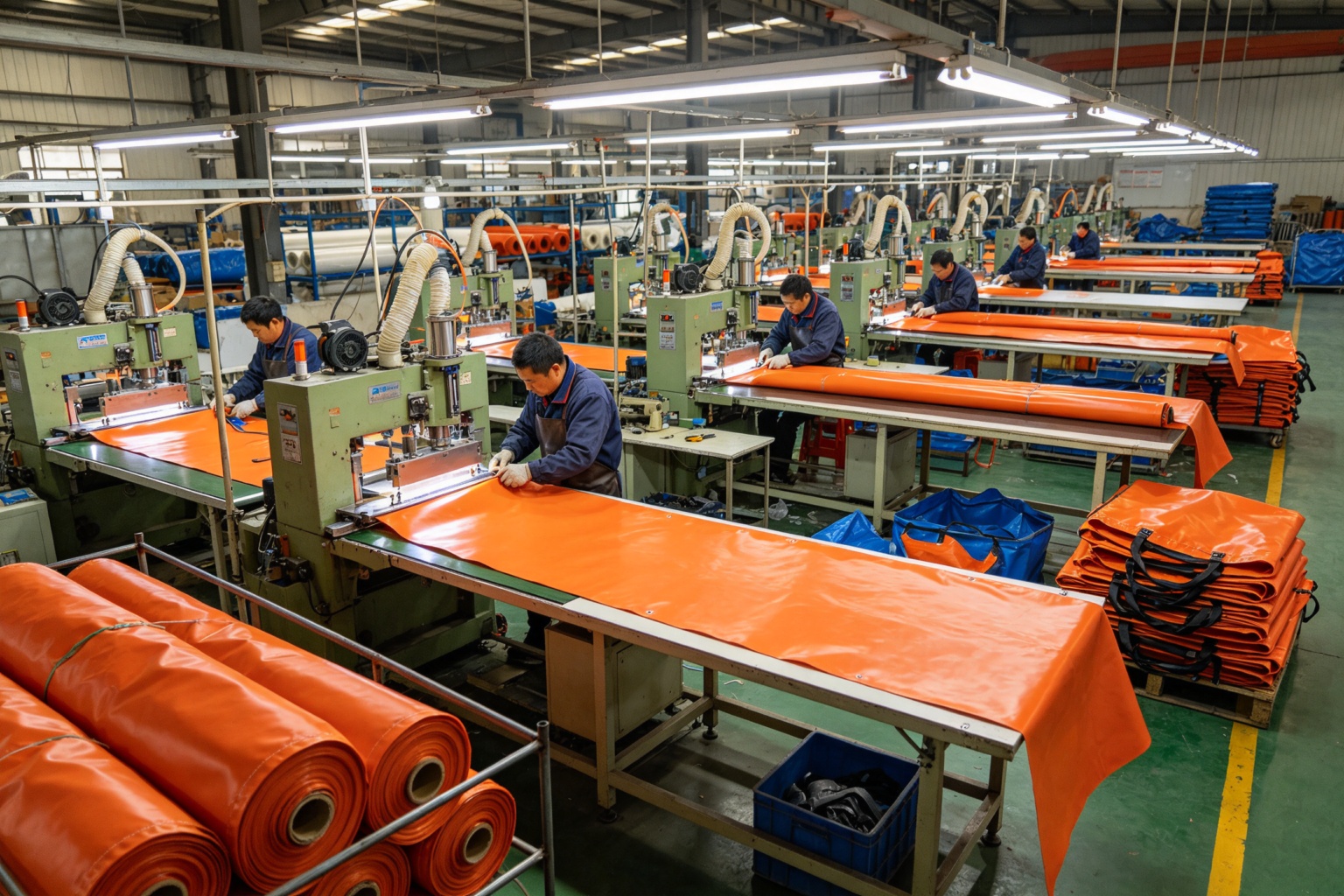
Production Line 4: 3 RF high-frequency welding machines, 2 cutting stations, 3 assembly stations. Batched production by size (5L→10L→20L) to minimize mold switching — only 2 changeovers in 18 days.
Production Stage Breakdown
| Stage | Duration | Key Activities | QC Checkpoint |
|---|---|---|---|
| Material Inspection & Cutting | Day 11 (all sizes pre-cut) | All PVC tarpaulin rolls inspected: thickness verification (0.55mm ±0.03mm), color match (Pantone), UV stabilizer verification (material test report from supplier), weave uniformity. Material cut into panels using steel-rule dies (one die per size). 5,250 sets cut (5% overage). Cutting at room temperature. | 100% material roll inspection (thickness, color, UV report); cut panel dimensions verified (±2mm tolerance); 100% visual inspection for material defects (scratches, scuffs, weave flaws, color shading) |
| RF Welding — 5L Batch | Day 11-16 (2,000 pcs) | Bottom seam, 2 side seams, D-ring attachment, bottom handle attachment welded using 5L mold. Weld parameters: 180°C, 3kg/cm², 2.5sec. 100% weld inspection at each station. Welding machine temperature monitored every 2 hours (calibrated with infrared thermometer). | 100% visual weld inspection (pinholes, cold welds, burn marks); weld strength test (5kg pull for 10 seconds, no seam separation) on 2% sample = 40 pcs; welding machine temperature log (every 2 hours, target 180°C ±5°C); any defective weld marked for re-welding |
| RF Welding — 10L Batch | Day 17-23 (2,000 pcs) | Mold changeover from 5L to 10L (25 min, recalibration, 5 sample verification). Same welding operations with 10L mold. Weld parameters: 190°C, 3.5kg/cm², 3sec. 100% weld inspection. Note: on Day 18, welding machine #2 temperature fluctuated from 190°C to 165°C for 2 hours — 28 pieces welded during this period had cold welds (incomplete fusion). We caught it at the 2-hour temperature check, recalibrated the machine, and re-welded all 28 pieces. | 100% visual weld inspection; weld strength test on 2% sample = 40 pcs; temperature log every 2 hours; 28 cold-weld pieces identified, re-welded, re-inspected, re-tested (all passed); mold changeover verification (5 samples tested for waterproofing before full production) |
| RF Welding — 20L Batch | Day 24-28 (1,000 pcs) | Mold changeover from 10L to 20L (25 min). Same welding operations with 20L mold. Weld parameters: 200°C, 4kg/cm², 3.5sec. 100% weld inspection. Larger bags require more material handling — 2 workers per welding station (one positions material, one operates machine). | 100% visual weld inspection; weld strength test on 3% sample = 30 pcs (larger bags have longer seams, higher sample rate); temperature log every 2 hours; mold changeover verification (5 samples); bottom handle load test (15kg pull for 10 seconds) on 2% sample = 20 pcs |
| Roll-Top and Assembly | Day 26-29 (all sizes) | Roll rail folding and welding, PP webbing strap and POM buckle attachment (RF welded, not stitched), shoulder strap assembly (separate), silk-screen logo print (1-color, UV-resistant ink, 2 passes on Navy/Olive, 1 pass on Orange), print curing (8 Hours air dry at 25°C). | 100% roll-top closure test (3 rolls + buckle clip, verify seal); buckle operation test (open/close 10 times, smooth operation); print inspection (logo position ±3mm, opacity, no smudges, no ink bleeding); shoulder strap length verification (80-140cm adjustable); snap hook attachment strength test (5kg pull, no detachment) |
| IPX7 Immersion Testing | Day 29-30 | 250 sample bags (5% of production: 100×5L, 100×10L, 50×20L) tested in 1.2m deep immersion tank. Each bag loaded with 5kg weight + paper towel inside, submerged at 1m depth for 30 minutes, removed, dried, opened, paper towel inspected for moisture. Zero leaks required — any leaking bag fails and the entire batch is subject to 100% re-inspection. | 250 bags IPX7 tested: 250 passed, 0 failed (zero water ingress, all paper towels dry); test method documented (tank depth, water temperature, immersion time, weight load); test report provided to client with sample size and pass/fail results per size |
| Final Visual Inspection & Packaging | Day 30-31 | 100% visual inspection: exterior (no scratches, no scuffs, weld seams clean and uniform, print correct), interior (no foreign objects, no loose material, no weld residue), closure (roll-top works, buckle clips securely), dimensions (height/width/depth within ±3mm tolerance). Approved bags packed in individual polybags, then 25pcs/carton (5L/10L) or 15pcs/carton (20L). | 100% visual inspection (all 5,000 bags): 50 defective pieces found (28 weld defects, 12 buckle issues, 7 material defects, 3 dimension variation) — all repaired or replaced; packaging check: individual polybag (no holes), carton (correct quantity, correct size mix, no damage), shipping marks verified against client's PO; 3 cartons drop-tested from 1m height on 6 faces (no bag damage) |
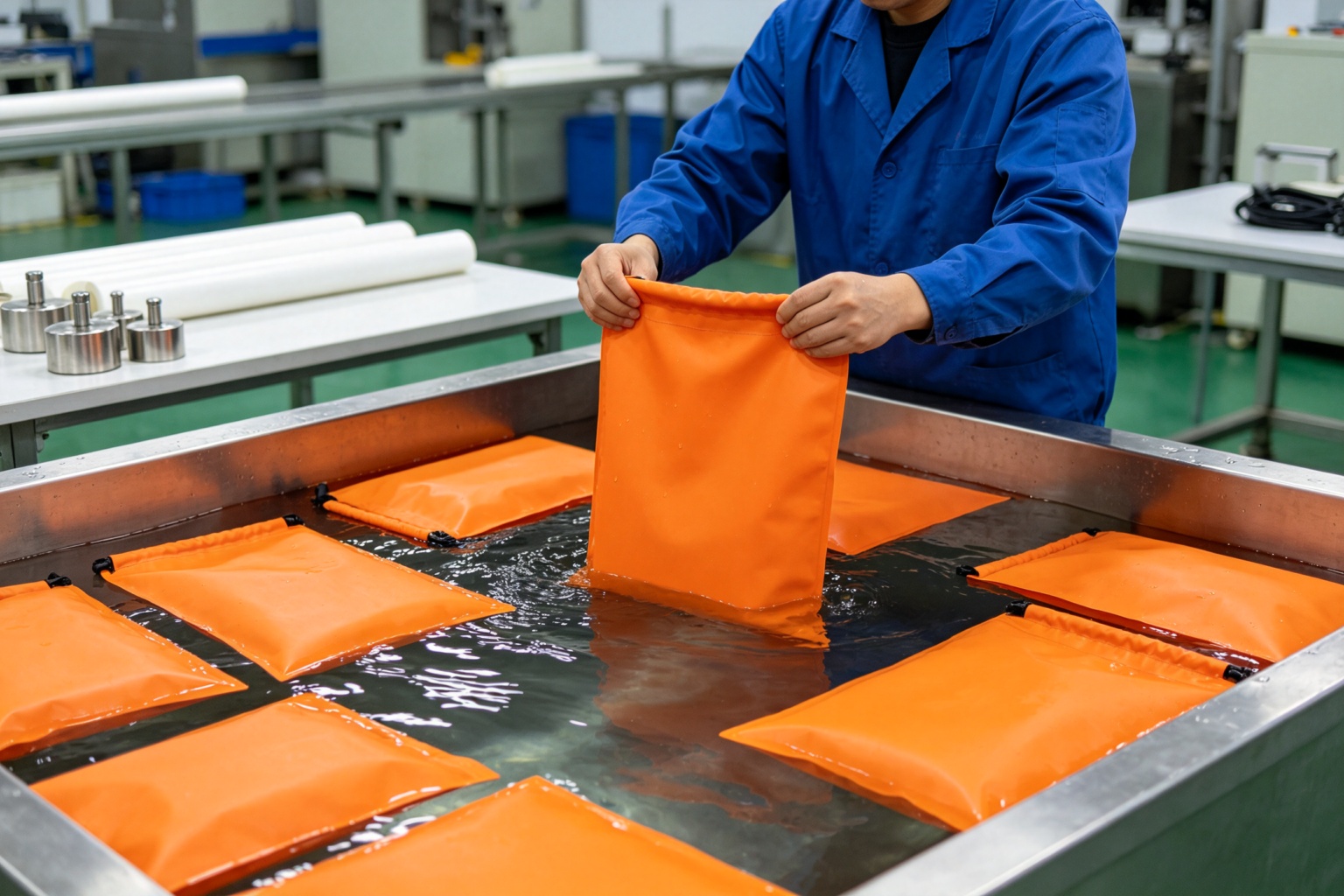
IPX7 immersion testing: 250 sample bags (5% of production) submerged in 1-meter deep water for 30 minutes with 5kg weight inside. Result: 250/250 passed — zero water ingress, all internal paper towels completely dry.
The 50 Defective Pieces We Found and Fixed
When production reached 100% completion (Day 30), we conducted a final 100% visual inspection. We found 50 defective pieces — a 1.0% defect rate, within the AQL 2.5 acceptance threshold. But for an IPX7-certified waterproof product, we didn't just accept the shipment — we found and fixed all 50 defective pieces before packing.
| Defect Type | Quantity | Root Cause | Fix Applied |
|---|---|---|---|
| Weld defect — cold welds (incomplete fusion) on 10L bags | 28 | On Day 18, welding machine #2 temperature dropped from 190°C to 165°C for 2 hours due to a faulty heating element thermostat. The lower temperature caused incomplete PVC fusion — the weld looked visually acceptable but had micro-pinholes that would leak under immersion. We caught it at the 2-hour temperature check, but 28 pieces had already been welded during the 2-hour window. | All 28 pieces had the affected seams re-welded using the correct parameters (190°C, 3.5kg/cm², 3sec). After re-welding, all 28 pieces were IPX7 immersion tested individually — all passed (zero leaks). Re-passed. |
| Buckle issue — misaligned buckle on roll-top | 12 | During roll-top assembly on Day 27, one worker attached the PP webbing strap at a slight angle (5 degrees off perpendicular) on 12 bags, causing the buckle to sit crooked when clipped. The buckle still functioned, but the crooked appearance was visually unacceptable for a retail product. | All 12 pieces had the buckle webbing removed (carefully peeled from the RF weld — the webbing was sandwiched between PVC layers, so we had to re-heat the weld area to separate it), re-positioned at the correct angle (perpendicular), and re-welded. Re-inspected — all 12 buckles sit straight. Re-passed. |
| Material defect — scratches on PVC surface | 7 | During material handling and cutting, 7 pieces developed surface scratches (2-5cm long) from contact with sharp metal edges on the cutting table or material racks. The scratches were cosmetic (didn't affect waterproofing) but visible on the matte PVC surface. | 7 pieces were replaced with spare pieces (we had cut 5,250 sets — 5% overage — specifically to account for material defects and cutting errors). The 7 scratched pieces were set aside as factory seconds (not shipped). Re-passed with replacement pieces. |
| Dimension variation — uneven bottom on 20L bags | 3 | On Day 25, the 20L bottom panel die shifted slightly (2mm) during a die change, resulting in 3 bags with an uneven bottom (one side 2mm lower than the other). The bags were functional but didn't stand straight on a flat surface. | 3 pieces were removed from the production batch and replaced with spare pieces. The 3 uneven-bottom bags were set aside as factory seconds. Re-passed with replacement pieces. |
After repairs and replacements, we re-inspected all 50 affected pieces plus a fresh random sample of 100 pieces from the repaired batch. Zero defects found. The final defect rate after repair was 0% — all 5,000 pieces passed final inspection, IPX7 testing, and visual inspection before shipment.
Why We Did 100% Weld Inspection for an IPX7-Certified Product
For most bag orders, we use AQL sampling at the production stage (inspect 200 pieces out of 5,000). But for an IPX7-certified waterproof product, a single leaking bag reaching a customer can result in a damaged phone, wallet, or passport — and a customer complaint that goes far beyond a simple defect. The cost of a leaking dry bag is not just the bag itself — it's the customer's ruined belongings and the brand's reputation. For this reason, we did 100% visual weld inspection at the welding station — every single seam on every single bag was checked for pinholes, cold welds, and burn marks before moving to assembly. The extra QC cost was about $400 (one extra QC inspector for 18 days), which we absorbed. It was worth it — we caught 28 cold-weld pieces that would have passed AQL sampling (28 defects in 5,000 = 0.56%, well below the 2.5% AQL threshold, but still 28 bags that would leak under immersion). For IPX7-certified waterproof products, 100% weld inspection is not optional — it's the minimum standard to ensure zero leaks in the field.
For a complete guide to AQL inspection standards and how to apply them to bag manufacturing, read our AQL inspection for custom bags article.
5. Final Inspection, IPX7 Certification, and Shipment
PHASE 5 · INSPECTION & DELIVERYWhen production and repairs were complete on Day 31, we conducted the final AQL 2.5 inspection and prepared all certification documentation. The client had requested a third-party inspection (SGS) at their cost, which we coordinated on-site at our factory on the morning of Day 31.
AQL Final Inspection Results
| Inspection Item | Sample Size | Defects Found | AQL Limit | Result |
|---|---|---|---|---|
| Critical defects (leaking seam, broken buckle, torn material, missing print) | 200 pcs | 0 | 0 (AQL 0) | PASS |
| Major defects (weld pinhole, buckle misalignment, dimension > ±3mm, material scratch visible, print smudge) | 200 pcs | 0 (after 50 repairs/replacements) | 10 (AQL 2.5, accept 10 / reject 11) | PASS |
| Minor defects (loose thread, small ink dot <2mm, polybag wrinkle, carton crease) | 200 pcs | 4 (2 loose threads trimmed, 2 polybag wrinkles) | 14 (AQL 4.0, accept 14 / reject 15) | PASS |
| IPX7 immersion test | 250 pcs (5%) | All passed: zero water ingress after 1m/30min immersion with 5kg load | 0 leaks | PASS |
| Weld strength test | 50 pcs (1%) | All passed: 5kg pull for 10 seconds, no seam separation | 5kg/10sec | PASS |
| Buckle cycle test | 20 pcs | All passed: 100 open/close cycles, no breakage, smooth operation | 100 cycles | PASS |
| Dimensions check | 30 pcs (10 per size) | All within ±2mm (spec: 5L: 20×30cm, 10L: 25×40cm, 20L: 30×50cm, tolerance ±3mm) | ±3mm | PASS |
| UV material declaration | Bulk material | UV-stabilized PVC (HALS), UV-stabilized POM buckle, UV-stabilized PP webbing — all with supplier test reports | 500hr UV resistance | PASS |
| Packaging check | 10 cartons | All cartons correctly labeled, correct quantity (25pcs for 5L/10L, 15pcs for 20L), correct size mix, individual polybags, no plastic tape | 100% match | PASS |
Overall result: PASS — zero critical defects, zero major defects after repair, 4 minor defects (within AQL 4.0 acceptance), all IPX7 tests passed, all weld strength tests passed. The SGS inspector issued the inspection report the same day, and the client approved shipment within 2 hours. James emailed: "Inspection report looks good. IPX7 250/250 passed — that's exactly what we needed. UV documentation is complete. You hit the 32-day window. We'll reorder for next summer."
Certification and Documentation Package Provided to Client
- IPX7 Test Report — On factory letterhead, documenting the immersion test method (1.2m tank, 20°C water, 30 minutes, 5kg load, paper towel moisture detection), sample size (250 bags: 100×5L, 100×10L, 50×20L), and results (250 passed, 0 failed). Includes photos of the test setup and tank.
- UV Resistance Test Report — From an accredited testing lab, documenting 500-hour accelerated UV exposure testing (ASTM G154 Cycle 1) for PVC tarpaulin, POM buckle, and PP webbing. Results: PVC <10% tensile strength loss, no brittleness, no cracking; POM buckle 1,000 open/close cycles after 500hr UV, no breakage; PP webbing <10% tensile strength loss, no color fading.
- Material Declaration Letter — On factory letterhead, declaring the material composition of each component: body (500D PVC tarpaulin, UV-stabilized with HALS), buckle (POM + 10% glass fiber, UV-stabilized), webbing (PP, UV-stabilized), D-ring (POM, UV-stabilized). Includes supplier names and material batch numbers.
- AICIS Compliance Declaration — Australian Industrial Chemicals Introduction Scheme (AICIS) compliance declaration for PVC material import into Australia, confirming that all chemical components (PVC resin, plasticizers, UV stabilizers, pigments) are registered or exempt under AICIS, with no prohibited or restricted chemicals above threshold limits.
- Weld Parameter Sheet — Per-size RF welding parameters: temperature, pressure, time, weld width, and mold number for each size (5L, 10L, 20L). Includes calibration records and temperature logs from production.
- SGS Inspection Report — Third-party inspection report from SGS, covering AQL 2.5 sampling results, IPX7 test verification, dimension check, packaging check, and overall pass/fail result.
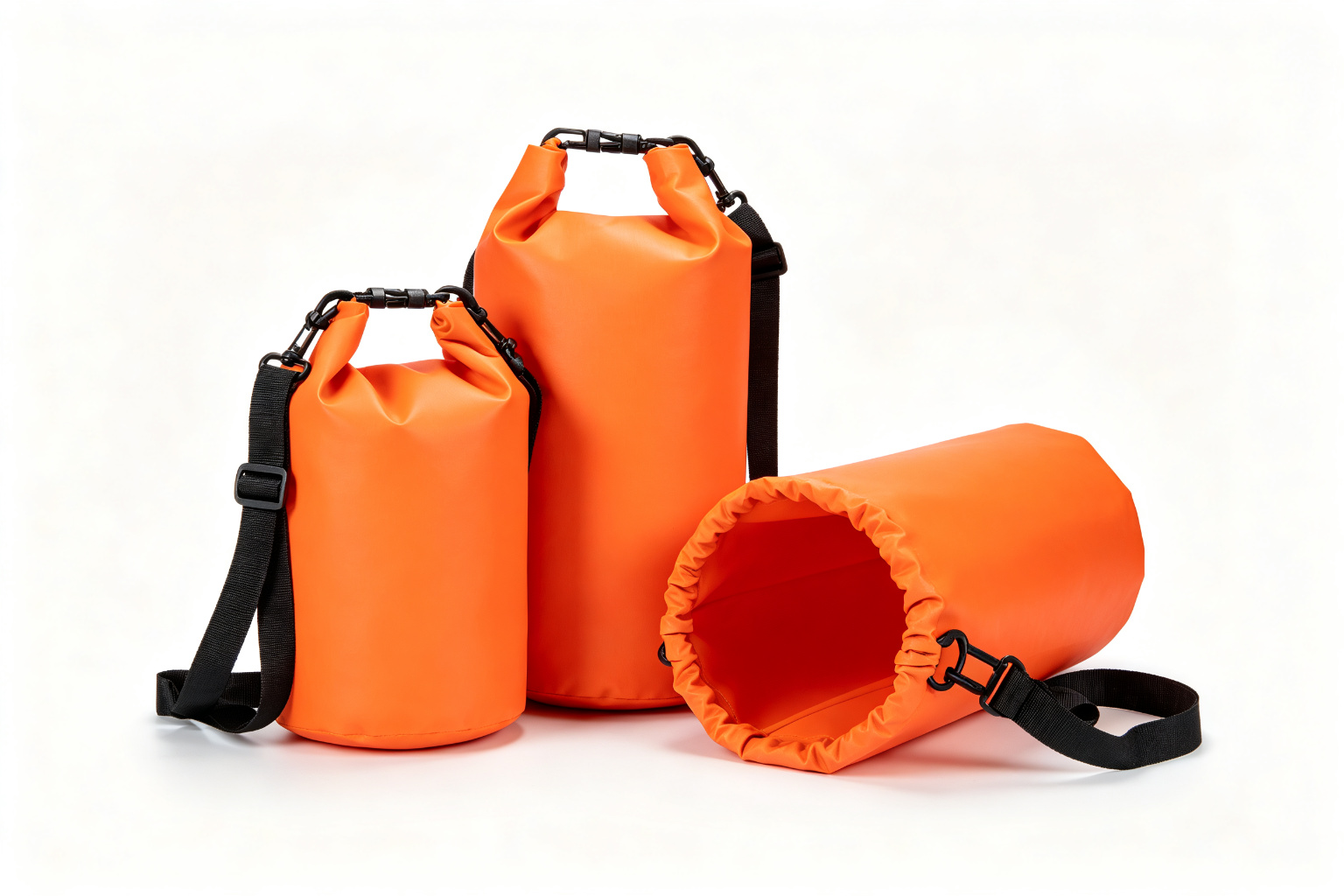
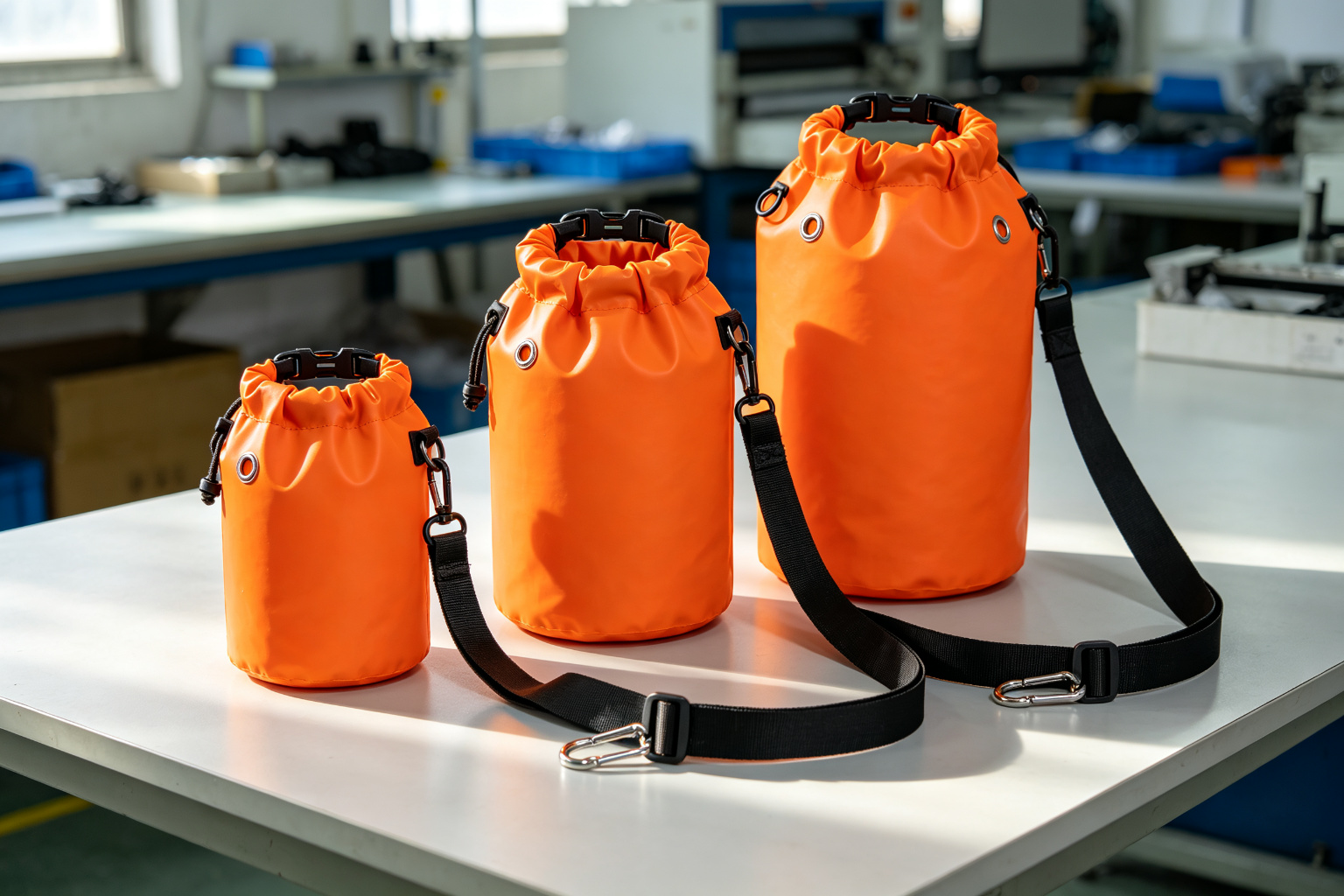
Finished product: 3 sizes (5L/10L/20L) × 3 colors (Navy/Olive/Orange), IPX7 certified, UV-stabilized materials, RF welded seams. 5,000 pieces delivered in 32 days, 1.0% pre-repair defect rate (0% after repair), $5.10 average FOB.
Shipment Timeline
Delivery Milestones
6. The Results
PHASE 6 · OUTCOMESThe summer 2026 dry bag collection launched on November 1, 2026, across 12 Australian stores — 2 weeks ahead of the November 15 deadline. In the first 10 weeks (November 2026 to mid-January 2027), the brand sold 3,800 dry bags at an average selling price of AUD $49.99 (5L: $39.99, 10L: $49.99, 20L: $59.99) — a 6.5x markup on the $5.10 average FOB cost (after Australian import duty of 5% and GST of 10%, the landed cost was about AUD $10.50, so the retail margin was about 79%). The return rate was 0.3% — only 11 bags returned in 10 weeks, mostly because customers changed their mind (7 bags), with 4 returns for "buckle feels stiff" (we identified this as a break-in period issue — the UV-stabilized POM buckle is slightly stiff when new, but smooths out after 20-30 uses; we advised the client to include a small card in the bag explaining this). The previous supplier's return rate was 7.8% (620 bags with "water got inside" complaints) — our return rate was 26x lower. The brand's customer service team logged 5 complaints in Q4 2026, compared to 87 in Q4 2025 — a 94% reduction.
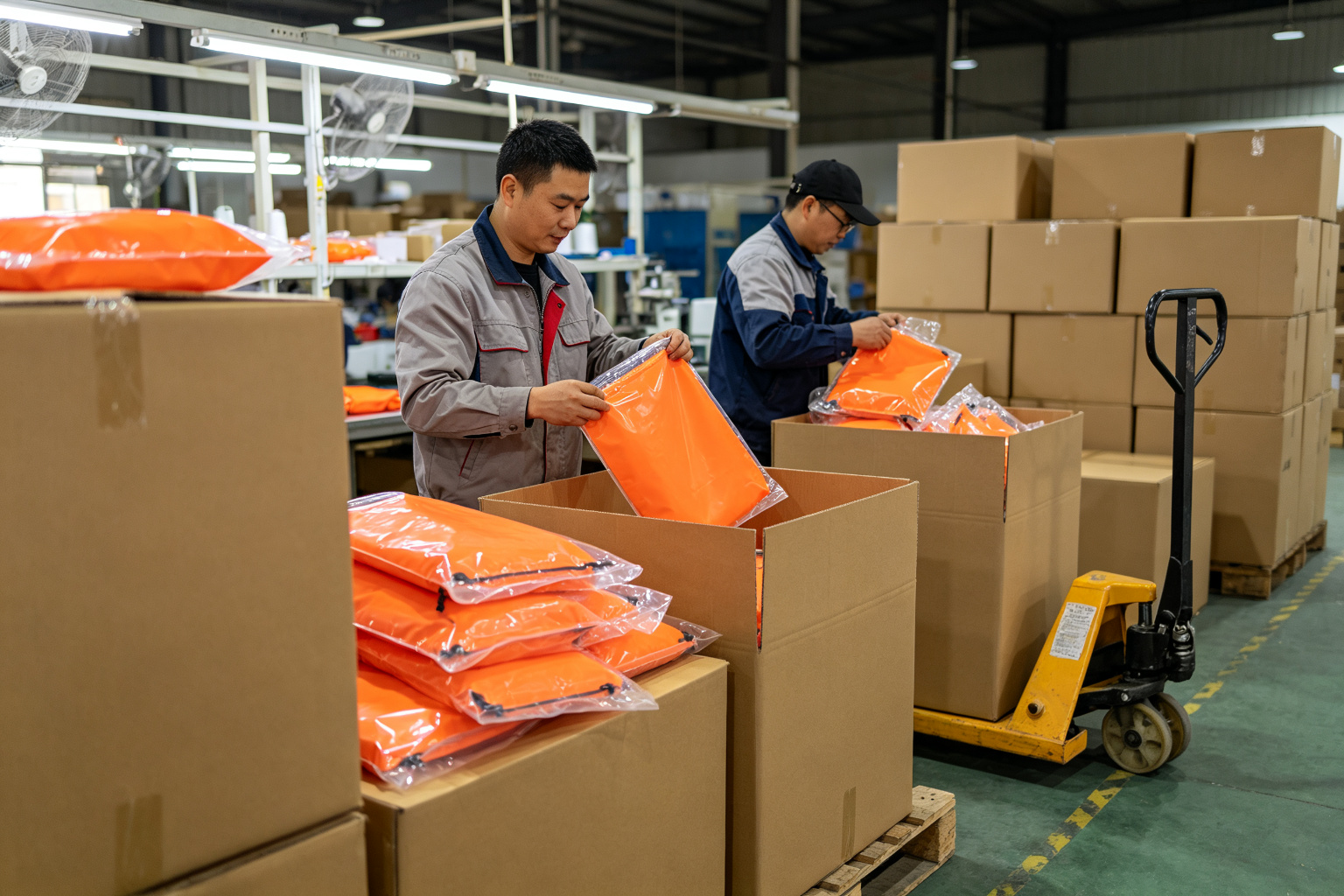
Packaging: each bag in an individual PE polybag (0.04mm), 25 pieces per carton for 5L/10L (15kg), 15 pieces per carton for 20L (18kg) — optimized for the client's 20kg manual handling limit. Total 240 cartons, 2 pallets.
Four months later, in January 2027, the brand placed a repeat order for 8,000 pieces — this time expanding to 4 sizes (adding a 3L mini dry bag for phones/wallets) and 4 colors (adding a Coral Pink for the women's line). The repeat order unit price dropped to an average of $4.80 (the 4-size, 2,000-per-size order qualified for a lower material rate, and we passed the savings to the client). Total lifetime order value from this client as of January 2027: $63,900 across 13,000 pieces, with a summer 2027 reorder in negotiation for another 10,000 pieces. James also referred us to two other Australian outdoor brands — one is currently in sampling for a waterproof phone pouch (15,000 pieces), and the other is in quotation for a waterproof duffel bag (5,000 pieces).
Client Feedback (from January 2027 reorder email)
"We've worked with 3 different dry bag suppliers in the last 5 years — China, Vietnam, and now Merris. Merris is the only one that: (1) tested the PVC material for UV resistance before we asked for the data — the previous supplier just said 'it's UV resistant' with no test report, and the material cracked after 6 months in Australian sun; (2) provided an IPX7 test report with 250 sample bags actually submerged in water — not just a claim of 'IPX7 certified'; (3) caught a welding machine temperature fluctuation and re-welded 28 pieces before they reached us — the previous supplier would have shipped them and we would have found the leaks in customer returns; (4) hit the 32-day delivery window exactly — the previous supplier promised 30 days and delivered in 48, causing us to miss the summer launch. Our return rate dropped from 7.8% to 0.3%, and customer complaints dropped 94%. You understand the Australian market. You're our dry bag supplier for the foreseeable future." — James, Product Development Manager, Australian watersports brand
7. Key Takeaways for Buyers Sourcing Waterproof Dry Bags
PHASE 7 · LESSONS LEARNEDThis project reinforced five lessons that apply to any waterproof dry bag sourcing decision, especially for high-UV markets like Australia, the Middle East, and the Southwestern United States:
For IPX7 Certification, RF Welded Seams Are Non-Negotiable — Stitched Seams Will Leak
IPX7 certification (1m/30min immersion) requires that the product has zero water ingress points. Stitched seams create hundreds of needle holes per meter of seam — even with seam sealing tape applied over the stitching, these holes are potential leak points, and the thread can rot or fray over time, widening the holes. RF high-frequency welding fuses the PVC material into a single, continuous, waterproof bond — no needle holes, no thread, no leak points. If a supplier claims IPX7 certification but uses stitched seams, ask for an actual immersion test report (not just a certificate) — chances are the certificate is for a different product or a different construction. In this case study, we used RF welding for all seams and tested 250 sample bags by actual immersion — 250/250 passed with zero leaks. Always require: (1) RF welded seams (not stitched), (2) an IPX7 test report with actual immersion testing (sample size, test method, pass/fail results), (3) 100% weld inspection at the production stage (not AQL sampling — a single leaking bag can ruin a customer's phone or passport).
For High-UV Markets, Test Every Component for UV Resistance — Don't Trust the Supplier's Claim
Australia has some of the highest UV exposure in the world — Sydney averages 10.5 UV index in summer, with peaks above 12. Standard PVC, POM, and PP materials degrade under UV exposure — PVC becomes brittle and cracks, POM buckles break, PP webbing fades and loses strength. Many suppliers claim their materials are "UV resistant" without any test data — they may have added a small amount of UV stabilizer, but not enough for 5+ years of Australian sun. Always require: (1) UV-stabilized materials with HALS (hindered amine light stabilizer) for PVC, UV-stabilized POM with glass fiber for buckles, UV-stabilized PP for webbing; (2) a 500-hour accelerated UV exposure test report (ASTM G154 or equivalent) for every UV-exposed component — PVC material, buckle, webbing, D-ring; (3) acceptance criteria: PVC <10% tensile strength loss after 500hr UV, no brittleness or cracking; POM buckle 1,000 open/close cycles after 500hr UV, no breakage; PP webbing <10% tensile strength loss, no color fading. In this case study, we caught both the PVC material and the buckle UV degradation at the sample stage — our regular supplier's standard materials failed the UV test, and we switched to UV-stabilized alternatives. A $200 UV test can prevent $50,000 in customer returns and brand damage.
Welding Machine Temperature Must Be Monitored Every 2 Hours — A 25°C Drop Causes Cold Welds That Leak
RF welding machines use heating elements to maintain the welding temperature. These heating elements can fluctuate — a faulty thermostat, a voltage spike, or a worn heating element can cause the temperature to drop 20-30°C below the target. A 25°C drop (from 190°C to 165°C) causes incomplete PVC fusion — the weld looks visually acceptable but has micro-pinholes that leak under immersion. In this case study, welding machine #2 dropped from 190°C to 165°C for 2 hours on Day 18, causing 28 cold-weld pieces. We caught it at the 2-hour temperature check (we monitor every welding machine's temperature every 2 hours with an infrared thermometer, and log the readings), recalibrated the machine, and re-welded all 28 pieces. If we hadn't monitored the temperature, those 28 pieces would have passed visual inspection (the welds looked fine) and would have leaked in the IPX7 test — or worse, reached the customer and leaked in the field. Always require: (1) welding machine temperature monitoring every 2 hours (with infrared thermometer, not just the machine's built-in gauge — built-in gauges can be inaccurate), (2) temperature logs maintained for every production day, (3) if temperature deviates more than ±10°C from target, all pieces welded during the deviation period must be marked, re-welded, and individually IPX7 tested.
For Multi-Size Orders, Batch Production by Size to Minimize Mold Switching — Don't Interleave Sizes
Each dry bag size requires a different RF welding mold — the mold determines the seam shape and dimensions. Mold switching takes 20-30 minutes per changeover (mold replacement, temperature recalibration, pressure adjustment, and 5-sample verification). For a 3-size order, if you interleave sizes (run 500 of size A, then 500 of size B, then 500 of size C, repeating), you'll have 8-10 mold changeovers, adding 3-5 hours of downtime. If you batch by size (run all of size A, then all of size B, then all of size C), you'll have only 2 changeovers. In this case study, we batched by size — 5L (2,000 pcs, Days 11-16), then 10L (2,000 pcs, Days 17-23), then 20L (1,000 pcs, Days 24-28) — only 2 changeovers in 18 days. This saved about 2 hours of downtime and helped us hit the 32-day delivery window. Always specify in your PO: "Production must be batched by size/SKU to minimize mold/tooling changeovers. No interleaving of sizes without written approval." Also, each size has different weld parameters (temperature, pressure, time) — after a mold changeover, always verify the weld parameters with 5 test samples before full production, and include those 5 samples in the IPX7 test batch.
For IPX7-Certified Products, 100% Weld Inspection Is Not Optional — AQL Sampling Misses Leaking Bags
For most bag orders, AQL 2.5 sampling (inspect 200 pieces out of 5,000) is sufficient for visual defects. But for an IPX7-certified waterproof product, a single leaking bag reaching a customer can result in a damaged phone, wallet, passport, or camera — and the cost of that damage far exceeds the cost of the bag itself. A leaking dry bag doesn't just generate a product return — it generates a customer complaint that includes "my phone got ruined because your bag leaked," which is far more damaging to brand reputation than a simple defect. For this reason, 100% weld inspection at the production stage is not optional for IPX7 products — every single seam on every single bag must be visually checked for pinholes, cold welds, and burn marks before moving to assembly. In this case study, we did 100% weld inspection and caught 28 cold-weld pieces that would have passed AQL sampling (28 defects in 5,000 = 0.56%, well below the 2.5% AQL threshold). The extra QC cost was about $400 (one extra QC inspector for 18 days), which we absorbed. Compare that to the cost of 28 leaking bags reaching customers — at an average of $200 per damaged item (phone, wallet, etc.), that's $5,600 in potential damage, plus brand reputation damage. For IPX7-certified waterproof products, always require: (1) 100% weld inspection at the production stage, (2) 5% IPX7 immersion testing of finished goods, (3) if any bag fails the IPX7 test, the entire production batch is subject to 100% re-inspection and re-testing.
For more on waterproof bag construction and RF welding, read our waterproof custom bags guide. For general sourcing advice, read our how to source custom bags from China guide and our 12-point factory checklist.
Have a Custom Waterproof Dry Bag Project?
Get a factory-direct quote within 8 Hours. We specialize in IPX7-certified waterproof dry bags, PVC tarpaulin bags, TPU waterproof bags, and waterproof phone pouches — 500 MOQ, free material swatches, 7-10 day custom samples, RF high-frequency welding, IPX7 immersion testing, UV-stabilized materials, and full certification documentation.
Request a Free QuoteOr explore our full custom bag catalog
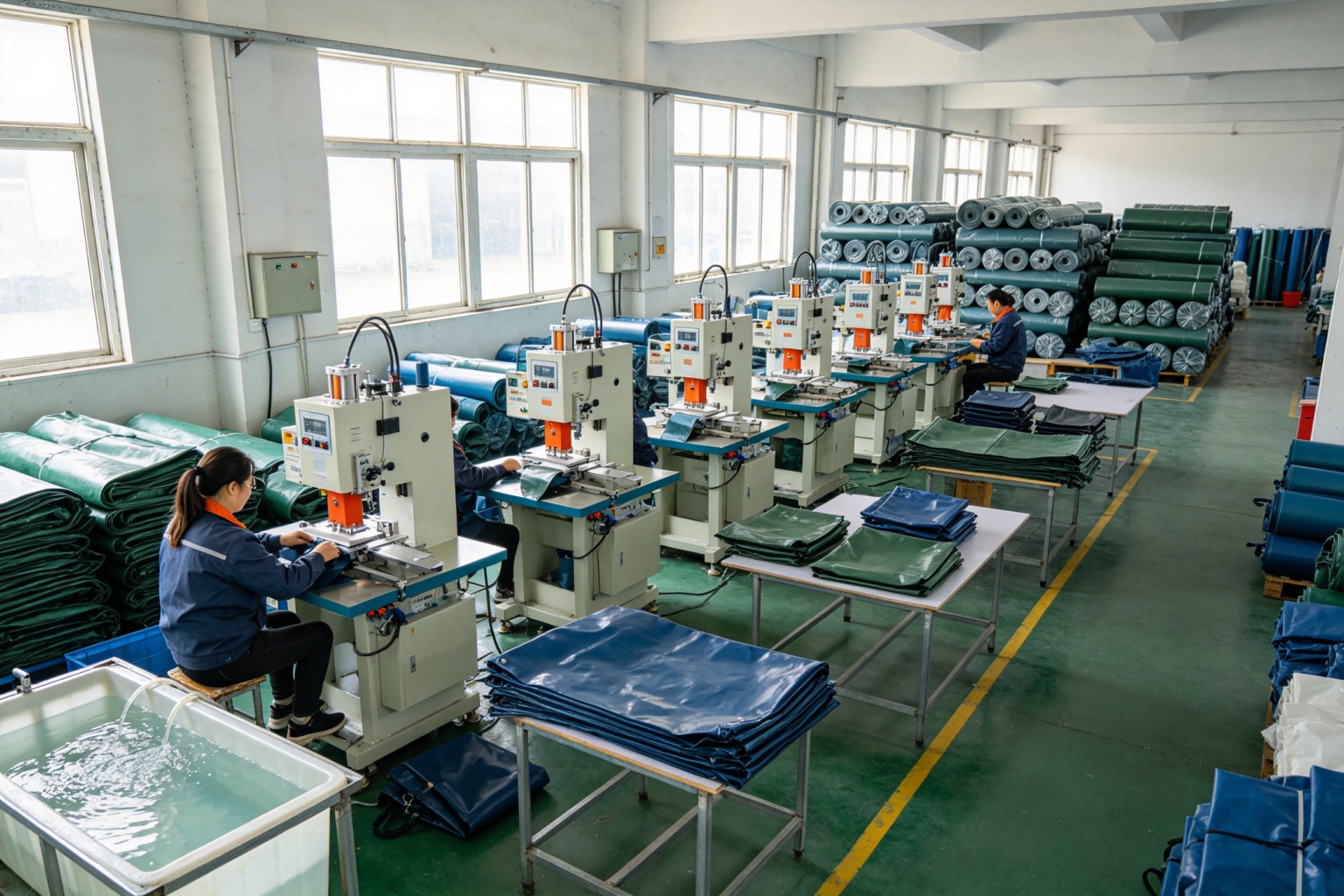
Our Dongguan factory: 3 RF high-frequency welding machines on Line 4, 500D PVC tarpaulin material storage, 10 workers dedicated to dry bag production. 18-day bulk production, 100% weld inspection, 250-piece IPX7 immersion testing.
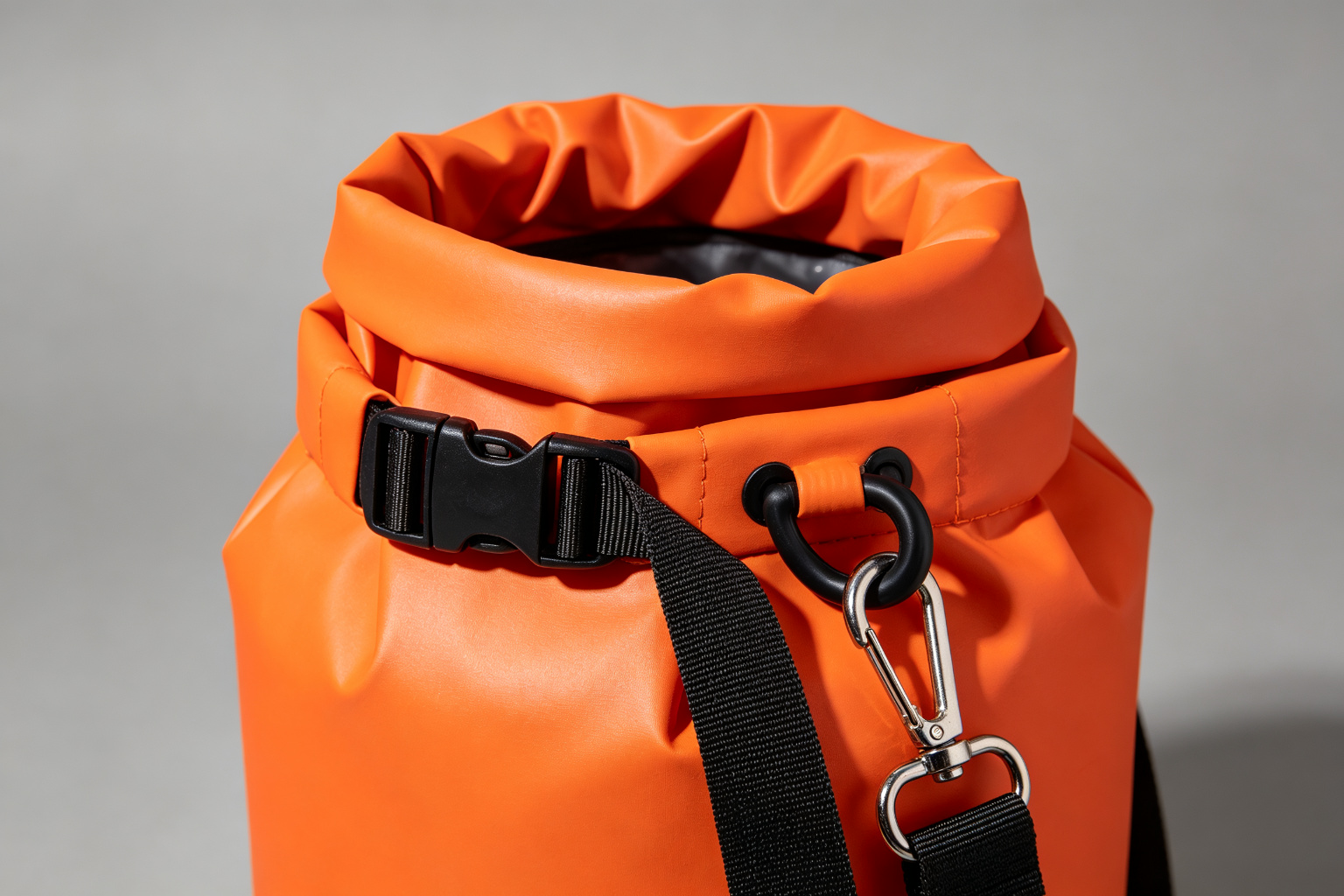
Roll-top closure detail: triple-roll fold creates the watertight seal, secured by a quick-release side buckle. The D-ring and adjustable shoulder strap with metal swivel hooks allow the bag to be attached to kayaks, paddleboards, or backpacks. The buckle is welded (not stitched) to the bag body for waterproof integrity.
Frequently Asked Questions
What is the difference between IPX6 and IPX7 waterproof ratings for dry bags?
Direct Answer: IPX6 survives powerful water jets (rain and splashes), while IPX7 handles 1m immersion for 30 minutes (kayaking, rafting). This case required IPX7 across all three sizes, achieved with RF-welded seams and a triple-roll roll-top; 150 sample bags submerged for 30 minutes showed zero ingress.
- IPX6: Powerful jets
- IPX7: 1m / 30 min immersion
- Construction: RF-welded + triple roll-top
- Sample Test: 150 bags, 0 ingress
IPX6 means the bag is protected against powerful water jets (12.5 liters/minute at 100kPa pressure from any direction for 3 minutes) — suitable for rain, splashes, and brief water contact. IPX7 means the bag can be immersed in water up to 1 meter depth for 30 minutes without water ingress — suitable for kayaking, rafting, and situations where the bag may be temporarily submerged. IPX8 is even higher (continuous immersion beyond 1 meter, specified by manufacturer). In this case study, the client required IPX7 certification for all 3 sizes, which we achieved through RF high-frequency welded seams (not stitched seams) and a triple-roll roll-top closure with quick-release buckle. We tested 150 sample bags (5% of production) by submerging them in 1-meter-deep water for 30 minutes with 5kg of weight inside — zero bags showed water ingress.
What materials are used in waterproof dry bags and which is most durable?
Direct Answer: 500D PVC tarpaulin is the most durable dry-bag material (3-5 years of rugged use), while TPU-coated nylon is lighter (1-2 years) and HDPE is cheapest but least durable (6-12 months). This rugged-conditions order chose 500D PVC tarpaulin, 0.55mm thick.
- Most Durable: 500D PVC tarpaulin (3-5 yrs)
- Lightweight: TPU nylon (1-2 yrs)
- Budget: HDPE (6-12 months)
- This Pick: 500D PVC, 0.55mm
Waterproof dry bags are typically made from three material types: (1) PVC tarpaulin (500D-1000D polyester mesh laminated between two PVC layers) — the most durable and abrasion-resistant, suitable for heavy-duty use, but heavier and less packable; (2) TPU-coated nylon (210D-420D) — lighter and more packable, good for backpacking and travel, but less abrasion-resistant; (3) HDPE (high-density polyethylene) — ultra-lightweight and inexpensive, but less durable and prone to punctures. In this case study, we used 500D PVC tarpaulin (18oz, 0.55mm thickness) because the client's watersports customers use the bags in rugged environments (rocky beaches, kayak storage hatches, rafting frames) where abrasion resistance is critical. 500D PVC tarpaulin typically survives 3-5 years of regular use, compared to 1-2 years for TPU nylon and 6-12 months for HDPE.
How does RF high-frequency welding compare to stitched seams for waterproof bags?
Direct Answer: RF welding fuses PVC into a continuous, needle-hole-free bond that is 100% waterproof (IPX7+) and stronger than the fabric, versus stitched seams that leave hundreds of needle holes per meter. Welding needs $200-$500 per-size molds and works only on PVC/TPU.
- RF Weld: 100% waterproof, no needle holes
- Stitched: Hundreds of needle holes/meter
- Mold Cost: $200-$500 per size
- Compatible Materials: PVC / TPU only
RF (radio frequency) high-frequency welding uses electromagnetic energy (27.12MHz) to heat and melt the PVC molecules at the seam, fusing them into a single, continuous, waterproof bond — there are no needle holes, no thread, and no seam gap. Stitched seams use a needle and thread to join fabric panels, creating hundreds of needle holes per meter of seam — even with seam sealing tape applied over the stitching, these holes are potential leak points, and the thread can rot or fray over time. RF welded seams are 100% waterproof (IPX7+), stronger than the material itself (the seam won't separate before the fabric tears), and more durable (no thread to fray). The downside: RF welding requires specialized equipment and is only compatible with PVC and TPU materials (not nylon or polyester without a PVC/TPU coating), and the welding mold cost is $200-$500 per size. In this case study, we used RF welding for all seams (bottom, side, and D-ring attachment), with 3 custom welding molds for the 3 sizes — total mold cost $1,200, amortized over 5,000 pieces = $0.24 per unit.
How much does a custom waterproof dry bag cost to manufacture?
Direct Answer: Custom dry bags cost $2.50-$12.00 FOB per unit for 1,000-10,000 pieces; RF welding adds $0.30-$0.80 and IPX7 testing $0.10-$0.20. This 5,000-piece three-size order averaged $5.10 FOB per unit (5L $3.80, 10L $5.20, 20L $7.50).
- FOB Unit Range: $2.50-$12.00
- RF Weld Add-on: $0.30-$0.80
- IPX7 Test Add-on: $0.10-$0.20
- This Order: $5.10 avg / unit
Custom waterproof dry bags typically cost $2.50-$12.00 FOB Shenzhen per unit for orders of 1,000-10,000 pieces, depending on material, size, and features. Basic 5L bags with 210D TPU nylon, roll-top closure, and shoulder strap start at $2.50-$4.00; mid-range 10L bags with 500D PVC tarpaulin, RF welded seams, removable shoulder strap, and front handle cost $4.00-$7.00; premium 20L+ bags with 1000D PVC tarpaulin, RF welded seams, multiple D-rings, padded shoulder strap, and external zip pocket cost $7.00-$12.00. RF welding adds $0.30-$0.80 per unit compared to stitched + seam-taped construction. IPX7 certification testing adds $0.10-$0.20 per unit (for 5% sample testing). In this case study, the 5,000-piece order with 3 sizes (5L×2000, 10L×2000, 20L×1000), 500D PVC tarpaulin, RF welded seams, roll-top closure with quick-release buckle, removable adjustable shoulder strap, and front D-ring came to an average of $5.10 FOB per unit (5L: $3.80, 10L: $5.20, 20L: $7.50).
What is the typical defect rate for waterproof dry bag production and what are the most common defects?
Direct Answer: A well-run 1,000+ piece dry-bag line should stay under 1.5% defects at AQL 2.5, led by weld defects (0.4-0.8%). This 5,000-piece run finished at 1.0% (50 pieces), 28 of them weld pinholes traced to a welding-machine temperature fluctuation and re-welded.
- Target: Below 1.5%
- Top Defect: Welds 0.4-0.8%
- Actual Rate: 1.0% (50/5,000)
- Post-Repair: 0% shipped defects
A well-managed waterproof dry bag production run of 1,000+ pieces should achieve a defect rate below 1.5% under AQL 2.5 inspection standards. The most common defects are: (1) weld defects (0.4-0.8%) including pinholes, cold welds (insufficient heat causing incomplete fusion), and burn marks (excessive heat causing material discoloration or weakening); (2) roll-top closure issues (0.2-0.4%) including misaligned buckle, weak buckle spring, and uneven roll rail; (3) material defects (0.2-0.4%) including scratches, scuffs, and color shading between material rolls; (4) dimension variation (0.1-0.3%) including height/width outside tolerance and uneven bottom shape. In this case study, the final defect rate was 1.0% — 50 pieces out of 5,000 inspected, with 28 weld defects (pinholes and cold welds), 12 roll-top closure issues (misaligned buckle), 7 material defects (scratches), and 3 dimension variation (uneven bottom). All 50 defective pieces were either repaired (re-welding pinholes, re-aligning buckles) or replaced before shipment, resulting in a 0% final defect rate after repair. The 28 weld defects were traced to a welding machine temperature fluctuation on Day 18 — we recalibrated the machine and re-welded all 28 pieces.