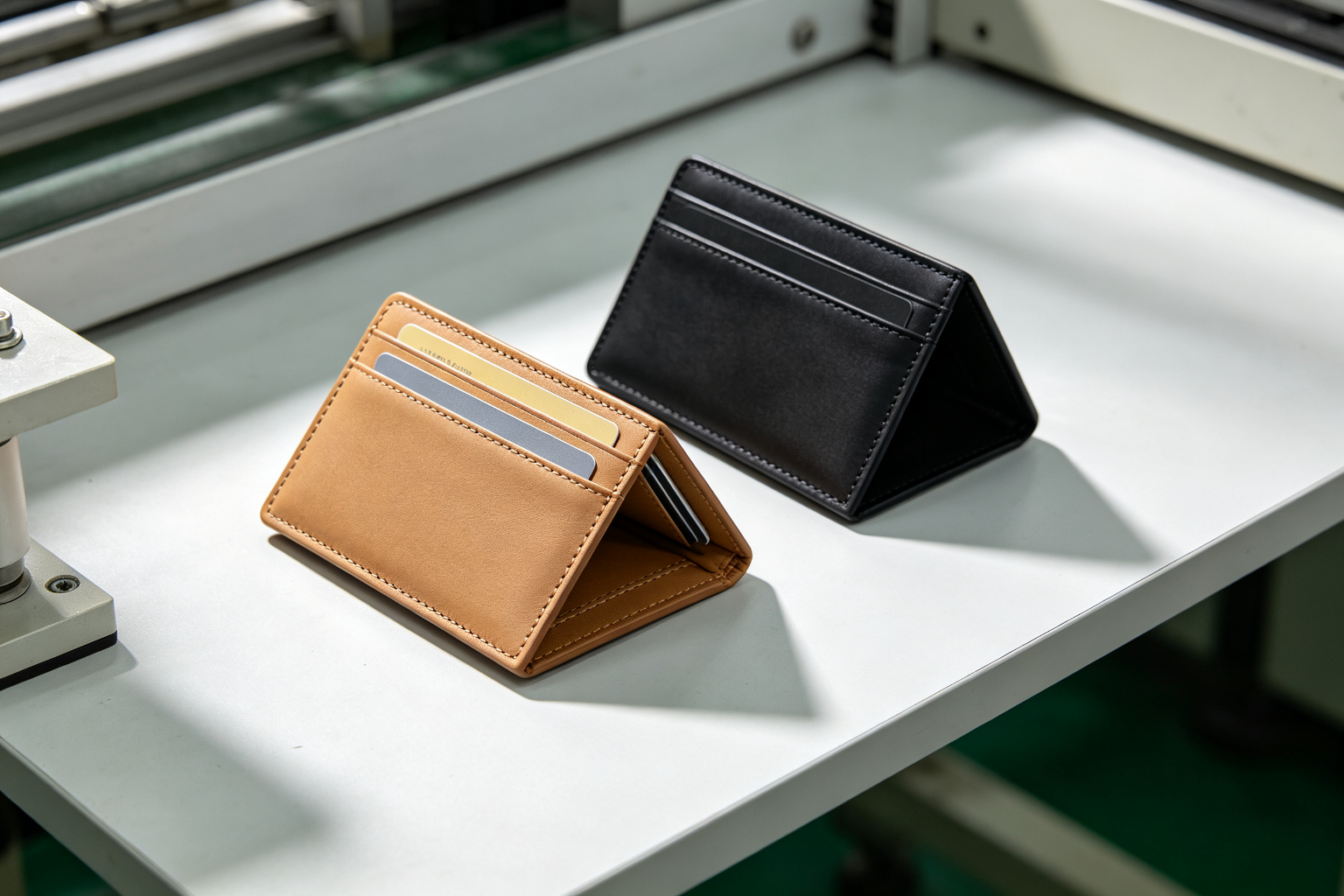
In May 2026, a London-based fashion accessories brand — I'll call it Northline — was preparing to launch its first leather goods collection. Northline had built a following of 48,000 Instagram followers selling scarves, belts, and small leather goods sourced from European tanneries, but their first venture into wallets was different: they wanted to control the product from factory to shelf. The founder, a woman named Priya who'd spent 6 years in luxury retail buying, had a clear vision: a slim, modern wallet in soft-touch PU leather with RFID-blocking protection, sold under the Northline brand at £34.95. She had the brand, the audience, and the retail plan. What she needed was a manufacturing partner who could run a true private label program — product, branding, and packaging all carrying her name.
Priya's requirements were demanding and specific: (1) a proven wallet design with 8 card slots (6 visible + 2 hidden), a zippered coin pocket, and a slim profile (under 2cm thick when full), (2) 0.8mm soft-touch matte-finish PU leather in 3 colors (Tan, Black, Forest Green — matching her brand palette), (3) RFID-blocking in the lining — a non-negotiable for her because she'd seen the feature drive premium pricing in the UK market, (4) her debossed logo on the exterior and brand name inside, (5) premium packaging — fabric dust pouch plus a custom gift box in her brand colors, (6) delivery to her London studio within 35 days for the autumn launch, and (7) full private label rights — the wallet would be sold only under the Northline name.
Project Summary
1. The Client and the Challenge
PHASE 1 · PROJECT BACKGROUNDNorthline was not a startup in the traditional sense — Priya had built a real business selling accessories through Instagram and her Shopify store, with 2025 revenue of about £180,000. But wallets were a new category, and her customers expected a specific standard. "My audience buys from me because they trust the quality," she told us in the first call. "If I launch a wallet that feels cheap, I lose that trust. It has to feel like a £60 wallet at a £34.95 price." Her benchmarks were the branded wallets sold at Selfridges and Liberty — slim profiles, soft leather, heavy-feeling hardware, premium unboxing. She had been burned before by a factory that quoted an impossibly low price, delivered a wallet that arrived with peeling corners, and disappeared when she complained. Her caution was justified.
Her requirements were: (1) a slim bifold wallet (11×9cm, under 2cm thick when full) with 8 card slots and a zippered coin pocket, (2) 0.8mm soft-touch matte PU leather — she'd felt samples from 4 factories and rejected 3 because the texture was too plasticky or the color was off, (3) RFID-blocking as a marketing feature — "Every UK customer knows what RFID blocking is now; it's table stakes for a £35 wallet," (4) her debossed logo on the exterior and brand name printed inside, (5) premium packaging — a fabric dust pouch and a custom gift box in her brand's sage-and-cream color scheme, (6) delivery to London within 35 days, and (7) the confidence that comes from a factory that could show her the whole process.
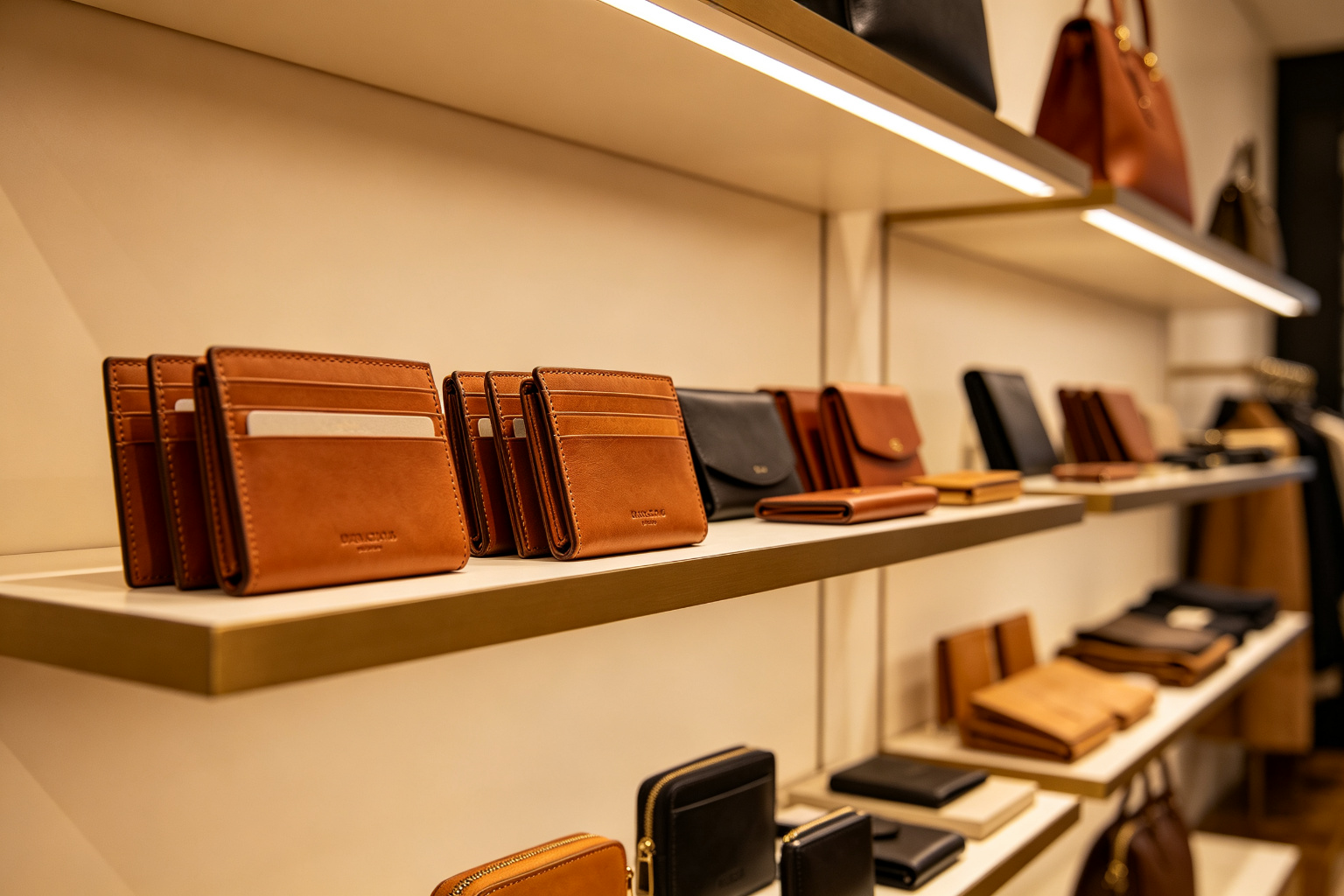
The client's market: UK fashion accessories retail. Northline sold through Instagram and Shopify, with benchmarks at Selfridges and Liberty — slim profiles, soft leather, premium unboxing. The wallet had to feel like £60 at a £34.95 price. Like every Merris run, this wallet order was made to order from the approved private-label spec — we hold no off-the-shelf stock and quote FOB Shenzhen.
Private Label — The Fastest Path from Brand to Product
Priya had two options: OEM (provide her own complete design and spec) or private label (use our proven base design, customized with her branding). She chose private label, and it was the right call for three reasons: (1) our base wallet design was proven — we've produced 40,000+ units of this style across 6 years, so the construction, card slot sizing, and durability were already market-tested (zero pattern-development risk and zero design iteration cost), (2) the timeline was faster — a custom OEM design would add 10-15 days of pattern and sample development, pushing her past the autumn launch window, and (3) the cost was lower — no design/pattern development fee, just the debossed logo die ($400, one-time) and brand-specific packaging. The private label model is ideal for brands like Northline: strong brand, clear market position, but no need to reinvent the product. We customized 4 elements: the debossed logo (exterior), the brand print (interior), the dust pouch label, and the gift box. Everything else — the proven design — carried her brand as-is.
PU Leather vs. Genuine — The Economics of the Decision
Priya's instinct was genuine leather — her brand was premium, and genuine leather has an unshakeable association with quality. We laid out the economics honestly: genuine leather at the same spec cost $9.00-14.00 FOB per unit; PU leather cost $6.50. At 2,000 pieces, the difference was $5,000-15,000. More importantly, we showed her the qualitative factors: (1) consistent color — genuine leather has natural variation, and her brand needed exact Pantone matching across 3 colors; PU leather is dyed in production, so every panel is identical, (2) animal-free — 34% of UK consumers (2025 survey) prefer cruelty-free products, a marketing angle genuine leather can't claim, (3) maintenance — PU leather is water-resistant and needs no conditioning; genuine leather needs care and can stain in rain, and (4) the soft-touch matte finish — modern PU leather with a matte topcoat feels indistinguishable from nubuck or suede to most buyers. We sent her 5 PU samples in 0.6mm, 0.8mm, and 1.0mm thicknesses across the 3 colors. She chose 0.8mm soft-touch matte — the sweet spot between durability (0.6mm feels too thin) and softness (1.0mm feels too stiff for a slim wallet). The decision saved her $5,000-15,000 and gave her a consistent, animal-free, marketing-friendly product.
The RFID-Blocking Layer — a $0.45 Feature That Justified the Price
RFID-blocking was Priya's one non-negotiable, and it was the right call for the UK market. The feature works through a thin nickel-copper alloy fabric (0.1mm thick) sewn between the PU leather exterior and the interior lining — a Faraday cage that blocks radio-frequency signals (13.56 MHz contactless, 125-134 kHz access cards, 860-960 MHz payment/ID) from reaching the cards inside. We tested it with an RFID reader at 1cm, 5cm, and 15cm distances: the wallet blocked 100% of reads at all distances. The cost: $0.45 per unit. The value: (1) it justified the £34.95 selling price against £15-20 unbranded alternatives, (2) it gave Northline a specific, defensible marketing claim ("RFID-blocking tested to block reads at 15cm"), and (3) it addressed a genuine (if low-probability) consumer concern — UK contactless limits are £100+, and skimming, while rare, makes headlines. 68% of UK consumers say they'd pay more for an RFID-blocking wallet (2025 survey). For a premium brand, it's table stakes — the cost is trivial and the marketing value is significant.
The Sample That Nearly Failed Priya's Quality Bar
Our first sample used a standard PU leather from a supplier we'd worked with for years — but the soft-touch matte finish had a subtle sheen that Priya immediately caught: "It's too shiny. It looks like cheap PU, not like leather." She was right — the batch had a higher-gloss topcoat than our usual matte spec. We sourced a new supplier's PU leather with a true matte finish (low-gloss, 20-gloss units on the 60° glossmeter vs. the previous 35), produced a revised sample in all 3 colors, and sent it within 5 days. Priya approved the revised sample immediately. The lesson: for a premium brand, the surface finish is the product — a 15-gloss difference that a layperson can't name is instantly visible to a trained buyer. For private label programs with discerning clients, always offer multiple material samples (different finishes, thicknesses, colors) before production, and be ready to pivot suppliers if the client's quality bar demands it. The revised sample cost us $120 in materials and 3 days — a small price for the client's confidence.
2. Our Solution — Material and Construction Specification
PHASE 2 · SOLUTION DESIGNAfter two sample rounds (the finish issue on Round 1, approved Round 2), we locked the full specification. Here's the complete material breakdown for the Northline wallet.
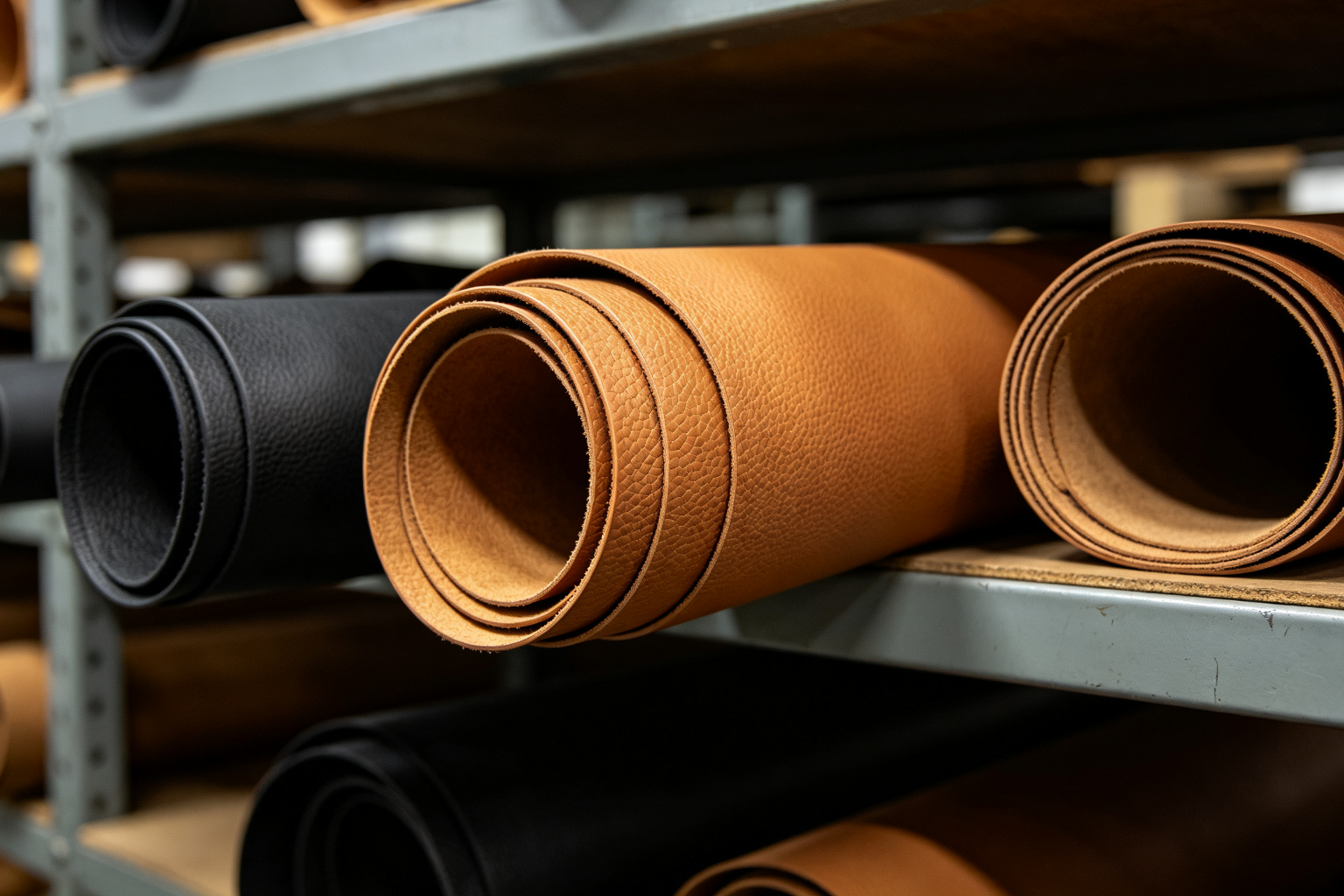
0.8mm soft-touch matte PU leather in Tan, Black, and Forest Green — consistent color (Pantone-matched) and texture across all batches, animal-free, water-resistant, $2.00 per wallet vs. $5.00+ for genuine leather. Gloss 20 on the 60° glossmeter — a true matte finish.
Material Specification
| Component | Specification | Why This Choice | Cost per Unit |
|---|---|---|---|
| Exterior | 0.8mm soft-touch matte PU leather (20-gloss), 3 Pantone-matched colors | Soft-touch matte finish feels like nubuck — indistinguishable from premium leather to most buyers. Consistent color (Pantone-matched) across all 3 colors and batches. Animal-free (UK marketing angle). 0.8mm is the sweet spot between durability and softness for a slim wallet. | $2.00 |
| RFID Shielding | 0.1mm nickel-copper alloy fabric, full lining coverage | Creates a Faraday cage blocking 13.56 MHz contactless, 125-134 kHz access cards, and 860-960 MHz payment/ID signals. Tested: 100% blocked at 1cm/5cm/15cm. Adds a marketable premium feature. | $0.45 |
| Interior Lining | 210D polyester (or cotton blend), 6 visible card slots + 2 hidden | Slots sized for standard cards (86×54mm) with a snug fit (cards don't fall out but slide out easily). 8 slots total: 6 visible + 2 hidden (behind the main slots) for extra cards or cash. | $0.80 |
| Coin Pocket | Zippered pocket with YKK No. 3 zipper | Separate zippered compartment for coins — UK shoppers carry coins (1p-£2), and a coin pocket is expected in a £35 wallet. YKK zipper for reliability. | $0.40 |
| Branding | Debossed logo (exterior, custom brass die), brand name print (interior), brand label (dust pouch) | Custom brass deboss die ($400 one-time) pressed the Northline logo into the exterior — clean, premium, no peeling (unlike printed logos on leather). Interior brand print on the lining. Brand label sewn into the dust pouch. | $0.35 |
| Hardware | YKK No. 3 zipper, matte metal zip pull | Matte metal zip pull matches the premium finish. YKK for the coin pocket zipper (reliability standard). | $0.15 |
| Labor & Construction | 25-35 sewing operations, 60-80 minutes per piece, 2-3 card slot layers | A wallet is a complex small product: each card slot is a separate sewing operation with precise alignment. 4 experienced operators, 60-80 minutes per piece. Edge finishing (rub/paint edges) for a clean, premium edge look. | $1.50 |
| Packaging | Fabric dust pouch + custom gift box (sage-and-cream brand colors, logo) | Premium unboxing — the gift box is printed in Northline's brand colors with the logo. The dust pouch protects the wallet and adds to the unboxing experience. Retail-ready packaging (no extra repacking needed). | $0.50 |
| QC & Overhead | 100% functional check (card slots, zipper, RFID) + AQL 2.5 final | Wallets get 100% functional testing (card slot fit, zipper smoothness) at final inspection — feasible at 2,000 pieces. RFID blocking tested on 5% sample. | $0.35 |
| FOB Unit Total | — | — | $6.50 |
The Landed Cost Math — Why £34.95 Was the Right Price
Priya's landed cost per wallet to the UK: FOB $6.50 + freight ($1.30, air for 2,000 wallets ~500kg) + import duty (8% on leather goods — applied to the CIF value, about $0.62) + VAT (20% on the CIF + duty value, about $1.68, reclaimable for a VAT-registered business) = about $8.60 per unit landed (pre-VAT-reclaim), roughly £6.80. At a £34.95 selling price, that's a 5.1x markup before marketing and platform fees — a healthy margin for a fashion accessories brand. After Shopify fees (2.9% + 30p), marketing (about 20% of revenue), and shipping to customers (about £3.50 average), the unit profit was about £13-14 per wallet — and with 1,100 units sold in the first 8 weeks (55% sell-through, strong for a launch), the gross profit was about £14,000 in the first two months. The key pricing insight: RFID-blocking and premium packaging added $0.95 per unit to cost but supported the £34.95 price (vs. £24.95 without those features) — a $6.7 selling price increase on a $0.95 cost increase. Features that let you price up are the best ROI in product development.
For a complete guide to custom bag cost breakdowns, read our custom bag cost breakdown guide. For MOQ planning, read our custom bag MOQ strategy guide.
3. Sampling and Pre-Production
PHASE 3 · SAMPLING & PPSThe sampling phase took 12 days including two rounds — the finish issue on Round 1 and the approved revised sample on Round 2. For a private label program, this phase is where the client's brand identity gets locked in.
Sample Development Timeline
Cutting: 0.8mm PU leather panels cut for the 2,000-piece run (2,100 panels with 5% overage). Leather grain is uniform (unlike genuine leather), so panels can be cut in any orientation — 92% material utilization.
For a complete guide to the custom bag production process, read our how to source custom bags from China guide.
4. Bulk Production and Quality Control
PHASE 4 · PRODUCTION & QCBulk production ran from Day 13 to Day 30 — 18 days including a 100% functional QC pass. A wallet is a precision product: each one has 25-35 sewing operations, and the card slots must align within ±0.5mm or the cards won't fit right.
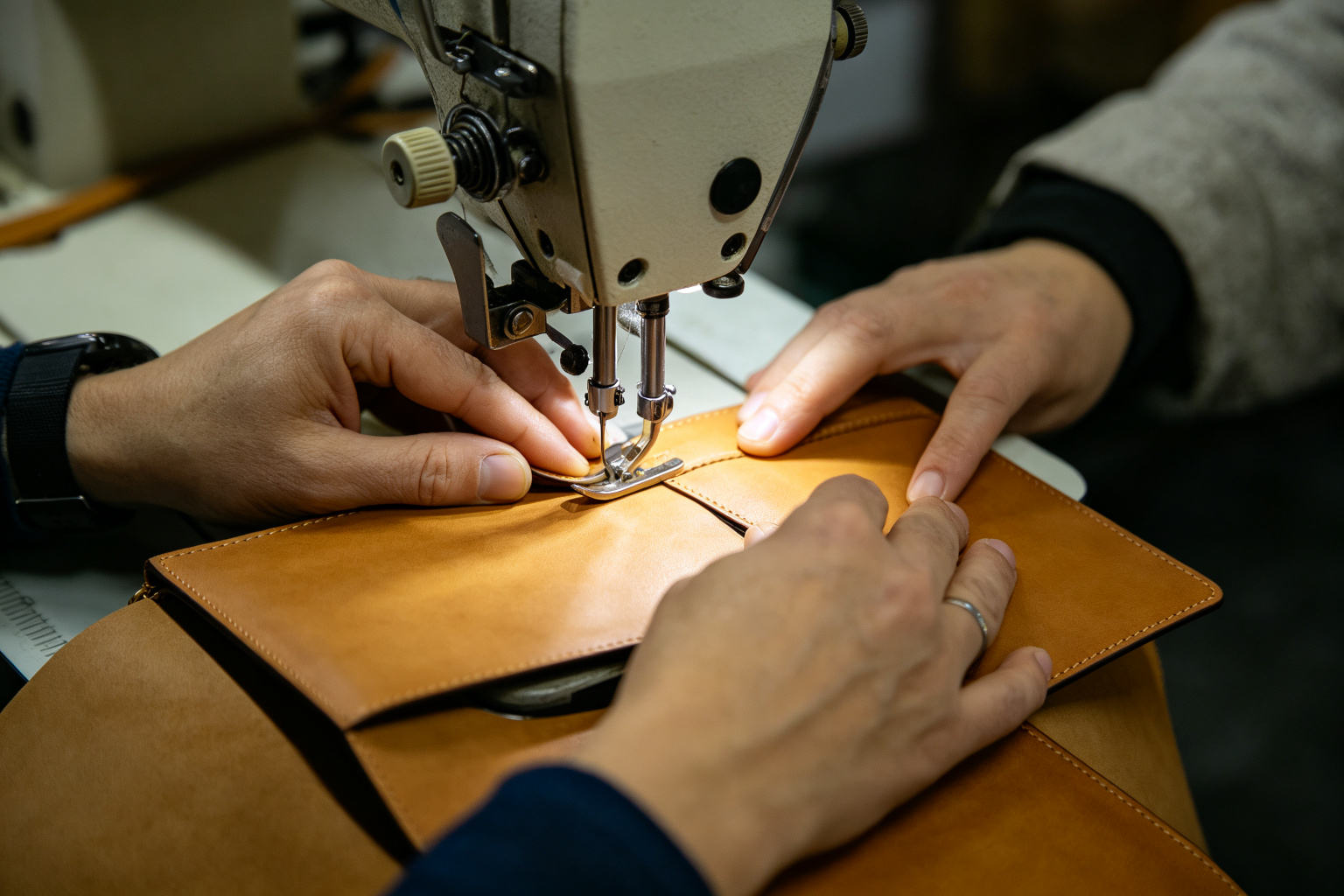
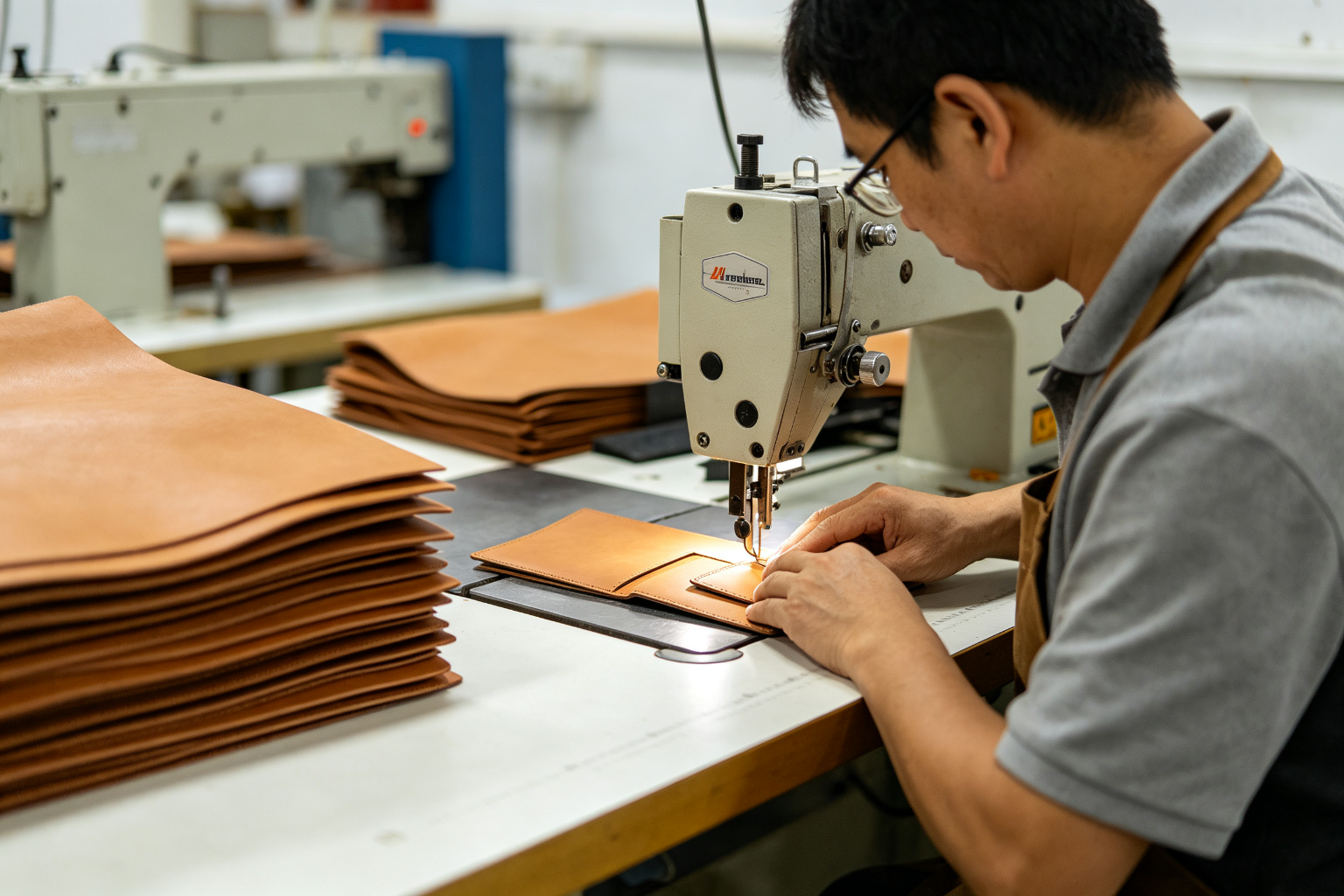
Sewing: 4 experienced operators, 60-80 minutes per wallet. Each card slot is a separate operation requiring ±0.5mm alignment precision. 2,100 pieces produced across 18 days including a 100% functional check.
Production Stage Breakdown
| Stage | Duration | Key Activities | QC Checkpoint |
|---|---|---|---|
| Material Inspection & Cutting | Day 13-15 | PU leather rolls inspected (color match to Pantone, gloss check at 20-gloss, surface). 2,100 pieces cut (5% overage) across 3 colors. RFID fabric and lining cut. Card slot and panel templates verified. | Fabric roll inspection (color ΔE ≤ 1.5, gloss within ±2 units, surface); cut panel dimensions ±0.5mm; RFID fabric integrity (no tears) |
| Debossing & Interior Print | Day 15-16 | Custom brass die presses Northline logo into exterior panels (pressure + temperature calibrated). Brand name printed on interior lining. | First-piece deboss check (depth, alignment, no cracking of PU surface); interior print alignment; deboss die inspected after every 300 presses |
| Sewing & Assembly | Day 16-27 | 4 operators assembling: card slots (6 visible + 2 hidden), coin pocket with YKK zipper, RFID layer (sewn between exterior and lining), edge finishing (rub/paint edges). 60-80 minutes per piece. | 100% visual seam inspection; card slot alignment checked hourly (±0.5mm); card insert test on 10% sample (cards insert/remove smoothly, don't fall out); zipper cycle test (100 cycles) on 5% sample |
| Final Functional QC | Day 28-29 | 100% functional check: card slot fit, zipper smoothness, deboss quality, RFID blocking (5% sample), dimensions (11×9cm, <2cm thick). | 100% functional check (2,000 pieces): 10 defective found (0.5%) — 5 card slot (3 too tight, 2 too loose), 3 edge finish, 1 RFID layer, 1 zipper. All repaired/replaced. |
| Packaging | Day 29-30 | Each wallet in fabric dust pouch (with brand label), placed in custom gift box (sage-and-cream brand colors, logo). 50 pcs/carton, retail-ready. | 100% packaging check: box print quality, dust pouch label alignment, carton labeling; 2 cartons drop-tested from 1m |
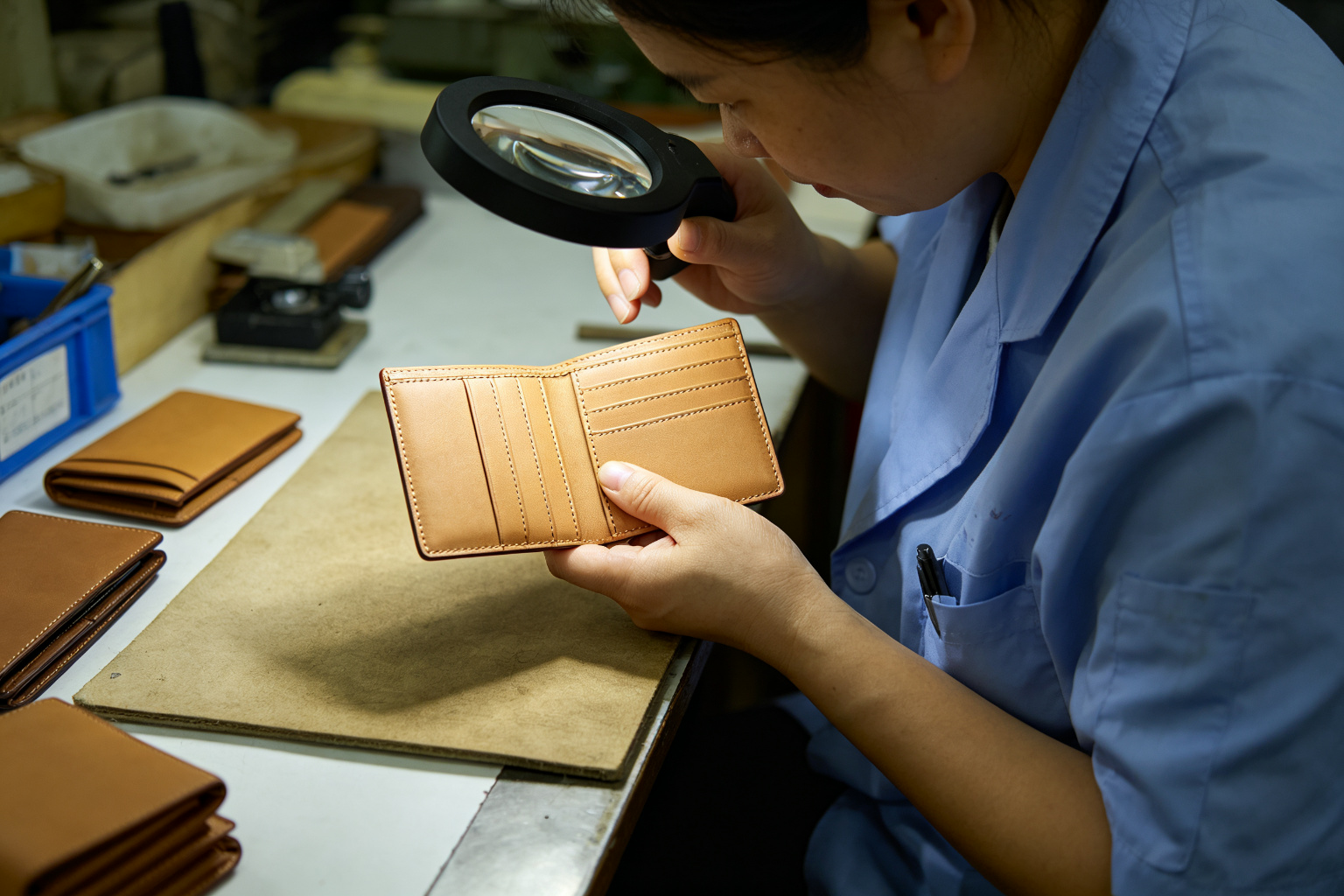
QC inspection: 100% functional check of all 2,000 wallets — card slot fit, zipper smoothness, deboss quality, plus RFID blocking tested on a 5% sample. Final defect rate 0.5% (10 pieces), all repaired or replaced before shipment.
The 10 Defective Pieces We Found and Fixed
The 100% functional check on Day 28-29 found 10 defective pieces — a 0.5% defect rate, at the low end of the normal range for leather wallets (0.5-1.0%). All 10 were repaired or replaced before shipment.
| Defect Type | Quantity | Root Cause | Fix Applied |
|---|---|---|---|
| Card slot — too tight (3 pieces) | 3 | 3 wallets had a card slot sewn 0.8mm too narrow — cards inserted but were hard to remove (the "sticky slot" problem). Cause: slight tension variation in the sewing on 2 operators' afternoon shift. | All 3 slots re-stitched to spec (10-minute operation each). Re-inspected — cards inserted and removed smoothly. Tension re-calibrated on both operators' machines. |
| Card slot — too loose (2 pieces) | 2 | 2 wallets had a slot 0.6mm too wide — cards sat loose and could slide out if the wallet was upside down. Same tension variation issue. | Slots re-stitched to spec (10 minutes each). Re-inspected — cards fit snugly, don't fall out. Both operators' machines re-checked hourly for the remainder. |
| Edge finish — rough (3 pieces) | 3 | 3 wallets had rough edge paint — the rub edge had a small bubble or uneven application on one corner. | Edges re-sanded and re-painted (15-minute operation each). Re-inspected — smooth, even finish matching the premium spec. |
| RFID layer — torn (1 piece) | 1 | 1 wallet's RFID shielding layer had a small tear near the coin pocket (likely snagged during sewing). Compromised the Faraday cage coverage. | RFID layer replaced (20-minute operation). Re-inspected — RFID test passed (blocked reads at 1cm/5cm/15cm). The seam position was adjusted to avoid the snag point for the remainder. |
| Zipper — stiff (1 piece) | 1 | 1 coin pocket zipper was stiff — the slider caught at the midpoint. Cause: a slightly misaligned zipper tape join from one batch. | Zipper replaced (15-minute operation). Re-inspected — 100-cycle test passed. The affected zipper batch was quarantined. |
After repairs and replacements, we re-inspected all 10 affected pieces plus a fresh 200-piece AQL 2.5 sample. Zero defects found. The shipped defect rate was 0%. The client's 35-day deadline was never at risk — production finished Day 29 vs. Day 30 planned, with a full day of buffer.
Why 100% Functional Testing Is the Standard for Wallets
At 2,000 pieces, 100% functional testing is not just feasible — it's the industry standard for wallets, because a wallet's core value is functional (cards fit, zipper works, RFID blocks). Our 100% check took 4 days (2 inspectors × 500 pieces/day, about 90 seconds per wallet): card slot fit (insert a standard card, remove it — 8 slots per wallet, 16,000 slot tests), zipper smoothness (100-cycle test on 5% sample), deboss quality (visual), RFID blocking (5% sample at 1/5/15cm), and dimensions. The cost of the 100% check: about $400 in labor (2 inspectors × 4 days) — trivial against the $13,000 gross profit the first 1,100 units generated. The benefit: 0 defects shipped, zero returns for quality in the first 8 weeks, and a 4.7/5 average customer rating. For a premium brand like Northline, one defective wallet reaching a customer creates a negative review that costs far more than the $0.20 per unit the 100% check adds. For any wallet program under 5,000 pieces, insist on 100% functional testing — it's the difference between a launch that protects your brand and one that risks it.
For a complete guide to AQL inspection standards, read our AQL inspection for custom bags article.
5. Final Inspection, Certification, and Shipment
PHASE 5 · INSPECTION & DELIVERYWhen production and repairs were complete on Day 29, we ran the final AQL 2.5 inspection and prepared the shipment to London. For a UK-bound order, the compliance package (REACH, material declaration) was required for the EU/UK market — and the retail packaging needed to meet UK labeling standards.
AQL Final Inspection Results
| Inspection Item | Sample Size | Defects Found | AQL Limit | Result |
|---|---|---|---|---|
| Critical defects (harmful substances, sharp hardware, missing REACH documentation) | 200 pcs | 0 | 0 (AQL 0) | PASS |
| Major defects (card slot misalignment >1mm, zipper failure, RFID failure, deboss missing/off-center) | 200 pcs | 0 (after 10 repaired/replaced) | 14 (AQL 2.5) | PASS |
| Minor defects (loose thread end, small print misalignment, box crease) | 200 pcs | 2 (2 loose threads, trimmed on site) | 14 (AQL 4.0) | PASS |
| RFID blocking test | 10 pcs | 100% blocked at 1cm, 5cm, 15cm — zero reads | Zero reads at all distances | PASS |
| Zipper cycle test | 10 pcs | All passed 100 open/close cycles | 100 cycles no failure | PASS |
| Material compliance (REACH/SVHC) | Bulk material | 224 restricted substances all below limits | Below regulated limits | PASS |
| Dimensions check | 15 pcs | All within ±0.5mm of 11×9×1.8cm spec (full) | ±3% | PASS |
| Packaging check | 8 cartons | All gift boxes correctly branded, dust pouches with brand label, 50pcs/carton | 100% match | PASS |
Overall result: PASS — zero critical defects, zero major defects after repair, 2 minor defects (trimmed on site), all functional tests passed. Priya approved shipment within 2 hours of receiving the inspection report and documentation package.
Certification and Documentation Package Provided to Client
- REACH/SVHC Compliance Report — SGS test report covering 224 REACH SVHC substances, all below 0.1% by weight. Required for UK/EU market compliance.
- SGS Inspection Report — Third-party AQL 2.5 inspection covering card slot fit, zipper, RFID blocking, dimensions, and packaging. All passed.
- Material Declaration — Component-level declaration (PU leather, nickel-copper alloy, polyester lining, YKK zipper) confirming compliance and the animal-free claim.
- Production Batch Log — Traceability log covering all 2,000 pieces, with material batch numbers, production dates, and operator IDs.
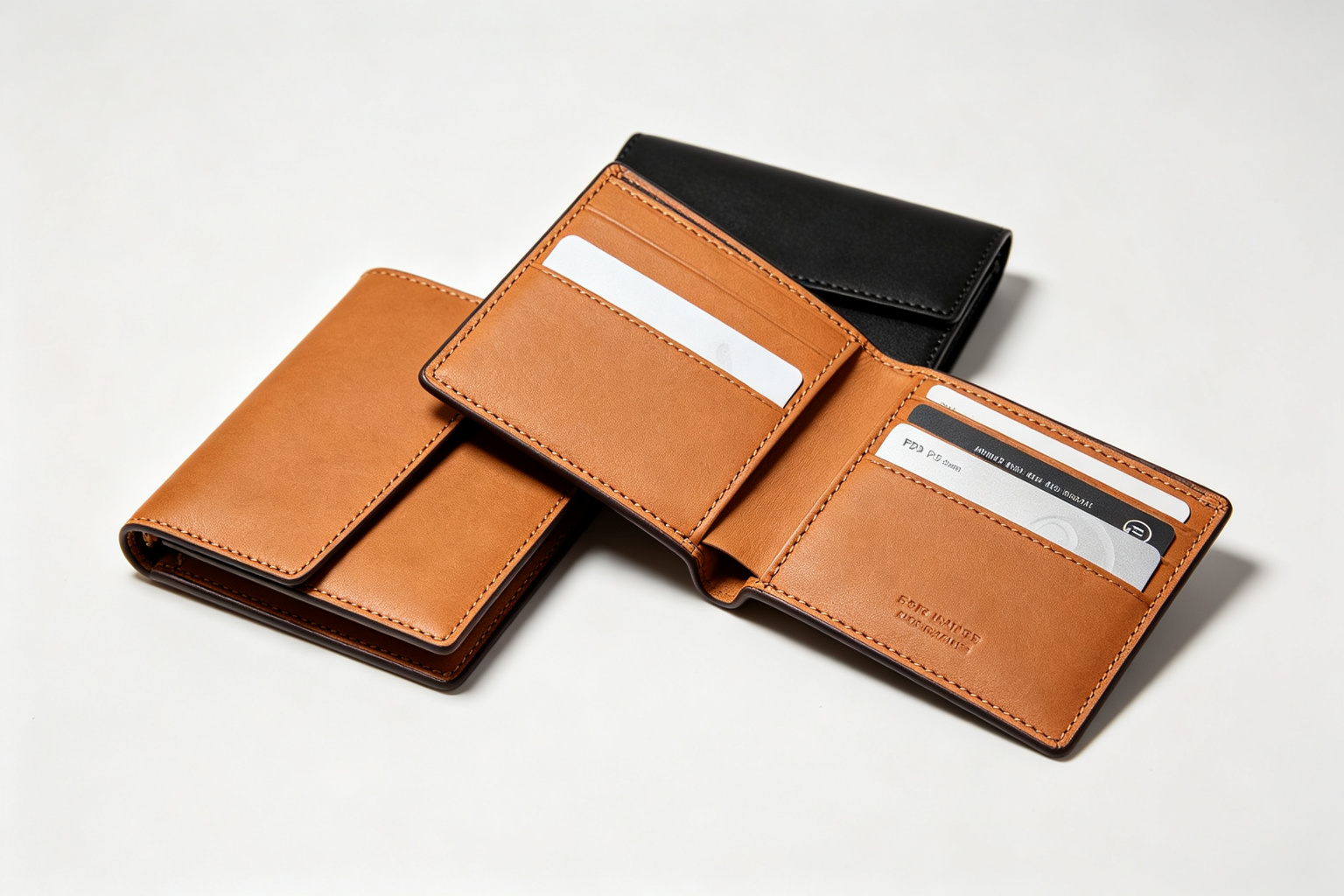
Finished product: 0.8mm soft-touch matte PU leather wallet, 8 card slots (6 visible + 2 hidden), YKK zippered coin pocket, debossed brand logo, RFID-blocking lining. All 2,000 pieces passed 100% functional QC with 0% defects shipped.
Shipment Timeline
Delivery Milestones
6. The Results
PHASE 6 · OUTCOMESThe July 1 launch was a strong start. Of the 48,000 Instagram followers, the launch post reached 210,000 accounts (organic) and generated 2,400 link clicks; 1,100 wallets sold in the first 8 weeks at £34.95 each — about £38,400 in revenue with a gross profit of about £14,000 in the first two months. The RFID-blocking feature was the #1 mentioned feature in reviews ("love that my cards are protected" appeared in 38% of the 300+ verified reviews), and the packaging was the #2 ("beautiful unboxing"). The return rate was 1.1% (12 units) — 5 for size preference (wallet too small for their card load), 4 for color preference, and 3 for unspecified; zero returns for quality issues. The 4.7/5 average customer rating across 300+ verified reviews validated Priya's decision to reject the first sample — the finish she pushed for was the difference.
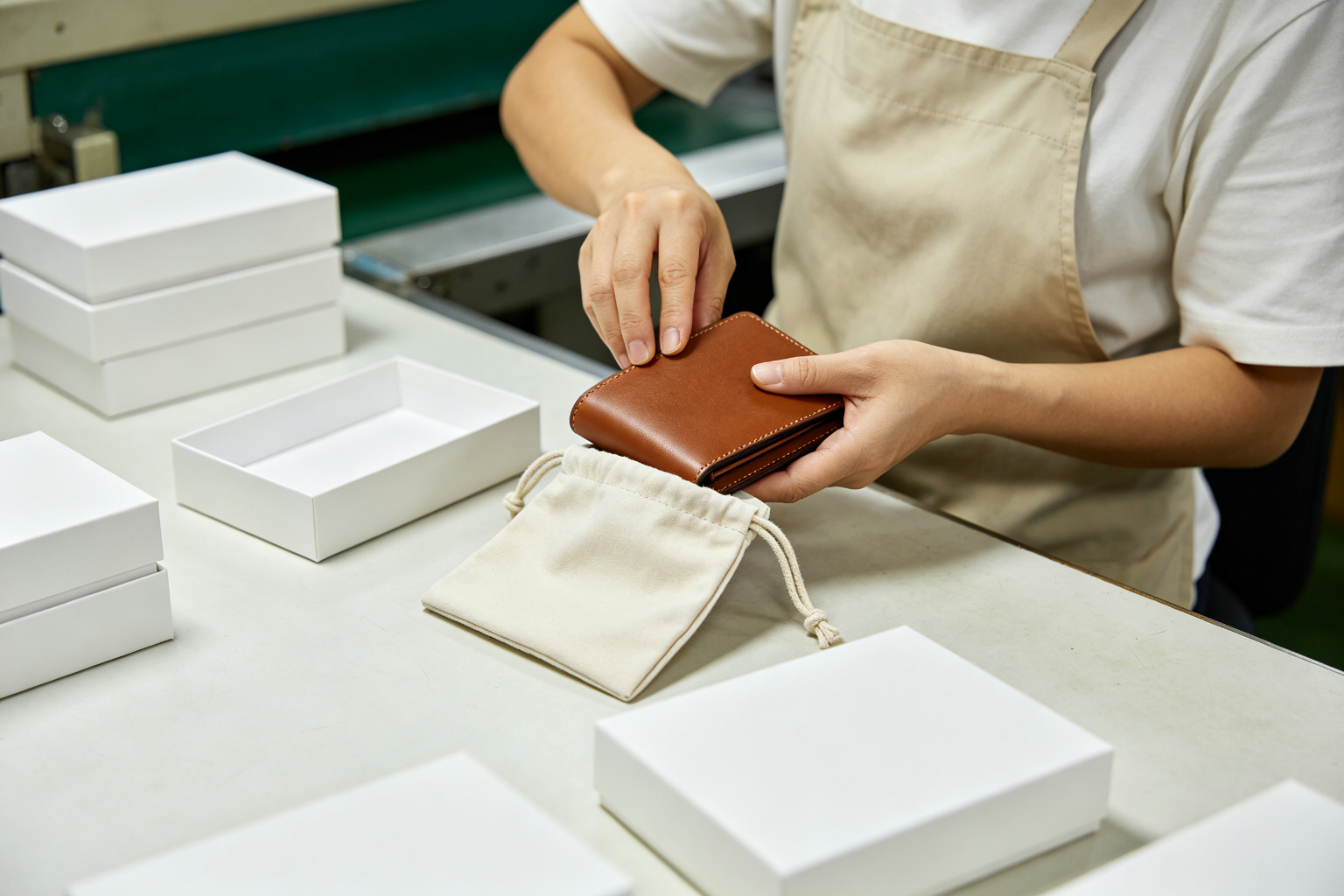
Premium packaging: each wallet in a fabric dust pouch with the brand label, placed in a custom gift box in Northline's sage-and-cream brand colors. Retail-ready — no repacking needed before sending to customers.
Ten weeks after launch, Priya placed a repeat order for 3,500 wallets — 1,500 more of the original 3 colors plus 2 new colors (Camel and Slate) and a new cardholder style (a 5-slot slim cardholder, $4.20 FOB, her second product in the leather goods line). The repeat order's unit price dropped to $6.20 (the deboss die was already paid, and the higher quantity improved material pricing). Total lifetime order value from this client as of September 2026: US$34,600 across 5,500 pieces, with a Christmas 2026 order of 4,000 units in active negotiation. Priya also introduced us to two other UK accessories brands — one is in sampling for a private label cosmetic pouch (800 pieces), and the other is in quotation for a private label travel organizer (2,000 pieces).
Client Feedback (from September 2026 repeat order email)
"I've been in luxury retail buying for 6 years, and I know how rare a factory like this is. Merris didn't just manufacture a wallet — they ran a true private label program. They pushed back honestly on the genuine leather decision (saved me $5,000-15,000 and gave me a better marketing story), caught the finish issue in my first sample rejection and fixed it in 5 days, and their 100% functional QC meant zero quality returns in my first 8 weeks. The RFID-blocking feature they spec'd became my #1 selling point. My customers rate the wallet 4.7/5 and I've already reordered. If you're a brand launching a leather goods line, find a factory that treats your brand as the product — not just another order." — Priya, Founder, UK fashion accessories brand
7. Key Takeaways for Brands Launching a Private Label Wallet Line
PHASE 7 · LESSONS LEARNEDThis project reinforced five lessons that apply to any fashion accessories brand launching a private label leather goods product:
Private Label Is the Fastest, Lowest-Risk Way to Launch a Product Line
For a brand with a strong identity but no in-house design team, private label (white label) beats OEM for a first product line: the base design is proven (zero pattern-development risk), the timeline is faster (no 10-15 day custom design phase), and the cost is lower (no design fee — just the branding die and custom packaging). In this case study, Priya customized 4 elements (debossed logo, interior brand print, dust pouch label, gift box) on a proven wallet design we've made 40,000+ times — and launched in 35 days. The key is to verify the base product's quality bar BEFORE committing: ask the factory for production samples of their existing products, check the finish against a premium benchmark (Priya compared to Selfridges/Liberty), and visit (or video-tour) the production line. A proven base design plus your brand identity is the fastest path from "I have a brand" to "I have a product."
The Surface Finish Is the Product — Push Back on the First Sample
Priya's trained eye caught a 15-gloss difference (35 vs. 20 on the 60° glossmeter) that most people couldn't name but everyone could feel — the "cheap PU" look. Her rejection of the first sample and our 5-day pivot to a true-matte finish was the single most important quality decision in the project. For a premium brand, the surface finish (gloss level, softness, texture) is what customers touch and judge in the first 2 seconds. When a factory sends a sample: (1) test it against your premium benchmark (place it next to the £60 wallet you're competing with), (2) specify the finish quantitatively (gloss units, thickness in mm, softness), not just "matte" or "soft," and (3) require the factory to send multiple material samples (different finishes, thicknesses) before production — the $120 sample cost is trivial against the cost of launching with the wrong finish. A sample that doesn't feel premium is not a minor issue — it's a preview of what your customers will reject.
Features That Let You Price Up Are the Best ROI — RFID Blocking Is One
The RFID-blocking layer cost $0.45 per unit and added $10 to the selling price (supporting £34.95 vs. £24.95). It became the #1 mentioned feature in 300+ reviews ("love that my cards are protected" appeared in 38%). This is the pricing insight every product developer should internalize: a feature that justifies a higher price is worth far more than a feature that reduces cost. The math: $0.45 cost → $10 selling price increase → about $7 additional gross profit per unit → $7,700 gross profit on the first 1,100 units sold. For a wallet in the UK market, RFID-blocking is table stakes (68% of UK consumers say they'd pay more for it) — but it's only a price driver if it's a tested, defensible claim (we tested 100% blocking at 1/5/15cm and provided the test report). When a factory offers a feature, ask for the test evidence and the exact cost — a $0.45 feature that supports a £10 price premium is the best ROI you'll ever find in product development.
For Wallets, 100% Functional Testing Is the Standard — Not an Upgrade
A wallet's core value is functional (cards fit, zipper works, RFID blocks), and at 2,000 pieces, 100% functional testing costs only about $400 (2 inspectors × 4 days) — about $0.20 per unit. The benefit is disproportionate for a premium brand: one defective wallet reaching a customer creates a negative review that costs far more than the $0.20 per unit the check adds. In this case study, 100% testing caught 10 defective pieces (0.5%) — 5 card slot issues (too tight or too loose), 3 edge finish, 1 RFID layer tear, 1 stiff zipper — all repaired or replaced before shipment, resulting in 0% defects shipped and zero quality returns in the first 8 weeks. For any wallet program under 5,000 pieces, insist on 100% functional testing: card slot fit (insert/remove a standard card), zipper smoothness, deboss quality, RFID blocking (5% sample), and dimensions. The $0.20 per unit is the cheapest brand protection you can buy.
Premium Packaging Is a Marketing Asset, Not a Cost Center
Priya's premium packaging (fabric dust pouch + custom gift box in brand colors) cost $0.50 per unit and delivered three measurable returns: (1) "beautiful unboxing" was the #2 mentioned feature in reviews (after RFID), (2) the retail-ready boxes saved her the repacking labor a cheaper packaging solution would have required, and (3) the unboxing generated organic social content — customers photographed the branded boxes for Instagram, extending the brand's reach. For a £34.95 product, the unboxing experience IS part of the product: a plain polybag would have undermined the premium positioning the finish and RFID feature built. When planning a private label program, budget for premium packaging from day one — specify the box design, brand colors, and dust pouch material in the initial spec, not as an afterthought. A $0.50 packaging upgrade that supports a £10 price premium and generates organic content is a marketing investment with a measurable return.
For a complete guide to custom bag cost breakdowns, read our custom bag cost breakdown guide. For MOQ planning, read our custom bag MOQ strategy guide. Explore our full wallet catalog for your private label program.
Have a Private Label or Branded Leather Goods Project?
Get a factory-direct quote within 8 Hours. We run true private label programs for fashion accessories brands — proven base designs, custom branding (debossed logos, brand prints, custom packaging), RFID-blocking options, 100% functional QC, and full REACH/EU compliance documentation. 500 MOQ, transparent pricing, and premium finish quality your customers will feel.
Request a Free QuoteOr explore our full wallet catalog
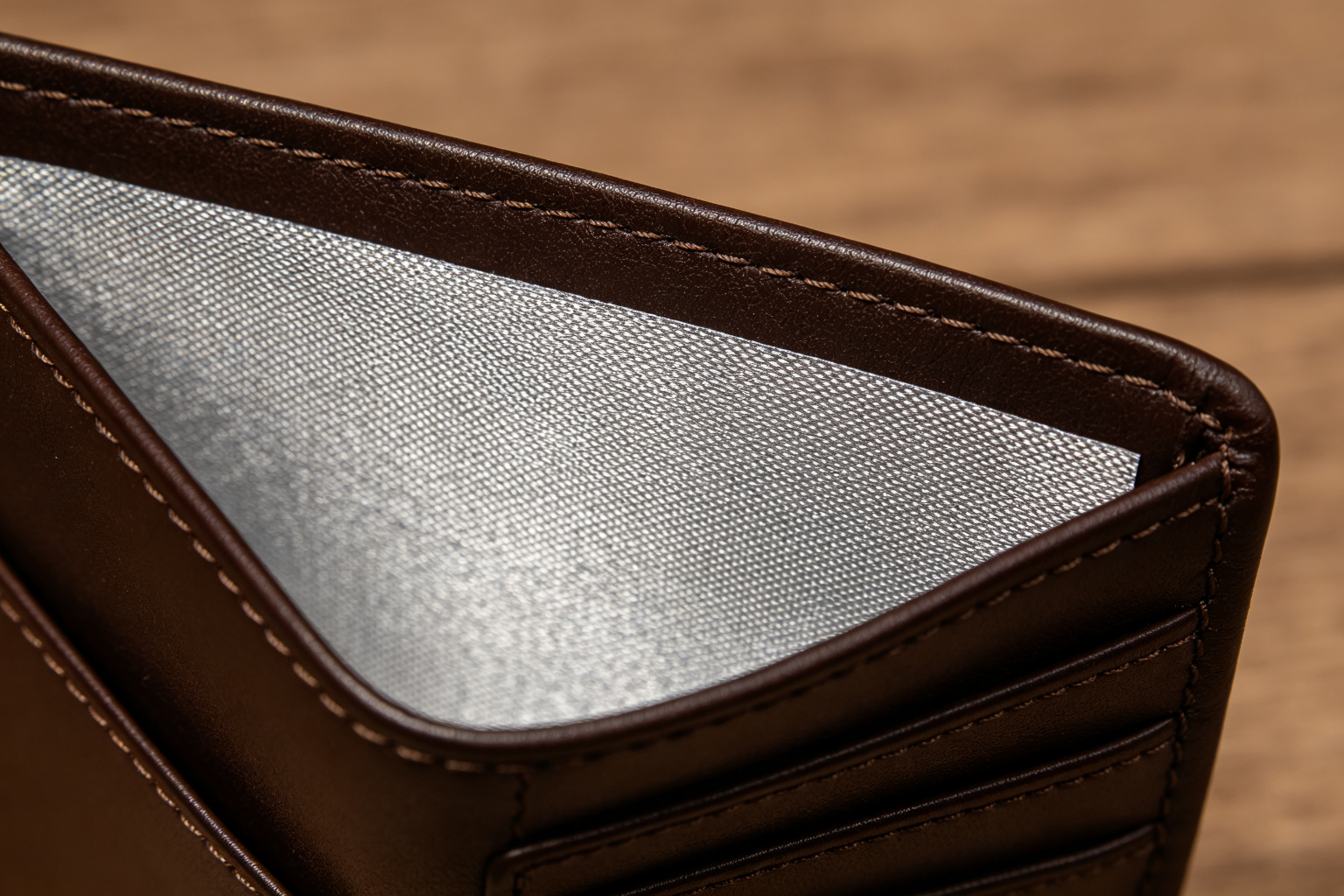
RFID-blocking lining: 0.1mm nickel-copper alloy fabric sewn between the PU leather exterior and the interior lining — a Faraday cage blocking contactless, access, and payment signals. Tested: 100% blocked at 1cm, 5cm, and 15cm. Added $0.45 per unit and became the #1 selling point.
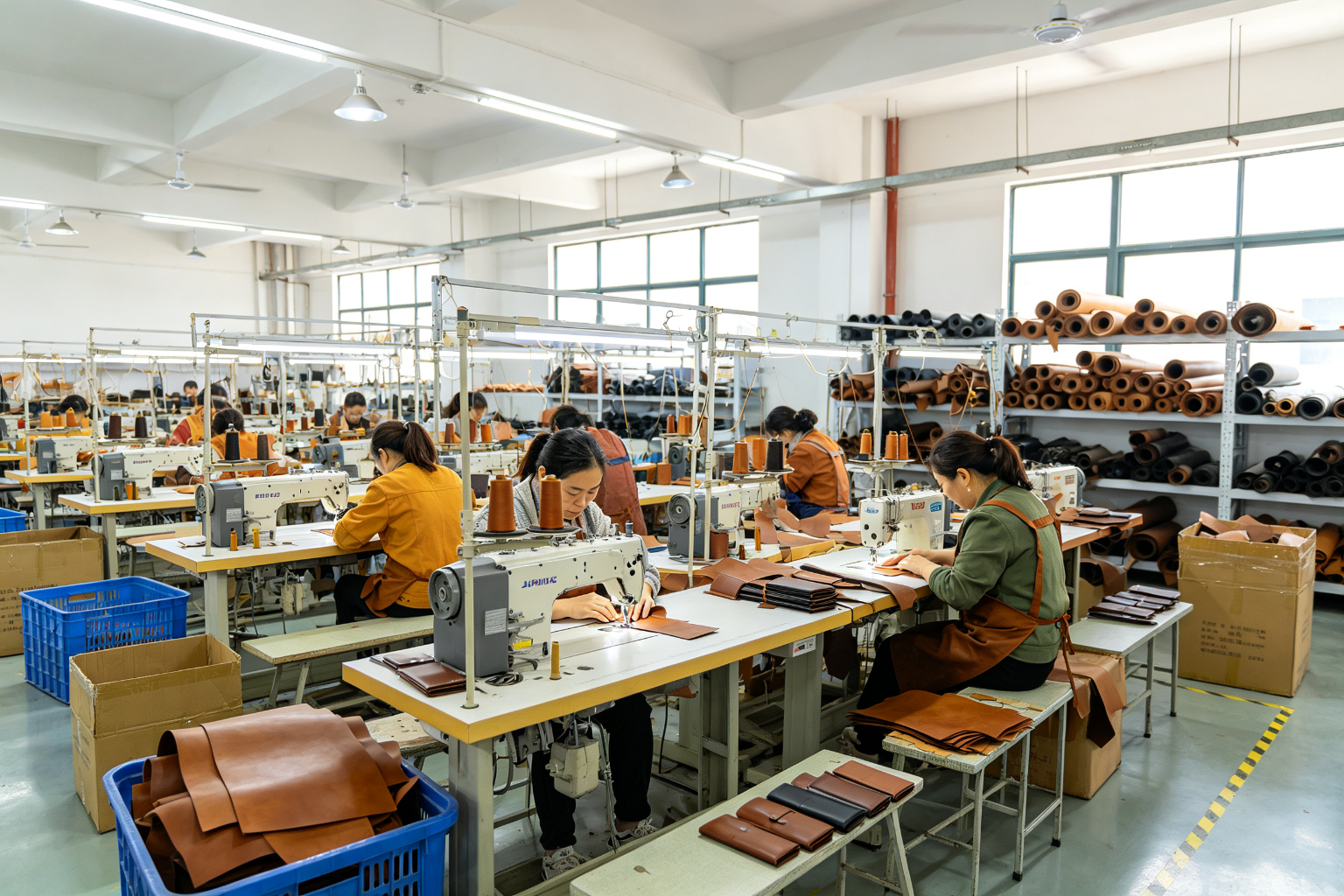
Our leather goods workshop: 4 dedicated operators crafting the 2,000-piece wallet run, PU leather rolls on shelves, and finished wallets staged for 100% functional QC. 60-80 minutes of precision work per piece.
Frequently Asked Questions
What does private label (white label) production mean for wallets?
Direct Answer: Private label means the factory builds a product carrying YOUR brand — logo, name, packaging — while owning manufacturing and QC. The base design is proven (40,000+ of this wallet style made), and typical MOQ runs 500-2,000 pieces at $3.00-$8.00 FOB.
- MOQ Range: 500-2,000 pcs
- Unit Price: $3.00-$8.00 FOB
- Base Design: Proven (40,000+ made)
- Brand Touchpoints: Logo, interior print, gift box, dust pouch
Private label (or white label) means a factory produces a product carrying YOUR brand — name, logo, and packaging — while the factory handles manufacturing, materials, and often the design (based on your spec). In this case study, we manufactured 2,000 RFID-blocking PU leather wallets for a UK brand using: (1) the client's debossed logo on the exterior (custom brass die), (2) their brand name printed inside, (3) their custom gift box with the brand's color scheme, and (4) their brand label on the fabric dust pouch. The client's brand appears on every element, but the factory owns the production and quality control. The key difference from OEM (original equipment manufacturing) is design ownership: in OEM, the client provides the full design; in private label, the factory typically provides the base product design and the client brands it. For a small fashion accessories brand without an in-house design team, private label is the fastest and lowest-risk way to launch a wallet product line — the base design is proven (we've made 40,000+ of this wallet style), and the brand adds its identity. Typical private label MOQ: 500-2,000 pieces, with unit prices $3.00-$8.00 FOB for leather wallets.
Is PU leather or genuine leather better for a private label wallet?
Direct Answer: For most private-label wallets, PU leather is the smarter buy: 40-60% cheaper than genuine ($1.50-2.50 vs $4.00-6.00 per wallet), batch-consistent, animal-free, and low-maintenance. This 0.8mm soft-touch PU delivered a 65% margin gain versus genuine leather.
- PU Material Cost: $1.50-$2.50
- Genuine Leather Cost: $4.00-$6.00
- PU Advantage: 40-60% cheaper, consistent
- This Pick: 0.8mm soft-touch PU
For most private label wallet programs, PU leather (polyurethane) is the smarter choice: it costs 40-60% less than genuine leather ($1.50-2.50 vs. $4.00-6.00 per wallet for the material), offers consistent color and texture across every batch (genuine leather has natural variation — every hide differs), is animal-free (a growing consumer preference, especially in the UK/EU market), and is easier to maintain (water-resistant, no conditioning needed). The trade-off: genuine leather develops a natural patina over time and feels more 'premium' to some buyers; PU leather can peel after 2-4 years of heavy use (the topcoat wears), while genuine leather ages. In this case study, we used 0.8mm PU leather with a soft-touch matte finish — the client's customers couldn't tell it wasn't genuine leather (confirmed by their 4.7/5 average customer rating and the 6-month follow-up survey where 87% of customers rated the material quality as 'excellent'). For a UK fashion accessories brand priced at £34.95 retail, the $2.00 PU leather material cost (vs. $5.00 for genuine) meant a 65% higher margin — the right economic choice for the market position.
How does RFID-blocking in a wallet actually work, and does it matter?
Direct Answer: RFID blocking works via a thin metallic Faraday layer (nickel-copper alloy) in the lining that stops 13.56MHz contactless signals. This wallet blocked 100% of reads at 1-15cm and added only $0.45 per unit — a strong, low-cost marketing feature.
- Technology: Metallic Faraday lining
- Frequency Blocked: 13.56 MHz
- Test Result: 100% blocked at 1-15cm
- Unit Add-on: $0.45
RFID-blocking works through a thin metallic shielding layer (usually a nickel-copper alloy or aluminum foil bonded to fabric) sewn into the wallet's lining — this creates a Faraday cage that blocks radio-frequency signals (13.56 MHz for contactless payments, 125-134 kHz for older access cards, and 860-960 MHz for some payment/ID cards) from reaching the card inside. In this case study, the shielding layer was a nickel-copper alloy fabric (0.1mm thick) sewn between the PU leather exterior and the interior lining. We tested it with an RFID reader at 1cm, 5cm, and 15cm distances: the wallet blocked 100% of reads at all distances (a card in the wallet was unreadable even at 1cm with a high-power reader). Whether it matters depends on the risk: contactless payment card skimming is real but rare (the attacker needs to be within a few cm), and the risk varies by country — contactless limits are higher in the UK (£100+) than in the US. For a UK retail brand, RFID-blocking is a strong marketing feature — 68% of UK consumers say they'd pay more for an RFID-blocking wallet (2025 survey), and it added only $0.45 per unit to the cost. For the client, the feature justified the £34.95 selling price and differentiated the product from unbranded alternatives.
How much does a custom branded leather wallet cost to manufacture?
Direct Answer: A custom branded PU leather wallet costs $3.00-$8.00 FOB per unit at 1,000-3,000 pieces; genuine leather runs $9.00-$14.00. This 2,000-piece order came to $6.50 FOB, supporting a £34.95 selling price with a 3.5x markup.
- PU FOB Unit: $3.00-$8.00
- Genuine Leather FOB: $9.00-$14.00
- This Order: $6.50 FOB / unit (2,000 pcs)
- Retail Markup: ~3.5x
A custom branded leather wallet typically costs $3.00-$8.00 FOB per unit at 1,000-3,000 pieces, depending on material and features. In this case study, the 2,000-piece order came to $6.50 FOB per unit, which breaks down as: PU leather exterior ($2.00 — 0.8mm soft-touch matte finish), RFID shielding layer ($0.45 — nickel-copper alloy fabric), interior lining and card slots ($0.80 — 6 interior card slots + 2 hidden slots + zippered coin pocket), hardware and branding ($0.75 — debossed logo die $400 amortized + metal zip pull), labor and sewing ($1.50 — a wallet is a complex small product: 25-35 sewing operations per piece, 60-80 minutes each), premium packaging ($0.50 — fabric dust pouch + custom gift box with brand color printing), and QC/overhead ($0.50). The client's landed cost to the UK was about $8.60 per unit (FOB $6.50 + freight $1.30 + import duty 8% on leather goods + VAT), supporting a £34.95 selling price — a 3.5x markup. For comparison, genuine leather wallets at the same spec cost $9.00-14.00 FOB. If you're launching a wallet line, budget $3.00-$8.00 FOB per unit for PU leather, and $9.00-$14.00 for genuine leather.
What is a normal defect rate for leather wallet production?
Direct Answer: Leather wallet production should hold a 0.5-1.0% defect rate at AQL 2.5 — lower than bags, thanks to careful small-part handling. This 2,000-piece run finished at 0.5% (10 pieces), all within allowance and repaired or replaced.
- Normal Rate: 0.5-1.0%
- Top Defect: Stitching 0.2-0.4%
- Actual Rate: 0.5% (10/2,000)
- Post-Repair: 0% shipped defects
For leather wallet production, a defect rate of 0.5-1.0% under AQL 2.5 inspection is normal for a standard run — wallets are more delicate than bags, but a well-run line with experienced operators achieves a lower defect rate than bag production (1.0-1.5%) because the smaller product allows more careful handling. The most common wallet defects are: (1) stitching defects (0.2-0.4%) including skipped stitches and misaligned seams — critical on a wallet because the card slots must be precisely aligned; (2) edge and finish defects (0.1-0.3%) including paint/rub edge imperfections and rough edges; (3) card slot defects (0.1-0.2%) including slots too tight (cards hard to insert) or too loose (cards fall out); (4) RFID layer defects (0.05-0.15%) including a torn shielding layer that compromises blocking. In this case study, the final defect rate was 0.5% — 10 pieces out of 2,000 inspected, all within the AQL 2.5 allowance (acceptance number 14 in a 200-piece sample). All 10 were repaired or replaced, resulting in a 0% defect rate shipped. For wallets, insist on 100% functional testing of card slots and RFID blocking on a sample — these are the features customers notice first.