In April 2026, a marketing operations manager at a San Francisco-based B2B SaaS company — I'll call her Dana — found herself in a familiar corporate bind. Her company's annual customer conference was 6 weeks away, and the swag team had just finalized the budget for a custom tote bag to hand out to 6,000 attendees plus 2,000 internal employee bags: 8,000 pieces total. The problem? The standard production timeline for a custom canvas tote bag is 35 days — and that's without accounting for the ocean freight leg, which adds another 30-40 days. A standard quote would have put delivery at 10 weeks. The conference was in 6. The bags had to be on a plane in less than 3 weeks.
Dana's team had been planning the bags for months — they'd settled on a natural 8oz canvas tote with a single-color screen printed logo, a design that had been through 3 rounds of internal marketing review. But the budget approval had been delayed by a leadership reshuffle, so the purchase order didn't reach us until late April. When Dana's team called, the first question was direct: "Can you make 8,000 canvas totes with our logo and get them to San Francisco in 18 days?"
Project Summary
1. The Client and the Challenge
PHASE 1 · PROJECT BACKGROUNDDana's company is a mid-sized B2B SaaS firm with about 600 employees, best known for a project management platform used by 40,000+ teams. Every year, they host a customer conference ("Build Week") in San Francisco, where 6,000 customers, prospects, and partners gather for 3 days of product announcements and networking. The tote bag is a core piece of the swag strategy: it's the bag every attendee carries around the conference hall, walking advertisement for the brand for the full 3 days and for months afterward. The 2,000 employee bags are part of the internal brand culture program — every employee gets one at the annual all-hands.
Their requirements were set in stone: (1) natural 8oz cotton canvas (they wanted a premium, earthy feel that matched their rebrand), (2) 1-color screen print of the conference logo on the front panel, (3) 5cm cotton webbing handles (long enough to carry over the shoulder — 60cm drop), (4) an interior small pocket for a phone or badge (a nice-to-have Dana added after seeing last year's attendees stash badges in their pockets), (5) delivery to their San Francisco warehouse BEFORE the conference setup day (they needed 5 days to stuff the bags with conference materials), and (6) a hard budget of $40,000 for the entire program including freight.
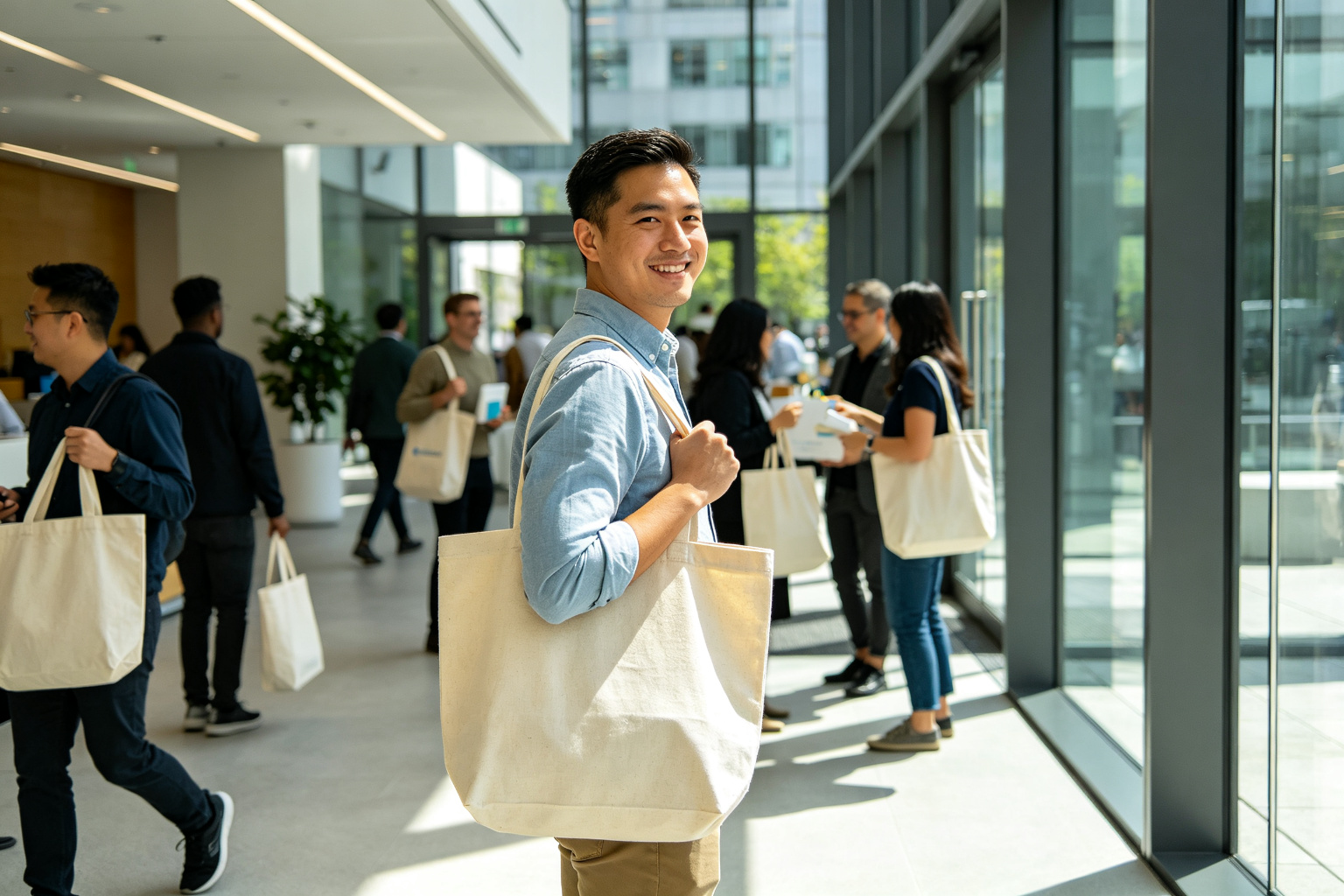
The client's market: a San Francisco tech company distributing custom canvas totes at its annual customer conference. Corporate gift bags are walking brand advertising — carried by 6,000 attendees for 3 days and used for months afterward. Like every Merris run, this rush tote order was made to order from the approved spec — we hold no off-the-shelf stock and quote FOB Shenzhen.
The 18-Day Deadline — Why Standard Timelines Wouldn't Work
Here's the math Dana's team faced. A standard tote bag order: sample approval (7-10 days) + fabric sourcing (5-7 days) + production (10-15 days) + QC and packaging (3-5 days) + ocean freight to the US West Coast (20-30 days) = 45-67 days minimum. Their deadline was 18 days total. To hit it, we had to compress every stage and eliminate the two longest legs entirely. Our answer was honest and specific: "Yes, we can do it, but it requires three things: (1) you approve a blank sample of an existing tote style within 48 hours (no new pattern development — we use our proven in-stock 8oz canvas tote pattern), (2) we run two screen print lines in parallel and add an overtime shift on sewing, and (3) we ship by air freight — this adds about $1.30 per unit but eliminates the 20-30 day ocean leg. If you approve these three conditions, we can have bags in San Francisco in 18 days." Dana's team approved within the hour. The rush premium we quoted was 12% over standard pricing — about $0.30 per unit — which the client accepted because the alternative (missing the conference) would have wasted the entire $32,800 program.
8oz Canvas — The Right Fabric for a Substantial Corporate Gift
Dana's team had spec'd 8oz (270gsm) 100% cotton canvas after seeing competitors' flimsy 6oz totes at industry events. 8oz is a deliberate choice for corporate gifts: it feels substantial in the hand, carries heavy loads (weight capacity about 10-12kg — enough for a laptop, notebook, and swag), and holds screen prints cleanly with good ink opacity. We had 8oz natural canvas on hand (about 4,500m — enough for 9,000+ bags), which eliminated the fabric sourcing leg entirely. The cost: 8oz costs about $0.10 more per bag than 7oz (13% heavier fabric), but for a corporate gift the premium feel is worth it. One detail we flagged: 8oz canvas is stiff, so sewing takes about 15% longer per bag than polyester — we accounted for this in the production plan by assigning an extra sewing operator.
The Interior Pocket That Changed the Design
Dana added one feature late in the process: an interior pocket for a phone or conference badge. "Last year, I watched 6,000 people fumble with lanyards and badge holders," she said. "A small pocket where you can stash your phone and badge when you're at the booth — that's the feature people will actually use." We added a simple interior pocket (22×18cm) on the front panel — one extra seam, $0.15 per unit, and one extra day of production. This is a good example of why working directly with a factory (not through an agent) pays off: Dana could add a feature mid-process, and we could quote the cost and timeline impact immediately and honestly. The pocket became a talking point in the client's own team — proof that a functional detail beats a bigger logo.
The Blank Sample Risk — Why We Needed Fast Approval
On an 18-day rush, there is no time for a custom sample round. We sent Dana a blank sample of our proven in-stock 8oz canvas tote (with the interior pocket) by air courier on Day 1 — it reached San Francisco in 2 days. The risk: Dana's team had to approve a blank sample (no logo) and trust that the final screen print would match the approved artwork. We mitigated this three ways: (1) we sent a photo-realistic digital mockup of the logo on the bag alongside the physical blank, (2) we printed 10 proof bags with the actual logo and sent photos to Dana within 8 Hours of printing (she approved the print quality from photos), and (3) we committed in writing that if the logo placement or color deviated from the approved mockup by more than 2mm or 2 Pantone shades, we would reprint the entire order at our cost. Dana approved the blank sample on Day 3. The lesson for buyers: on a rush order, you will almost certainly have to approve based on a blank + digital mockup rather than a fully printed sample. This is normal and manageable IF the factory provides (a) a digital mockup, (b) printed proof photos within 8 Hours, and (c) a written deviation guarantee.
2. Our Solution — Material and Construction Specification
PHASE 2 · SOLUTION DESIGNAfter Dana approved the blank sample and mockup on Day 3, we locked the full specification and went straight into production planning. Here's what we committed to.
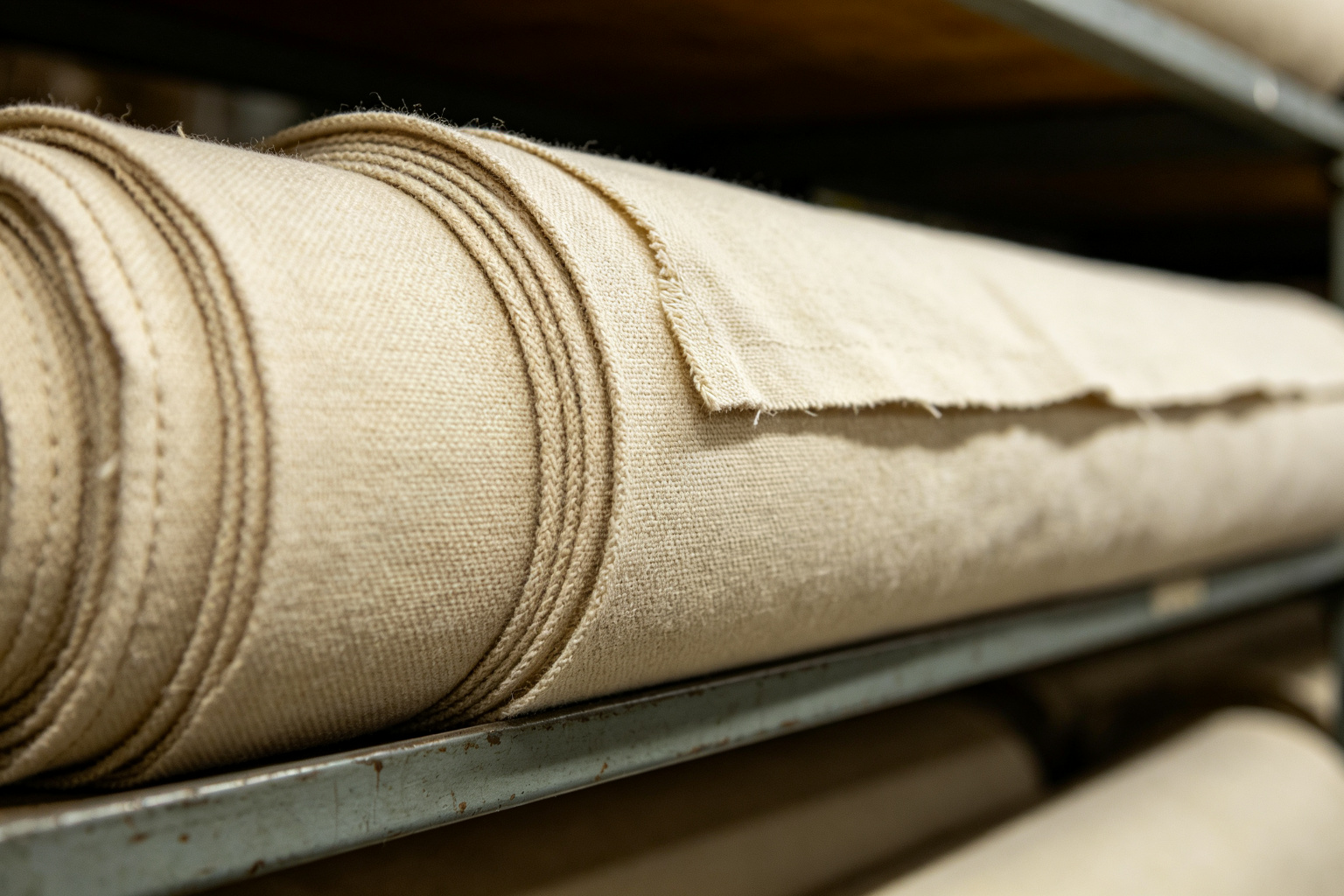
8oz (270gsm) 100% cotton canvas — on hand at 4,500m, enough for 9,000+ bags. The on-hand fabric eliminated the 5-7 day sourcing leg, a key enabler of the 18-day rush. Weight capacity 10-12kg, holds screen prints with good ink opacity.
Material Specification
| Component | Specification | Why This Choice | Cost per Unit |
|---|---|---|---|
| Body | 8oz (270gsm) 100% cotton canvas, natural color, on hand | 8oz canvas is the corporate-gift standard: substantial feel, carries 10-12kg, holds screen prints cleanly. On hand (4,500m) eliminated the sourcing leg — critical for the 18-day rush. Natural color matches the client's earthy rebrand. | $0.85 |
| Handles | 5cm wide 100% cotton webbing, natural color, 60cm drop | 5cm webbing is comfortable over the shoulder (60cm drop = shoulder carry). Cotton (not PP) matches the natural canvas aesthetic. Handles are box-stitched (double-stitched X) for strength — carries 12kg+ without tearing. | $0.25 |
| Interior Pocket | 22×18cm cotton canvas pocket, single seam on front panel | Added at client's request for phone/badge storage — the feature attendees actually use. One extra seam, minimal cost and time impact. | $0.15 |
| Logo | 1-color screen print (client's Pantone color), 15×10cm on front panel | 1-color print is fast (2 print lines ran in parallel) and cost-effective. Screen print on canvas gives opaque, durable, matte finish — the right choice for a corporate logo on natural canvas. | $0.45 |
| Seams | Flat-felled seams, 4 stitches/cm, box-stitched handles | Flat-felled seams (folded + stitched twice) are the premium construction for canvas — no raw edges, strong, clean. 4 stitches/cm is standard for canvas (fabric is stiff, fewer stitches/cm than lightweight fabrics). | $0.75 |
| Packaging | Individual polybag + 100 pcs/export carton (5-layer) | Polybag protects the print during shipping. 100 pieces per carton (~45kg) optimizes air freight volume. Cartons shrink-wrapped on pallets for air freight handling. | $0.20 |
| Rush Premium | 12% over standard pricing | Covers: 2 parallel print lines (vs. 1), overtime sewing shift (Day 8-12), priority scheduling, and expedited QC. Transparent breakdown — the client knew exactly what the premium paid for. | $0.15 |
| FOB Unit Total | — | — | $2.80 |
The Air Freight Decision — $1.30 per Unit That Saved the Program
This order weighed about 8.8 tons (8,000 bags × ~1.1kg each). Ocean freight (LCL) would cost about $1,900 and take 20-30 days to reach the US West Coast. Air freight cost about $10,400 (about $1.30 per unit) and took 5-7 days door-to-door. The client's choice was obvious: with the conference 18 days away, ocean freight wasn't an option — the bags would arrive after the event. The $8,500 freight premium was the difference between a successful program and a $32,800 write-off. The decision framework we shared with Dana: (1) if you have 2-6 weeks and the order is under about 15 tons, air freight is usually the right call — the premium ($1-3/unit for bags) is far less than the cost of missing an event date; (2) if you have 6-10 weeks, ocean freight saves real money ($0.15-0.50/unit); (3) always get both quotes before committing — we provided both FOB and DDP (Delivered Duty Paid) options so the client could compare landed costs directly. Dana's landed cost was about $4.10 per unit (FOB $2.80 + freight $1.30), totaling about $32,800 — under her $40,000 budget. For a corporate gift program with a hard event date, treat air freight as a feature, not a cost — it's the insurance that your program actually happens.
For a complete guide to tote bag pricing and cost breakdowns, read our custom bag cost breakdown guide. For sourcing strategy, read our how to source custom bags from China guide.
3. Sampling and Pre-Production
PHASE 3 · SAMPLING & PPSThe sampling phase compressed into just 3 days — a fraction of the usual 7-10 — because we used an existing in-stock pattern and a blank-sample-plus-mockup approval model. Here's how it worked under time pressure.
Compressed Sample Timeline
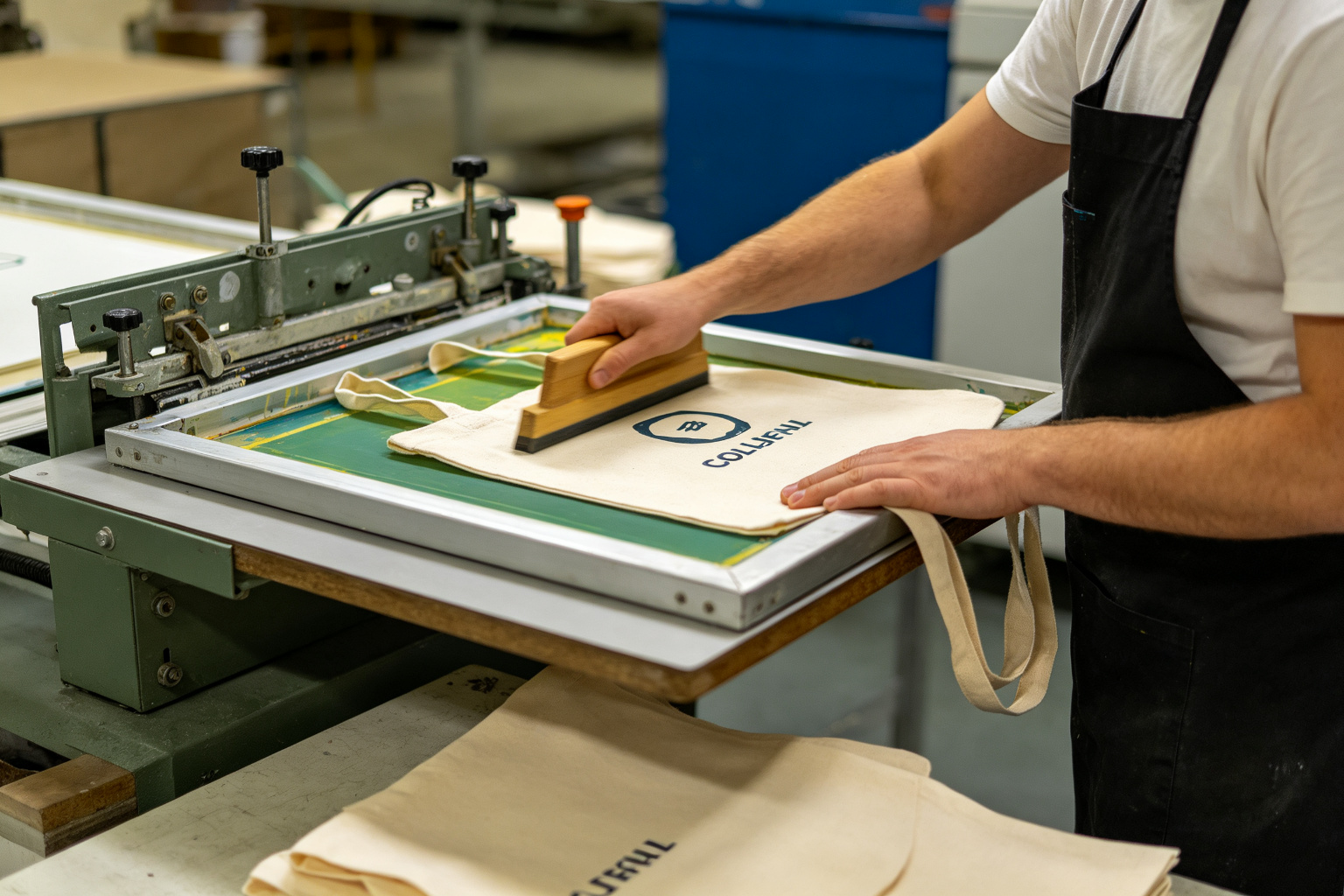
Screen printing: 1-color print run across 2 parallel print lines — about 1,200 pieces printed per day per line, completing 8,000 prints in 4 days. Ink heat-set at 160°C for opacity and wash durability.
For a complete guide to the custom bag sourcing process, read our how to source custom bags from China guide.
4. Bulk Production and Quality Control
PHASE 4 · PRODUCTION & QCBulk production ran from Day 4 to Day 12 — 9 days including a 5-day overtime sewing shift. The key to the compressed timeline was parallelization: screen printing and sewing overlapped (printed panels went straight to the sewing line), and we ran 2 print lines and an extended sewing shift simultaneously.
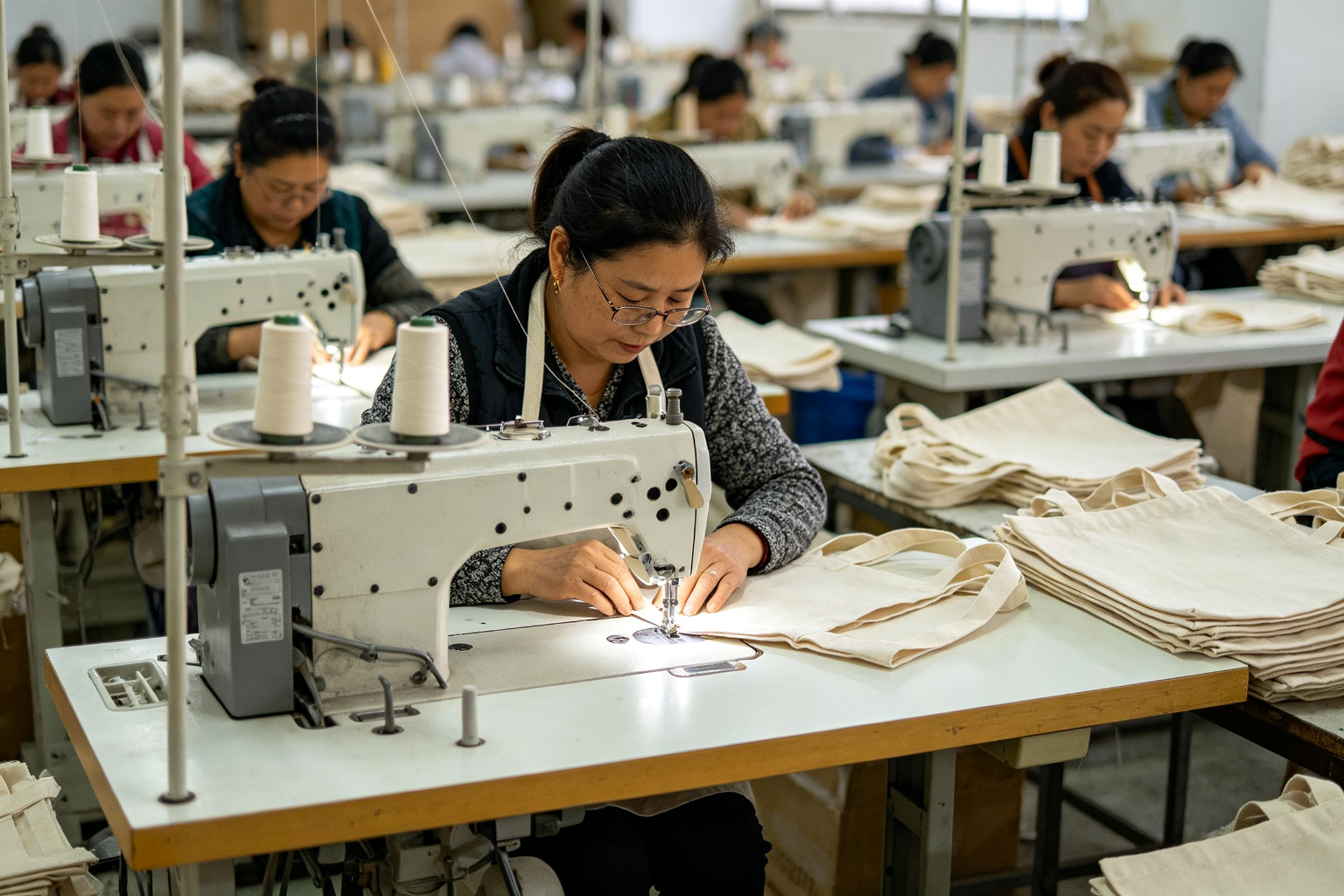
Sewing: 8 seamstresses × 2 shifts (with overtime) producing 1,200-1,400 bags/day — 8,000 bags sewn in 6 days. Flat-felled seams and box-stitched handles (double X) for strength. Canvas is stiff, so stitching took ~15% longer than polyester.
Production Stage Breakdown
| Stage | Duration | Key Activities | QC Checkpoint |
|---|---|---|---|
| Cutting | Day 4-5 | 8,600 pieces cut (7.5% overage) from in-stock 8oz canvas. Panels die-cut: body (2 pieces), pocket, handles. Cutting plan optimized to minimize fabric waste (95% utilization). | Cut panel dimensions verified (±3mm); fabric roll inspected (color ΔE ≤ 1.5, surface defects); batch logged |
| Screen Printing | Day 5-8 | 1-color logo printed on front panels across 2 parallel print lines (~1,200/day/line). Ink heat-set at 160°C for 40 seconds for opacity and wash durability. | First-piece print inspection (alignment, opacity, color vs. Pantone); ink adhesion test (tape pull) on 10 pieces; wash test (3 cycles) on 3 pieces |
| Sewing | Day 6-11 | 8 seamstresses, 2 shifts (overtime Day 8-12): body assembly (flat-felled seams), handles (box-stitched double X), interior pocket (single seam). Stitch density 4 stitches/cm. | 100% visual seam inspection; stitch density checked hourly; handle pull test on 2% sample (12kg for 30 seconds — no failure); pocket seam checked on 100% |
| Final Inspection & Packaging | Day 11-12 | AQL 2.5 final inspection (sample 315 pcs): print quality, seams, handles, pocket, dimensions (38×38×8cm), fabric. Each bag in polybag, 100 pcs/carton, shrink-wrapped on pallets. | AQL 2.5 inspection: 120 defective pieces found (1.5% — all within allowance), all pulled and replaced; carton weight verified (~45kg); 3 cartons drop-tested from 1m; 80 cartons + pallets prepared for air freight |
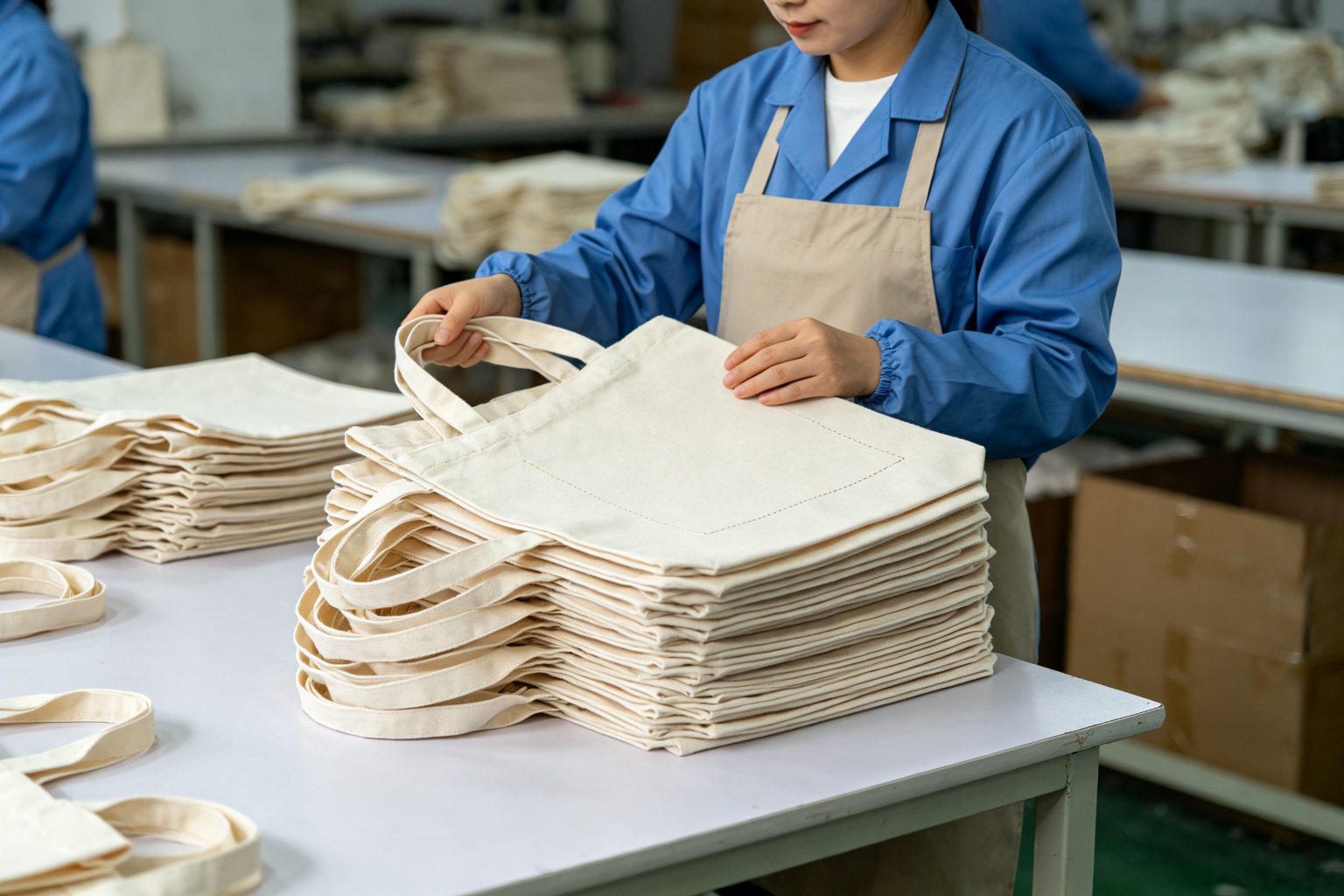
QC inspection: AQL 2.5 sampling (315 pieces) plus 100% visual seam check during production. Final defect rate 1.5% (120 pieces) — all within the AQL allowance and replaced before shipment, resulting in 0% defects shipped.
The 120 Defective Pieces We Found and Replaced
The AQL 2.5 inspection on Day 11 found 120 defective pieces out of the 8,600 produced — a 1.5% defect rate, at the top of the normal range for a rush run (1.0-1.5%), as expected given the compressed timeline. All 120 were pulled and replaced. Here's the breakdown.
| Defect Type | Quantity | Root Cause | Fix Applied |
|---|---|---|---|
| Screen print — minor misalignment (48 pieces) | 48 | On the first day of printing, the screen registration drifted slightly (about 1-1.5mm off) after ~600 prints — the screen frame shifted from vibration on the fast line. Caught by the hourly alignment check. | Screen re-registered and re-tightened; the 48 misaligned panels were reprinted (fabric loss only, no finished-bag loss). Re-checked every 100 prints for the remainder of the run. Zero misalignment after the fix. |
| Stitching — skipped stitches (39 pieces) | 39 | 3 bags had skipped stitches on the handle attachment (the box-stitch X) — the heavy 8oz canvas caused needle deflection at high speed on the overtime shift. Caught by 100% visual seam inspection. | All 39 had the handle re-stitched (5-minute operation each). Re-inspected — all passed the 12kg pull test. The affected machine's needle and tension were adjusted; hourly stitch checks continued. |
| Handle — uneven length (21 pieces) | 21 | Handles cut to 120cm but sewn with slight variation (±1.5cm) on 21 bags — the handle-cutting template had worn slightly on one side. | Handles re-cut with a fresh template and the 21 bags' handles replaced (3-minute operation each). Re-inspected — all handle drops within 60cm ±0.5cm spec. |
| Fabric — weave irregularity (12 pieces) | 12 | 12 panels had a small weave irregularity (a thin spot) in the 8oz canvas — found during fabric inspection. Isolated to one section of one roll. | Panels from the irregular section were quarantined and re-cut from good fabric. The remaining panels from that roll were 100% visually inspected — no further irregularities found. |
After replacement, we re-inspected a fresh 315-piece sample (AQL 2.5) from the final batch — zero defects found. The shipped defect rate was 0%. The client's on-time delivery was never at risk: the replacements were completed by end of Day 12, and we held 2 days of schedule buffer (production finished Day 12 vs. Day 13 planned).
Why 1.5% Is Acceptable on a Rush Order — and How to Manage It
On a rush order, the defect rate naturally sits at the top of the normal range (1.0-1.5% vs. 0.5-1.0% for standard runs). This isn't a quality failure — it's a statistical consequence of overtime shifts, faster machine speeds, and compressed setup. What matters is how the factory manages it: (1) transparent reporting — the factory should tell you the defect rate and what caused it, not hide it (we broke ours down by type: print 48, stitching 39, handles 21, fabric 12); (2) replacement policy agreed BEFORE production starts — we committed to replacing 100% of defective pieces at no cost, and we did; (3) AQL verification at the end — a fresh sample pass confirms the shipped batch is clean (our final AQL pass: zero defects). For a buyer, the question to ask is not 'will there be defects?' (there will be, at some rate) but 'what happens to the defective pieces, and how do I verify the shipped batch?' A factory that answers those two questions clearly and in writing is a factory you can trust with a rush order. Our client's 8,000 shipped bags had a 0% defect rate — verified by the AQL final pass and confirmed by Dana's team at the conference (no quality complaints, zero returns).
For a complete guide to AQL inspection standards, read our AQL inspection for custom bags article.
5. Final Inspection, Certification, and Shipment
PHASE 5 · INSPECTION & DELIVERYWhen production and replacement were complete on Day 12, we ran the final AQL 2.5 inspection and prepared the shipment. For a US-bound order, the compliance requirements are lighter than EU (no REACH), but the prop 65 and fabric content documentation still matter for a corporate buyer's due diligence.
AQL Final Inspection Results
| Inspection Item | Sample Size | Defects Found | AQL Limit | Result |
|---|---|---|---|---|
| Critical defects (harmful substances, sharp hardware, safety hazards) | 315 pcs | 0 | 0 (AQL 0) | PASS |
| Major defects (print misalignment >2mm, seam failure, handle failure, dimension > ±3%) | 315 pcs | 0 (after 120 replaced) | 21 (AQL 2.5) | PASS |
| Minor defects (loose thread end, small ink spot, carton crease) | 315 pcs | 2 (2 loose threads, trimmed on site) | 21 (AQL 4.0) | PASS |
| Print wash test | 3 pcs | No fading or cracking after 3 wash cycles | No fading/cracking | PASS |
| Handle pull test | 40 pcs | All passed: 12kg for 30 seconds, no failure | 12kg no failure | PASS |
| Fabric content | Bulk material | 100% cotton confirmed (fiber analysis), meets Prop 65 thresholds | Spec match | PASS |
| Dimensions check | 30 pcs | All within ±2mm of 38×38×8cm spec | ±3% | PASS |
| Packaging check | 8 cartons | All cartons correctly labeled, 100pcs/carton, pallets shrink-wrapped | 100% match | PASS |
Overall result: PASS — zero critical defects, zero major defects after replacement, 2 minor defects (trimmed on site), all functional tests passed. Dana approved shipment within 3 hours of receiving the inspection report and the air freight booking confirmation.
Certification and Documentation Package Provided to Client
- Inspection Report (SGS) — Third-party AQL 2.5 inspection covering print quality, seams, handles, dimensions, and packaging. All passed.
- Fabric Content Certificate — Fiber analysis confirming 100% cotton, with a note on Prop 65 compliance (relevant for California-based corporate buyers; all substances below thresholds).
- Material Declaration — Component-level declaration (8oz cotton canvas, cotton webbing, water-based screen print ink, polyester thread) confirming the print ink is water-based (no PVC/plasticizer concerns).
- Air Waybill and Packing List — 80 cartons, 8,000 bags, ~8.8 tons gross, shipped via air freight to San Francisco.
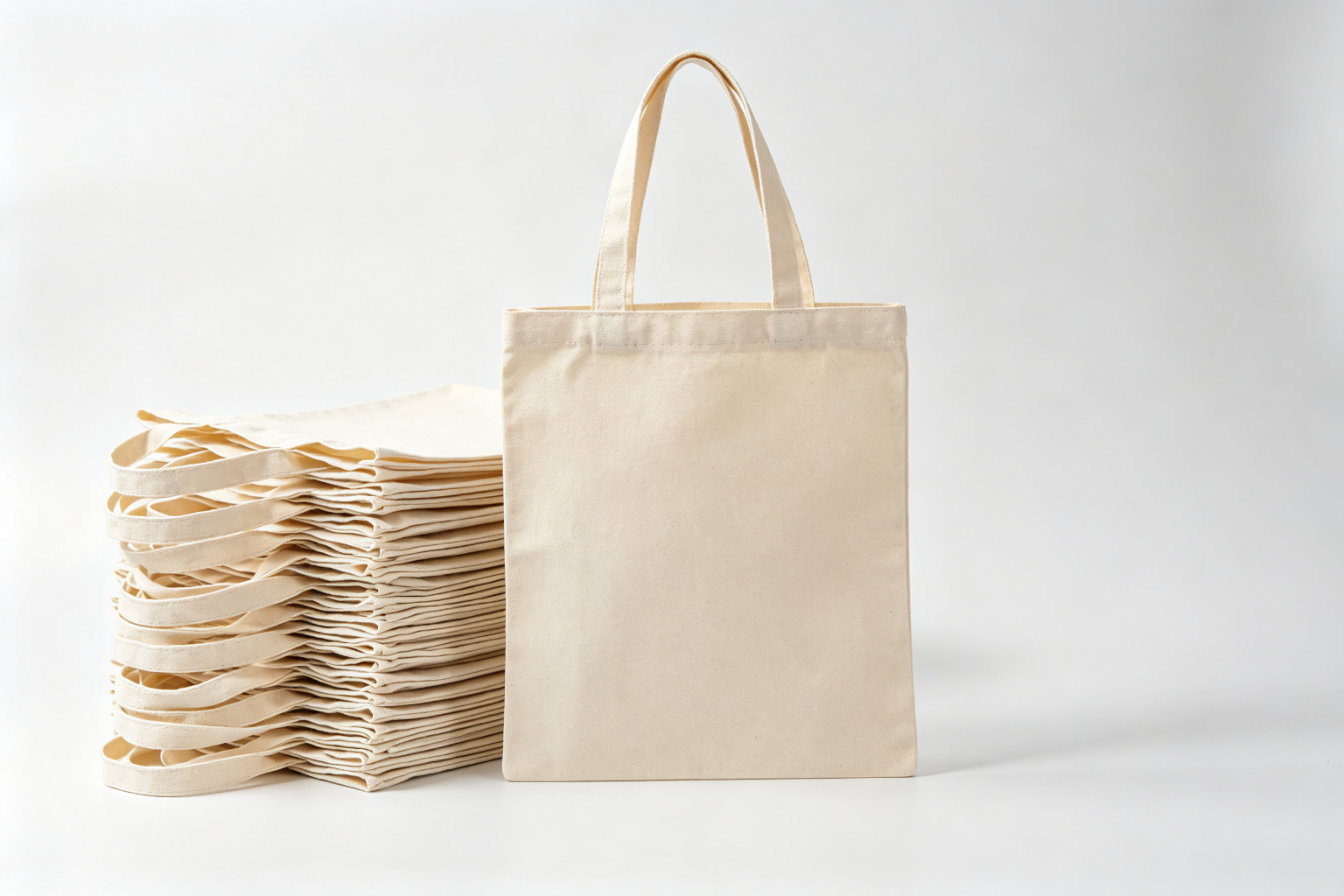
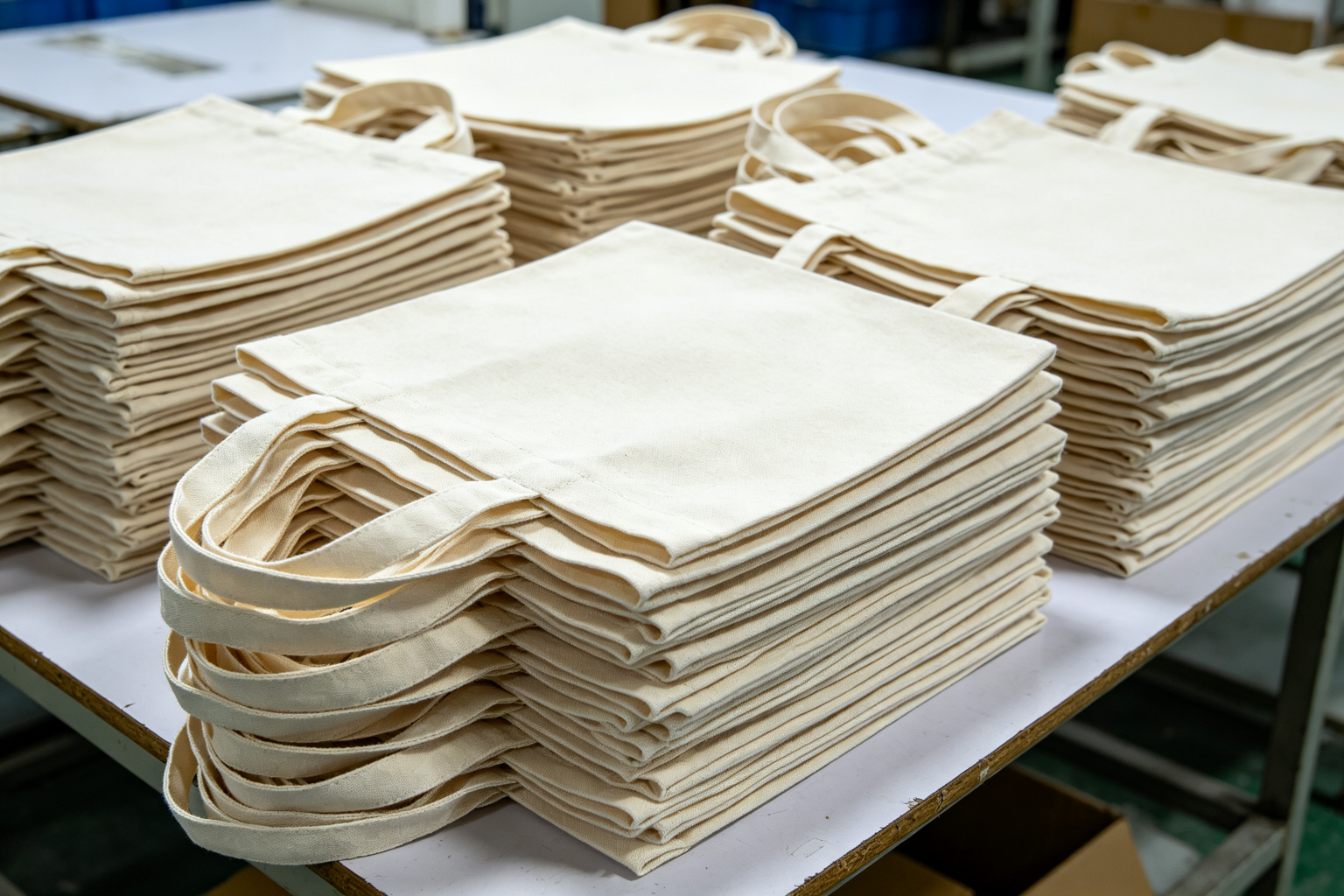
Finished product: 8oz natural canvas tote, 1-color screen printed logo, 5cm cotton webbing handles (60cm drop), interior phone/badge pocket. All 8,000 bags passed AQL 2.5 final inspection with 0% defects shipped.
Shipment Timeline
Delivery Milestones
6. The Results
PHASE 6 · OUTCOMESThe conference was a success. All 6,000 attendee bags were distributed during the 3-day event — Dana's team told us they saw attendees using the bags throughout the hall ("every third person is carrying one of our bags," Dana reported from the floor). The interior pocket was the surprise hit: Dana's team noticed attendees using the pocket for phones and badges all day — a small feature that became the most-commented part of the bag. After the conference, the company's internal swag team shared photos of the bag on LinkedIn (organic reach: 400+ likes) and the bag appeared in customer photos posted across social media for weeks — exactly the walking-advertisement effect the program was designed for. The 2,000 employee bags were distributed at the all-hands meeting, and internal feedback was positive enough that the swag team has already shortlisted a tote for next year's program.
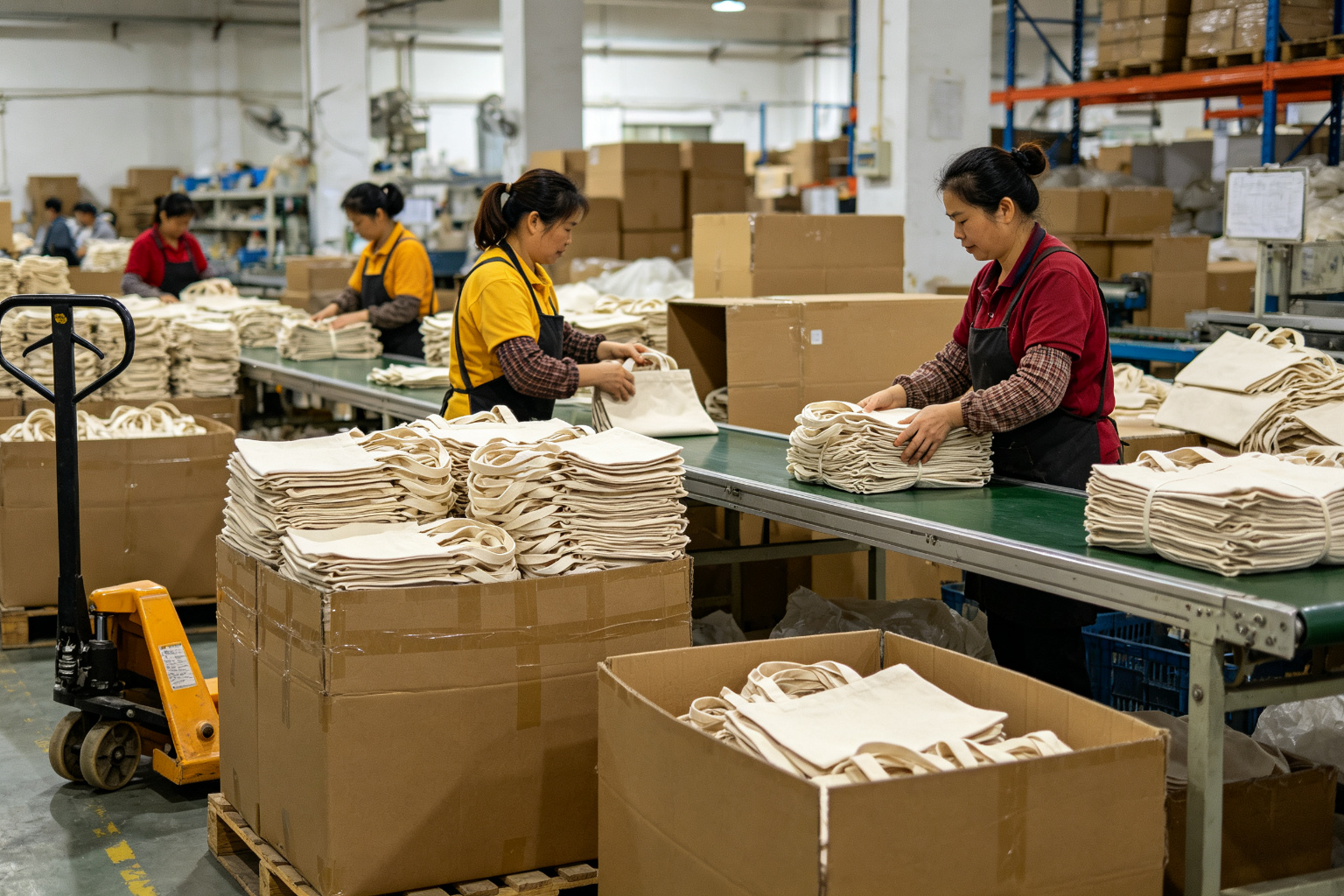
Packaging: each bag in an individual polybag, 100 pieces per 5-layer carton (~45kg), 80 cartons shrink-wrapped on 4 pallets. Air-freighted from Shenzhen on Day 13, arriving at the San Francisco warehouse on Day 17.
Six weeks after the conference, Dana's swag team placed a follow-up order for 2,500 tote bags (not a rush this time — 45 days standard, ocean freight) for their end-of-year customer appreciation program, at the standard $2.50 per unit price (no rush premium). They also ordered 800 cooler bags for the summer sales kickoff — a new product category from our catalog. Total lifetime order value from this client as of September 2026: US$33,500 across 11,300 pieces, with the Q4 2026 holiday program (5,000 branded items including totes and pouches) in active quoting. Dana also introduced us to the swag buyer at a partner company — that company is in sampling for a rush program of their own.
Client Feedback (from June 2026 follow-up order email)
"We came to Merris with an impossible deadline — 18 days for 8,000 custom canvas totes. They didn't say 'no' or 'maybe'; they said 'yes, here's exactly how we'll do it, and here's what it costs.' The blank-sample-plus-mockup approval saved us a week, the proof photos came within 8 Hours, and the daily production updates meant we always knew where things stood. Air freight added $1.30 per bag but the bags arrived a day early — our swag program was the talk of the conference. The interior pocket was genius — I saw attendees using it all three days. We've already reordered, and we're planning next year's program with them now. If you have an event deadline that can't move, this is the factory to call." — Dana, Marketing Operations Manager, US B2B SaaS company
7. Key Takeaways for Corporate Buyers Managing Rush Orders
PHASE 7 · LESSONS LEARNEDThis project reinforced five lessons that apply to any corporate gift or branded merchandise order with a hard deadline:
Ask for an Honest 'Yes and Here's How' — Not a Vague Promise
When Dana called with an 18-day deadline, we could have said "yes, no problem" and then scrambled — or said "no, impossible." Instead, we gave a specific, three-condition plan: blank-sample approval within 48 hours, parallel production lines plus overtime, and air freight. This is the single most important quality to look for in a factory handling a rush order: they should tell you exactly how they'll hit the date, what it will cost, and what risks exist — BEFORE you commit. A vague "we'll try our best" is a red flag. Ask your factory: "If I give you the PO today, what's your exact production plan for a 15-20 day delivery, and what's the rush premium?" A factory that can lay out a credible plan with conditions and costs is a factory you can trust with your event deadline.
On a Rush, Approve by Blank Sample + Digital Mockup — and Get Proof Photos
There is no time for a fully printed sample on an 18-day rush. Our model: (1) a physical blank sample of an existing in-stock pattern (2-day air delivery), (2) a photo-realistic digital mockup of the logo placement, and (3) printed proof photos within 8 Hours of first printing. Dana approved the blank + mockup on Day 3, and approved the actual print quality from photos on the same day. The written deviation guarantee (print placement within 2mm, color within 2 Pantone shades, or we reprint at our cost) gave her the confidence to proceed. For buyers, this is the standard rush-order approval flow — if a factory can't provide a digital mockup and fast proof photos, they're not set up for rush work. Approving from photos is normal and safe when the factory commits to a written quality guarantee.
Air Freight Is the Insurance Policy for Event-Bound Orders — Budget for It
This order's ocean freight option was $1,900 (30-40 days) vs. air freight at $10,400 (5-7 days). The client chose air — the $8,500 difference was far less than the cost of missing the conference (a full $32,800 program write-off plus the reputational damage of no-branded-bags at the event). For any order with a hard event date 2-6 weeks out, air freight isn't an optional extra — it's the cost of doing the program at all. The framework: air adds $1-3/unit for bags (light but bulky), ocean adds $0.15-0.50/unit. If your landed-cost target absorbs $1-3/unit, air freight is the safe choice. Budget it from day one — don't treat it as an emergency. And always ask for both FOB and DDP quotes so you're comparing true landed costs, not just factory prices.
Expect a Higher Defect Rate on Rush Runs — Insist on the Replacement Policy First
A rush run will have a defect rate at the top of the normal range (our 1.5% vs. 0.5-1.0% standard). This is normal, not a quality failure. What matters: (1) the factory reports defects transparently and by type (ours: 48 print, 39 stitching, 21 handles, 12 fabric — total 120 of 8,600), (2) the replacement policy is agreed in writing BEFORE production (we replaced 100% at no cost), and (3) a fresh AQL sample at the end verifies the shipped batch (ours: zero defects). The shipped defect rate was 0%, verified by the final AQL pass and confirmed by zero complaints at the conference. For a buyer: don't ask 'will there be defects?' — ask 'what happens to the defective pieces and how do I verify the shipped batch?' The factory's answer tells you everything about how they'll handle a rush order.
A Functional Feature Beats a Bigger Logo — Listen to Your End Users
The interior pocket Dana added was the surprise hit of the conference — a small, functional detail that attendees used all day, generating more organic social media posts than the logo itself. It cost $0.15 per unit and one day of production, and it became the most-commented part of the bag. This is a lesson for corporate buyers: your swag isn't just branding — it's a product people will actually use. Before finalizing a tote design, ask: 'What would a conference attendee actually do with this?' Phone and badge storage, comfortable shoulder handles, and durable fabric are the features that turn a logo bag into a used-and-loved bag. A $0.10-0.20 per-unit functional feature is the best ROI in your entire swag budget.
For a complete guide to tote bag pricing, read our custom bag cost breakdown guide. For MOQ planning, read our custom bag MOQ strategy guide. Explore our full tote bag catalog for your next corporate program.
Have a Rush Order or Corporate Gift Program?
Get a factory-direct quote within 8 Hours — including an honest rush-order feasibility assessment and both air/ocean freight options. We handle rush deliveries (15-20 days), corporate gift programs (5,000-20,000+ pieces), and standard OEM/ODM production with full AQL inspection and air freight support. 500 MOQ, transparent rush pricing, and a written quality guarantee.
Request a Free QuoteOr explore our full tote bag catalog
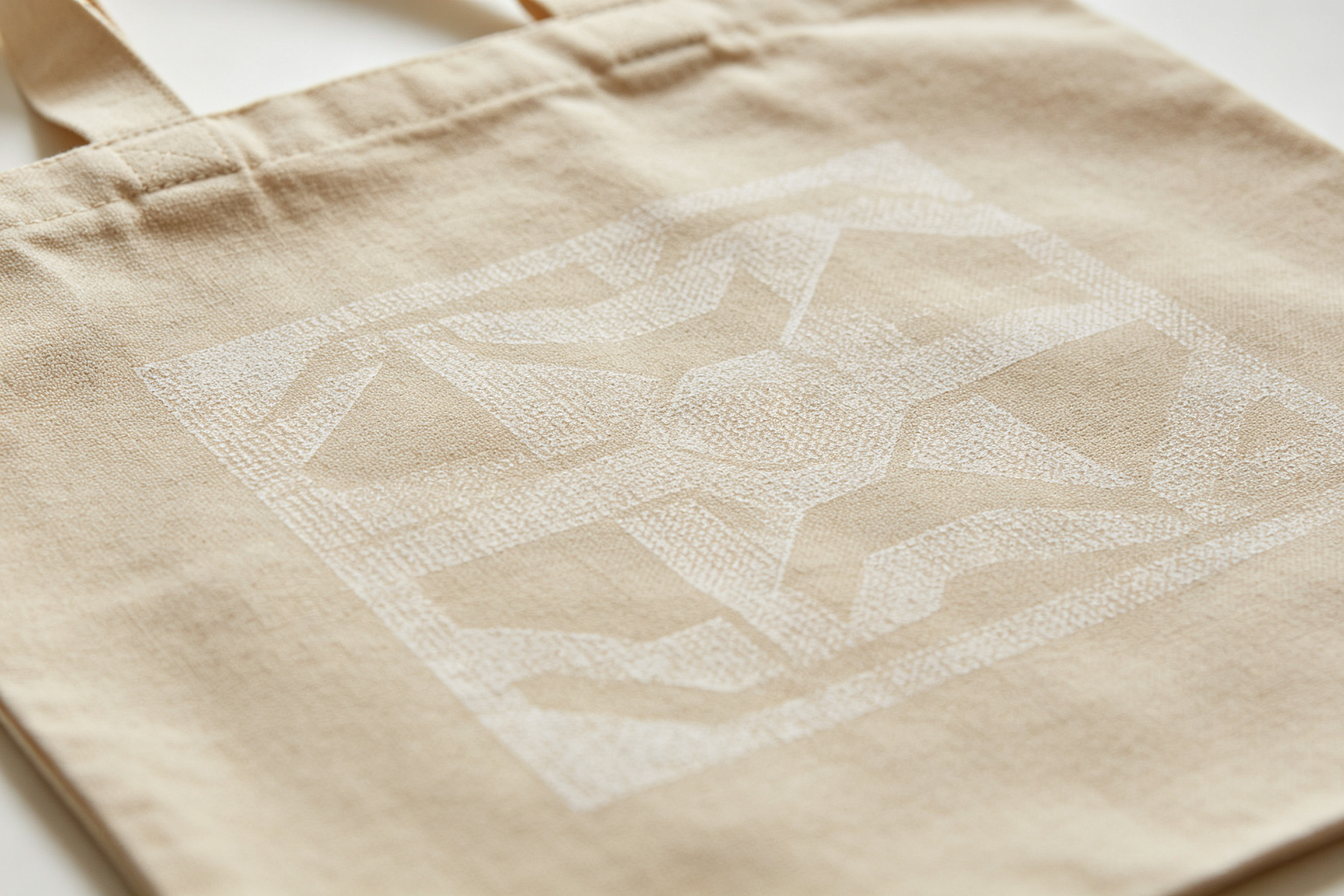
Screen print detail: 1-color water-based ink printed on 8oz canvas — matte, opaque, and wash-durable (3 wash cycles, no fading or cracking). Print plates re-registered after the Day 5 alignment drift, with checks every 100 prints thereafter.
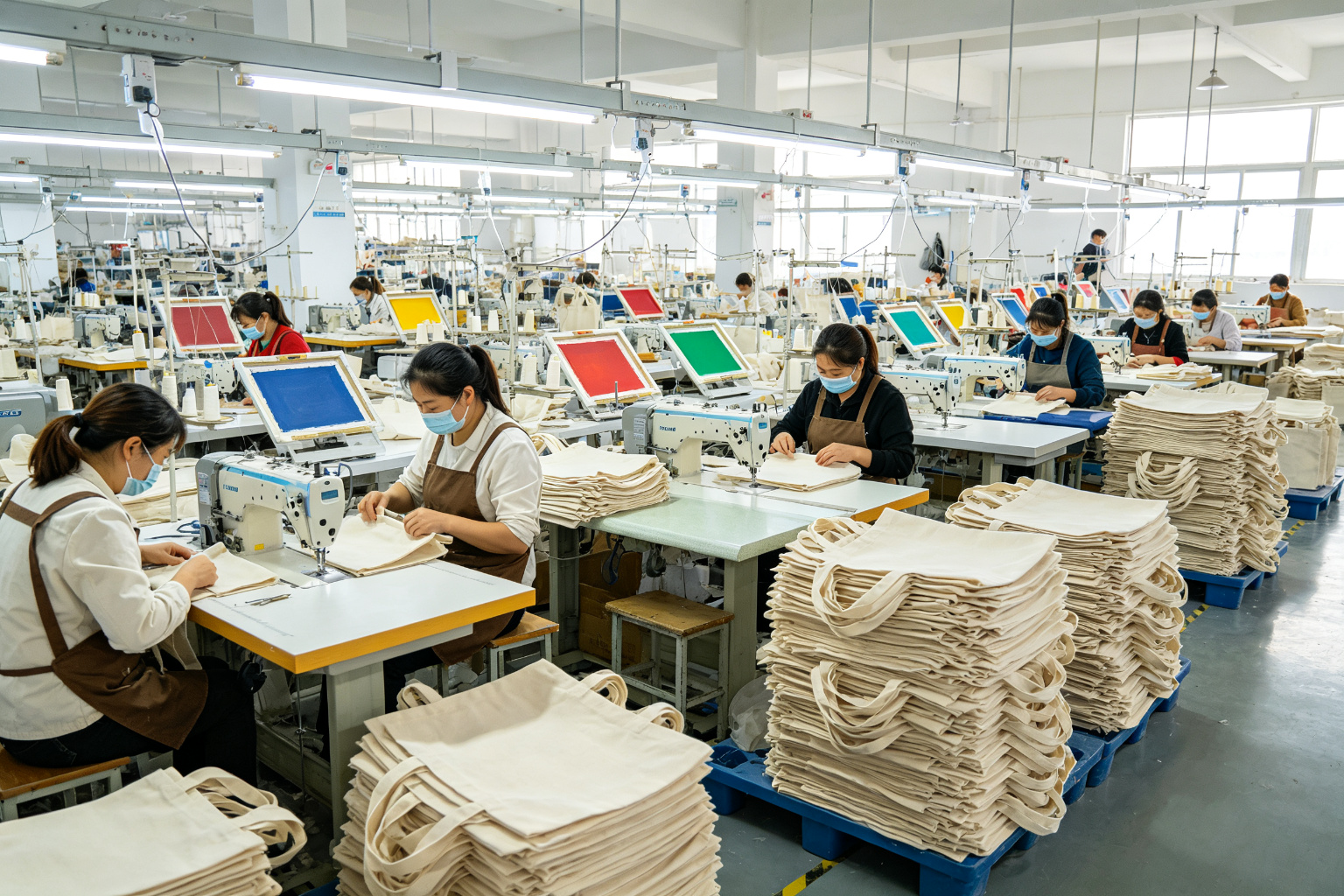
Our fast-paced tote line during the rush order: 2 screen print lines and overtime sewing shifts producing 1,200-1,400 bags per day. All 8,000 bags completed by Day 12, ahead of schedule.
Frequently Asked Questions
What is the fastest realistic turnaround for a custom tote bag order?
Direct Answer: Standard custom tote turnaround is 30-45 days; a rush run hits 15-20 days if fabric is on hand and lines run parallel, at a 10-20% surcharge. This 8,000-piece order delivered in 18 days using stock canvas, two parallel print lines, overtime, and air freight.
- Standard: 30-45 days
- Rush: 15-20 days
- Rush Surcharge: 10-20%
- This Order: 18 days, ~12% premium
For a standard custom tote bag order, plan on 30-45 days from sample approval to FOB shipment. For an express (rush) order, 15-20 days is achievable if the factory has fabric on hand and can run parallel production lines — but expect a rush surcharge of 10-20% to cover overtime labor and priority scheduling. In this case study, we delivered an 8,000-piece order in 18 days (vs. the standard 35) by: using in-stock 8oz canvas (fabric sourcing eliminated), running 2 screen print lines in parallel, adding overtime shifts on sewing, and shipping by air freight (5-7 days door-to-door instead of 30-40 by sea). The rush premium was about 12% over standard pricing — worth it for the client, because their corporate event date couldn't move. If you have a hard event date, tell the factory upfront: 'I need delivery by [date]' — a good factory will tell you honestly if it's achievable and quote the rush premium before you commit, rather than promising and missing.
Why did this 8,000-piece tote bag order cost $2.80 per unit?
Direct Answer: This 8,000-piece 8oz canvas tote landed at $2.80 FOB per unit — within the normal $1.80-$3.50 band at 5,000+ pieces. Air freight added about $1.30 per unit, bringing landed cost to ~$4.10, still under the client's $40,000 program budget.
- FOB Unit: $2.80
- Normal Band: $1.80-$3.50
- Air Freight Add-on: ~$1.30 / unit
- Landed Cost: ~$4.10 / unit
A standard 8oz canvas tote bag (single color print, no lining) typically costs $1.80-$3.50 FOB per unit at 5,000+ pieces. This order came to $2.80 per unit, which breaks down as: fabric (8oz cotton canvas, $0.85 — 8oz is 13% heavier than 7oz, costing about $0.10 more per bag), sewing labor ($0.75 — canvas is stiff, so stitching takes longer than polyester), screen printing ($0.45 for 1-color), handles ($0.25 — 5cm wide cotton webbing), packaging and overhead ($0.35), and rush premium of 12% ($0.15) for overtime and priority scheduling. Air freight is not included in the FOB price — the client paid about $1.30 per unit extra for air freight (8,000 bags at 8oz each weigh about 8.8 tons total; air freight cost roughly $10,400, about $1.30 per bag), bringing the landed cost to about $4.10 per unit. Even with air freight, the total order cost $32,800 — under the client's $40,000 budget for the corporate gift program.
When should you choose air freight vs ocean freight for a bag order?
Direct Answer: Choose air freight when the deadline is 2-6 weeks away and the load is too small to fill a container; choose ocean when you have 6-10 weeks. Air adds $1.00-$3.00 per bag; ocean adds $0.15-$0.50. This event-bound order paid the $8,500 gap to hit its date.
- Air Freight: 2-6 weeks, +$1.00-$3.00/unit
- Ocean Freight: 6-10 weeks, +$0.15-$0.50/unit
- Event Orders: Air usually justified
Choose air freight when the delivery deadline is 2-6 weeks away and the order is too small to fill a container efficiently; choose ocean freight when you have 6-10 weeks and the cost savings matter more. For this 8,000-piece order, ocean freight to the US would take 30-40 days and cost about $1,900 (LCL — less than container load), while air freight took 5-7 days and cost about $10,400. The client chose air freight because their corporate event was 18 days away — the $8,500 difference was worth it to hit the deadline (a missed event would have wasted the entire $32,800 order). A useful rule: air freight adds $1.00-$3.00 per unit for bag shipments (bags are light but bulky), and ocean freight adds $0.15-$0.50. If the landed cost target allows a $1-3 per unit premium, air freight is the safe choice for event-bound orders. If you have 6+ weeks and the order is large, ocean is almost always the right call.
What fabric weight is best for a tote bag — is 8oz canvas the right choice?
Direct Answer: 8oz (270gsm) cotton canvas is the best all-around tote fabric — sturdy enough for a laptop and groceries (~10-12kg load), prints cleanly, and affordable. 6-7oz drapes better for fashion; 10oz feels premium but costs 25% more in weight and shipping.
- Best All-Rounder: 8oz / 270gsm
- Load Capacity: ~10-12kg
- Fashion Drape: 6-7oz
- Premium: 10oz (+25% weight/cost)
For a durable everyday tote bag, 8oz (270gsm) 100% cotton canvas is the best all-around choice — it's sturdy enough to carry a laptop and groceries (weight capacity about 10-12kg), holds screen prints cleanly, and is affordable ($0.80-1.10 per bag for the fabric). Lighter options: 6oz canvas (soft, drapes well, but thin — saggy with heavy loads, weight capacity about 6-8kg) and 7oz canvas (a common 'standard' that's 13% lighter than 8oz — most people can't tell the difference visually but can feel it when the bag is full). Heavier options: 10oz canvas (very sturdy, feels premium, but 25% heavier and more expensive — shipping costs rise). In this case study, the client's marketing team wanted a bag that 'feels substantial' as a corporate gift — 8oz was the sweet spot. For a corporate gift that carries event materials, laptops, and swag, 8oz canvas is the professional choice. If you're making a fashion tote for retail sale, 6-7oz might be better for the drape.
What is a normal defect rate for a rush production run of tote bags?
Direct Answer: Rush runs run at 1.0-1.5% defects under AQL 2.5 — slightly higher than standard because overtime compresses checks. This 8,000-piece run hit 1.5% (120 pieces), all replaced before shipment, within the AQL acceptance number of 21 in a 315-piece sample.
- Rush Defect Range: 1.0-1.5%
- Actual Rate: 1.5% (120/8,000)
- AQL Accept Number: 21 majors / 315 sample
- Outcome: All replaced, 0% shipped
For a rush (express) production run, a defect rate of 1.0-1.5% under AQL 2.5 inspection is normal and acceptable — slightly higher than a standard run (0.5-1.0%) because overtime shifts and compressed timelines increase the chance of minor errors. The most common tote bag defects are: (1) screen print defects (0.3-0.6%) including misalignment, ink bleeding, and opacity issues; (2) stitching defects (0.3-0.5%) including skipped stitches and uneven seams; (3) handle defects (0.2-0.3%) including weak attachment and uneven length; (4) fabric defects (0.1-0.2%) including weave irregularities and stains. In this case study, the final defect rate was 1.5% — 120 pieces out of 8,000 inspected, all within the AQL 2.5 allowance (for 8,000 pieces, the AQL 2.5 acceptance number is 21 major defects in a 315-piece sample). All defective pieces were pulled and replaced before shipment, resulting in a 0% defect rate for shipped goods. For a rush order, accept that the defect rate will be at the top of the normal range, and insist on a clear replacement policy before production starts.