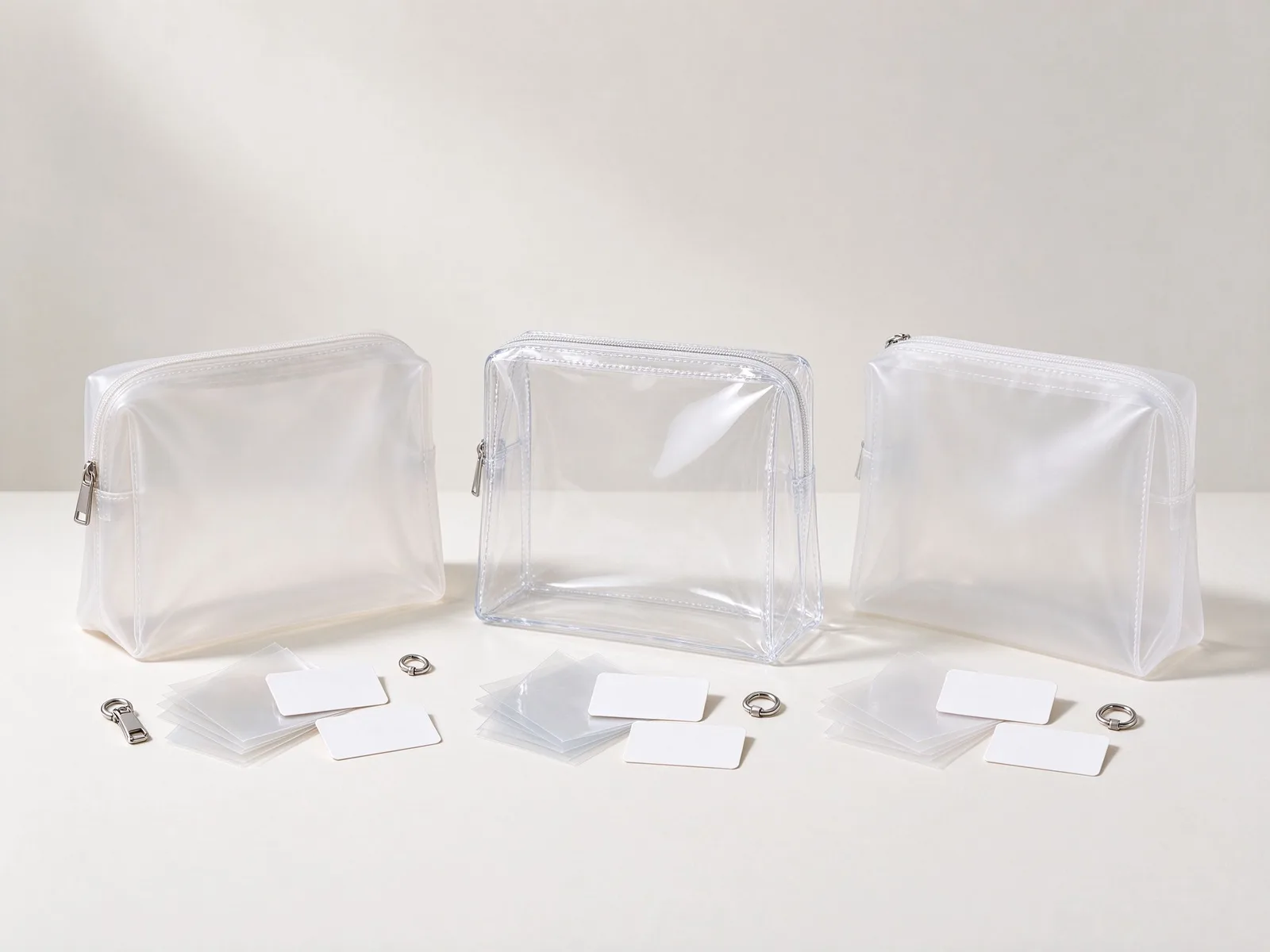
Three clear plastics dominate transparent cosmetic bags: TPU (thermoplastic polyurethane), PVC (polyvinyl chloride), and EVA (ethylene-vinyl acetate). To a buyer reading product listings they look nearly identical — glossy, transparent, and water-resistant. On the factory floor they behave very differently: different raw-material costs, different odour and plasticiser profiles, different weld behaviour, different cold-weather flex, and different compliance exposure in the EU and US. Choosing between them is not a styling decision; it is a sourcing decision that sets your unit price, your target-market compliance risk, and how your product behaves after months of retail shelf life.
This guide is written for B2B buyers — brand owners, importers, and merchandisers — who need to specify a clear cosmetic or travel pouch and want to understand what actually separates these three materials before they ask a factory for samples. It does not repeat the full manufacturing workflow (see our custom cosmetic bag manufacturing guide for the complete process). Instead it goes deeper on the one decision that drives most of your cost, compliance, and quality risk: which clear material to build around.
Quick Answer
For most premium and EU/US retail programs, clear TPU is the safer default: soft hand feel, low odour, broad REACH/FDA acceptance, and no phthalate concern when the formulation is verified. Clear PVC is the value option — cheaper and very clear, but it needs a phthalate-free formulation and odour checks, and it is the material most likely to raise restricted-substance questions in the EU. EVA is the softest and most flexible, often used where a matte or softer touch is wanted, but surface scratch resistance and creasing need sample review. No single material is universally "best" — the right choice depends on your brand tier, target market, price point, and packaging.
Why the Clear Material Choice Matters More Than You Think
Transparent cosmetic bags are a high-volume, low-differentiation category. The material you choose shows up in three places that directly affect your P&L:
- Unit cost and margin — raw film price and weld efficiency differ materially between the three polymers. At 500 MOQ the film-grade choice can swing unit cost by $0.50–$1.20, which matters when your retail price is fixed by the channel.
- Compliance exposure — the EU restricts certain phthalates in plasticised materials under REACH, and food-contact rules apply if the pouch ever touches food or is sold with a food-safety claim. PVC, because it is plasticised, gets the most scrutiny; TPU and EVA carry different, usually lighter, documentation needs.
- Customer experience and returns — odour, creasing, cracking in the cold, and yellowing over time are the reasons clear pouches get returned. These are material properties, not workmanship defects, and no amount of QC fixes a material that was wrong for your market.
From our factory in Dongguan, we have produced clear TPU, PVC, and EVA cosmetic pouches for beauty and lifestyle brands across the US, EU, and Australia. The most expensive mistake we see is not picking a "bad" material — it is a brand approving a sample in warm factory conditions, then shipping a pouch that cracks in a Northern-European winter or reeks of plasticiser when the consumer opens the box. This guide is built to prevent that by separating what is marketing, what is chemistry, and what you can verify on a sample.
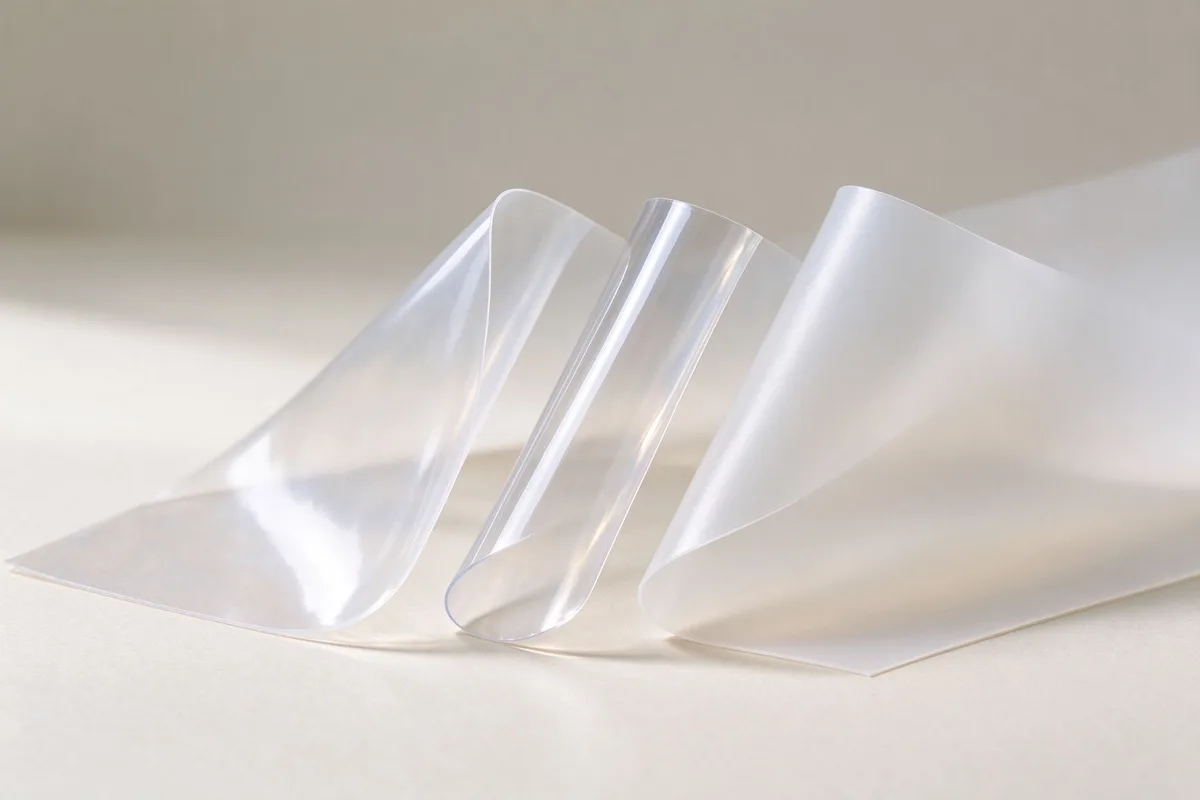
Three clear films side by side: flexible TPU, stiff glossy PVC, and softer matte EVA.
TPU is a thermoplastic polyurethane. It is the fastest-growing clear material in premium beauty packaging because it combines high transparency with softness, low odour, and strong flex fatigue resistance. Unlike PVC, TPU is not plasticised to achieve flexibility — its flexibility comes from its polymer backbone, which removes the phthalate question that follows flexible PVC in the EU. It is also more resistant to oils and abrasion, which matters for a bag that holds lotions and makeup.
From a sourcing standpoint, clear TPU means higher film cost and, typically, a slightly higher sample cost. In exchange you get a material that holds its clarity, resists creasing better than thin PVC, and has a more premium hand feel. For EU retailers and clean-beauty brands it is the lower-risk conversation to have.
| Property (indicative) | Clear TPU | Clear PVC | Clear EVA |
|---|---|---|---|
| Flexibility source | Polymer backbone (no plasticiser) | Plasticiser added to PVC resin | Polymer backbone (VA content) |
| Typical film gauge (pouches) | 0.30–0.50 mm | 0.20–0.40 mm | 0.30–0.60 mm |
| Transparency | High | High | Medium–high |
| Hand feel | Soft, premium | Firm, slightly plasticky | Softest, slightly rubbery |
| Odour control | Low odour when formulation controlled | Check plasticiser odour | Generally low, grade dependent |
| Cold-weather flex | Strong | Can stiffen / crack | Good |
| Relative film cost | Highest | Lowest | Middle |
| EU restricted-substance exposure | Lower (verify formulation) | Higher (plasticiser scrutiny) | Lower (verify additives) |
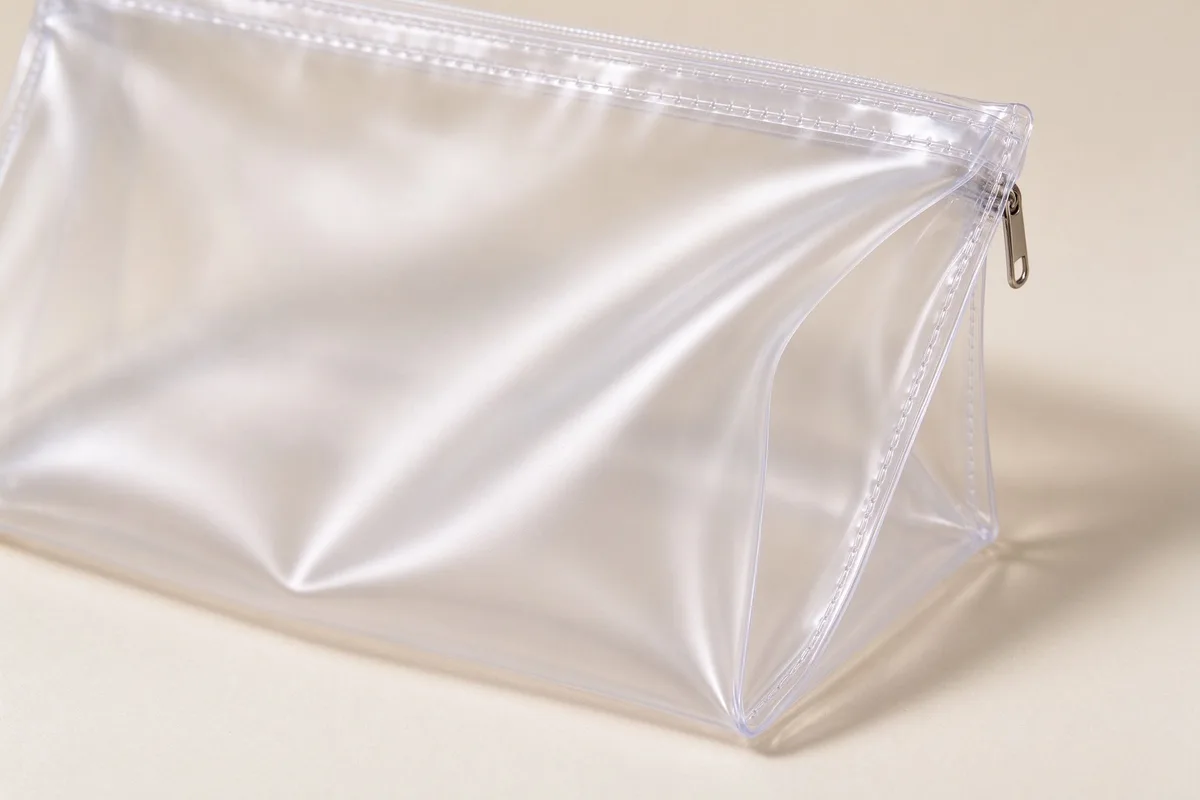
A clear TPU pouch folds without white crease marks — the reason it is the default for premium retail programs.
clear TPU cosmetic bag, the two specifications that matter most are gauge and formulation. Gauge below 0.30 mm feels flimsy and develops creases after repeated use; most factories default to 0.25 mm to save cost. Specify a minimum gauge in your tech pack and verify it with a micrometer on the approved sample. On formulation, request the restricted-substance report for the exact grade you will use in production — not a generic "TPU is compliant" statement, because compliance is formulation- and use-specific.Material 2: Clear PVC — The Value Option With the Most Scrutiny
PVC is the classic clear plastic. It is cheap, very clear, easy to heat-seal with radio-frequency welding, and widely used for promotional and budget cosmetic pouches. The catch is that rigid PVC is stiff, so flexible PVC film is made by adding plasticisers. Those plasticisers are exactly what EU regulators restrict in certain articles, which is why flexible PVC draws more documentation requests than TPU or EVA.
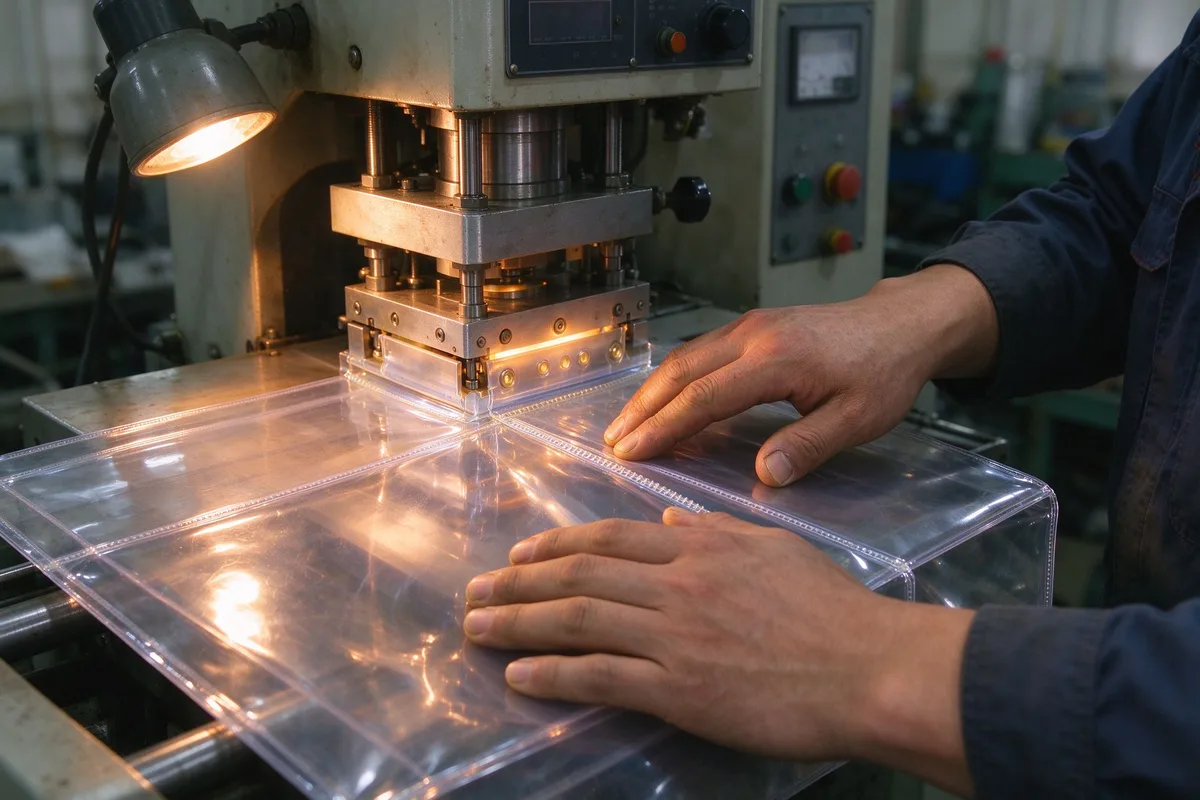
Radio-frequency welding fuses the clear film from within, giving PVC its fast, low-cost heat-sealed edges.
ach/restrictions_en" target="_blank" rel="noopener nofollow">REACH regulation, restrictions on certain phthalates in plasticised materials apply to specific article categories and concentration thresholds; the list of restricted and candidate substances is maintained by the European Chemicals Agency (ECHA) and updated over time. The practical consequence for a bag buyer is that flexible PVC needs a current supplier declaration and, where your buyer or risk assessment requires it, a laboratory report confirming the specific grade is free of the relevant restricted substances above the applicable limits. This is not a reason to avoid PVC outright — it is a reason to budget for the documentation and to verify it before production rather than discovering a gap at customs or a retailer compliance review.Buyer Note
A material is not automatically compliant because it is called PVC, TPU, EVA, or "eco." Compliance depends on the actual formulation, the supplier documentation, the use case, and the destination market. Always request current declarations and, when required, a laboratory report for the relevant restricted substances per component. Confirm obligations with your EU importer or compliance adviser.
For a budget-conscious program, clear PVC can still be the right call — but only with a verified phthalate-free formulation, an odour check, and a realistic look at cold-weather performance. If your pouches ship into the EU or to a clean-beauty retailer, expect the conversation to be heavier than with TPU. A clear PVC/TPU pouch built to a tight spec can serve both value and mid-tier programs when the documentation is in place.
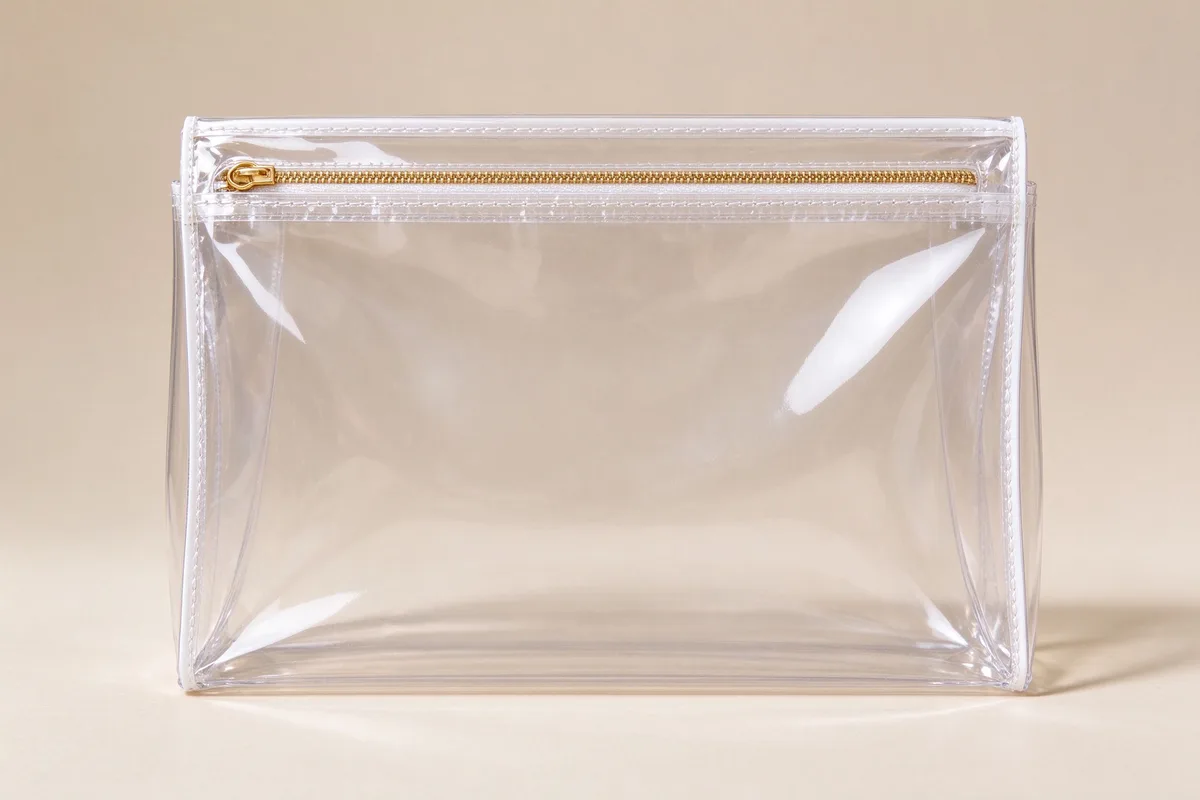
Glossy clear PVC reads as high clarity on shelf, but it creases, scratches, and needs phthalate screening for the EU.
EVA is an ethylene-vinyl acetate copolymer. Its flexibility comes from the vinyl-acetate content in the polymer chain rather than from plasticisers, which keeps it in a lighter compliance lane than plasticised PVC. EVA film is soft, lightweight, and flexible, with a slightly rubbery feel that some brands prefer for a more casual, less "hard plastic" aesthetic. It is often used for mesh-topped pouches, soft travel organisers, and lay-flat wash bags where a rigid clear shell is not wanted.
The trade-offs are transparency, which is usually a step below TPU and PVC, and surface durability — EVA can scratch and show creases more readily than TPU, and performance is grade dependent. The vinyl-acetate content and additive package influence softness, odour, and weld behaviour, so a sample review is essential before you commit. For a mesh-and-clear travel wash bag or a soft lay-flat pouch, EVA can be an excellent fit when clarity and scratch resistance are not the top priority.
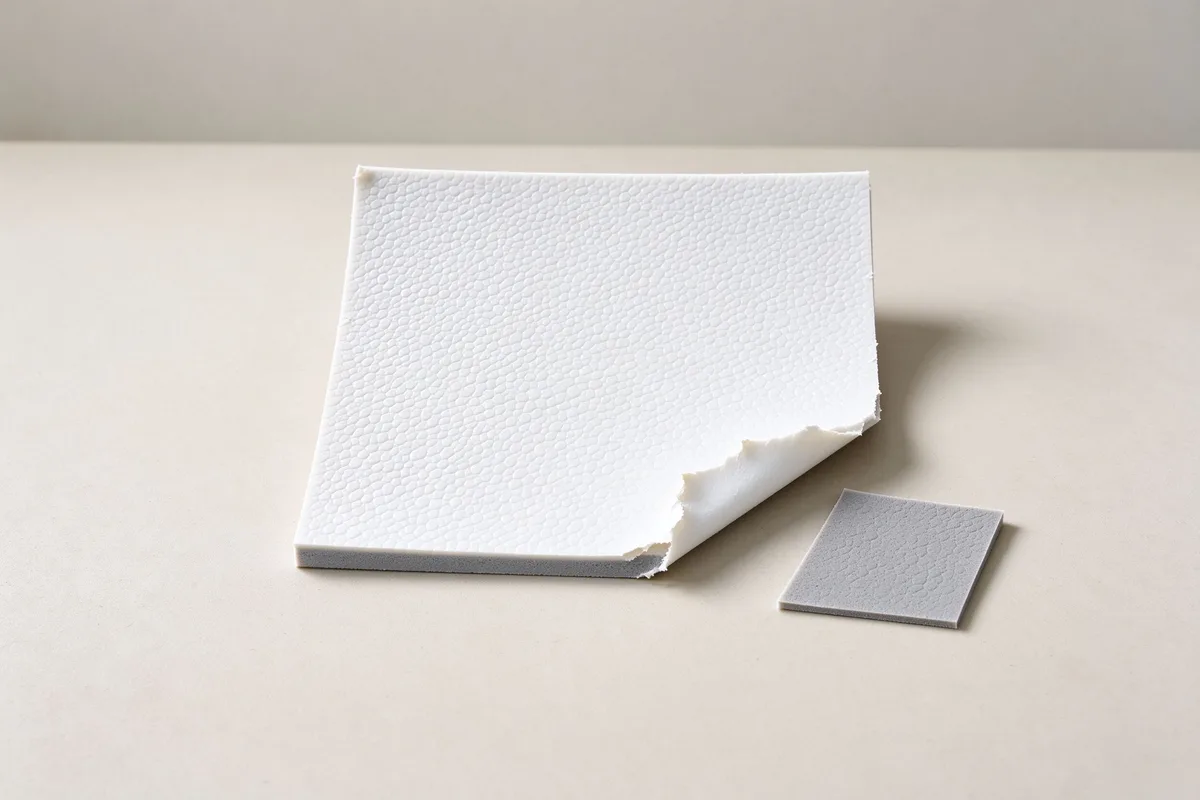
Soft EVA adds cushioning for bottles, at the cost of the crystal-clear transparency TPU and PVC give you.
The compliance picture for clear cosmetic bags is often overstated by marketing. Here is what a buyer actually needs, separated by market.
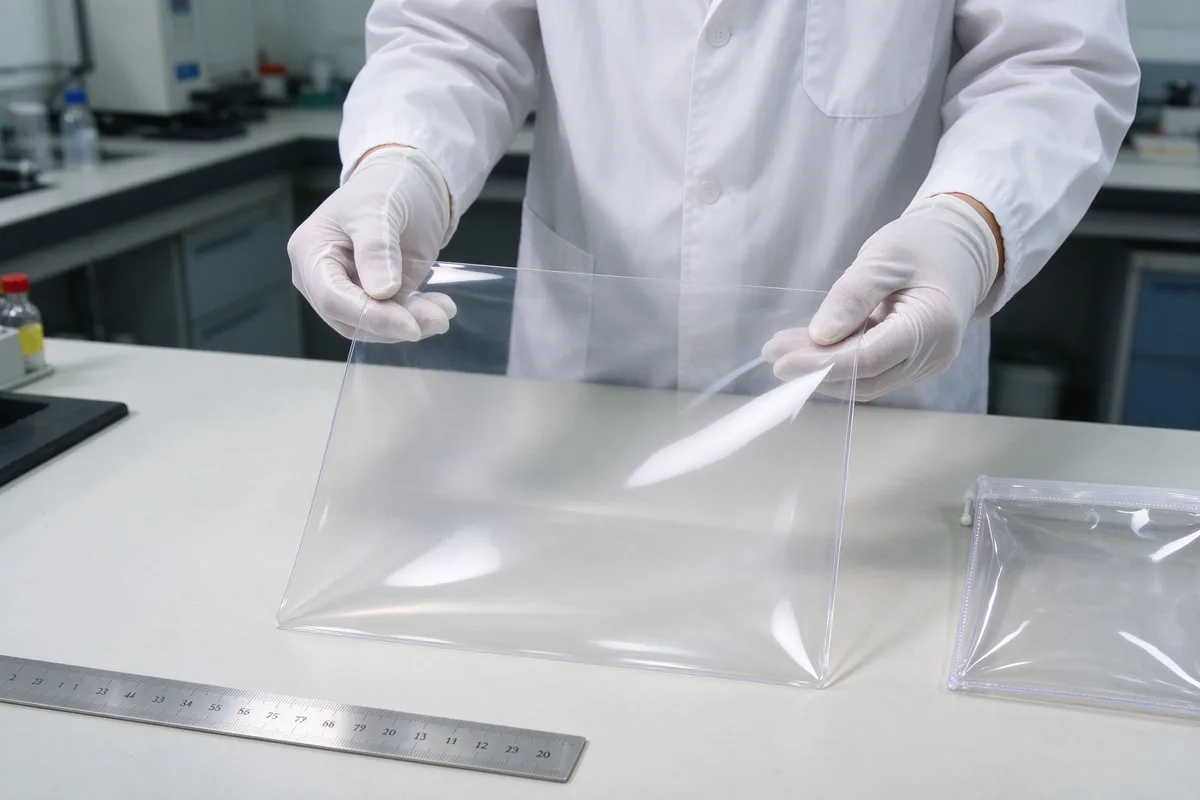
Clear film samples inspected under a light table as part of the material compliance check.
REACH (EC 1907/2006) is the EU's chemical regulation. For bags, buyers typically screen for restricted phthalates in flexible PVC and some coated materials, plus substances on the current REACH Candidate List. The relevant restriction on certain phthalates in plasticised articles, and the list of candidate substances of very high concern, are published by ECHA and amended over time. Request current supplier declarations and, when required, a laboratory report for the relevant restricted substances for each material or component. Test scope, price, and validity vary by laboratory and material; treat a report as evidence for a specific batch and formulation, not a permanent certificate.
Food contact (if it applies)
If your pouch is used to hold food, or you make any food-safety claim, the EU's framework for plastic materials in contact with food — Commission Regulation (EU) No 10/2011 — sets migration limits for substances that may transfer from the plastic into food, expressed in mg of substance per kg of food. In the US, the FDA regulates food-contact substances through the relevant sections of 21 CFR, including indirect food-additive provisions for polymers and plasticisers. Whether these rules apply depends on your exact use, your claim, and the pouch's role. If food contact is in scope, verify the grade's food-contact documentation — do not assume a "food-safe" label alone is sufficient.
US market: TSA 3-1-1 travel claims
The TSA 3-1-1 rule governs how travellers pack carry-on liquids: containers of 3.4 oz (100 ml) or less, all placed in one quart-sized clear bag per person. This is a traveller packing rule, not a product certification. A clear pouch can be designed to fit that rule and help screening, but no factory certifies a bag as "TSA approved." Use wording like "clear travel pouch designed for easier airport screening" and note that final screening decisions are made by airport security. This distinction protects you from an unverifiable claim.
How to Verify the Material on a Sample
You cannot tell TPU, PVC, and EVA apart from a photo. You can tell them apart on a sample, in about five minutes, with a small checklist:
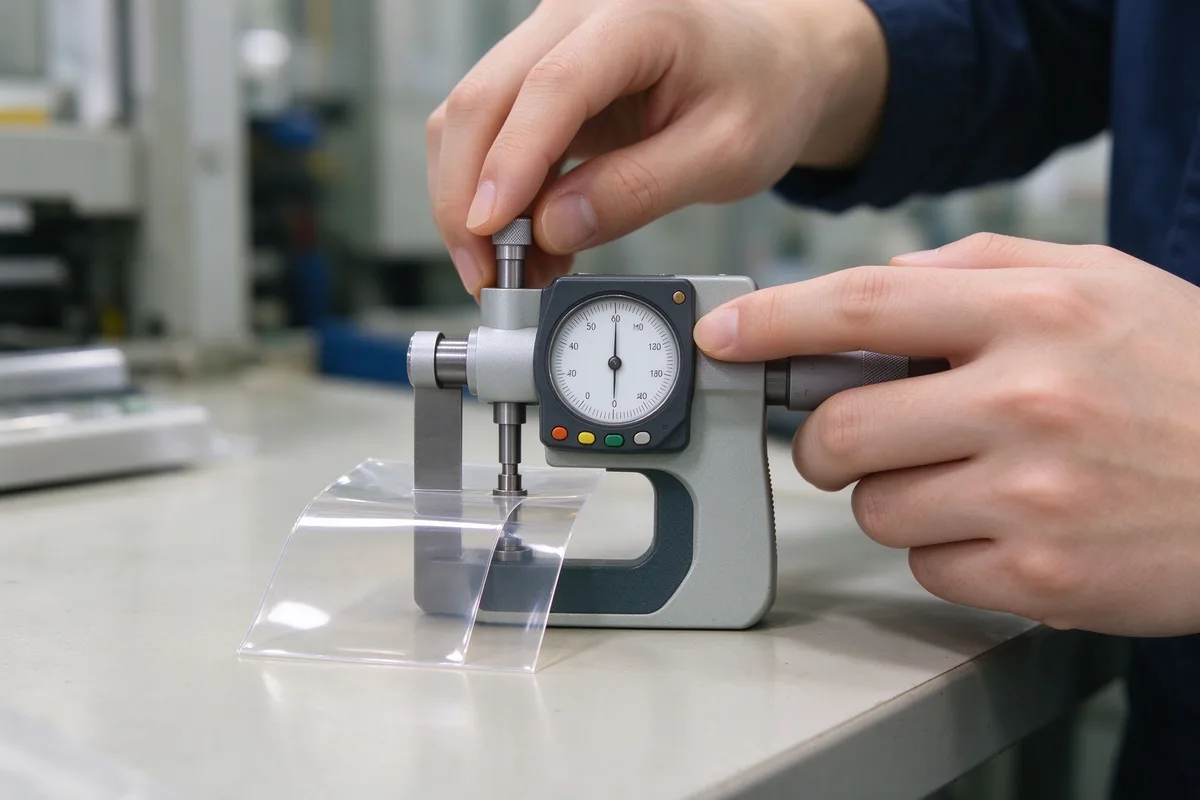
A micrometer checks the film gauge at the body and the seam — 0.25 mm PVC vs. the softer TPU grades differ in feel and price.
- Measure the gauge. Use a micrometer on the body and the seam. Confirm it matches the tech pack. 0.25 mm PVC vs 0.40 mm TPU is a real difference you should know before approving.
- Flex test. Fold the pouch open and closed 20–30 times. Watch for white crease marks, cracking, or separation at the weld. Repeat after chilling the sample in a fridge for an hour to simulate cold-weather use.
- Odour test. Open the sample in a sealed bag for 24 hours, then smell it. A strong chemical odour points to formulation issues that will trigger consumer complaints and returns.
- Transparency check. Hold it against a printed label. Clarity differences between grades show up quickly at arm's length.
- Weld inspection. Pull gently on the RF-welded seams. The bond should hold without a visible weak line; on production we cut open random bags and run a peel test on each seam to confirm bond strength.
- Request the report. Ask the factory for the restricted-substance report covering the exact production grade, plus the odour and any requested physical tests. If they cannot name the grade and the test, treat the claim as unverified.
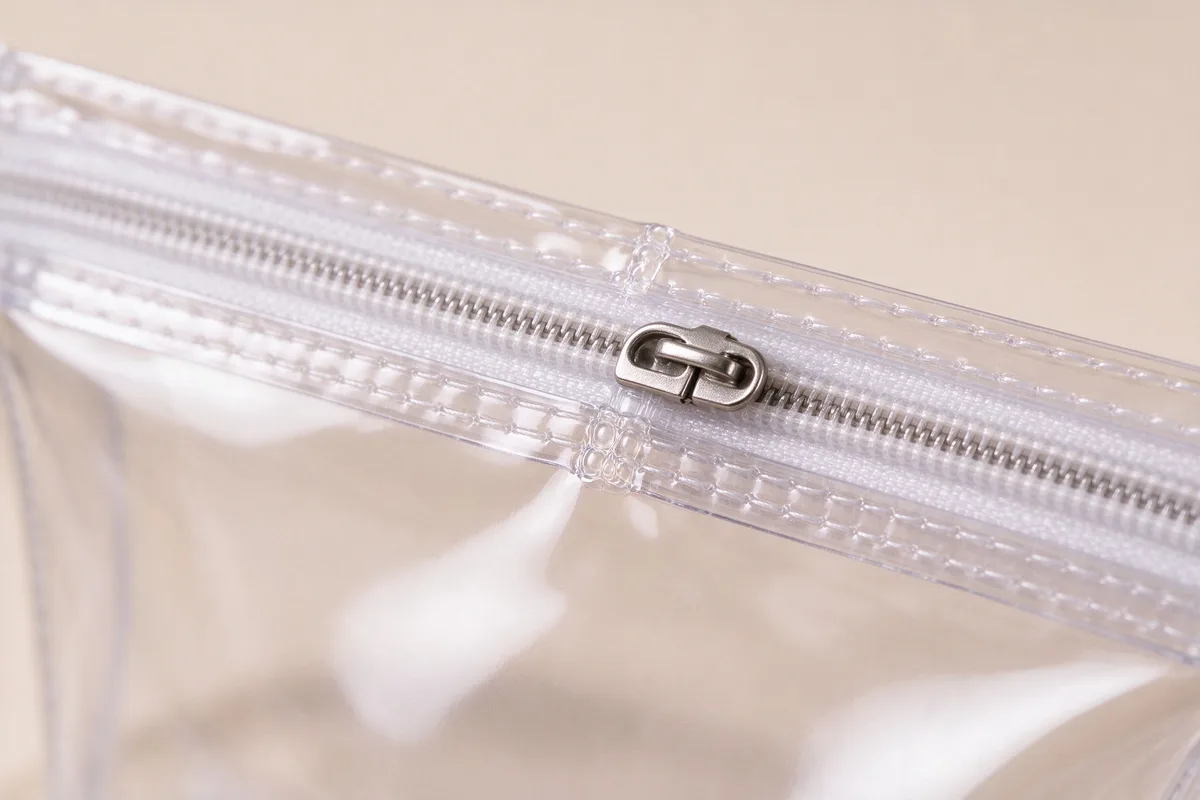
The zipper tape and the heat-sealed weld bead — two points a buyer checks before approving a production run.
Use this as a starting decision matrix — your factory can confirm the specifics for your design and quantity:
| Your program | Recommended material | Why |
|---|---|---|
| Premium beauty brand, EU/US retail | Clear TPU | Soft hand feel, low odour, lighter compliance conversation |
| Value / promotional pouch, warm climate | Clear PVC | Lowest cost; verify phthalate-free formulation and odour |
| Soft lay-flat organizer, casual brand | Clear EVA | Softest feel; confirm clarity, scratch, and crease behaviour |
| Travel / TSA-style clear pouch | Clear TPU | Best balance of clarity, flex, and durability for repeated travel |
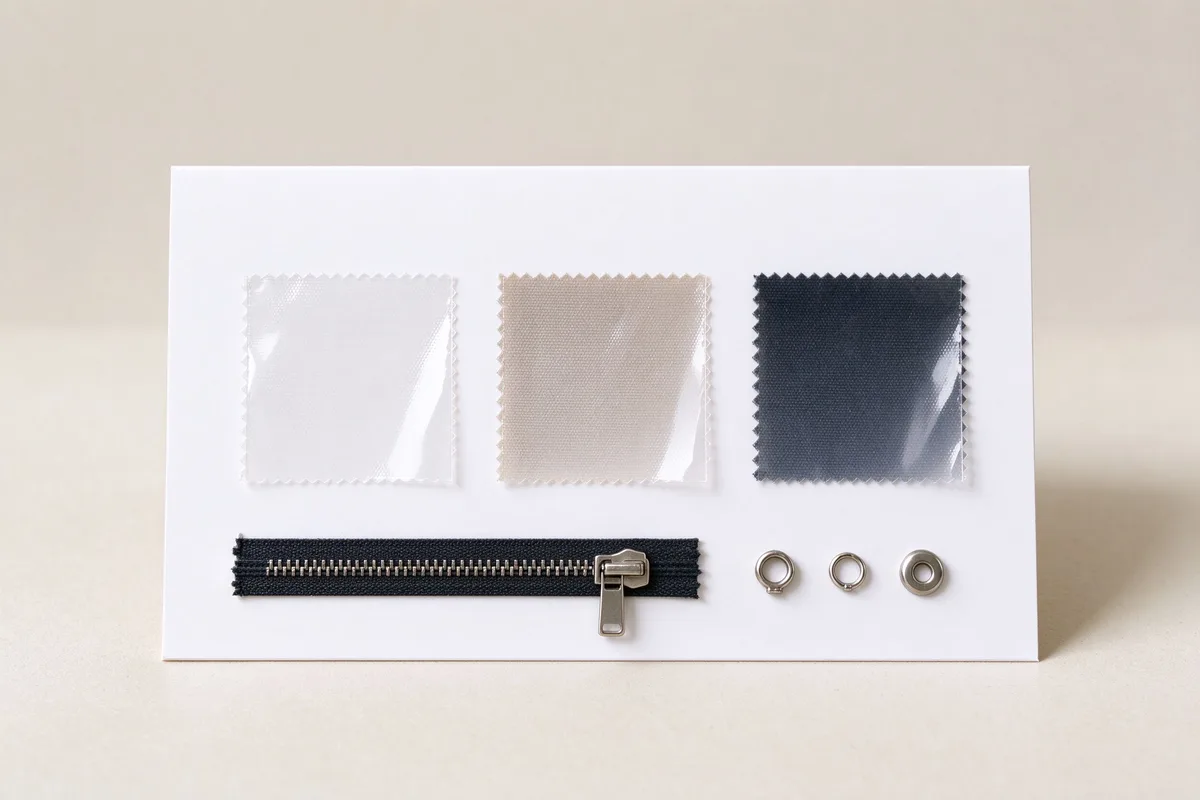
A typical sourcing sample kit — film swatches, a zipper, and hardware — is the fastest way to judge material against your tech pack.
the tech pack before you request quotes. For a complete field-by-field spec, see our tech pack guide. And for the full clear-bag category, browse custom cosmetic bag options — every order is made to your approved spec, with no off-the-shelf stock, quoted FOB Shenzhen at a planning MOQ of 500 pieces.Ready to Source Clear Cosmetic Bags?
Get a factory-direct quote within 8 hours. 500 MOQ, free material swatches, and 7-day custom samples. We specialize in clear TPU, PVC and EVA pouches, plus vegan leather, RPET and hanging toiletry organizers.
Request a Free QuoteOr explore our full cosmetic bag catalog
Frequently Asked Questions
Which clear material is best for a cosmetic bag — TPU, PVC, or EVA?
Direct Answer: For most premium and EU/US programs, clear TPU is the safer default — soft hand feel, low odour, and a lighter restricted-substance conversation. Clear PVC is the value option but needs a phthalate-free formulation and odour checks; EVA is the softest choice, with clarity and scratch performance to confirm on a sample.
- Premium default: Clear TPU
- Value option: Clear PVC (check plasticiser + odour)
- Softest choice: Clear EVA (confirm clarity)
For most premium beauty and EU/US retail programs, clear TPU is the safer default: it combines high transparency with softness, low odour, and strong flex resistance, and its flexibility comes from the polymer backbone rather than added plasticisers. Clear PVC is the lowest-cost option but is plasticised, so it needs a verified phthalate-free formulation and an odour check. Clear EVA is the softest and most flexible, with performance depending on grade — confirm clarity, scratch resistance, and crease behaviour on a sample. No material guarantees a specific airport or compliance outcome; verify the actual grade.
Is PVC safe for cosmetic bags sold in the EU?
Direct Answer: Flexible PVC is not banned, but it draws the most restricted-substance scrutiny in the EU because it is plasticised. Request a current supplier declaration and, where required, a laboratory report confirming the specific grade is free of relevant restricted substances above the applicable limits. Compliance is formulation- and use-specific.
- Not banned: PVC remains usable in the EU
- Key ask: Restricted-substance report for the grade
- Heavier scrutiny: Flexible PVC vs TPU/EVA
Flexible PVC is not banned in the EU, but it is the material most likely to raise restricted-substance questions because plasticisers are added to make it flexible. Under REACH, restrictions and candidate lists are maintained by the European Chemicals Agency and amended over time. Request a current supplier declaration and, where your buyer or risk assessment requires it, a laboratory report confirming the specific production grade is free of relevant restricted substances above the applicable limits. Compliance depends on the formulation and use case — confirm obligations with your EU importer or compliance adviser.
What does "TSA-compliant" mean for a clear cosmetic bag?
Direct Answer: The TSA 3-1-1 rule is a traveller packing rule, not a product certification. A clear pouch can be designed to support it, but no factory certifies a bag as "TSA approved." Use wording like "clear travel pouch designed for easier airport screening" and note that final decisions are made by airport security.
- It is a rule, not a cert: 3-1-1 packing guidance
- Safe wording: "designed for easier airport screening"
- Avoid: "TSA approved" claims without a basis
The TSA 3-1-1 rule limits carry-on liquids to containers of 3.4 oz (100 ml) or less, all placed in one quart-sized clear bag per person. This is a traveller packing rule, not a product certification. A clear pouch can be designed to support easier screening, but no factory certifies a bag as "TSA approved." Use wording such as "clear travel pouch designed for easier airport screening," and note that final screening decisions are made by airport security.
How much does the clear material choice affect the price?
Direct Answer: At 500 MOQ the film-grade choice can swing unit cost by roughly $0.50–$1.20 FOB Shenzhen. Clear PVC is the cheapest film; clear TPU is the most expensive; EVA sits in between. The spread is small per unit but material at retail margin.
- Indicative spread: ~$0.50–$1.20 / unit
- Cheapest film: Clear PVC
- Most expensive: Clear TPU
At a planning MOQ of 500 pieces, the clear-material choice can swing unit cost by roughly $0.50–$1.20 FOB Shenzhen. Clear PVC is the lowest-cost film; clear TPU is the most expensive; EVA sits in between. The per-unit spread looks small, but it compounds at retail margin and is easy to give back if the cheaper material triggers a compliance review, odour complaints, or cold-weather returns. For an order-specific quote, send your spec to our team — we quote FOB Shenzhen with no hidden mould or plate fees disclosed up front.
Can I order a custom clear cosmetic bag with my logo?
Direct Answer: Yes. Clear TPU/PVC/EVA pouches accept silk-screen and pad printing for logos; specify the logo method and Pantone colour in the tech pack. Standard MOQ is 500 per colour/style; existing welding moulds can sometimes start at 300. Samples ship in 7 days.
- Logo methods: Silk-screen, pad printing
- Standard MOQ: 500 pcs / colour / style
- Sample time: ~7 days
Yes. Clear TPU/PVC/EVA pouches accept silk-screen and pad printing for logos; the method and Pantone colour are specified in the tech pack. The standard MOQ is 500 pieces per colour and style, and clear pouches on existing welding moulds can sometimes start at 300 pieces. Custom-shaped pouches require 500 pieces to justify the mould cost. Samples typically ship in about 7 days and are refundable on larger orders.