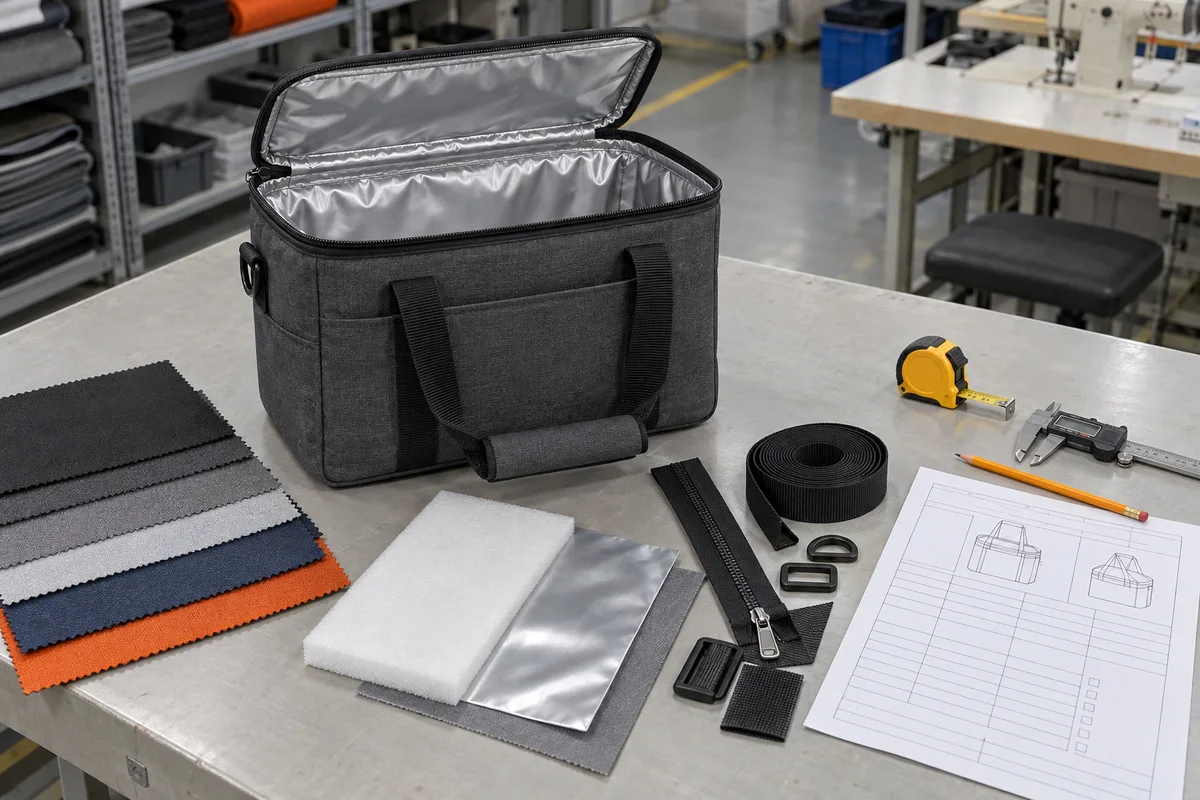
A request such as “Please quote 1,000 custom cooler bags in 600D Oxford” sounds specific, but it still leaves most of the cost and performance decisions to the supplier. The factory does not know the finished capacity, coating, foam type, foam thickness, liner construction, zipper grade, leak-resistance target, logo process, packaging or test conditions. One supplier may assume a basic promotional build; another may price a reusable retail build. Their unit prices cannot be compared because they are not quoting the same product.
The purpose of an RFQ—request for quotation—is to create one controlled brief that every shortlisted factory answers against. It does not need to be a 30-page engineering document. It does need to state the decisions that change material consumption, labor, tooling, compliance and risk. If your product is still early in development, mark uncertain fields as “factory recommendation required” instead of leaving them invisible.
Quick answer: what should a cooler bag RFQ include?
Define 12 items before asking for a firm quote: intended use, finished size and capacity, outer fabric, insulation system, inner liner, seam and closure construction, compartments and load points, branding, quantity and color split, target-market documentation, quality tests, and packaging plus delivery terms. Attach a dimensioned drawing or reference sample, then ask every supplier to list assumptions and exclusions separately.
Why vague cooler bag RFQs produce misleading prices
Cooler bags are layered functional products. Two samples can look almost identical in a catalog image while using different foam thicknesses, liner grades and seam methods. Those hidden choices determine cold retention, leakage risk, odor, structure and production cost. A quotation is therefore only useful when the specification behind it is visible.
| Vague request | Quotable requirement | Why the difference matters |
|---|---|---|
| “600D cooler bag” | 600D polyester Oxford, black stock color, PU backing; supplier to state finished fabric weight | Denier does not define coating, backing, weight or water resistance. |
| “Keeps food cold for six hours” | Target six-hour temperature curve under an agreed ambient temperature, payload, ice-pack charge and opening schedule | Hold-time claims are meaningless when test conditions differ. |
| “Food-safe lining” | PEVA liner of agreed thickness; documentation required for the stated destination market and intended contact conditions | Material names do not automatically prove compliance for every market or use. |
| “Leakproof” | Sewn-and-taped or welded liner; pass criterion and test duration stated in writing | A water-resistant shell does not make the assembled bag leakproof. |
| “1,000 pieces with logo” | 1,000 pieces total, 500 per stock color; one-color screen print, 120 × 80 mm, Pantone reference provided | Color splits and artwork method can change MOQ, setup and unit price. |
The 12-point custom cooler bag RFQ checklist
Intended use
State whether the bag is for lunch, grocery delivery, picnics, outdoor retail, medical transport or a promotional campaign.
Size and capacity
Provide finished dimensions, liters or a real payload such as six 330 ml cans plus two ice packs.
Outer shell
Name the fabric, denier or weight, coating, color source and required surface performance.
Insulation
State foam family, target thickness, structure and the performance test it must support.
Inner liner
Define PEVA, foil, TPU or another liner, including thickness, joining method and documentation needs.
Seams and closure
Choose sewn, taped or welded construction and specify the zipper or roll-top closure expectation.
Structure and load
List pockets, dividers, base support, handles, shoulder straps and the intended carrying weight.
Branding
Provide artwork, dimensions, Pantone colors, placement and preferred print, embroidery or label method.
Quantity and colors
State total quantity and the exact split by style, size and color—not only the overall order total.
Market and documents
Name the destination, sales channel, intended use and any current declarations or tests your importer requires.
Quality plan
Write measurable pass criteria for dimensions, thermal performance, leakage, straps, zippers and appearance.
Packaging and delivery
Define packing method, carton marks, Incoterm, destination port and the required ship—not arrival—date.
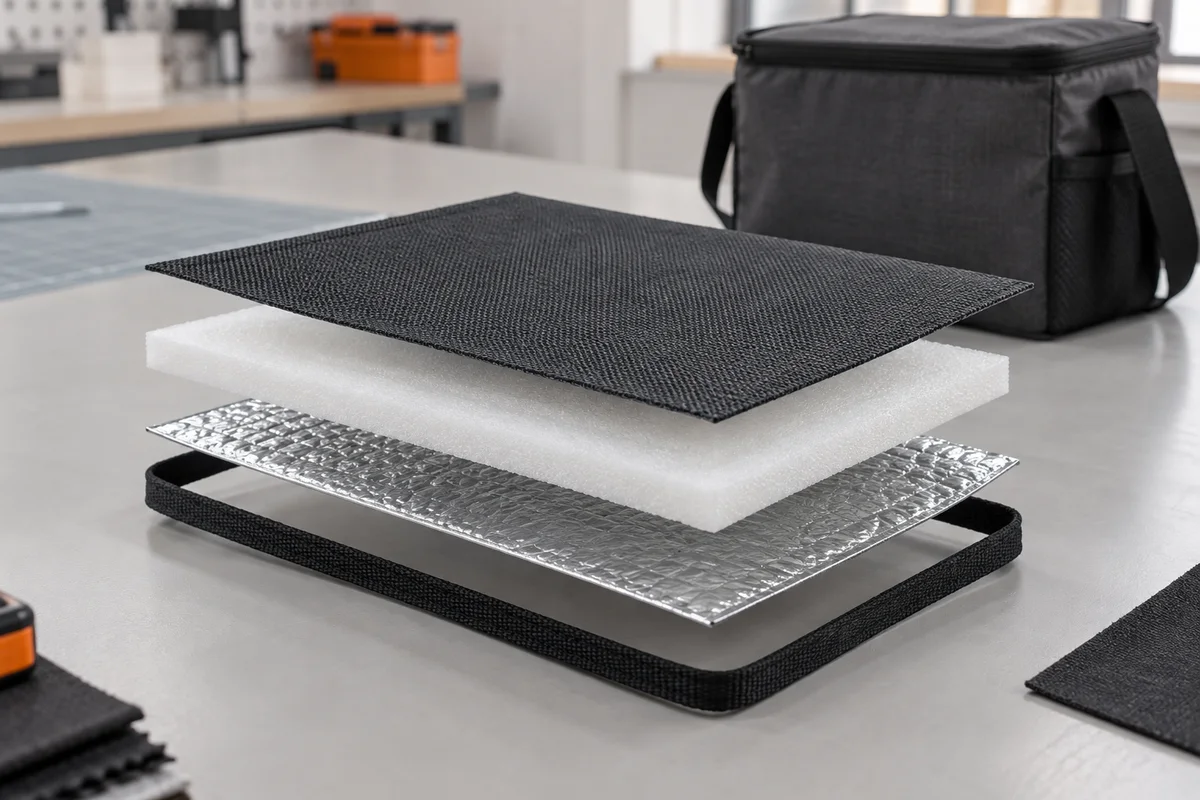
A cooler bag should be quoted as a material system: shell, insulation, liner, joining method and edge construction.
1–3. Define the use, capacity and outer shell first
1. Intended use controls the specification
Start with the job the product must perform. A one-day event giveaway has a different construction target from a retail picnic cooler expected to survive weekly use. A grocery delivery bag may prioritize large openings, wipe-clean interiors and rider handling. A medical or temperature-sensitive program may require validated temperature ranges, traceable documentation and a different development process entirely.
Include the user, payload, use duration, environment and sales channel. This lets the factory recommend a sensible build instead of automatically quoting the cheapest or strongest option. Over-specifying a giveaway wastes budget; under-specifying a retail product creates returns.
Use a real construction as the visual starting point, then write down what must change. For example, compare a structured Oxford picnic cooler, a compact logo lunch cooler and a water-resistant round cooler. The reference identifies the form; your RFQ still controls the hidden materials and acceptance criteria.
2. Quote capacity with dimensions and a real payload
“Ten-liter cooler” is helpful but incomplete because capacity can be calculated differently around insulation and rounded corners. Give the finished external dimensions, intended internal dimensions if critical, and the items the bag must hold. Photographs of the payload arranged in the required orientation are useful. If the product must fit standard food containers, bottles or cans, provide their actual measurements.
Note whether the bag must fold flat for shipping. A rigid base board and thick foam improve structure but increase carton volume. The quotation should show the packed dimensions and units per carton so you can evaluate landed cost, not only FOB unit price.
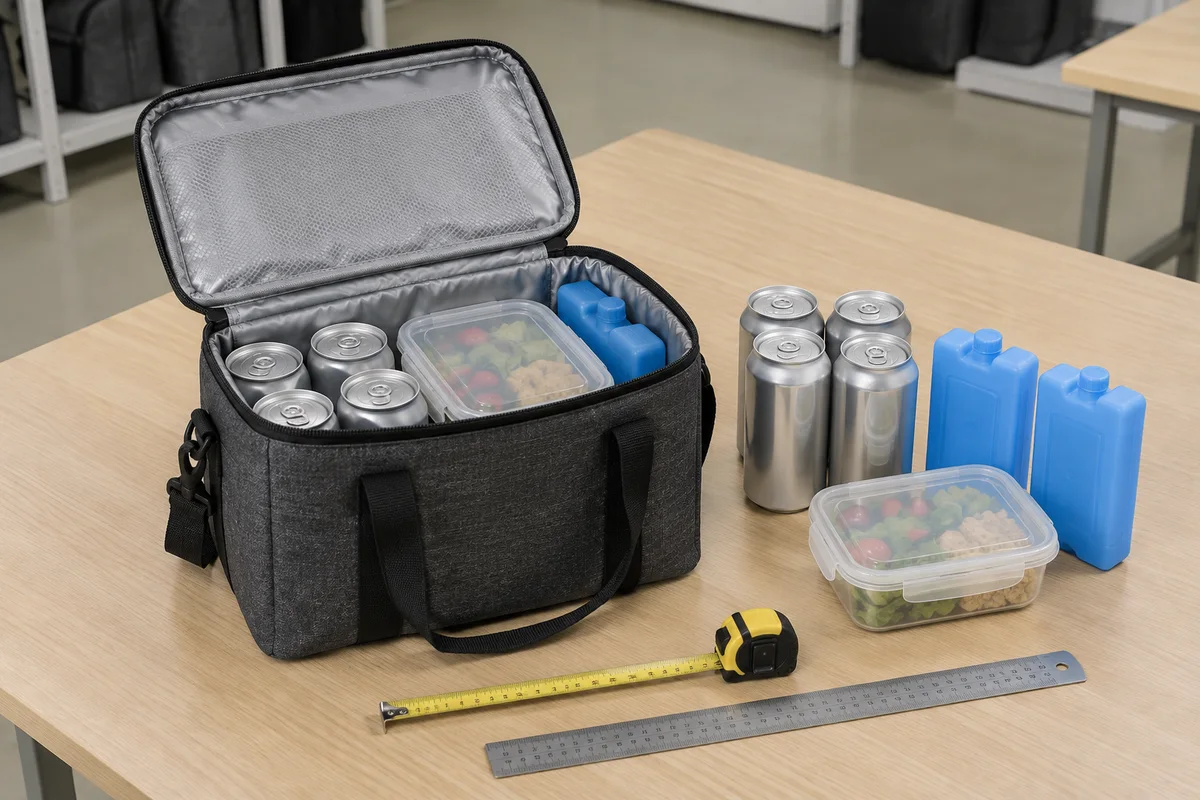
Define capacity with a real payload and its orientation, not liters alone. The same nominal volume can produce a very different usable interior.
3. Specify more than “600D Oxford”
600D polyester Oxford is a common shell for reusable insulated lunch and picnic bags because it balances durability, printability, weight and cost. But “600D” only describes yarn denier. Ask the supplier to identify the backing or coating, finished weight, stock or custom color, and any water-resistance treatment that is part of the quotation.
For a lower-cost promotional program, non-woven polypropylene or a lighter polyester may be sufficient. Premium outdoor programs may use heavier Oxford, ripstop, RPET or TPU-coated fabric. If you are considering recycled polyester, define what chain-of-custody evidence the project requires and read our GRS buyer's guide before making a public recycled-content claim.
4–6. Lock the insulation, liner and leak-resistance level
4. Convert a cold-retention claim into test conditions
Foam thickness affects thermal performance, but it is not the only variable. Bag volume, surface area, zipper gaps, seam construction, payload temperature, ice-pack quantity, ambient temperature and opening frequency all influence the result. This is why “5 mm EPE keeps cold for six hours” should not be treated as a universal rule.
In the RFQ, state the target use and ask the factory to propose the insulation system. Then define how the approved sample will be tested: ambient temperature, starting product temperature, payload, ice charge, probe position, reading interval, opening schedule and pass threshold. Your quotation should identify whether the test is an internal sample-room check or an accredited third-party test.
Practical starting point
A basic promotional lunch bag may start with approximately 3 mm closed-cell foam. A reusable retail lunch or picnic bag may start around 5 mm, while longer-hold programs may evaluate 8 mm or another foam system. These are development starting points, not guaranteed hold times. Confirm the finished construction through sample testing.
5. Name the liner and the documentation scope
PEVA and reflective foil laminates are common in insulated bags, while welded TPU may suit projects that place a higher priority on leak resistance and durability. Specify material thickness, color, surface finish, joining method and cleaning expectation. If the liner may contact unpackaged food or ice, tell the supplier and your compliance adviser exactly how the product will be used.
Avoid accepting a generic phrase such as “FDA approved liner” without checking the document, sample description, test scope, supplier identity and date. Requirements vary by destination and contact condition. The RFQ should ask for the documents your importer or retailer actually needs; it should not ask the factory to guess the legal route.
6. Distinguish water resistance from leak resistance
A PU-backed outer shell can shed light rain while the inner liner still leaks through needle holes. Sewn-only liners are appropriate when the bag carries sealed containers and condensation is limited. Sewn-and-taped seams add protection around stitch lines. Welded liner construction removes many needle-hole paths and can support a higher leak-resistance target, but it changes materials, equipment, tooling and cost.
State the real requirement: “No visible damp spot after the agreed water-fill and tilt test” is clearer than “waterproof.” If the product is meant to carry loose ice or liquid, say so before quotation. For a deeper explanation of seams and closures, use our waterproof bag construction guide.
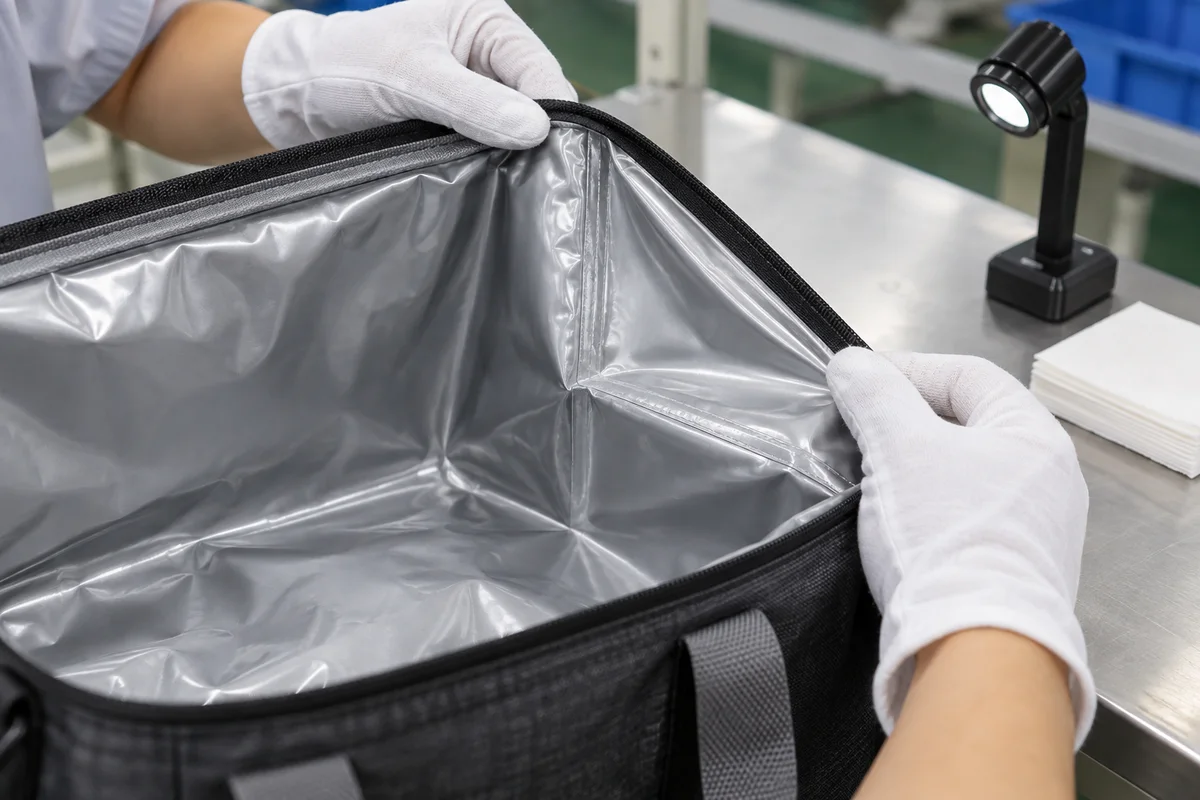
Liner material and seam method must be specified together. Inspection should focus on corners, joins and every likely leak path.
7–9. Describe the structure, branding and order split
7. Draw every compartment and load-bearing point
List the main compartment, dry pocket, bottle pocket, divider, lid mesh, base board and any removable insert. For handles and shoulder straps, state the intended loaded weight. Webbing width, reinforcement patches and bar-tack locations should appear on the drawing or approved sample. A cooler bag full of drinks places much more stress on handle joins than an empty catalog sample suggests.
If you do not yet have a controlled drawing, start with our bag tech pack guide. A simple front, side, top and internal view with numbered callouts is enough to eliminate many expensive assumptions.
8. Attach production-ready branding instructions
Include vector artwork, finished logo size, placement measurements and color references. State whether you prefer screen printing, heat transfer, embroidery, woven labels, rubber patches or another method. The factory should confirm whether your chosen process is compatible with the shell texture, insulation and lamination sequence.
Ask for setup charges and artwork limitations as separate quotation lines. A supplier should not quietly change a fine multicolor logo into a simpler method to reach the target price.
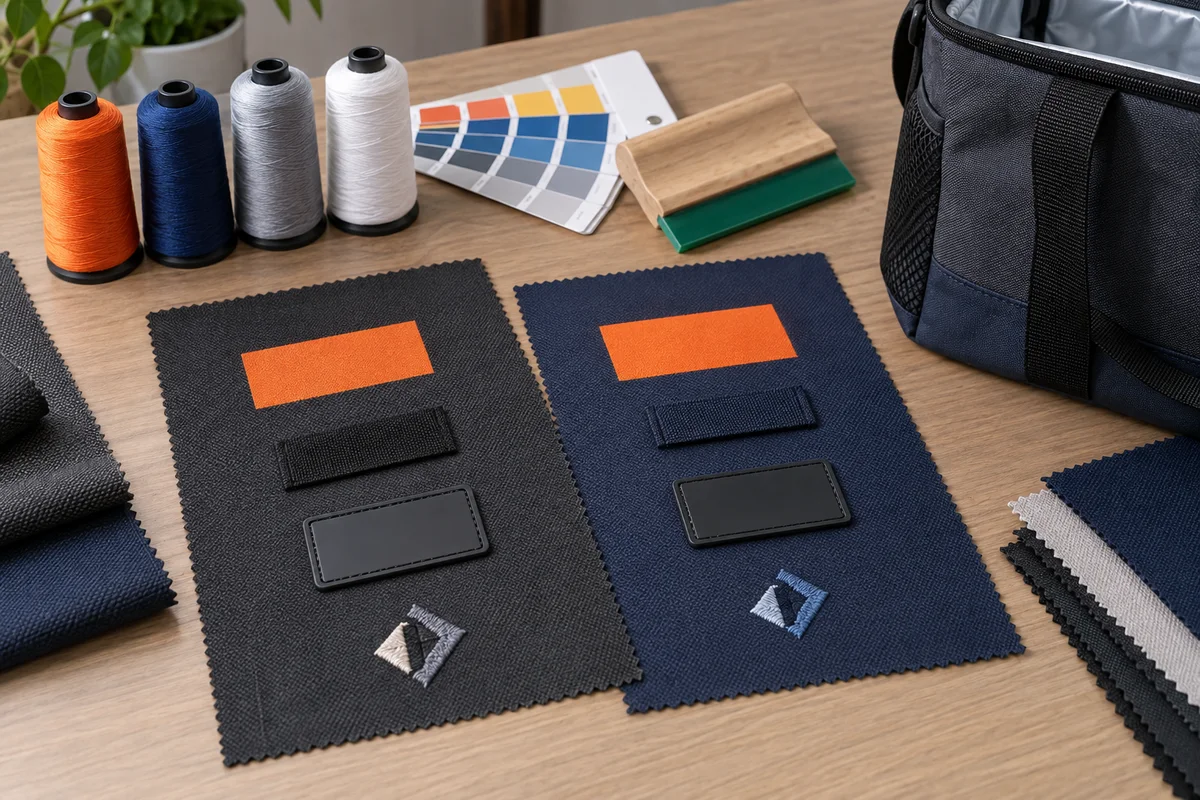
Compare branding methods on the actual shell fabric. Fine detail, color count, texture and order volume all affect the best production process.
9. Break quantity down by style, size and color
“1,000 pieces total” can mean one stock color, four custom-dyed colors or two sizes across multiple prints. Those are different manufacturing programs. State the quantity for every SKU and ask whether the MOQ applies per design, per colorway or to the combined order.
Merris generally plans custom cooler bag production from 500 pieces per design and colorway. Stock fabrics and standard trims may make a lower-risk trial easier; custom-dyed textiles, molded parts, special laminations or welded structures can raise the minimum. Our MOQ strategy guide explains which design decisions usually create the minimum.
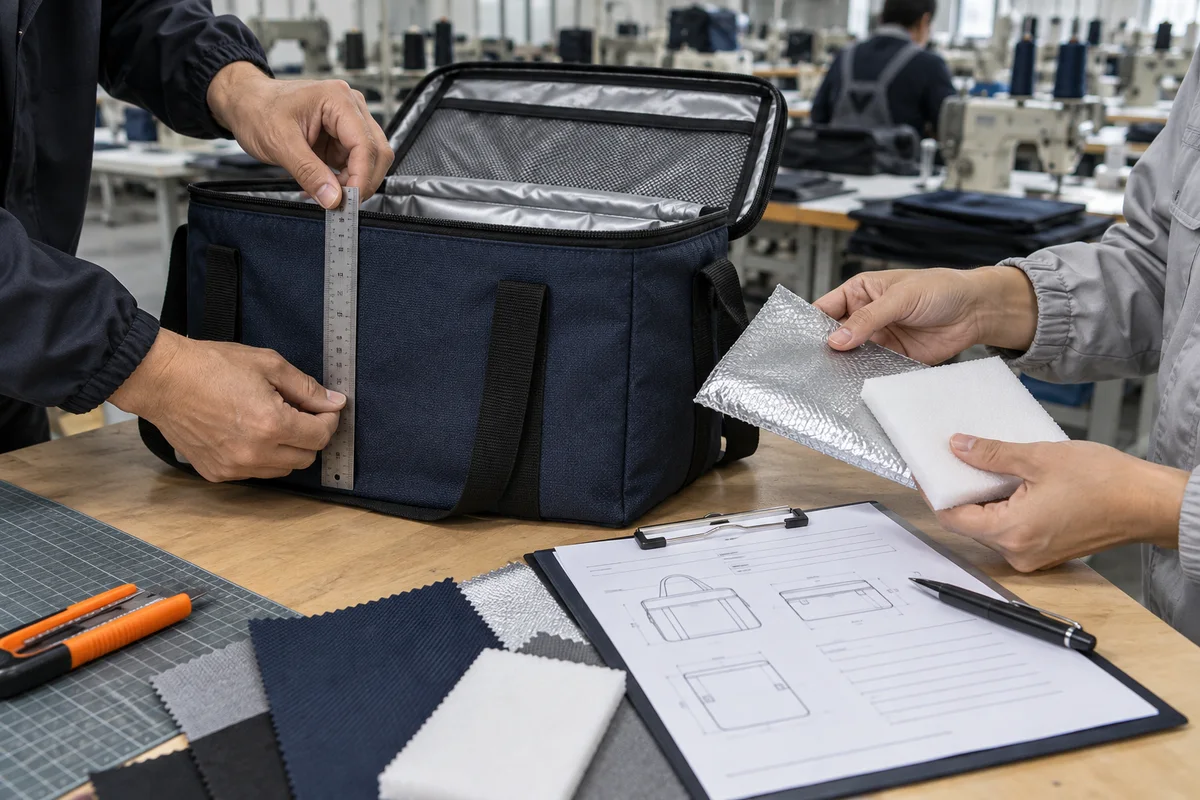
Review dimensions and hidden materials together. A photograph can approve appearance, but it cannot control the production specification.
10–12. State compliance, quality, packaging and delivery terms
10. Tell the supplier where and how the bag will be sold
Name the destination country, importer, sales channel and product use. A retailer program may impose restricted-substance, labeling, packaging or social-compliance requirements in addition to legal obligations. Ask for current evidence tied to the actual material or finished product where required. Do not assume that a factory-level certificate automatically covers every component or marketing claim.
11. Put measurable quality criteria into the RFQ
Separate appearance checks from functional tests. Appearance criteria include dimensions, color, logo position, stitching and surface defects. Functional criteria may include liner leakage, thermal performance, zipper cycling, handle loading and a loaded drop test. State which checks apply to the development sample, which apply during production and which belong in final random inspection.
For bulk inspection, define defect categories and the agreed sampling plan before production. Our AQL inspection guide for custom bags shows how to turn subjective quality comments into acceptance and rejection criteria.
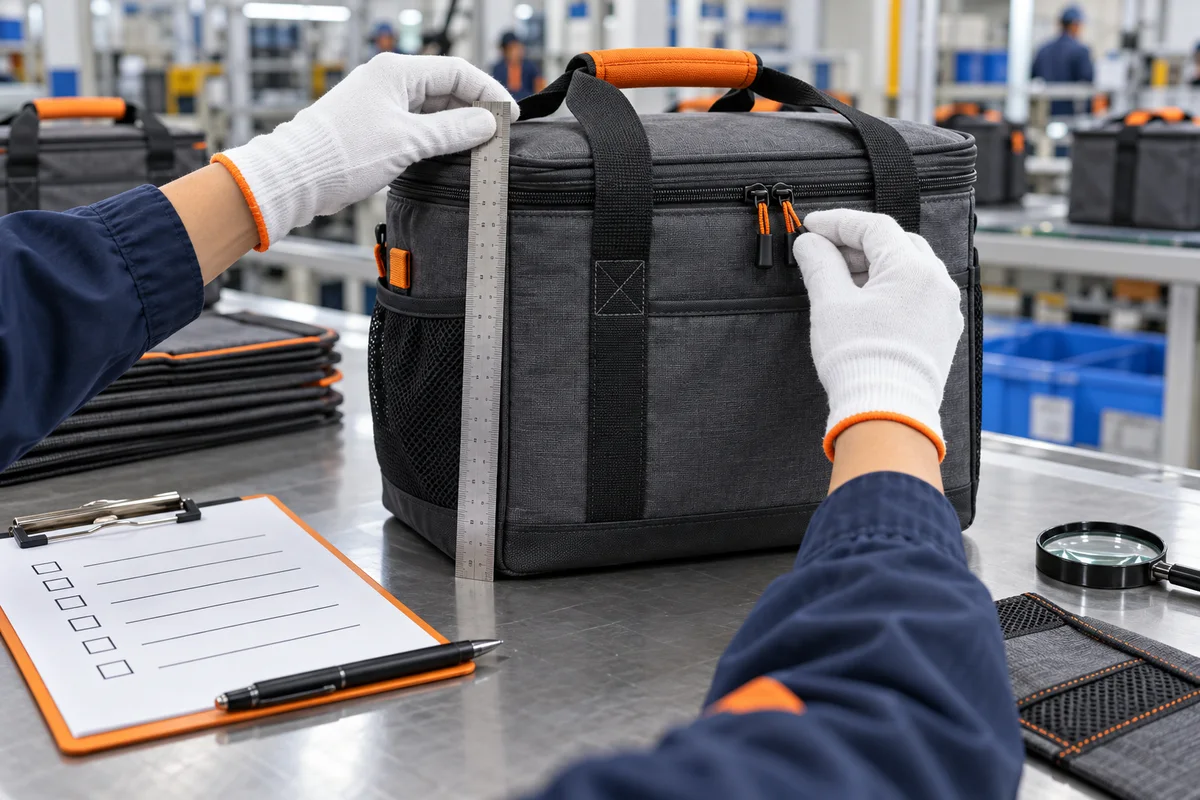
Final QC should verify dimensions, zipper operation, handle reinforcement and workmanship against the approved sample and inspection criteria.
12. Separate product price from packaging and logistics
Specify whether each bag is folded, stuffed, placed in a polybag or packed in retail packaging. Include barcode, hangtag, warning label and carton-mark requirements. Ask the factory to show carton quantity, carton dimensions, gross weight and estimated shipment volume.
Request the price under a named Incoterm, such as EXW or FOB, and identify the relevant place or port. State the required ship date and destination separately from the desired arrival date. Production timing starts only after the specification, sample, artwork and deposit are approved; a vague deadline encourages every supplier to make a different assumption.
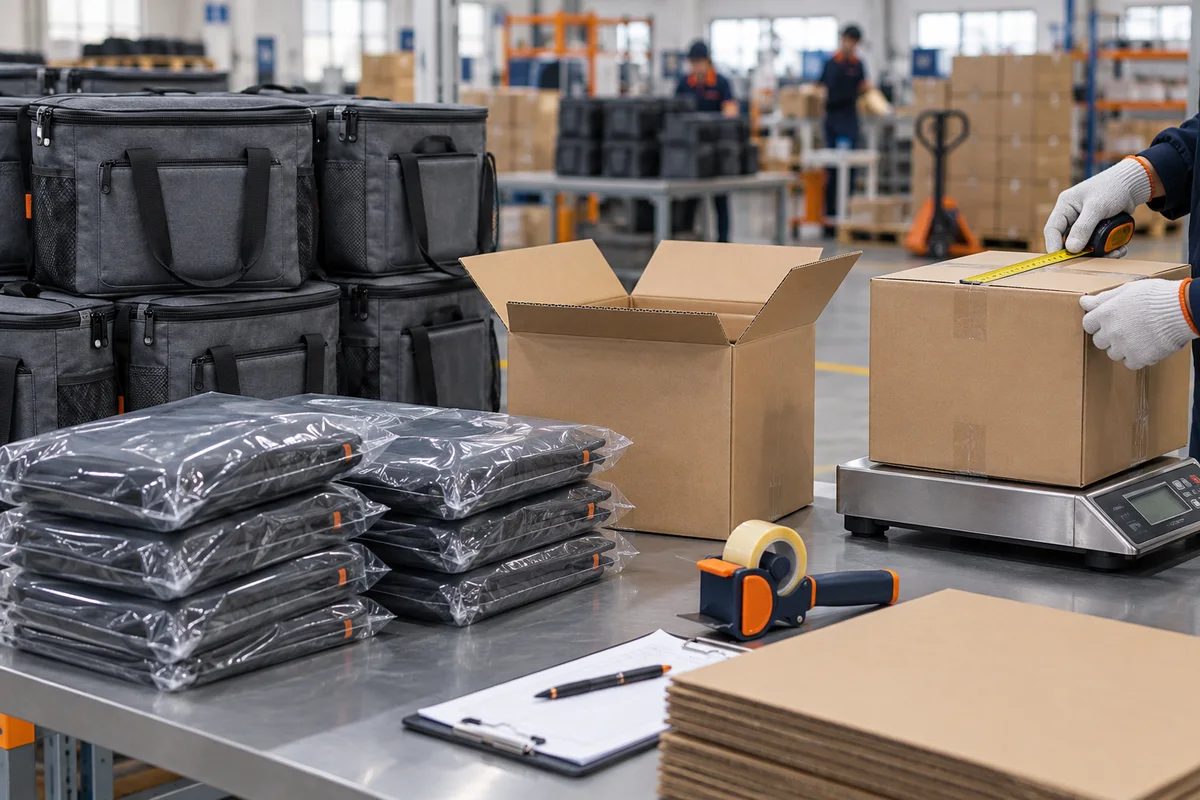
Carton quantity, dimensions and gross weight belong in the quotation because packaging choices directly affect shipment volume and landed cost.
A copy-and-paste RFQ brief for custom cooler bags
Use the template below for the first inquiry. Attach your drawing, logo file and reference photos, then replace every bracketed field. If a decision is open, write “supplier to recommend and explain” rather than deleting the line.
Custom Cooler Bag RFQ
Project / style name: [ ]
Intended use and target customer: [ ]
Destination market and sales channel: [ ]

Finished external dimensions: [L × W × H]
Target internal capacity / payload: [liters or actual items]
Fold-flat requirement: [yes / no]

Outer shell: [material, denier/weight, coating, color]
Insulation: [type, thickness, target performance]
Inner liner: [material, thickness, color, seam method]
Closure: [zipper / roll top / other]
Compartments and pockets: [ ]
Handles / strap and target loaded weight: [ ]

Logo process, size, colors and placement: [ ]
Artwork file attached: [yes / no]

Quantity by style and color: [ ]
Required sample type and approval date: [ ]
Required tests / documents: [ ]
Packaging and carton marks: [ ]
Incoterm and named place: [ ]
Required ship date and destination port: [ ]

Please quote separately:
1. Sample and tooling charges
2. Unit price by quantity tier
3. Logo and packaging charges
4. Testing or documentation charges
5. Lead time after sample approval
6. Carton size, weight and estimated shipment volume
7. Every assumption, substitution and exclusion
How to compare supplier quotations fairly
Normalize each quotation before choosing a supplier. Create one comparison sheet and place the quoted specification beside your RFQ line by line. If a field is blank, treat it as an unanswered question—not an approval. The cheapest price should not advance until the material stack, construction and terms match the others.
| Comparison field | What must match | Common hidden difference |
|---|---|---|
| Material stack | Shell, backing, foam type/thickness, liner type/thickness | Thinner foam or unspecified coating |
| Construction | Seam method, reinforcement, zipper, webbing and base support | Sewn-only liner quoted against a taped or welded requirement |
| Quantity basis | Pieces per design, color and size | Price assumes one color although the RFQ contains three |
| Testing | Test conditions, sample count and who performs the test | Internal visual check substituted for a required report |
| Commercial terms | Incoterm, payment, tooling ownership, lead-time start point | EXW price compared with FOB price |
| Packaging | Individual pack, retail pack, carton quantity and marks | Retail packaging omitted from the headline unit price |
Do not approve a “same as photo” quotation
Reference photos are useful for shape and visual direction, but they do not reveal the foam, liner, reinforcement, zipper specification or testing history. Ask the supplier to issue a written bill of materials and mark every departure from your RFQ before sample payment.
What happens after the RFQ?
- Specification review: the factory flags missing or conflicting requirements and proposes construction options.
- Itemized quotation: product, branding, tooling, packaging, testing and commercial assumptions are separated.
- Development sample: the sample uses the intended bulk materials and construction wherever possible.
- Functional review: dimensions, payload, leakage, thermal target, straps, zipper and appearance are checked.
- Golden sample and revision lock: every approved change is recorded under one revision before bulk begins.
- Production and inspection: incoming materials, first output, inline production and finished goods are checked against the approved references.
For a real example of how these decisions work together, see our 3,000-piece insulated lunch cooler case study. You can also review current construction options in the custom cooler bag collection before sending your brief.
Have a cooler bag brief ready?
Send the completed checklist, reference images and target quantity. Our team will identify missing specifications before preparing the quotation.
Request a Specification ReviewFrequently asked questions
What information does a cooler bag manufacturer need for a quotation?
Direct Answer: For an accurate quote, send intended use, dimensions or capacity, outer fabric, insulation type and thickness, liner, closure and leak requirement, logo method, quantity per color, packaging, destination market, required tests, and delivery date. Photos alone are not enough.
- Must-Provide: Use, size, fabric, insulation, liner, qty, destination
- Not Enough: Photos alone
- Outcome: Accurate written quote
At minimum, provide intended use, finished dimensions or capacity, outer fabric, insulation type and thickness, liner, closure and leak-resistance requirement, logo method, quantity per color, packaging, destination market, required tests and delivery date. Photographs alone are not enough for an accurate quotation.
Is 600D Oxford suitable for custom cooler bags?
Direct Answer: 600D polyester Oxford is a common mid-range outer shell that balances abrasion resistance, printability, weight, and cost — but the coating, backing, and construction still must be specified. The denier number alone does not define water resistance or total quality.
- 600D Oxford: Mid-range, balanced
- Must Specify: Coating, backing, construction
- Denier Alone: Not a water-resistance claim
Yes. 600D polyester Oxford is a common mid-range shell because it balances abrasion resistance, printability, weight and cost. The coating, backing, color treatment and finished construction still need to be specified; denier alone does not define water resistance or total quality.
How thick should cooler bag insulation be?
Direct Answer: Insulation thickness depends on size, payload, ambient temperature, opening frequency, and target hold time: 3mm EPE suits a basic promo lunch bag, while 5-8mm closed-cell foam fits longer-hold retail or outdoor programs. Always approve the choice with a sample test.
- Basic Promo Bag: 3mm EPE
- Long-Hold / Outdoor: 5-8mm closed-cell foam
- Validation: Project-specific sample test
It depends on bag size, payload, ambient temperature, opening frequency and target hold time. About 3 mm EPE may suit a basic promotional lunch bag, while 5–8 mm or another closed-cell foam system may suit longer-hold retail or outdoor programs. Approve the final choice through a project-specific sample test.
What is the typical MOQ for a custom cooler bag?
Direct Answer: Merris typically plans custom cooler bag production from 500 pieces per design and colorway. Stock fabrics may support a lower trial, while custom-dyed fabric, molded hardware, or welded construction can raise the minimum; the final MOQ is confirmed after spec review.
- Standard MOQ: 500 pcs per design/color
- Lower Trial: Stock fabrics / standard parts
- Higher MOQ Triggers: Custom dye, molded hardware, welding
Merris generally plans production from 500 pieces per design and colorway. Stock fabrics and standard components may support a lower-risk trial, while custom-dyed fabric, molded hardware or welded construction can require a higher minimum. The final MOQ is confirmed after specification review.
Can two cooler bag quotations be compared by unit price alone?
Direct Answer: No. Compare quotes only after matching fabric denier and coating, foam type and thickness, liner grade, seam method, zipper, webbing, logo process, testing, packaging, quantity basis, and Incoterm. A cheaper quote often reflects a different construction, not a lower margin.
- Compare On: Identical spec + Incoterm basis
- Cheap Quote Risk: Different construction
- Never Compare: Unit price alone
No. Confirm that fabric, foam, liner, seam method, zipper, webbing, logo, testing, packaging, quantity basis and Incoterm are the same. A cheaper quote often reflects a different construction rather than a lower supplier margin.